












❤️ Simcoe County Addiction Recovery Stories: How Local Residents Rebuilt Their Lives and Found New Purpose
Last updated: June 9, 2026
Quick Answer: Simcoe County addiction recovery stories reflect a growing network of local services, peer support, and community-based programs that help residents move from active addiction to stable housing, employment, and meaningful lives. The 2026 opening of RVH’s live-in addictions treatment centre and the HART of Simcoe County hub in Barrie represent significant milestones in expanding access to structured, long-term recovery pathways for people across the region.
Key Takeaways
- The HART of Simcoe County hub in Barrie connects addiction, mental health, housing, and social services in one location, with a “no wrong door” entry approach [3]
- RVH opened a new 16-bed co-ed live-in addictions treatment centre in June 2026, funded in part by the Ontario government [1][10]
- Recovery in Simcoe County is defined beyond sobriety to include stable housing, employment, and community connection
- Opioids, alcohol, and stimulants are among the most common substances driving addiction treatment demand in the region
- OHIP covers medically necessary addiction treatment, including withdrawal management and physician-led programs
- Peer support workers with lived experience play a central role in guiding residents through recovery
- Rural residents in Simcoe County face added barriers including transportation and fewer local services
- Recovery timelines vary widely, but structured residential programs typically run 4 to 12 weeks, followed by community support
- Mental health conditions such as anxiety, depression, and trauma frequently accompany addiction and require concurrent treatment
- Families of people in recovery can access support through organizations such as Al-Anon and local community health centres
What Are the Most Common Types of Addiction in Simcoe County
Opioids, alcohol, and methamphetamine are the most frequently cited substances in Simcoe County addiction treatment referrals. Cannabis and benzodiazepines also appear regularly among residents seeking help.
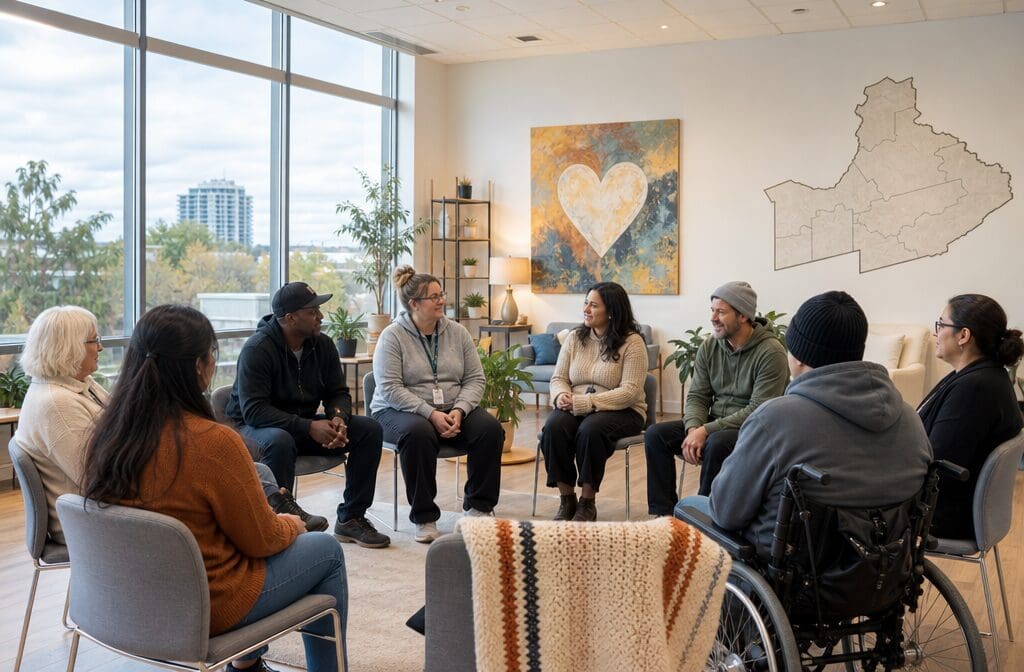
The HART of Simcoe County hub was designed specifically to address the complexity of these cases, many of which involve more than one substance and co-occurring mental health conditions [3]. Local leaders touring the facility in spring 2026 noted that clients arrive through emergency services, shelters, hospitals, and self-referral, reflecting how broadly addiction affects the community [9].
For context on the region’s ongoing mental health crisis, the overlap between untreated mental illness and substance use is a consistent theme in local recovery narratives.
How Do People Typically Start Their Recovery Journey in Simcoe County
Most residents begin their recovery journey through a crisis point — an overdose, a hospital visit, a housing loss, or a family intervention. From there, the HART hub’s “no wrong door” model means a person can be connected to services regardless of how they first reach out [9].
Key entry points include:
- Emergency Medical Services (EMS) referrals
- Hospital emergency departments at RVH and Stevenson Memorial
- Shelters and community outreach workers
- Self-referral or family-initiated contact with community health centres
- Primary care physicians
Once connected, navigation staff at HART help clients build individualized recovery plans that address substance use alongside housing, income, and mental health needs [3].
Can You Get Addiction Treatment Covered by OHIP
Yes. OHIP covers medically necessary addiction treatment in Ontario, including withdrawal management (detox), physician-prescribed medications like methadone or buprenorphine, and hospital-based programs. The new RVH live-in addictions treatment centre in Barrie operates within the publicly funded system [1][10].
Residential programs at private facilities may carry out-of-pocket costs ranging from a few thousand dollars to over $30,000 for extended stays, but publicly funded beds — including those at the new RVH centre — are available at no direct cost to eligible Ontario residents. Holmes House in Simcoe also provides addiction supportive housing at no cost to clients through its publicly funded model [2].
Choose public programs if: cost is a barrier, you need concurrent mental health support, or you want peer-supported, community-integrated care.
What Mental Health Challenges Often Accompany Addiction
Anxiety, depression, post-traumatic stress disorder (PTSD), and trauma histories are the most common mental health conditions seen alongside addiction in Simcoe County residents. This is sometimes called a “concurrent disorder.”
The HART hub was built to address this directly, housing mental health and addiction services under one roof rather than sending clients to separate systems [3]. Treating both conditions at the same time significantly improves long-term recovery outcomes, according to Ontario health system guidelines.
Residents dealing with substance abuse and concurrent mental illness often describe the integrated model as the first time they felt “seen as a whole person” rather than bounced between services.
What Local Addiction Treatment Centres Have the Best Reputations
The following Simcoe County facilities are consistently referenced in local recovery discussions:
FacilityLocationTypeHART of Simcoe CountyBarrieIntegrated hub (addiction, mental health, housing)RVH Live-In Addictions Treatment CentreBarrie16-bed residential programHolmes House / ASH ProgramSimcoeAddiction supportive housingSouth Georgian Bay Community Health CentreCollingwood areaOutpatient and primary care
The RVH centre, opened in June 2026, is linked directly to the HART hub and offers a structured live-in environment where clients stabilize, engage in therapy, and transition to community supports [1][10]. Holmes House provides permanent supportive housing for people in longer-term recovery [2].
For updates on southern Georgian Bay communities and local health services, Georgian Bay News covers regional developments regularly.
Are There Differences Between Urban and Rural Addiction Recovery Experiences
Yes, and the gap is significant. Barrie residents have easier access to the HART hub, RVH, and walk-in services. Residents in rural parts of Simcoe County — including communities around Collingwood, Penetanguishene, and smaller townships — often face longer wait times, limited public transit, and fewer local drop-in options.
Rural recovery challenges include:
- Transportation to Barrie for appointments or residential programs
- Social stigma in smaller, tightly connected communities
- Fewer harm reduction services (e.g., supervised consumption, needle exchanges)
- Limited peer support networks outside urban centres
The South Georgian Bay Community Health Clinic serves as an important access point for residents outside Barrie, offering outreach and referral services.
What Support Groups Exist for Families of Recovering Addicts
Families in Simcoe County can access Al-Anon and Nar-Anon meetings, both of which operate in Barrie and surrounding communities. The HART hub also connects families to navigation supports and counselling [3].
Other options include:
- Family therapy through community mental health agencies
- Peer family support groups at local community health centres
- Online support communities for rural families who cannot travel
The spiritual transformation many families describe — moving from fear and helplessness to active support roles — is a recurring theme in local recovery stories.
What Resources Help Recovering Residents Find New Jobs
Employment re-entry is one of the most cited challenges in Simcoe County addiction recovery stories. The HART hub explicitly tracks employment as a long-term outcome measure, and local leaders have pointed to job re-entry as a key marker of successful recovery [9].
Practical employment resources include:
- Ontario Works employment supports
- Barrie-area Employment Ontario offices
- Business Development Centre open houses for residents exploring self-employment
- Vocational rehabilitation through ODSP for those with concurrent disabilities
- Peer support workers at HART who model employment pathways through their own recovery journeys
Common mistake: Rushing back to high-stress work environments before building a stable recovery foundation. Most counsellors recommend addressing housing and mental health stability before pursuing full-time employment.
Warning Signs Someone Might Need Addiction Help in Simcoe County
Early intervention consistently leads to better outcomes. Warning signs that a Simcoe County resident may need addiction support include:
- Withdrawal from family, friends, or regular activities
- Unexplained financial problems or missing money
- Changes in sleep, appetite, or personal hygiene
- Increased secrecy or defensiveness about substance use
- Missing work, school, or regular commitments repeatedly
- Physical signs such as track marks, tremors, or significant weight change
Anyone concerned about themselves or someone else can contact the HART hub directly, call ConnexOntario at 1-866-531-2600, or visit a local emergency department without needing a referral [3].
How Long Does Typical Addiction Recovery Take
Recovery is not a fixed timeline, but structured programs in Simcoe County typically run 4 to 12 weeks for residential treatment, followed by months or years of community-based support. The RVH live-in centre is designed as a stabilization and transition program, not a permanent solution [10].
Key phases most residents move through:
- Crisis stabilization and withdrawal management (days to weeks)
- Residential or intensive outpatient treatment (4 to 12 weeks)
- Transitional housing and peer support (3 to 12 months)
- Long-term community integration — employment, relationships, purpose (ongoing)
The HART model tracks clients across all these phases to prevent people from losing momentum between services [9].
Conclusion
Simcoe County addiction recovery stories share a common thread: recovery becomes possible when people have access to the right support at the right time, and when that support addresses the whole person, not just the substance. The 2026 opening of RVH’s live-in treatment centre and the ongoing work of the HART hub represent a meaningful shift toward that model [1][3].
Actionable next steps for residents and families:
- Contact the HART of Simcoe County hub directly at simcoe.ca/hart for navigation support
- Call ConnexOntario (1-866-531-2600) for 24/7 referrals to local services
- Attend an Al-Anon or Nar-Anon meeting if a family member is struggling
- Ask a family doctor about OHIP-covered addiction medicine options
- Follow Georgian Bay News for ongoing coverage of building up Simcoe County and local health developments
Recovery in Simcoe County is not a straight line, but the resources, the peer workers, and the community are here.