






















Last updated: August 14, 2026
Quick Answer: The Snowbirds, Canada’s iconic military aerobatic demonstration team, completed their final flights in 2025 after more than five decades of service. The Royal Canadian Air Force retired the team due to aging CT-114 Tutor aircraft and the high cost of replacement. Their farewell tour crossed Canada before the team officially disbanded, closing one of the country’s most beloved aviation traditions.
The Snowbirds’ final flights refer to the farewell tour and last official performances of the 431 Air Demonstration Squadron, the Royal Canadian Air Force unit that operated as The Snowbirds. After more than 50 years of thrilling audiences with precision aerobatics, the team completed its last shows in 2025 and was officially retired.
The farewell was not a sudden end. The RCAF announced the retirement in advance, allowing Canadians to gather at airshows and fly-pasts for one last look at the red-and-white Tutors in the sky. For many Canadians, it marked the end of a deeply personal national symbol.
The Snowbirds trace their roots to 1971, when the 431 Air Demonstration Squadron was formally established at CFB Moose Jaw in Saskatchewan. Canada had operated aerobatic teams before, but the Snowbirds became the country’s permanent, professional demonstration unit.
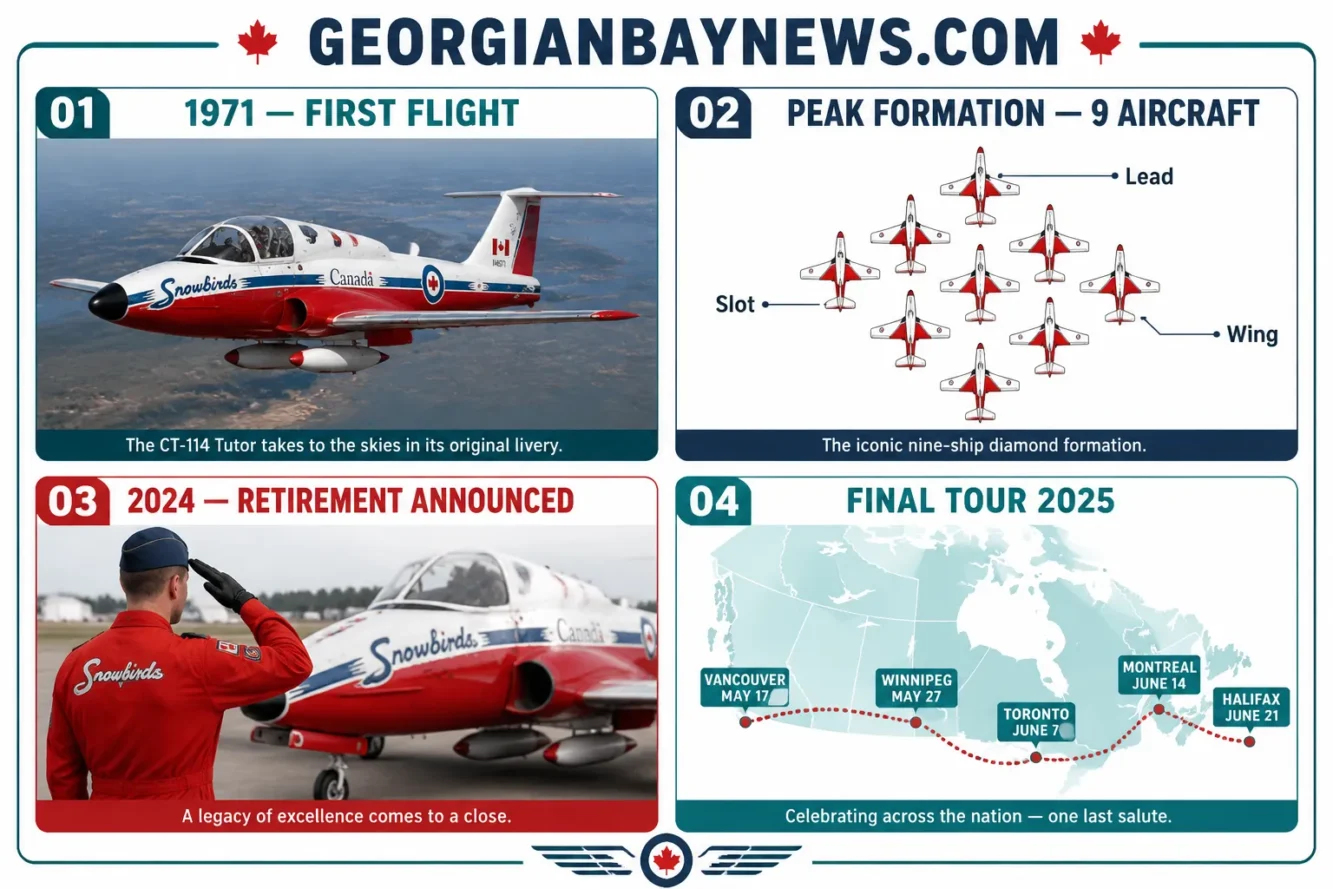
Key milestones in their history include:
The team was based at 15 Wing Moose Jaw for most of its history, and the Tutor jet was their aircraft from the very beginning to the very end.
The Snowbirds were active for approximately 54 years, from 1971 to 2025. That span makes them one of the longest-running military aerobatic demonstration teams in the world.
Over those decades, they performed at more than 2,000 airshows and public events, reaching an estimated audience of 175 million people across Canada, the United States, and internationally (RCAF historical records).
The Snowbirds retired primarily because the CT-114 Tutor aircraft became too old and expensive to maintain safely. The Tutor entered service in the 1960s, meaning the airframes were well over 50 years old by the time the retirement decision was made.
Key reasons for the retirement:
The decision was not taken lightly. The Snowbirds represented a significant investment in national pride and military public relations. But the economics and safety calculus ultimately pointed to retirement.
At full strength, The Snowbirds operated with nine aircraft in formation, flown by nine pilots. The full team typically included 11 members: nine demonstration pilots plus a team coordinator and a narrator who managed the public-facing commentary at airshows.
Pilots were selected RCAF officers with significant flying experience. A typical tour of duty on the team lasted two to three years before pilots returned to other RCAF postings.
The Snowbirds became famous for their precision nine-jet formations, their distinctive red-and-white color scheme, and their accessibility to ordinary Canadians. Unlike some military demonstration teams that perform primarily at military bases, The Snowbirds regularly appeared at community airshows across small and large cities alike.
Their signature maneuvers included:
The red-and-white Tutor jets against a blue sky became one of the most recognizable images in Canadian public life.
The Snowbirds’ final tour took place across Canada in 2025, visiting cities from British Columbia to the Atlantic provinces. The tour was designed to give as many Canadians as possible a chance to say goodbye.
Confirmed stops included major airshow venues and fly-pasts over Canadian cities. Crowds gathered in large numbers at every location, with many families bringing children who had never seen the team fly live.
The CT-114 Tutor aircraft used by The Snowbirds are being distributed to museums, air force bases, and static display locations across Canada. Several aircraft are expected to be preserved as gate guardians at military installations, while others will go to aviation museums for public display.
None of the retired Tutors are expected to return to flying status. The aircraft will serve as permanent reminders of the team’s legacy.
The Snowbirds’ last official airshow performance took place in 2025 as part of their farewell tour. The final show drew an emotional crowd, with many spectators, former team members, and RCAF personnel in attendance.
The final flight concluded with a traditional missing-man formation, a ceremonial aerial tribute used to honor fallen aviators and mark significant endings in military aviation.
As of 2026, the RCAF has not announced plans to revive The Snowbirds or establish a replacement aerobatic demonstration team. The retirement appears to be permanent in its current form.
Some aviation advocates and members of the public have called for a new team using modern aircraft, but no formal program has been approved or funded. Canadians who want to follow ongoing aviation and winter weather news can explore related coverage, including updates on snow events and seasonal stories in our region.
No direct replacement for The Snowbirds has been announced as of 2026. The RCAF continues to conduct public outreach and recruitment activities, but a dedicated aerobatic demonstration squadron has not been confirmed.
Some observers have suggested that Canada could partner with allied nations or adopt a smaller-scale demonstration capability using current RCAF training aircraft, but these remain speculative discussions rather than official plans.
No, the Snowbirds pilots did not all retire simultaneously. As the team wound down, pilots at various stages of their tour rotations returned to other RCAF postings. Some completed their planned two-to-three-year demonstration tours and moved on before the final season. Others stayed through the last performances.
The ground crew, technicians, and support staff similarly transitioned to other RCAF roles or retired from military service based on their individual career timelines.
For those who missed the live farewell tour, footage of The Snowbirds’ final performances is available through RCAF official channels, Canadian news archives, and video platforms. Several broadcasters covered the final shows, and fan-recorded footage from across the farewell tour cities is widely available online.
The RCAF has also produced documentary content covering the team’s history and final season, which is accessible through official government and military media channels.
The Snowbirds flew for more than half a century, and their retirement in 2025 marked the end of an era in Canadian aviation and national identity. From their founding at CFB Moose Jaw in 1971 to their final missing-man formation, the team gave Canadians something rare: a shared symbol of precision, courage, and pride that crossed regional and generational lines.
What you can do now:
The sky over Canada is quieter now. But the legacy of The Snowbirds will stay in the record books, in museum hangars, and in the memories of the millions who looked up.
Content, illustrations, and third-party video appearing on GEORGIANBAYNEWS.COM may be generated or curated with AI assistance or reproduced pursuant to the fair dealing provisions of the Copyright Act, R.S.C. 1985, c. C-42. Attribution and hyperlinks to original sources are provided in acknowledgment of applicable intellectual property rights. Such referencing is intended to direct traffic to and support the original rights holders’ platforms.