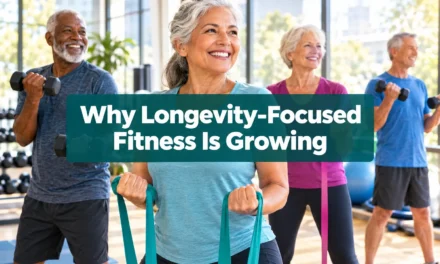






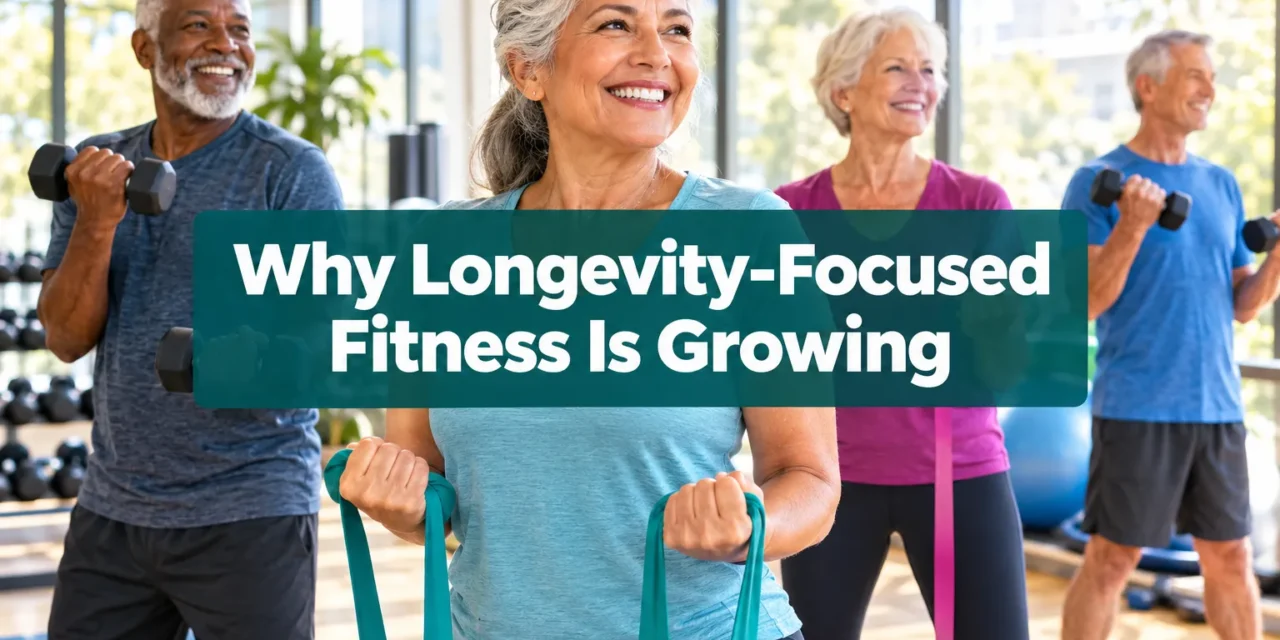
Gym memberships marketed around “anti-aging” and “longevity” have surged so fast that even major outlets are warning shoppers to look closer at the claims behind them [1]. This is the core tension behind why longevity-focused fitness is growing: what older adults should look for in a program is no longer obvious, because marketing language has outpaced the actual science in many gyms and apps. Wearable trackers and senior-specific training are now ranked among the top global fitness trends for 2026, and social platforms are flooded with older creators demonstrating strength routines that rack up millions of views [10]. The demand is real. The confusion about what actually works is just as real.
The fitness industry’s pivot toward healthy aging is not a passing fad. Newsweek’s October 2026 reporting found gyms and wellness brands increasingly using “longevity” as a core selling point, prompting the National Academy of Sports Medicine and the Health and Fitness Association to urge clearer, evidence-based standards for what these programs actually deliver [1]. At the same time, the American College of Sports Medicine’s 2026 worldwide trends survey placed wearable technology and fitness programming for older adults among the top global priorities [10].
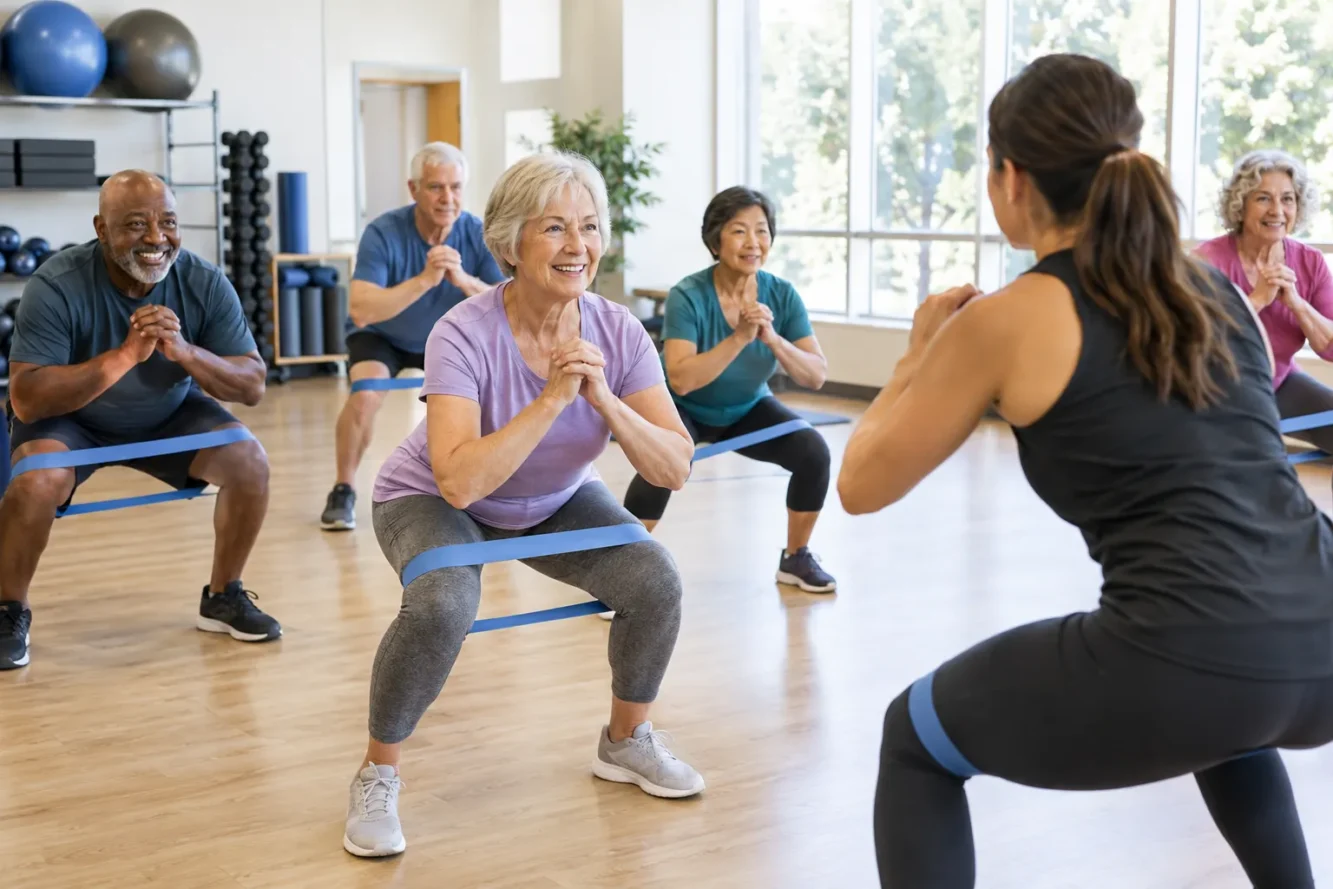
High-profile campaigns have amplified public interest. The “Movement Longevity” initiative, backed by Jennifer Aniston and PVOLVE in October 2026, exposed a striking awareness gap: many women over 50 still do not know strength training is essential for healthy aging, not optional [10]. Social media has picked up the thread, with older creators driving viral engagement around longevity workouts far beyond traditional fitness marketing channels [10].
This is where why longevity-focused fitness is growing: what older adults should look for in a program becomes a practical question rather than a marketing slogan. Newsweek’s reporting specifically flags the risk of programs that lean on buzzwords like “cellular renewal” or “reverse aging” without peer-reviewed support [1]. Harvard Health researchers instead describe movement as the closest thing science has to a longevity drug, but stress that the benefit comes from consistent, structured activity, not a single trendy technique [5].
Stanford Medicine’s 2026 guidance on aging well in your 60s and 70s echoes this: habits that genuinely extend healthspan are unglamorous and repeatable, including regular resistance work, protein-adequate nutrition, and social engagement, not biohacking shortcuts [3]. Programs worth paying for should be able to explain, in plain terms, which outcome each exercise is meant to improve.
“The benefit comes from consistent, structured activity, not a single trendy technique.” This distinction is the clearest test for separating real longevity programs from marketing hype.
Expert consensus from AARP, UCHealth, and Northwestern Medicine converges on a multimodal approach: cardio, strength, balance, and flexibility together, not in isolation [2][9]. A program missing any one of these legs is incomplete.
| Component | Why It Matters | What to Look For |
|---|---|---|
| Strength training | Preserves muscle mass and bone density | Progressive resistance, at least twice weekly |
| Balance work | Reduces fall risk | Single-leg stands, dynamic balance drills |
| Cardio endurance | Supports heart and lung health | Walking, cycling, or swimming most days |
| Flexibility and mobility | Maintains joint range of motion | Stretching or gentle yoga sessions |
UCHealth and Stanford both note that walking remains foundational, but it should be a starting point, not the entire plan; adding strength and balance work produces far greater returns on healthspan [2][3]. Programs like UTMB Health’s Geri-Fit, an evidence-based strength curriculum launched for older adults in August 2026, illustrate this layered approach by combining supervised resistance training with measurable functional outcomes [6]. Those looking for gentler entry points might also explore somatic chair yoga or a stress relieving stretch routine before progressing to more demanding resistance work.
Fall prevention has moved from a secondary benefit to a headline outcome of longevity-focused training. SDSU Extension’s 2025-2026 Fall Prevention Week programming specifically highlighted physical activity as the most effective intervention for reducing fall risk among older adults [4]. Community programs such as EnhanceFitness and Geri-Fit build balance and lower-body strength directly into their curricula for this reason [4][6].
Organizations like the Healthy Aging Association and Pennsylvania’s Department of Aging have expanded outreach around functional aging, reinforcing that falls, not just chronic disease, are a leading threat to independence [7]. Programs worth considering should include seated or standing balance drills, gait training, and lower-body strengthening as standard components, not optional add-ons. Community wellness efforts, including resources from staying safe initiatives and local south georgian bay community health clinic programming, often fold fall-prevention education directly into group fitness sessions.
Given how crowded this market has become, evaluating why longevity-focused fitness is growing: what older adults should look for in a program means asking direct questions before signing up.
Real Simple’s 2026 roundup of longevity exercises reinforces that simple, well-executed movements, such as sit-to-stands and loaded carries, often outperform expensive gadget-driven programs [8]. Nutrition also matters alongside movement; pairing training with strategic food choices supports recovery and muscle retention. For those weighing broader wellness marketing claims, reviewing content tagged under such as healthy aging can help separate substantiated advice from hype, and academic guidance from institutions like Stanford University School of Medicine offers a useful benchmark for comparison. Social, low-impact options such as sorry not sorry pickleball can also complement structured strength work by adding enjoyable, consistent movement.
The growth of longevity-focused fitness reflects a genuine shift in how older adults think about aging, but growth in marketing has outpaced growth in rigorous standards. The clearest path forward is a program built on strength training, balance work, cardio, and flexibility, with fall prevention treated as a core metric rather than a footnote. Before joining any program, ask for credentials, request measurable progress tracking, and insist on a trial session. Evidence, not slogans, should guide the choice, and the best programs will welcome that scrutiny.
[1] Fitness Industry Healthy Aging Longevity Claims Warning 12516909 – https://www.newsweek.com/fitness-industry-healthy-aging-longevity-claims-warning-12516909
[2] Keys To Longevity For Older Adults How To Age Well – https://www.uchealth.org/today/keys-to-longevity-for-older-adults-how-to-age-well/
[3] Healthy Habits For Successful Aging 60s And 70s – https://med.stanford.edu/news/insights/2026/01/healthy-habits-for-successful-aging-60s-and-70s.html
[4] Sdsu Extension Highlights Physical Activity During Fall Prevention Week – https://extension.sdstate.edu/news/sdsu-extension-highlights-physical-activity-during-fall-prevention-week
[5] Movement And Your Healthspan Why Activity May Be The Closest Thing We Have To A Longevity Drug – https://www.health.harvard.edu/healthy-aging-and-longevity/movement-and-your-healthspan-why-activity-may-be-the-closest-thing-we-have-to-a-longevity-drug
[6] Strong At Any Age Utmb Health Strength Training Program Helps Older Adults Improve Health And Independence – https://www.utmb.edu/news/article/utmb-news/2026/08/05/strong-at-any-age–utmb-health-strength-training-program-helps-older-adults-improve-health-and-independence
[7] About – https://www.healthyagingassociation.org/about.html
[8] Longevity Exercises 12009572 – https://www.realsimple.com/longevity-exercises-12009572
[9] Essential Exercises Older Adults – https://www.aarp.org/health/healthy-living/essential-exercises-older-adults/
[10] Strength For Life How Rep Fitness Is Powering The Longevity Movement In Gyms – https://athletechnews.com/strength-for-life-how-rep-fitness-is-powering-the-longevity-movement-in-gyms/
Content, illustrations, and third-party video appearing on GEORGIANBAYNEWS.COM may be generated or curated with AI assistance or reproduced pursuant to the fair dealing provisions of the Copyright Act, R.S.C. 1985, c. C-42. Attribution and hyperlinks to original sources are provided in acknowledgment of applicable intellectual property rights. Such referencing is intended to direct traffic to and support the original rights holders’ platforms.