




















Last updated: October 18, 2026
The 2026 Ontario Building Code changes update permit timing, sewage system rules, and several technical standards without replacing the underlying National Building Code 2020 framework Ontario already uses. For homeowners, renovators, and cottage owners around Georgian Bay, the practical effect is mostly about timing: when a permit was applied for, and which version of the rules applies to a specific project. Most small renovations are not dramatically more expensive, but some cottage-country sewage and septic rules have shifted enforcement to local municipalities.
The main 2026 changes are administrative and technical updates layered onto the existing code, not a full rewrite. Ontario describes the update as reducing regulatory burden, improving safety and quality, and making housing easier to build, while keeping the National Building Code 2020 as the base document.[3][6]
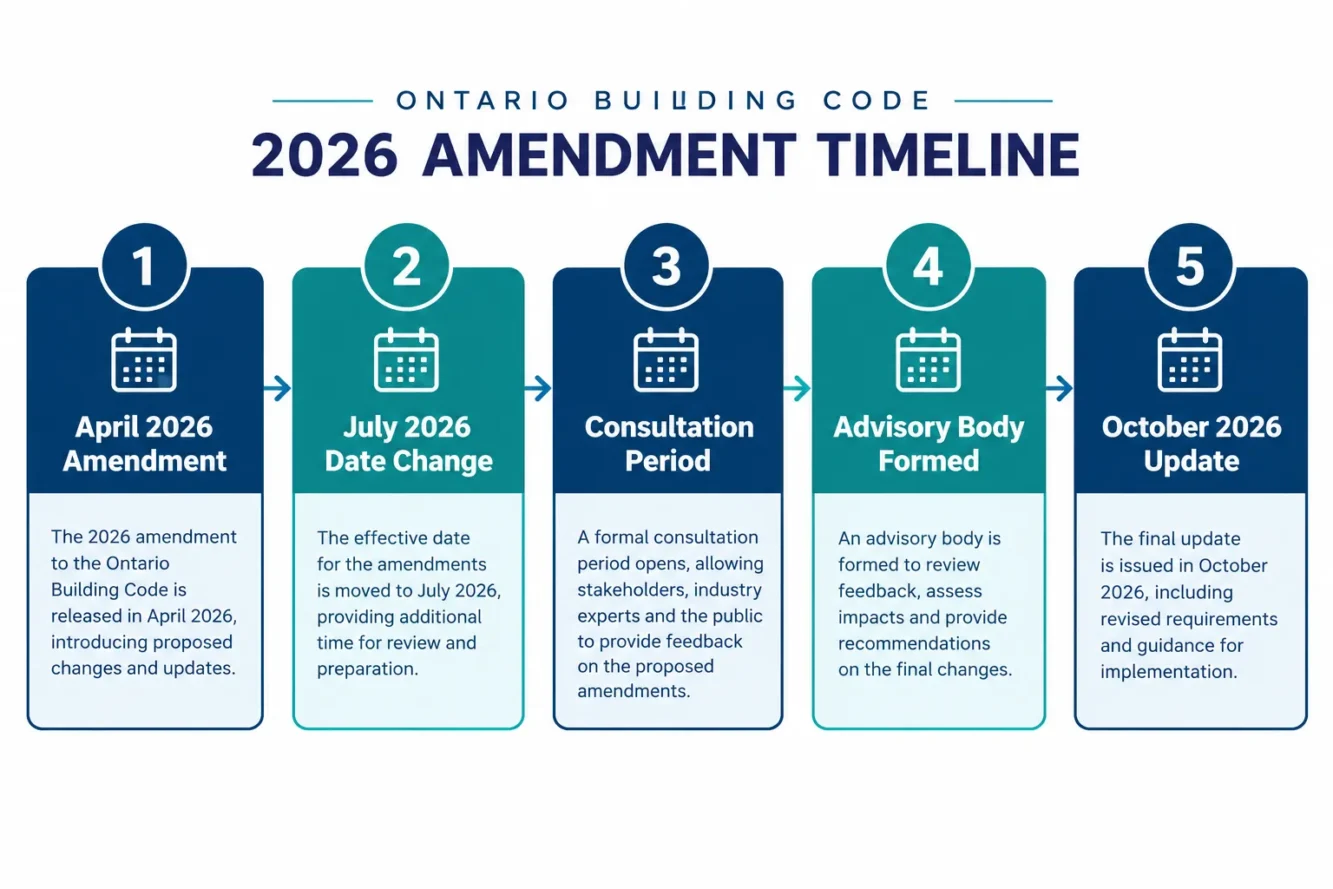
Key technical items from 2026 amendments include:
For a typical renovation on a year-round home near Southern Georgian Bay, these are background changes a licensed designer or contractor should already be tracking. Homeowners rarely need to read the regulation text directly.
Ontario adjusted the effective date for its latest amendments more than once in 2026, which matters for anyone timing a permit application. O. Reg. 119/26 moved an implementation date from April 1, 2026 to April 21, 2026, and O. Reg. 242/26 later moved a related date from April 21, 2026 to July 17, 2026.[1][2]
That pattern tells a simple story: Ontario has been fine-tuning when rules kick in, not just what the rules say. Choose a conservative approach if a renovation or cottage build is near a code boundary date: ask the building department which version applies to a specific application date, rather than assuming the newest rules automatically apply.
The 2026 version is an amended edition of the same National Building Code 2020 foundation Ontario has used for several years, not a separate standalone code. O. Reg. 163/24 confirms the province adopts the National Building Code of Canada 2020 plus Ontario amendments dated October 1, 2026.[6]
In practice, differences show up as:
| Area | 2020-era rules | 2026 amendments |
|---|---|---|
| Base framework | National Building Code 2020 | Same base, with October 2026 Ontario amendments layered on[6] |
| Sewage systems | Older trench-pipe wording | Clarified shallow-buried trench pipe rules[5] |
| Sudbury/North Bay enforcement | Regional health unit and conservation authority | Nine local municipalities and townships[5] |
| Implementation dates | Fixed dates | Repeatedly adjusted through 2026 regulations[1][2] |
Most renovations must follow the code version in force on the date a permit application is made, and current transitional rules allow some older projects to continue under earlier requirements. O. Reg. 163/24 states that construction with permits issued on or before December 31, 2024, or applications made on or before March 31, 2025 in certain circumstances, may continue under the earlier framework if other conditions are met.[6]
How to know if a renovation needs 2026 compliance:
Common mistake: assuming a renovation started years ago is automatically grandfathered. Transitional provisions depend on specific dates and conditions, not project age alone.
Yes. Seasonal and cottage properties are subject to the same provincial code framework as year-round homes, and recent amendments specifically touch cottage-country infrastructure. The April 2026 amendments shifted sewage system enforcement in parts of the Sudbury and North Bay areas from a regional health unit and conservation authority to nine local municipalities and townships.[5]
For owners in Southern Georgian Bay Communities and nearby areas like Springwater Township, this means:
Edge case: a cottage converted to year-round use may trigger additional requirements beyond what applied when it was seasonal-only. Check with the local building department before starting that conversion.
Most structural, plumbing, and sewage-related renovation work still requires a permit, and the 2026 amendments have not introduced a broad new permit fee structure on their own. Permit requirements come from the Building Code Act, 1992, which gives municipalities authority to require permits and enforce compliance.[9]
Permit-need checklist:
Choose a licensed designer or contractor if the renovation touches structure, plumbing, or sewage. Choose a simple permit inquiry call if the work is purely cosmetic.
Is the 2026 code more expensive than 2020 overall? There is no verified provincial data showing a broad cost increase tied directly to the 2026 amendments; most changes are administrative date and enforcement updates rather than new material or labour requirements.[1][2][5]
Ontario’s 2026 amendments, as documented, focus mainly on sewage systems, applicable law references, and implementation dates rather than announcing a new energy-efficiency tier for 2026 specifically.[5][6] Homeowners planning insulation, window, or mechanical upgrades should still follow existing National Building Code 2020 energy provisions already built into Ontario’s code stack, since no separate 2026 energy standard has been confirmed in the sources reviewed here.
Practical step: ask a contractor to confirm which energy compliance path (prescriptive or performance) applies to a specific renovation before ordering materials.
Skipping required permits or ignoring code requirements can lead to stop-work orders, fines, or forced removal of non-compliant work, since municipalities enforce the Building Code Act, 1992 locally.[9] There is no blanket homeowner exemption from the 2026 amendments; exemptions exist only through specific transitional provisions tied to permit dates.[6]
Contractors are watching the Ontario Gazette and OAA bulletins closely because 2026 has brought multiple date-change regulations in a short window.[1][2] Builders active near South Georgian Bay Online coverage areas are advising clients to lock in permit applications early rather than wait, since another date adjustment is always possible given the pattern seen in April and July 2026.
Common homeowner mistakes:
Is there one single 2026 Ontario Building Code document?
No. Ontario uses the National Building Code 2020 as its base, with Ontario-specific amendments dated October 1, 2026 layered on top.[6]
Do renovations started before 2026 need to follow the new amendments?
Some may qualify for transitional rules if permits were issued by December 31, 2024 or applications made by March 31, 2025 under specific conditions.[6]
Why have implementation dates changed so many times in 2026?
Ontario filed at least two regulations in 2026 adjusting dates, moving them from April 1 to April 21, then from April 21 to July 17.[1][2]
Do cottage owners face different rules than city homeowners?
The core code applies the same way, but enforcement for some sewage systems in Sudbury and North Bay areas moved to local municipalities in 2026.[5]
Is a permit always required for a deck or addition?
In most cases yes, especially for structural additions; confirm with the local building department before starting.[9]
Did the 2026 changes make renovations more expensive?
No broad cost increase is documented in the sources reviewed; most 2026 changes are administrative and enforcement-focused.[1][2][5]
What is the Building Code Short-Term Advisory Body?
It is a group formed in June 2026 to advise Ontario’s minister on broader Building Code reforms, as part of an ongoing review process.[7]
Where can homeowners check the current official code text?
Ontario’s Building Code page and the consolidated O. Reg. 163/24 regulation are the official sources for current requirements.[3][6]
The 2026 Ontario Building Code changes are real, but they are mostly about timing, enforcement structure, and technical housekeeping rather than a sweeping overhaul of construction rules. Homeowners renovating a kitchen or adding a deck should confirm permit application dates with their local building department. Cottage owners near Sudbury and North Bay should check which municipality now handles sewage permits. Renovators and contractors should keep watching Ontario Gazette filings, since 2026 has already brought multiple date adjustments. Next step: before breaking ground on any structural, plumbing, or sewage work, call the local building department, confirm the applicable code version for the project’s permit date, and get written confirmation rather than relying on assumptions.
[1] R26242 – https://www.ontario.ca/laws/regulation/r26242
[2] R26119 – https://www.ontario.ca/laws/regulation/r26119
[3] Ontarios Building Code – https://www.ontario.ca/page/ontarios-building-code
[4] 026 0744 – https://ero.ontario.ca/notice/026-0744
[5] Recent Amendments To Ontarios Building Code – https://oaa.on.ca/whats-on/news-and-insights/news-and-insights-detail/Recent-Amendments-to-Ontarios-Building-Code
[6] ontario.ca – https://www.ontario.ca/laws/regulation/240163
[7] Building%20code%20consultation%20paper%20 %20eng – https://ero.ontario.ca/public/2026-07/Building%20Code%20Consultation%20Paper%20-%20ENG.pdf
[8] ontario.ca – https://www.ontario.ca/laws/regulation/260272
[9] 92b23 – https://www.ontario.ca/laws/statute/92b23
[10] R26110 – https://www.ontario.ca/laws/regulation/r26110
Content, illustrations, and third-party video appearing on GEORGIANBAYNEWS.COM may be generated or curated with AI assistance or reproduced pursuant to the fair dealing provisions of the Copyright Act, R.S.C. 1985, c. C-42. Attribution and hyperlinks to original sources are provided in acknowledgment of applicable intellectual property rights. Such referencing is intended to direct traffic to and support the original rights holders’ platforms.