





















Perennial Vegetables for Canadian Gardens: Plant Once, Harvest for Years with Asparagus, Rhubarb, and Beyond

Last updated: March 16, 2026
Quick Answer: Perennial vegetables like asparagus, rhubarb, honeyberries, and Egyptian walking onions are ideal for Canadian gardens because they survive harsh winters, return every spring without replanting, and build toward long-term food security. Most take one to three years to establish but then produce reliable harvests for a decade or more with minimal annual effort.

Key Takeaways
- Asparagus can produce for 15 to 20 years once established — worth the two-year wait before first harvest.
- Rhubarb is one of the most cold-hardy perennial edibles available, thriving in USDA/Canadian hardiness zones 2 through 8.
- Honeyberries (Haskap) and alpine strawberries are trending perennial crops for northern climates in 2026. [2]
- Egyptian walking onions and perpetual spinach offer low-maintenance, season-long harvests with massive interest among Canadian growers. [2]
- Edible landscaping — mixing perennial food plants into ornamental beds — is a flourishing trend in 2026. [1]
- Perennial vegetables reduce annual seed costs, planting labor, and soil disturbance compared to annual crops.
- Most perennial vegetables prefer well-drained, fertile soil and a dedicated permanent bed.
- Avoid common mistakes like harvesting too early in year one, which weakens root systems.
Why Perennial Vegetables for Canadian Gardens Make Sense in 2026
Planting perennial vegetables is one of the most practical ways to build a resilient home food supply. For Canadian gardeners dealing with short growing seasons, unpredictable spring weather (including late-season storms that can dump significant snowfall), and rising grocery costs, a plant-once strategy pays off fast.
Unlike annual vegetables that require fresh seeds, soil preparation, and transplanting every year, perennials establish deep root systems that survive Canadian winters and re-emerge each spring. The upfront investment — in time, soil prep, and patience — pays dividends for years.
“Edible landscaping is flourishing in 2026, reflecting Canadians’ desire for healthy, local produce and greater food security awareness.” [1]
The Best Perennial Vegetables for Canadian Gardens
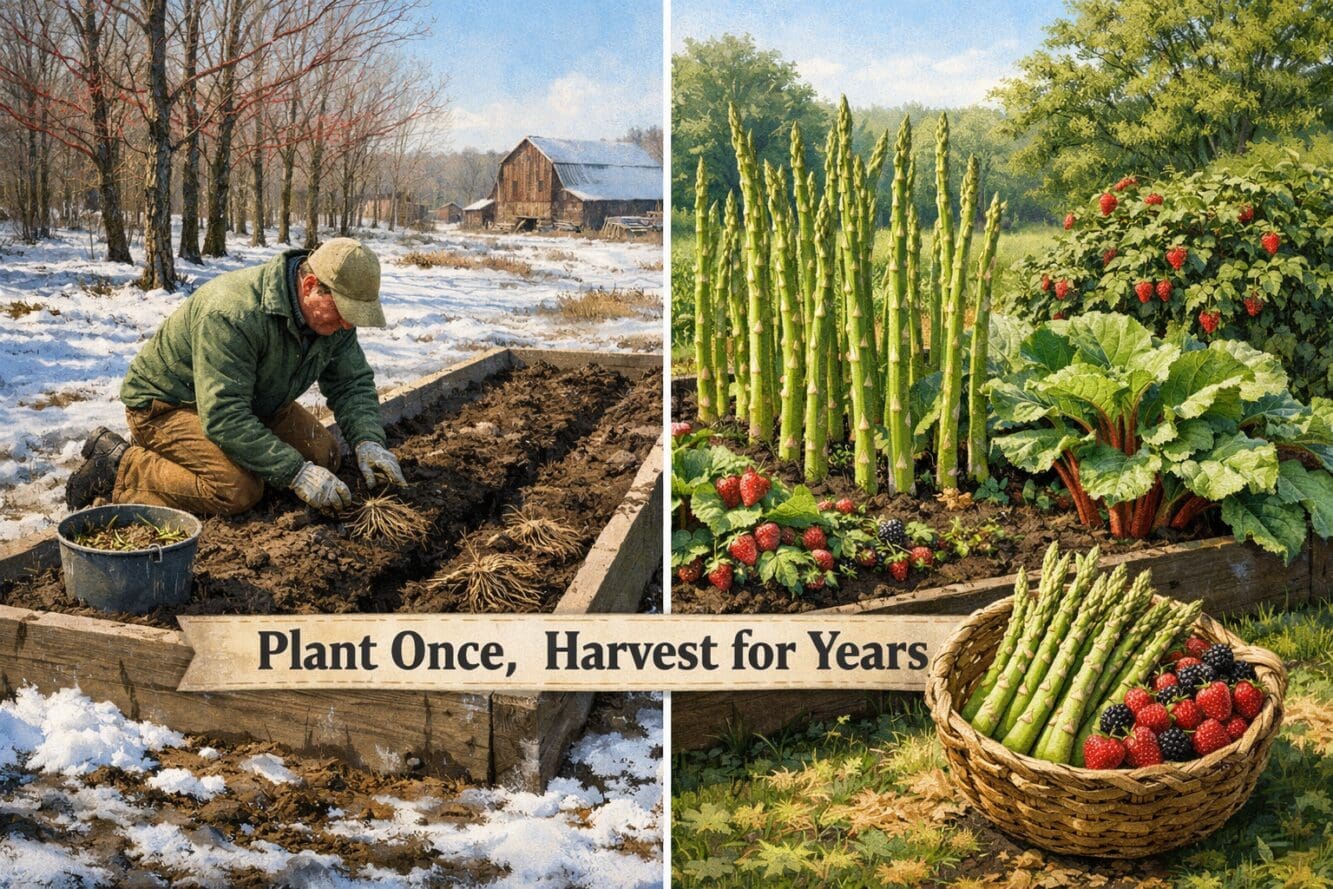
The strongest performers for most Canadian hardiness zones are asparagus, rhubarb, honeyberries, Egyptian walking onions, alpine strawberries, and perpetual spinach. Each suits different garden sizes and skill levels.
Asparagus
- Hardiness: Zones 3–8
- Time to first harvest: 2–3 years from crown planting
- Productive lifespan: 15–20+ years
- Best for: Gardeners willing to wait for a long-term payoff
Plant asparagus crowns (not seeds) in a dedicated, permanent raised bed or trench. Crowns establish faster and produce more reliably. Do not harvest any spears in year one, and harvest lightly in year two. Full harvests begin in year three.
Common mistake: Cutting spears too early. Letting fronds grow through the first two seasons feeds the root crown and determines how productive the bed will be for the next two decades.
Rhubarb
- Hardiness: Zones 2–8 (one of the most cold-tolerant options)
- Time to first harvest: 1 year from division or transplant
- Productive lifespan: 10–15 years before division is needed
- Best for: Beginning gardeners and northern Canadian climates
Rhubarb is forgiving, fast to establish, and productive. Plant divisions in early spring or fall in full sun with rich, well-drained soil. Harvest stalks by pulling, not cutting, to avoid rot at the base. Never eat the leaves — they contain oxalic acid and are toxic.
Honeyberries (Haskap) and Alpine Strawberries
Both are trending as perennial crops for northern climates in 2026. [2] Honeyberries tolerate temperatures as low as -40°C and produce blueberry-like fruit earlier in the season than most other berries. Alpine strawberries are smaller than garden strawberries but produce continuously from June through frost with no runners to manage.
- Choose honeyberries if: you garden in zones 2–4 and want a reliable, low-spray berry crop.
- Choose alpine strawberries if: you want a compact edging plant that doubles as a food source.
Egyptian Walking Onions and Perpetual Spinach
Egyptian walking onions are a standout perennial edible for Canadian gardens. [1] They produce small bulbs at the top of their stalks that “walk” to new spots as they fall and re-root — essentially self-propagating. Perpetual spinach (a type of Swiss chard) has seen massive interest in Canada for its ability to produce fresh leaves from a single spring planting throughout the entire summer. [2]
How to Set Up a Perennial Vegetable Bed
Getting the bed right the first time matters because perennials will occupy that space for years. If you’re new to raised bed gardening, reviewing common beginner raised bed mistakes before you start can save significant frustration.
Step-by-step setup:
- Choose a permanent location with at least 6–8 hours of direct sun.
- Amend soil deeply — asparagus roots reach 60 cm down. Work in compost and aged manure.
- Separate perennials from annuals to avoid disrupting root systems during annual bed prep.
- Mulch heavily each fall to protect crowns from freeze-thaw cycles.
- Label plants clearly — perennial beds look bare in early spring and it’s easy to damage crowns accidentally.
Perennial Vegetable Comparison Table
| Vegetable | Hardiness Zone | Years to Harvest | Lifespan | Difficulty |
|---|---|---|---|---|
| Asparagus | 3–8 | 2–3 years | 15–20 years | Moderate |
| Rhubarb | 2–8 | 1 year | 10–15 years | Easy |
| Honeyberry | 2–6 | 2–3 years | 20+ years | Easy |
| Alpine Strawberry | 3–8 | 1 year | 3–5 years | Easy |
| Egyptian Walking Onion | 3–9 | 1 year | Indefinite | Very Easy |
| Perpetual Spinach | 4–9 | Same season | Annual/biennial | Very Easy |
Edible Landscaping: Blending Perennials into Your Yard
Perennial vegetables don’t have to live in a separate vegetable patch. Edible landscaping — integrating food plants into ornamental garden designs — is one of the top gardening trends of 2026. [1] Rhubarb’s large, dramatic leaves work well as a backdrop plant. Alpine strawberries make attractive ground cover along pathways. Honeyberry shrubs function as productive hedging.
This approach also supports local pollinator populations. Flowering perennial vegetables attract wild bees and other beneficial insects — a meaningful contribution to garden biodiversity. For more on the role of native pollinators in healthy gardens, see the buzz on wild bees versus honeybees.
FAQ
How long before asparagus produces a full harvest?
Expect a full harvest starting in year three after planting crowns. Harvesting too early weakens the plant and reduces long-term yield.
Can rhubarb survive a Canadian winter without protection?
Yes. Rhubarb is one of the hardiest perennial vegetables available, surviving in zones as cold as zone 2 without mulching, though a layer of straw mulch improves spring emergence.
What is perpetual spinach and why is it popular in Canada?
Perpetual spinach is a type of Swiss chard that produces continuously from one spring planting. It has seen significant interest among Canadian gardeners for its long harvest window and minimal care requirements. [2]
Do honeyberries need two plants to produce fruit?
Yes. Honeyberries require cross-pollination, so plant at least two different varieties within close proximity for fruit production.
Are Egyptian walking onions truly perennial?
Yes. They self-propagate by dropping their top-set bulbils, which root and grow new plants. A single planting can sustain itself indefinitely with minimal intervention. [1]
When should perennial vegetable beds be fertilized?
Apply compost or a balanced organic fertilizer each spring as growth begins, and again lightly after the main harvest period ends. Avoid high-nitrogen feeds late in the season, which can reduce winter hardiness.
Can perennial vegetables grow in containers?
Rhubarb and alpine strawberries adapt reasonably well to large containers (minimum 40–50 cm deep). Asparagus is difficult to grow in containers due to its deep root system.
Is perpetual spinach the same as regular spinach?
No. Perpetual spinach is botanically a chard, not true spinach, but its leaves taste similar and it tolerates heat and cold far better than standard spinach.
Conclusion: Build Your Perennial Food Garden This Season
Perennial vegetables for Canadian gardens represent one of the smartest long-term investments a home gardener can make. Plant asparagus crowns this spring and by year three, fresh spears will arrive every May without any replanting. Add rhubarb, honeyberries, and Egyptian walking onions to diversify the harvest across the entire growing season.
Actionable next steps:
- Identify one permanent bed location this week — full sun, good drainage.
- Order asparagus crowns or rhubarb divisions from a Canadian nursery before stock sells out in early spring.
- Add one low-effort option (Egyptian walking onions or alpine strawberries) alongside your main perennials to start harvesting in year one.
- Mulch every fall to protect crowns through freeze-thaw cycles.
- Be patient with asparagus — the two-year wait is the only real obstacle between now and decades of effortless harvests.
The labor is front-loaded. The rewards compound every year.
References
[1] 6 Popular Gardening Trends To Embrace In 2026 – https://gardeningwithsharon.com/general/6-popular-gardening-trends-to-embrace-in-2026/
[2] Watch – https://www.youtube.com/watch?v=gjzuUDJ9eCI
Content, illustrations, and third-party video appearing on GEORGIANBAYNEWS.COM may be generated or curated with AI assistance or reproduced pursuant to the fair dealing provisions of the Copyright Act, R.S.C. 1985, c. C-42. Attribution and hyperlinks to original sources are provided in acknowledgment of applicable intellectual property rights. Such referencing is intended to direct traffic to and support the original rights holders’ platforms.
Much Appreciate You Sharing This Post - It Helps MUCH!!!