






















Herb Gardens for Canadian Cooks: Cold-Hardy, High-Flavor Herbs in Pots, and Kitchen Windows

Sharing is SO MUCH APPRECIATED!


Last updated: March 8, 2026
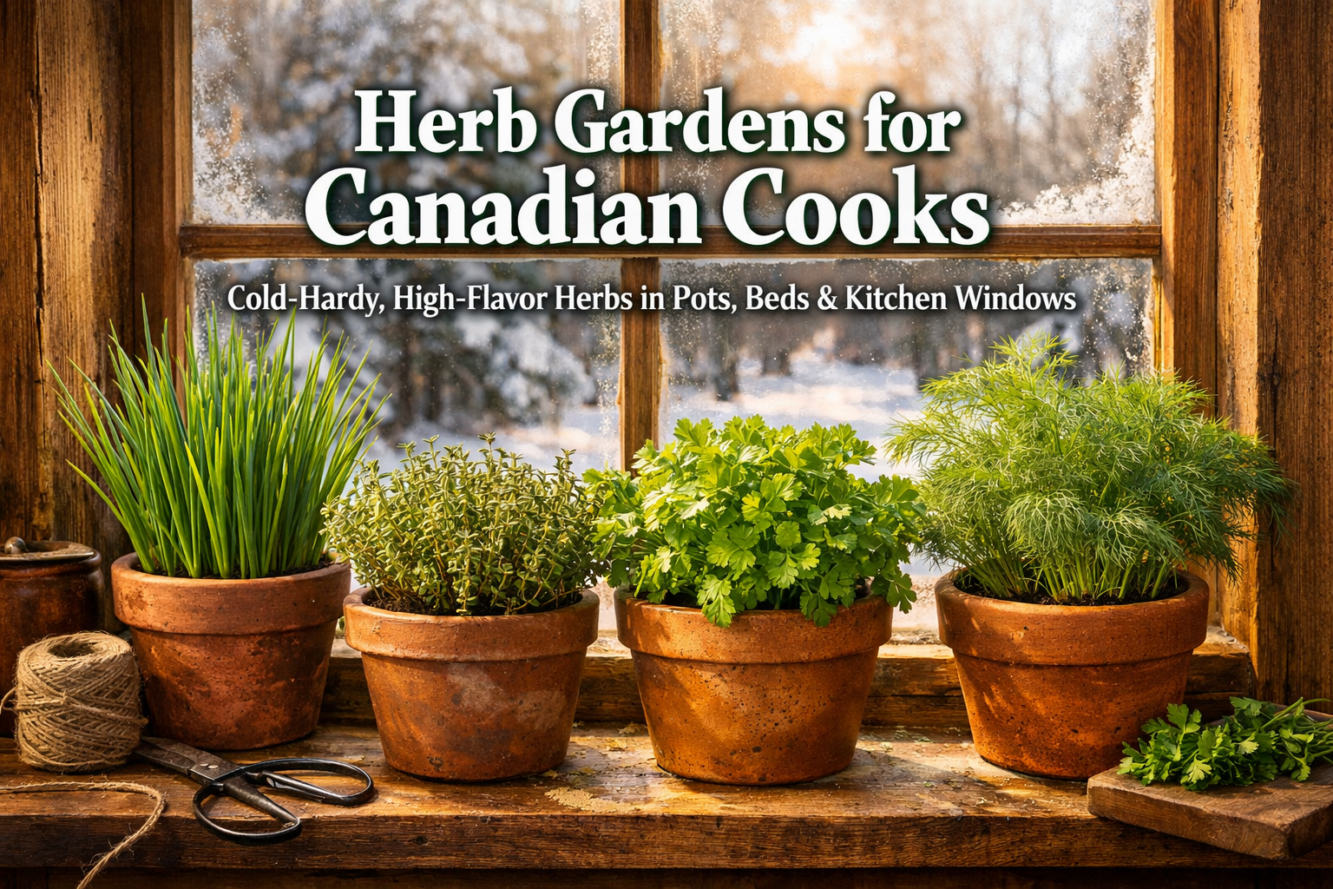
Growing fresh herbs in Canada doesn’t require a greenhouse or a mild climate. With the right variety choices and a few practical strategies, Canadian cooks can harvest parsley, dill, thyme, chives, and more from late spring through early winter, and even year-round on a sunny windowsill. This guide to herb gardens for Canadian cooks: cold-hardy, high-flavor herbs in pots, beds, and kitchen windows covers everything from variety selection and province-specific timing to overwintering perennials and avoiding the most common mistakes.
Key Takeaways
- Chives, thyme, oregano, and mint are perennial herbs hardy to Zone 3 or colder, meaning they survive winters across most of Canada without protection.
- Parsley, dill, and cilantro are cool-season herbs that actually prefer Canadian spring and fall temperatures over summer heat.
- Container gardening is one of the fastest-growing trends in Canadian gardening in 2026, making herb growing accessible to apartment dwellers and condo owners [1].
- Kitchen windowsill herbs need at least 6 hours of direct light daily; a south-facing window is ideal, but supplemental grow lights work in darker months.
- Start cool-season herbs (dill, cilantro, parsley) outdoors 2–4 weeks before the last frost date in your region.
- Warm-season herbs like basil shouldn’t go outside until nighttime temperatures stay above 10°C consistently.
- Overwintering perennial herbs in pots requires insulation or moving containers to an unheated garage where temperatures stay between -5°C and 5°C.
- Low-input gardening methods, including building healthy soil structure rather than relying on heavy fertilization, produce better-tasting herbs [2].
Quick Answer
Canadian cooks get the best results by growing cold-hardy perennials (chives, thyme, oregano, mint) in garden beds and cool-season annuals (parsley, dill, cilantro) in pots or beds timed around frost dates. For year-round supply, keep a few pots of parsley, chives, and basil on a bright kitchen windowsill or under a basic grow light. Choose varieties bred for shorter seasons, source seeds locally when possible [2], and don’t overthink soil amendments: good drainage and decent compost are enough for most culinary herbs.
Which Herbs Grow Best in Canadian Climates?
The best herbs for Canadian gardens are those that either tolerate frost or thrive in the cooler temperatures that define much of the Canadian growing season.
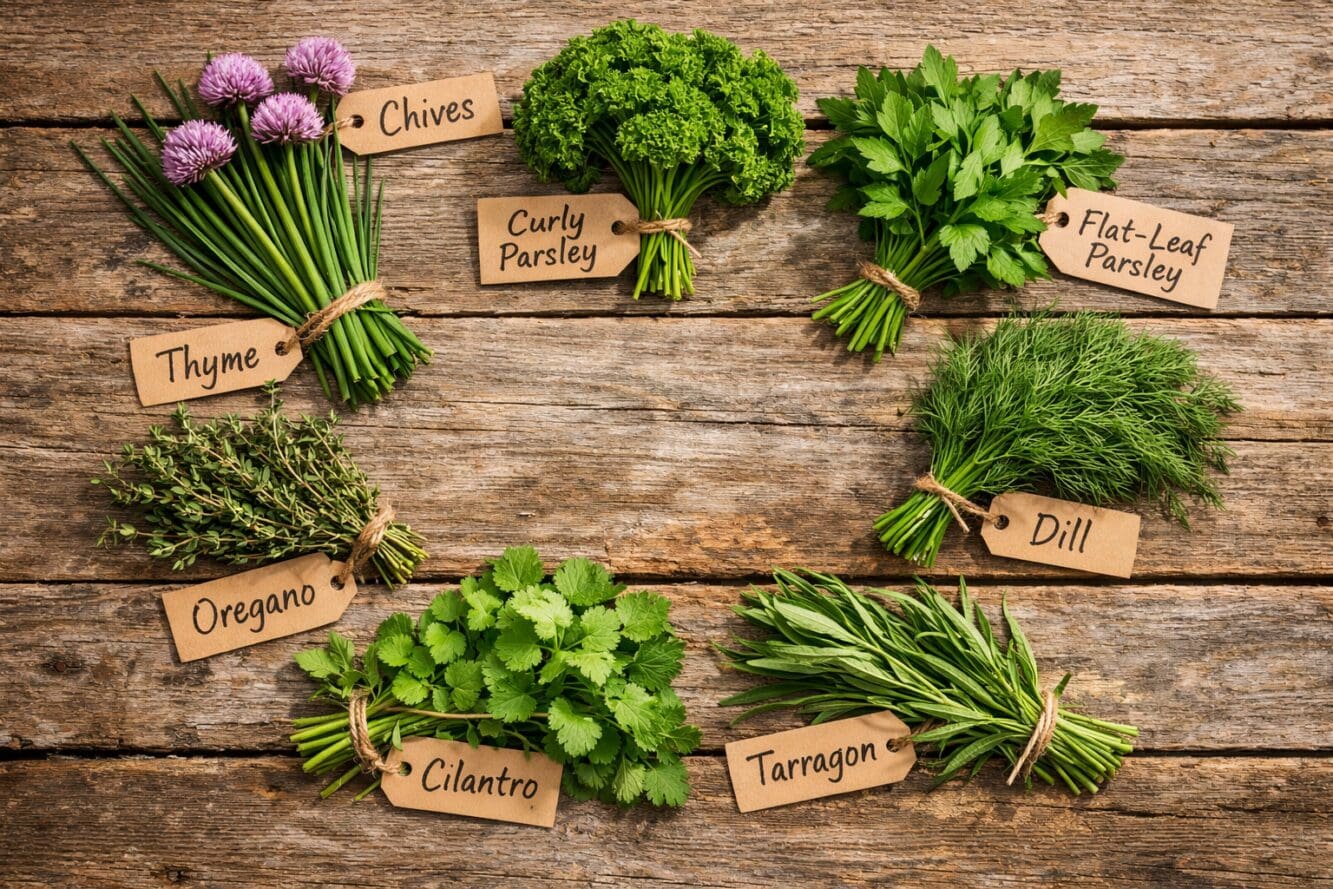
Cold-hardy perennials (survive Zone 3–4 winters):
- Chives — Hardy to Zone 2. One of the first herbs to emerge in spring. Produces mild onion-flavored leaves and edible purple flowers.
- Thyme — Hardy to Zone 4 (some cultivars to Zone 3). Prefers well-drained, slightly alkaline soil. English thyme is the most winter-reliable.
- Oregano — Hardy to Zone 4. Greek oregano has the strongest culinary flavor. Spreads readily.
- Mint — Hardy to Zone 3. Grows aggressively; keep it in a pot or a contained bed to prevent takeover.
- Lovage — Hardy to Zone 3. Tastes like intense celery. Grows tall (up to 1.5 meters) and produces abundantly.
- French tarragon — Hardy to Zone 4 with good drainage. Must be grown from divisions, not seed.
Cool-season annuals and biennials:
- Parsley (biennial) — Tolerates light frost. Italian flat-leaf has stronger flavor; curly holds up better as garnish.
- Dill — Direct-sow outdoors; doesn’t transplant well. Bolts quickly in heat, so succession-plant every 3 weeks.
- Cilantro — Bolts fast in warm weather. Best planted in early spring and again in late August for a fall harvest.
Warm-season herbs (need protection or indoor start):
- Basil — No frost tolerance. Amazel Basil and Pesto Besto are popular 2026 container varieties bred for compact growth and high leaf production [1].
- Rosemary — Perennial only in Zone 8+, so treat it as a container plant in most of Canada and bring it indoors for winter.
Decision rule: If you cook mostly European or Middle Eastern dishes, prioritize thyme, oregano, parsley, and rosemary. For Southeast Asian or Latin American cooking, focus on cilantro, Thai basil, and mint.
When Should Canadian Gardeners Start Herbs Outdoors?
Timing depends on your province and local frost dates. Cool-season herbs can go out 2–4 weeks before the last expected frost. Warm-season herbs like basil need soil temperatures above 15°C.
| Province/Region | Approximate Last Frost | Start Cool-Season Herbs | Start Warm-Season Herbs |
|---|---|---|---|
| Southern BC (Vancouver) | Mid-March | Early March | Late April |
| Southern Ontario | Mid-May | Late April | Early June |
| Prairies (Calgary, Winnipeg) | Late May | Early May | Mid-June |
| Atlantic Canada (Halifax) | Late May | Early May | Mid-June |
| Northern Ontario / Northern BC | Early June | Mid-May | Late June |
Common mistake: Starting basil outdoors too early. A single night below 5°C can stunt or kill basil seedlings, even if daytime temperatures feel warm. Wait until nighttime lows are reliably above 10°C.
Climate-adaptive plant selection is becoming standard practice in 2026, with more Canadian gardeners sourcing locally adapted seeds that perform better in their specific regional conditions [2]. Check with local garden centers or seed libraries for varieties proven in your area.
As summer temperatures rise, it’s worth remembering to protect yourself outdoors as well while tending your garden beds.
How Do You Grow Herbs in Containers and Kitchen Windows?
Container gardening is an established and expanding trend in 2026, making herb growing viable for Canadians without traditional garden beds [1]. A sunny balcony, patio, or kitchen window is enough space for a productive herb garden.
Container basics:
- Use pots at least 15 cm (6 inches) deep for most herbs. Basil and dill prefer 20–25 cm depth.
- Ensure every pot has drainage holes. Herbs hate soggy roots.
- Use a well-draining potting mix, not garden soil. A blend of peat-free potting mix with perlite (roughly 3:1) works well.
- Water when the top 2 cm of soil feels dry. Overwatering kills more container herbs than underwatering.
Kitchen windowsill growing:
- South-facing windows provide the strongest light. East or west windows work for shade-tolerant herbs like parsley, chives, and mint.
- If natural light drops below 6 hours daily (common from November through February in most of Canada), add a basic LED grow light on a timer set to 12–14 hours.
- Keep indoor herbs away from heating vents, which dry out leaves rapidly.
- Harvest frequently to encourage bushy growth rather than leggy stems.
Best herbs for windowsill growing: chives, parsley, basil (with adequate light), mint, and thyme. Dill and cilantro are possible but tend to bolt quickly indoors due to warmth.
Quick example: A 60 cm window box can hold one basil plant, one parsley plant, and a clump of chives, providing enough fresh herbs for daily cooking through winter.
For those looking for culinary inspiration to pair with a fresh herb harvest, a creamy roasted cauliflower soup is an excellent place to start using homegrown thyme and parsley.
What Are the Best Soil and Feeding Practices for Herb Flavor?
Herbs grown in lean, well-drained soil produce more concentrated essential oils, which means stronger flavor. Over-fertilizing actually dilutes taste.
- In beds: Amend with 2–3 cm of finished compost in spring. That’s usually enough for the entire season. Mediterranean herbs (thyme, oregano, rosemary) prefer even leaner soil.
- In containers: A light liquid feed (half-strength balanced fertilizer) every 3–4 weeks during the growing season is sufficient for heavy feeders like basil and parsley. Skip feeding for thyme and oregano.
- Soil pH: Most culinary herbs prefer a pH between 6.0 and 7.5. Lavender and thyme lean toward the alkaline end.
The low-input gardening movement gaining traction in 2026 emphasizes building soil structure through compost and mulch rather than relying on synthetic fertilizers [2]. This approach aligns perfectly with herb growing, where less feeding often means better flavor.
Common mistake: Planting rosemary or thyme in rich, moisture-retentive soil. These Mediterranean herbs need sharp drainage and will develop root rot in heavy, wet conditions. Add coarse sand or extra perlite to their planting mix.
Environmental awareness is part of good gardening practice. Understanding how climate change affects local ecosystems can help gardeners make better decisions about water use and plant selection.
How Do You Overwinter Herbs in Canada?
Perennial herbs in garden beds generally survive Canadian winters on their own if they’re rated for your hardiness zone. The challenge is container-grown perennials and tender herbs like rosemary.
Overwintering perennials in beds:
- Stop harvesting 4–6 weeks before the first expected fall frost so plants can harden off.
- After the ground freezes, apply 10–15 cm of mulch (straw, shredded leaves, or evergreen boughs) over the root zone.
- Remove mulch gradually in spring as temperatures rise.
Overwintering perennials in containers:
- Containers freeze faster and deeper than ground soil, which can kill roots even on hardy plants.
- Choose one of these strategies:
- Move pots to an unheated garage or shed where temperatures stay between -5°C and 5°C.
- Sink the entire pot into a garden bed and mulch over it for the winter.
- Cluster pots together against a south-facing wall and wrap them in burlap or bubble wrap insulation.
Overwintering tender herbs (rosemary, lemon verbena):
- Bring indoors before the first frost.
- Place in the brightest window available and reduce watering significantly.
- Expect some leaf drop; this is normal as the plant adjusts to lower light.
Edge case: French tarragon can be tricky in Zone 4. It survives winter cold but often dies from wet winter soil. Plant it in a raised bed with excellent drainage, or grow it in a container and overwinter in a cold garage.
Which Herbs Should Canadian Cooks Prioritize?
For maximum kitchen impact with minimum effort, focus on the herbs that are expensive to buy fresh, lose flavor quickly after harvest, or are hard to find in grocery stores.
High-priority herbs (biggest gap between store-bought and homegrown):
- Dill — Wilts within a day of purchase. Homegrown dill, snipped minutes before serving, is incomparably better.
- Cilantro — Bolts and decays quickly. Growing it means always having it at peak freshness.
- Basil — Refrigeration damages basil leaves (they turn black). A living plant on the counter stays fresh indefinitely.
- Chives — Rarely sold fresh in bundles large enough for regular cooking. A single plant produces for years.
- French tarragon — Almost impossible to find fresh in Canadian grocery stores. Essential for béarnaise, chicken dishes, and French vinaigrettes.
Lower priority (easy to find and store):
- Dried oregano and thyme retain flavor well, so the urgency to grow fresh is lower, though fresh is still superior.
- Rosemary keeps for weeks in the fridge, making it less critical to have on hand as a living plant.
Community events like local arts and crafts walks sometimes feature vendors selling herb seedlings and handmade planters, which can be a great way to start a collection.
What Are Common Mistakes When Growing Herbs in Canada?
Even experienced gardeners make these errors with herbs. Avoiding them saves time and produces better harvests.
- Planting cilantro and dill in midsummer. Both bolt immediately in heat. Plant them in cool weather (spring or late summer) instead.
- Crowding herbs in one pot. Mint will smother everything else. Basil needs room to bush out. Give each herb its own container, or pair only compatible growers (thyme and oregano work together).
- Harvesting too timidly. Regular cutting encourages branching and more leaf production. Remove up to one-third of the plant at a time.
- Letting herbs flower before harvesting. Once herbs bolt and flower, leaf flavor declines sharply. Pinch off flower buds on basil and cilantro to extend the harvest window.
- Using garden soil in containers. Garden soil compacts in pots, suffocating roots. Always use a quality potting mix.
- Ignoring succession planting. A single planting of dill or cilantro gives 3–4 weeks of harvest at best. Sow new seeds every 2–3 weeks for continuous supply.
For those interested in broader community wellness and finding calm during the busy growing season, breathing and mindfulness techniques can complement time spent in the garden.
Herb Gardens for Canadian Cooks: A Season-by-Season Checklist
Early Spring (March–April):
- Start basil and parsley seeds indoors under lights
- Order seeds from local Canadian suppliers [2]
- Direct-sow cilantro and dill outdoors once soil can be worked (southern regions)
Late Spring (May–June):
- Transplant basil outdoors after last frost
- Direct-sow dill, cilantro, and parsley in cooler regions
- Divide and replant perennial chives, oregano, and mint
Summer (July–August):
- Harvest frequently; dry or freeze surplus
- Succession-plant cilantro and dill for fall harvest
- Pinch basil flowers weekly
Fall (September–October):
- Pot up rosemary and bring indoors before first frost
- Mulch perennial herb beds after ground freezes
- Take cuttings of thyme and oregano for indoor winter pots
Winter (November–February):
- Maintain windowsill herbs with supplemental light
- Start planning next year’s herb garden and ordering seeds
- Enjoy dried and frozen herbs from summer’s harvest
Local summer festivals and community events often coincide with peak herb-harvesting season, making it easy to combine outdoor fun with garden tending.
FAQ
Can I grow rosemary outdoors year-round in Canada?
Only in the mildest parts of coastal British Columbia (Zone 8+). Everywhere else, grow rosemary in a pot and bring it indoors for winter.
How much light do indoor herbs need?
At least 6 hours of direct sunlight daily. During Canadian winters, most windowsills don’t provide enough, so a basic LED grow light on a 12–14 hour timer is recommended.
Is it cheaper to grow herbs or buy them?
A single packet of basil seeds (roughly $3–$4) can produce more basil than $50 worth of grocery store clamshells over a season. Perennial herbs like chives and thyme cost nothing after the first year.
Why does my cilantro keep bolting?
Cilantro bolts in response to heat and long daylight hours. Plant it in partial shade during summer, or grow it only in spring and fall when temperatures are below 25°C.
Can I grow herbs in a north-facing window?
Most culinary herbs won’t thrive without direct sun. Mint and parsley can tolerate lower light, but a grow light is a better solution for north-facing windows.
What’s the easiest herb for a beginner Canadian gardener?
Chives. They’re perennial, cold-hardy to Zone 2, nearly impossible to kill, and useful in dozens of dishes.
Should I grow herbs from seed or buy transplants?
Buy transplants for basil, rosemary, and French tarragon (tarragon must be grown from divisions). Grow dill, cilantro, and parsley from seed, as they don’t transplant well.
How do I preserve herbs for winter?
Freeze basil, dill, and cilantro in ice cube trays with olive oil. Dry thyme, oregano, and rosemary by hanging bundles upside down in a warm, dry room for 1–2 weeks.
Can herbs survive a Canadian balcony in winter?
Container-grown herbs are unlikely to survive on an exposed balcony in most of Canada. Move pots indoors or to an unheated enclosed space.
Do herbs attract pollinators?
Yes. Flowering herbs like chives, thyme, oregano, and dill are excellent pollinator plants. Letting a few plants flower benefits wild bees and other pollinators.
Conclusion
Building an herb garden suited to Canadian conditions comes down to three practical decisions: choosing varieties rated for your hardiness zone, timing plantings around your local frost dates, and matching growing methods (beds, containers, or windowsills) to your available space and light. Start with chives, parsley, and thyme for reliability, add dill and cilantro for cool-season freshness, and grow basil in containers where you can control its environment. Harvest often, feed lightly, and plan for winter by mulching perennials and moving tender herbs indoors. A well-planned herb garden for Canadian cooks delivers better flavor than anything available at the grocery store, from the first chive shoots in April through the last windowsill basil leaves in February.
References
[1] Top Canadian Gardening Trends 2026 – https://www.provenwinners.com/learn/finding-right-plant/top-canadian-gardening-trends-2026
[2] Watch – https://www.youtube.com/watch?v=eyB2d23_QPg
Content, illustrations, and third-party video appearing on GEORGIANBAYNEWS.COM may be generated or curated with AI assistance or reproduced pursuant to the fair dealing provisions of the Copyright Act, R.S.C. 1985, c. C-42. Attribution and hyperlinks to original sources are provided in acknowledgment of applicable intellectual property rights. Such referencing is intended to direct traffic to and support the original rights holders’ platforms.
Sharing is SO MUCH APPRECIATED!