























🔆 Why the Sun Is Getting Stranger: What Solar Maximum Means for Flares, Auroras, and Satellite Risk

Last updated: May 27, 2026
Quick Answer: The Sun is currently in its solar maximum phase — the peak of its roughly 11-year activity cycle — which means more solar flares, stronger geomagnetic storms, and a higher risk of disruption to satellites, GPS, and power grids. NASA and NOAA confirmed the Sun entered this maximum phase in 2024, and activity remains elevated into 2026. [5] The good news: auroras are more visible than ever. The concern: our technology is more exposed than it was during the last peak.
Key Takeaways
- Solar maximum is the peak of the Sun’s 11-year cycle, marked by more sunspots, flares, and coronal mass ejections (CMEs).
- NASA and NOAA confirmed solar maximum began in 2024, with the smoothed sunspot number expected between 105–125. [5]
- Solar flares are classified by intensity (A, B, C, M, X); X-class flares pose the greatest risk to technology. [6]
- A solar flare and a coronal mass ejection (CME) are different events — CMEs carry the most destructive potential for Earth.
- Satellites in low Earth orbit face increased atmospheric drag and radiation exposure during solar maximum.
- Power grids at high latitudes — Canada, Scandinavia, northern Russia — are most vulnerable to geomagnetic storm damage.
- Auroras are visible much farther from the poles during solar maximum, including parts of the continental United States and central Europe.
- Your smartphone is generally safe, but GPS accuracy, radio communications, and aviation systems face real disruption risk.
- Scientists use real-time data from NOAA’s Space Weather Prediction Center and NASA’s Solar Dynamics Observatory to track activity. [6]
- Solar Cycle 25 has been more active than forecasters initially predicted. [1]
What Exactly Is Solar Maximum and How Long Does It Last?
Solar maximum is the peak period of the Sun’s 11-year magnetic activity cycle, when sunspot numbers hit their highest point and solar energy output becomes most volatile. It is not a single day — it is a phase that can last one to two years.

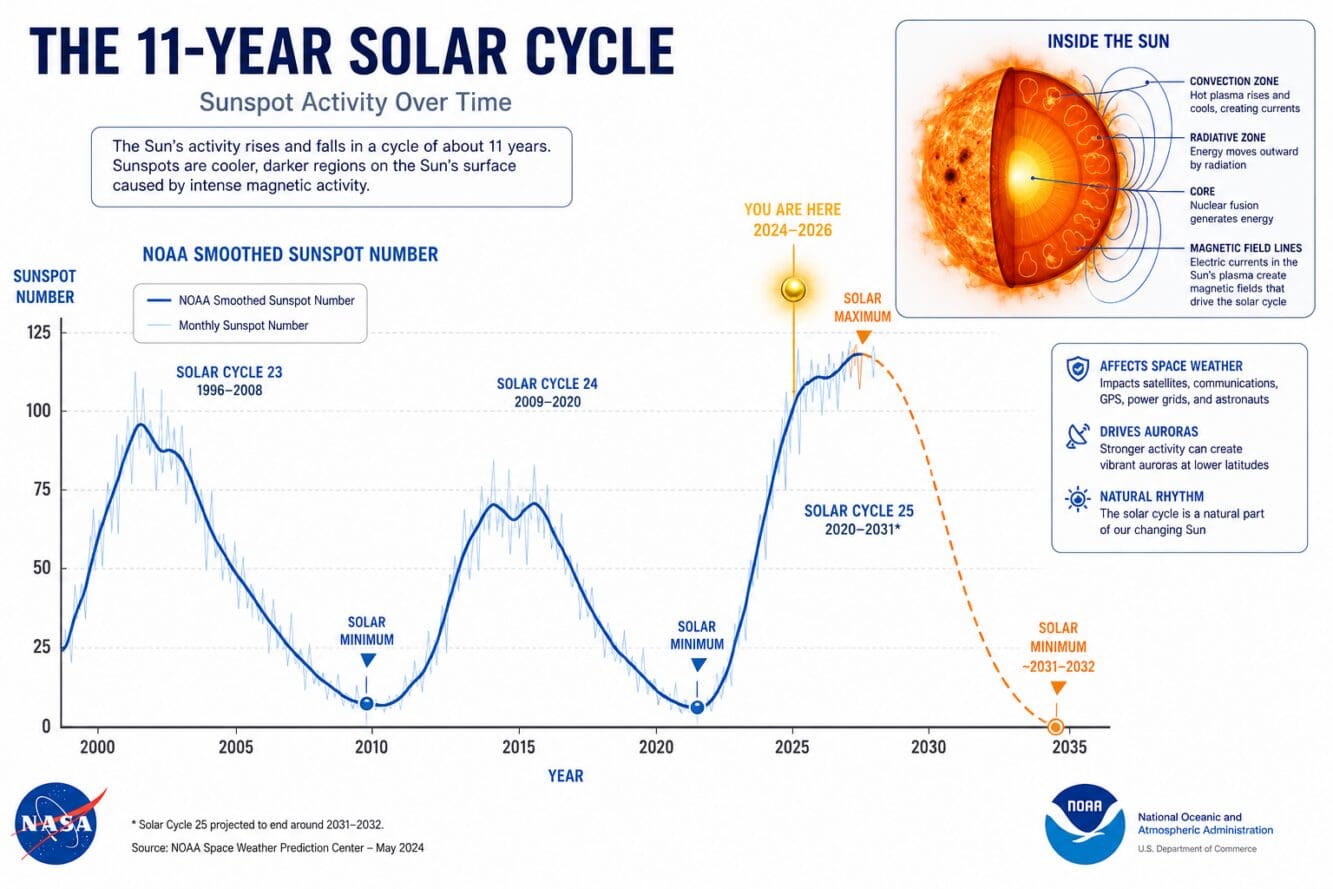
NOAA’s Solar Cycle Prediction Panel estimated the peak of Solar Cycle 25 would fall between November 2024 and March 2026, with a smoothed sunspot number around 105–125. [5] As of mid-2026, the Sun’s activity is beginning its gradual decline toward solar minimum, though significant flare events remain possible for months to come. [4]
How the cycle works:
- The Sun’s magnetic field flips polarity roughly every 11 years.
- As the field becomes increasingly tangled, sunspots form where magnetic energy breaks through the surface.
- More sunspots mean more opportunities for flares and CMEs.
- After maximum, activity slowly winds down toward solar minimum — the quietest phase.
What’s the Difference Between a Solar Flare and a Coronal Mass Ejection?
A solar flare is a burst of electromagnetic radiation (X-rays and UV light) that travels at the speed of light and reaches Earth in about 8 minutes. A coronal mass ejection (CME) is a physical cloud of magnetized plasma that takes 1–3 days to arrive. Both originate from the same magnetic activity, but they carry different risks.
EventTravel Time to EarthPrimary RiskSolar Flare~8 minutesRadio blackouts, GPS errorsCoronal Mass Ejection1–3 daysPower grid damage, satellite disruptionSolar Energetic ParticlesHoursRadiation risk to astronauts, polar flights
Key rule: A flare without a CME causes short-term radio disruption. A CME that hits Earth’s magnetic field triggers a geomagnetic storm — and that’s when infrastructure becomes genuinely vulnerable.
How Dangerous Are Solar Flares During Peak Solar Activity?
Most solar flares cause minor or no disruption at ground level. The danger scales sharply with flare classification, and X-class flares — the strongest — can knock out high-frequency radio communications for hours and degrade GPS signals across entire hemispheres. [6]
In early February 2026, the Sun unleashed a series of back-to-back solar flares, a reminder that solar maximum’s active phase is not yet finished. [10] Scientists have also recently flagged the possibility of a rare “superflare” event, though the probability remains low. [8]
Flare classification scale:
- A and B class: Background noise, no noticeable effect on Earth.
- C class: Minor disruptions to radio in polar regions.
- M class: Short radio blackouts, minor satellite issues.
- X class: Wide-area radio blackouts, GPS degradation, potential power grid stress.
Can Solar Storms Actually Damage Your Phone or Computer?
Your phone and laptop are almost certainly safe from direct damage during solar maximum. Consumer electronics are shielded by Earth’s atmosphere and magnetic field, so ground-level radiation from even strong flares is negligible for personal devices.
What can be affected is the infrastructure your devices depend on:
- GPS accuracy degrades during strong flares because ionospheric distortion bends satellite signals.
- Mobile networks that rely on satellite backhaul may experience brief outages.
- Aviation communication on polar routes uses high-frequency radio, which flares can black out for hours.
Choose to worry less about your phone and more about whether your region’s power grid has surge protection — that’s where the real vulnerability sits.
Will Solar Maximum Make Northern Lights More Visible?
Yes, significantly. During solar maximum, geomagnetic storms are more frequent and more intense, pushing auroral activity much farther from the poles than usual. [2]
Residents of southern Canada, the northern United States, the UK, and central Europe have already seen auroras in 2025 and 2026 that would have been invisible during solar minimum. For communities around Georgian Bay and Southern Ontario, this has been a genuine spectacle. Aurora visibility depends on:
- Kp index: A reading of 5 or above typically produces visible auroras at mid-latitudes.
- Local light pollution: Darker skies dramatically improve visibility.
- Cloud cover: The single biggest practical barrier.
- Timing: Activity peaks 1–3 days after a large CME is observed leaving the Sun.
Apps like SpaceWeatherLive and NOAA’s 3-day forecast give reliable advance notice of strong aurora events. [3]
How Do Scientists Predict and Track Solar Activity?
NOAA’s Space Weather Prediction Center (SWPC) monitors the Sun in real time using data from satellites including SOHO, STEREO, and the Deep Space Climate Observatory (DSCOVR). NASA’s Solar Dynamics Observatory captures high-resolution images of the Sun’s surface every 12 seconds. [6]
Forecasters track sunspot regions, measure X-ray flux for flare detection, and model CME trajectories using coronagraph imagery. The SWPC issues alerts at three levels: Watch (days in advance), Warning (hours), and Alert (event in progress). Staying informed is straightforward — NOAA’s storm and space weather updates are echoed across public weather services.
What Risks Do Solar Flares Pose to Satellites and Space Missions?
Satellites face two compounding problems during solar maximum: increased atmospheric drag and direct radiation damage. When solar activity heats Earth’s upper atmosphere, it expands outward — increasing drag on satellites in low Earth orbit (LEO) and causing orbital decay faster than expected.
SpaceX’s Starlink constellation, for example, lost dozens of satellites to enhanced atmospheric drag following a geomagnetic storm in February 2022. Space exploration developments continue to grapple with this risk as LEO becomes more crowded. High-energy particles from strong flares can also degrade solar panels and damage onboard electronics over time.
Can Solar Flares Affect Power Grids or Cause Blackouts?
Yes — and this is the most serious infrastructure risk. A powerful CME induces geomagnetically induced currents (GICs) in long conductive lines like power transmission cables, pipelines, and railway tracks. These currents can overheat and destroy large transformers, which take months to replace.
The 1989 Quebec blackout, caused by a geomagnetic storm, left 6 million people without power for up to 9 hours. A repeat of the 1859 Carrington Event — the most powerful geomagnetic storm on record — would cause damage estimated in the trillions of dollars by modern assessments.
Regions most at risk:
- High-latitude areas: Canada, Scandinavia, northern Russia, Alaska.
- Areas with long transmission lines running north-south.
- Grids without GIC-blocking capacitors installed.
For context, states of emergency triggered by severe geomagnetic events are a real planning scenario for national emergency management agencies.
How Often Does Solar Maximum Happen and What Makes This Cycle Different?
Solar maximum occurs roughly every 11 years. The current period is Solar Cycle 25, which began in December 2019 after the quiet solar minimum of Cycle 24. [3]
What makes Cycle 25 notable is that it significantly outpaced early forecasts. Initial predictions called for a relatively weak cycle, but sunspot numbers have exceeded expectations, making this one of the more active cycles in recent decades. [1] Scientists are now debating whether longer-term patterns — sometimes called the “grand solar maximum” of the 20th century — are shifting, which adds genuine scientific interest to the current period. [4]
Are Some Regions of Earth More Vulnerable to Solar Storm Impacts?
High-latitude regions face the greatest direct risk from geomagnetic storms, but the vulnerability picture is more complex than geography alone.
Factors that increase risk:
- Latitude: Areas above 50° north or south experience stronger GICs.
- Grid infrastructure age: Older grids with fewer protective devices are more exposed.
- Dependence on satellite services: Remote communities relying on satellite internet and GPS navigation have fewer backup options.
- Polar aviation routes: Flights over the poles face higher radiation exposure and potential radio communication loss during strong events.
For readers in Southern Georgian Bay and similar northern communities, the combination of latitude and reliance on satellite-linked services means staying safe during major space weather events is a practical concern, not just an abstract one.
How Do Astronauts Stay Safe During Increased Solar Radiation?
Astronauts aboard the International Space Station (ISS) face elevated radiation exposure during solar maximum because they orbit above most of Earth’s protective atmosphere. NASA monitors solar activity continuously and has protocols in place for crew to shelter in more heavily shielded sections of the station when a major flare or CME is detected.
For future deep-space missions — to the Moon or Mars — radiation shielding is a critical design requirement, since astronauts beyond Earth’s magnetic field have no natural protection. Solar maximum makes the timing of such missions a genuine safety variable.
FAQ
Q: Is solar maximum dangerous for the average person on the ground?
A: No. Earth’s atmosphere and magnetic field absorb the radiation and charged particles. Ground-level health risk from solar flares is negligible for most people.
Q: Can a solar flare knock out the internet?
A: A sufficiently large CME could damage undersea cables or satellite infrastructure enough to cause regional internet disruptions. A direct hit from a Carrington-scale event could cause widespread outages lasting weeks.
Q: How do I know when a big solar storm is coming?
A: NOAA’s Space Weather Prediction Center (swpc.noaa.gov) issues free alerts. Several apps also push Kp index notifications in real time.
Q: Will solar maximum end soon?
A: Activity is declining from its 2024–2025 peak but remains elevated into mid-2026. A return to solar minimum is expected around 2030. [4]
Q: Does solar maximum affect climate?
A: The Sun’s total energy output varies by less than 0.1% across the solar cycle — too small to drive significant climate change. Solar variability is a minor factor compared to greenhouse gas forcing.
Q: Can I damage my eyes watching a solar flare?
A: Never look directly at the Sun without certified solar eclipse glasses. Flares are not visible to the naked eye and do not increase the danger of looking at the Sun, but the Sun is always dangerous to view directly.
Q: What was the strongest solar storm in recorded history?
A: The 1859 Carrington Event remains the benchmark. It caused auroras visible in the tropics and set telegraph systems on fire across North America and Europe.
Q: Are airlines changing routes because of solar maximum?
A: Yes. During strong geomagnetic storms, airlines sometimes reroute polar flights to avoid radio communication blackouts and reduce crew radiation exposure.
Conclusion
Understanding why the Sun is getting stranger — and what solar maximum means for flares, auroras, and satellite risk — is no longer just a concern for astronomers. As of 2026, the peak of Solar Cycle 25 is behind us but its effects are still unfolding. Power utilities, satellite operators, aviation authorities, and emergency planners are all actively managing space weather risk.
Actionable steps for everyday readers:
- Sign up for NOAA space weather alerts at swpc.noaa.gov — free, real-time notifications for strong geomagnetic storms.
- Check the Kp index the night before you plan aurora viewing; a Kp of 5 or higher means mid-latitude visibility is likely.
- Back up critical data before a forecasted major storm if you rely on satellite-linked systems for business or remote work.
- Talk to your utility provider about whether your local grid has GIC protection — it’s a legitimate question for community stakeholders and local councils.
- Stay informed — solar activity will gradually decline toward minimum, but significant events remain possible through 2027.
The Sun has always been active. What’s changed is how much of our daily life now depends on the technology it can disrupt.
References
[1] Solar Maximum Expected 2024 New Predictions Suggest – https://www.space.com/solar-maximum-expected-2024-new-predictions-suggest
[2] Will 2026 Still Bring Strong Auroras What The Suns Recent Activity Tells Us – https://www.space.com/stargazing/auroras/will-2026-still-bring-strong-auroras-what-the-suns-recent-activity-tells-us
[3] Solar Cycle – https://www.spaceweatherlive.com/en/solar-activity/solar-cycle.html
[4] Declining Phase For Suns Activity But Whats Next – https://www.metoffice.gov.uk/blog/2026/declining-phase-for-suns-activity-but-whats-next
[5] Nasa Noaa Sun Reaches Maximum Phase In 11 Year Solar Cycle – https://science.nasa.gov/science-research/heliophysics/nasa-noaa-sun-reaches-maximum-phase-in-11-year-solar-cycle/
[6] Solar Cycle Progression – http://www.swpc.noaa.gov/products/solar-cycle-progression
[8] Scientists Warn The Sun Could Be About To Produce A Superflare – https://www.forbes.com/sites/jamiecartereurope/2026/05/24/scientists-warn-the-sun-could-be-about-to-produce-a-superflare/
[10] Facebook – NASA Solar System – https://www.facebook.com/NASASolarSystem/posts/in-early-february-2026-the-sun-unleashed-a-torrent-of-back-to-back-solar-flares-/1377635944399347/
Much Appreciate You Sharing This Post - It Helps MUCH!!!