





















😷 Ontario’s Early 2026 Flu Season: Symptoms, Testing, Treatment and When Families Should Stay Home


Last updated: October 27, 2026
Quick Answer
Ontario’s flu season arrived earlier than usual this year, with provincial test positivity near 3% by late September 2026 and children showing the sharpest early increases.[1][2] Influenza A is driving most cases, antivirals work best within 48 hours of symptom onset, and free flu shots are available to everyone six months and older starting October 26, 2026.[3][4][5] Families should plan for a sick child to stay home at least 24 hours after fever breaks without medicine, and adults should watch for breathing trouble as a signal to seek emergency care.
Key Takeaways
- Ontario’s 2026-27 flu season started earlier than the past four seasons, with test positivity crossing the epidemic threshold of 5% nationally by early October 2026.[1][6]
- Children aged 5-11 had 6.8% test positivity and those aged 1-4 had 5.3% for the week ending September 26, 2026, both higher than the provincial average.[2]
- Influenza A is the dominant strain this season, and early data suggest the 2026-27 vaccine matches circulating H1N1pdm09 and H3N2 subclades reasonably well.[2][4][7]
- Free flu and updated COVID-19 vaccines became available to all Ontarians aged six months and older on October 26, 2026.[3][5]
- Most healthy people recover from flu in 5 to 10 days and can return to work once fever-free for 24 hours without medication.
- Antivirals like oseltamivir work best when started within 48 hours of symptoms and are prioritized for high-risk groups.
- Hospitalizations for flu, COVID-19 and RSV are all projected to rise through late fall 2026.[2][8]
What Are the Main Symptoms of the 2026 Flu Strain in Ontario
The 2026 Ontario flu strain, dominated by Influenza A, causes sudden fever, chills, body aches, dry cough, sore throat and extreme tiredness.[2][4] Unlike a cold, flu symptoms tend to hit fast rather than build gradually over days.

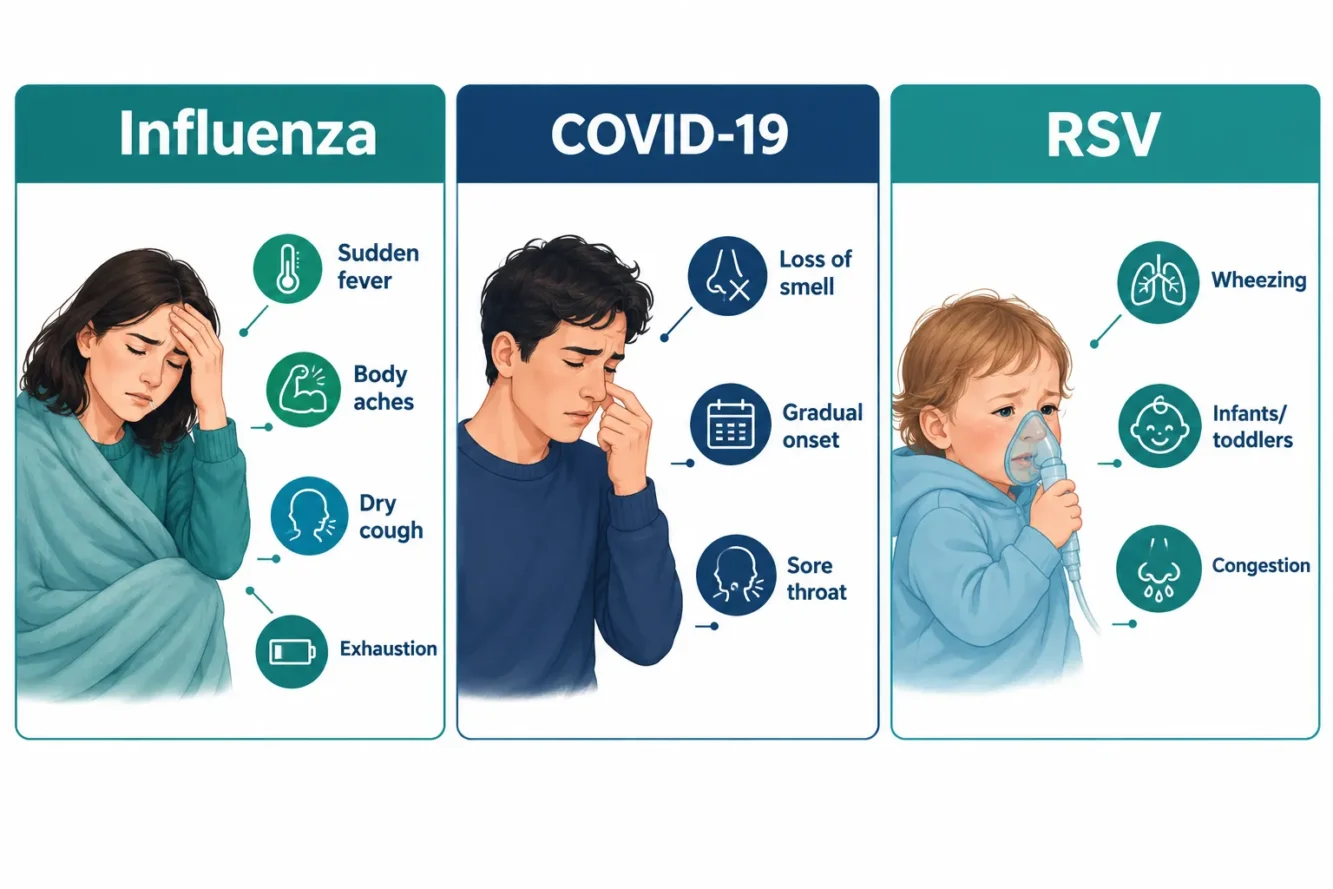
Common signs include:
- Fever of 38°C or higher, often starting within hours
- Muscle and joint aches, sometimes severe
- Headache and fatigue that can last a week or longer
- Dry cough and sore throat
- In children: vomiting, diarrhea, and higher fevers are more common than in adults
Public Health Ontario surveillance shows children carrying a larger share of early-season cases, with positivity rates nearly double the provincial average in kids aged 5-11.[2] A mistake families often make is assuming a child’s illness is “just a cold” because the fever seems mild at first, flu fevers in kids can spike quickly after the first 24 hours, so watch the trend, not just the first reading.
Where Can I Get a Flu Test in Ontario Right Now
Flu testing in Ontario is available through family doctors, walk-in clinics, pharmacies offering rapid testing, and assessment centres connected to local public health units.[9] Hospitals also test patients who arrive with severe symptoms.
Options include:
- Family physician or nurse practitioner offices (often combine flu and COVID-19 swabs)
- Participating pharmacies with rapid antigen or PCR testing
- Urgent care centres for same-day results
- Public health unit-run respiratory clinics during peak season
Choose a pharmacy rapid test if you need a quick answer to decide on antivirals within the 48-hour treatment window. Choose a PCR test through your doctor if you have underlying health conditions and need a more definitive result for treatment planning.
How Much Does Flu Testing Cost in Ontario
Flu testing through OHIP-covered settings, family doctors, walk-in clinics, and hospitals, is free for Ontario residents with a valid health card.[9] Pharmacy rapid tests purchased without a prescription may carry an out-of-pocket cost, though some are offered free during high-demand periods as part of provincial respiratory season planning.[8]
A common mistake is assuming all pharmacy testing is free; call ahead or check with provincial resources before visiting, since coverage can vary by site and by whether the test is ordered by a health professional.
How Long Does the Flu Last and When Can I Go Back to Work
Flu symptoms typically last 5 to 10 days, with fever usually breaking within 3 to 5 days and lingering fatigue or cough sometimes stretching longer. Most adults can return to work once they have been fever-free for 24 hours without fever-reducing medication and feel well enough to function normally.
Edge case: older adults and people with chronic conditions may take longer to recover and should confirm readiness with a healthcare provider before returning to work, especially in jobs involving close contact with vulnerable people.
What’s the Best Treatment for the Flu in 2026
The best flu treatment combines rest, fluids, fever management, and, for high-risk patients, early antiviral medication started within 48 hours of symptom onset.[8] There is no single “best” option for everyone; treatment depends on age, health status, and how early symptoms are caught.
Decision rule: choose antiviral treatment (such as oseltamivir) if you are over 65, pregnant, have a chronic condition like asthma or diabetes, or are caring for a young infant, and contact a provider as soon as symptoms start, since antivirals lose effectiveness after 48 hours.
Supportive care for everyone else includes:
- Acetaminophen or ibuprofen for fever and aches
- Fluids to prevent dehydration
- Rest until fever resolves
- Humidifiers or saline rinses for congestion
How Many Days Should Kids Stay Home From School With the Flu
Children should stay home from school for at least 24 hours after their fever breaks without fever-reducing medicine, and often need 3 to 5 days total away from school depending on symptom severity.[8] Returning too early risks spreading the virus to classmates and teachers during the most contagious window.
Quick example: a child with fever on Monday and Tuesday who becomes fever-free by Wednesday morning can typically return Thursday, provided energy and appetite have improved.
When Should I Go to the Emergency Room Instead of Urgent Care
Go to the emergency room for difficulty breathing, chest pain, bluish lips, confusion, or a fever that won’t respond to medication in infants, older adults, or pregnant individuals.[8] Urgent care is appropriate for moderate symptoms that need evaluation but don’t involve these red flags.
Warning signs requiring ER care:
- Trouble breathing or shortness of breath
- Persistent chest or abdominal pressure
- Sudden dizziness or confusion
- Severe or persistent vomiting
- Fever above 40°C that doesn’t respond to medication
- In children: bluish skin, not waking up, extreme irritability
Can You Get the Flu Twice in One Season
Yes, it is possible to get the flu twice in one season because multiple influenza strains, including different Influenza A subtypes, often circulate at the same time.[4] Immunity from one infection doesn’t fully protect against a genetically different strain.
This is why vaccination still matters even after a flu infection, the shot covers strains beyond the one a person already fought off.
Is the 2026 Flu Worse Than Previous Years
It is too early to call the 2026-27 season more severe overall, but it started earlier and with higher pediatric positivity than recent years.[2] Public Health Ontario notes activity is rising more gradually than in the past four seasons, even though it began sooner.[2][7]
Hospitalizations for flu, COVID-19 and RSV combined are projected to increase over the coming weeks, so families should prepare now rather than wait for peak season.[2][8]
Can I Treat the Flu at Home or Do I Need Antibiotics
Most flu cases are treated at home with rest and supportive care; antibiotics do not work against influenza because it is a virus, not a bacterial infection. Antibiotics are only needed if a secondary bacterial infection, such as pneumonia, develops.
Common mistake: requesting antibiotics for flu symptoms. This won’t help and contributes to antibiotic resistance. Seek medical attention instead if symptoms worsen after initially improving, that pattern can signal a bacterial complication.
Do Flu Vaccines Protect Against the Current Ontario Strain
Early indications suggest the 2026-27 flu vaccine is a reasonably good match for the H1N1pdm09 and H3N2 subclades currently circulating in Ontario.[2][4][7] Vaccination remains the most reliable way to reduce the risk of severe illness, even when the match isn’t perfect.
Free flu and updated COVID-19 vaccines have been available to all Ontarians aged six months and older since October 26, 2026, through pharmacies, public health units, and participating doctors and nurse practitioners.[3][5]
What Should Pregnant Women Do If They Get the Flu
Pregnant individuals who develop flu symptoms should contact a healthcare provider promptly, since pregnancy increases the risk of severe complications and early antiviral treatment is often recommended.[3][8] Provincial guidance lists pregnant people among groups who should be immunized as early as possible each season.[3][8]
Pregnant women should avoid waiting out symptoms at home if fever is high or breathing feels labored, these cases warrant same-day medical contact rather than a wait-and-see approach.
Common Mistakes People Make When Treating the Flu
The most frequent mistake is waiting too long to seek antiviral treatment, missing the 48-hour window when medication works best. Another is returning to work or school too soon, before the 24-hour fever-free rule is met.
Other mistakes include:
- Mixing over-the-counter medications and accidentally doubling up on acetaminophen
- Skipping fluids, which worsens fatigue and headache
- Assuming a mild cough means it’s safe to resume normal activity around vulnerable family members
- Not checking on elderly relatives living alone during peak symptom days
When Does Someone Stop Being Contagious With the Flu
Most adults stop being contagious about 24 hours after their fever resolves without medication, typically 5 to 7 days after symptoms began. Young children and people with weakened immune systems may remain contagious longer, sometimes up to 10 days.
This is a key reason school and workplace return guidance focuses on the fever-free window rather than simply “feeling better,” since contagiousness can outlast the worst symptoms.
Conclusion and Next Steps
Ontario’s early 2026-27 flu season means families should act now rather than wait for the usual late-October surge.[1][2][6] Book a flu shot as soon as possible, since free vaccines for everyone six months and older rolled out province-wide on October 26, 2026.[3][5] Keep a thermometer, fever reducer, and rapid test kit at home, and know the 24-hour fever-free rule before sending kids back to school. Watch for breathing trouble, confusion, or fevers that won’t break, these call for emergency care, not a wait-and-see approach. For families tracking kids’ health through the season, check resources tagged under kids for related coverage, and stay alert as hospitalizations are expected to climb through the coming weeks.[2][8]
References
- Flu Season Ahead of Schedule Ontario Cases 9. cbc.ca.
- Article 577cb225 D266 53af Be0c 62964c102c22. insidehalton.com.
- Flu Facts. ontario.ca.
- Influenza. publichealthontario.ca.
- Ontario Providing Free Flu and Covid 19 Vaccines Across the Province. news.ontario.ca.
- Ontario Flu Covid Vaccines 9. cbc.ca.
- Resources. publichealthontario.ca.
- Moh Seasonal Respiratory Pathogen Guide En 2026 10 05. ontario.ca.
- Flu. ontariohealth.ca.
Content, illustrations, and third-party video appearing on GEORGIANBAYNEWS.COM may be generated or curated with AI assistance or reproduced pursuant to the fair dealing provisions of the Copyright Act, R.S.C. 1985, c. C-42. Attribution and hyperlinks to original sources are provided in acknowledgment of applicable intellectual property rights. Such referencing is intended to direct traffic to and support the original rights holders’ platforms.
Much Appreciate You Sharing This Post - It Helps MUCH!!!