




















Vitamin B6 Supplement Safety: Who May Be at Risk of Nerve Damage and What Canadians Should Check

Vitamin B6 Supplement Safety: Who May Be at Risk of Nerve Damage and What Canadians Should Check

Last updated: October 26, 2026
Quick Answer
Vitamin B6 supplement safety matters because long-term high-dose use, generally at or above 10 mg a day over extended periods, has been linked to nerve damage in some adults [1]. Canadians should check supplement labels for total daily B6 content, add up every source including multivitamins and fortified foods, and speak with a pharmacist if daily intake regularly nears or exceeds upper reference levels. Those most at risk include people combining multiple B6-containing products, older adults, and anyone on medications that interact with B6 metabolism.
Key Takeaways
- Health Canada’s 2026 safety review flagged possible nerve damage risk at daily B6 intakes of 10 mg or higher, sustained over time [1][2].
- Vitamin B6 supplement safety depends on cumulative dose from all sources, not just one product.
- Nerve damage from B6 often starts with tingling or numbness in the hands and feet, not sudden pain.
- Older adults, long-term high-dose users, and people on certain medications face higher risk for B6 toxicity.
- Canada’s current reference intakes set adult needs far below typical supplement doses, which is why label-checking matters [3].
- Most B6 nerve damage improves after stopping the supplement, but recovery can take months and is not guaranteed [2].
- Food-based B6 is very unlikely to cause toxicity; supplements and fortified products are the real concern [4][5].
- International regulators in Malaysia, Singapore, and Australia have issued parallel warnings about cumulative B6 exposure [6][7][8].
How Much B6 Is Too Much to Take Daily
Daily B6 intake above 10 mg over months or years is the threshold Health Canada’s 2026 review associated with a possible nerve damage signal, though it stresses more data is needed at these lower-than-previously-assumed levels [1][2]. Older safety guidance focused on much higher doses, often 50 mg or more, as the danger zone.
This is a meaningful shift. Many over-the-counter multivitamins, B-complex formulas, and energy supplements contain 25 mg, 50 mg, or even 100 mg of B6 per serving, far above the new area of concern.
- Check the Supplement Facts panel for “Vitamin B6 (Pyridoxine)” and note the milligram amount per serving.
- Add up B6 from every product used daily: multivitamin, B-complex, PMS formula, energy drink, or fortified cereal.
- If the running total regularly sits at or above 10 mg a day for weeks or months, that is a signal to review the regimen with a pharmacist.
Choose caution if a product’s label lists B6 in doses that look designed for “energy” or “stress support,” since these formulas often carry disproportionately high B6 content relative to actual nutritional need.
What Does B6 Nerve Damage Feel Like
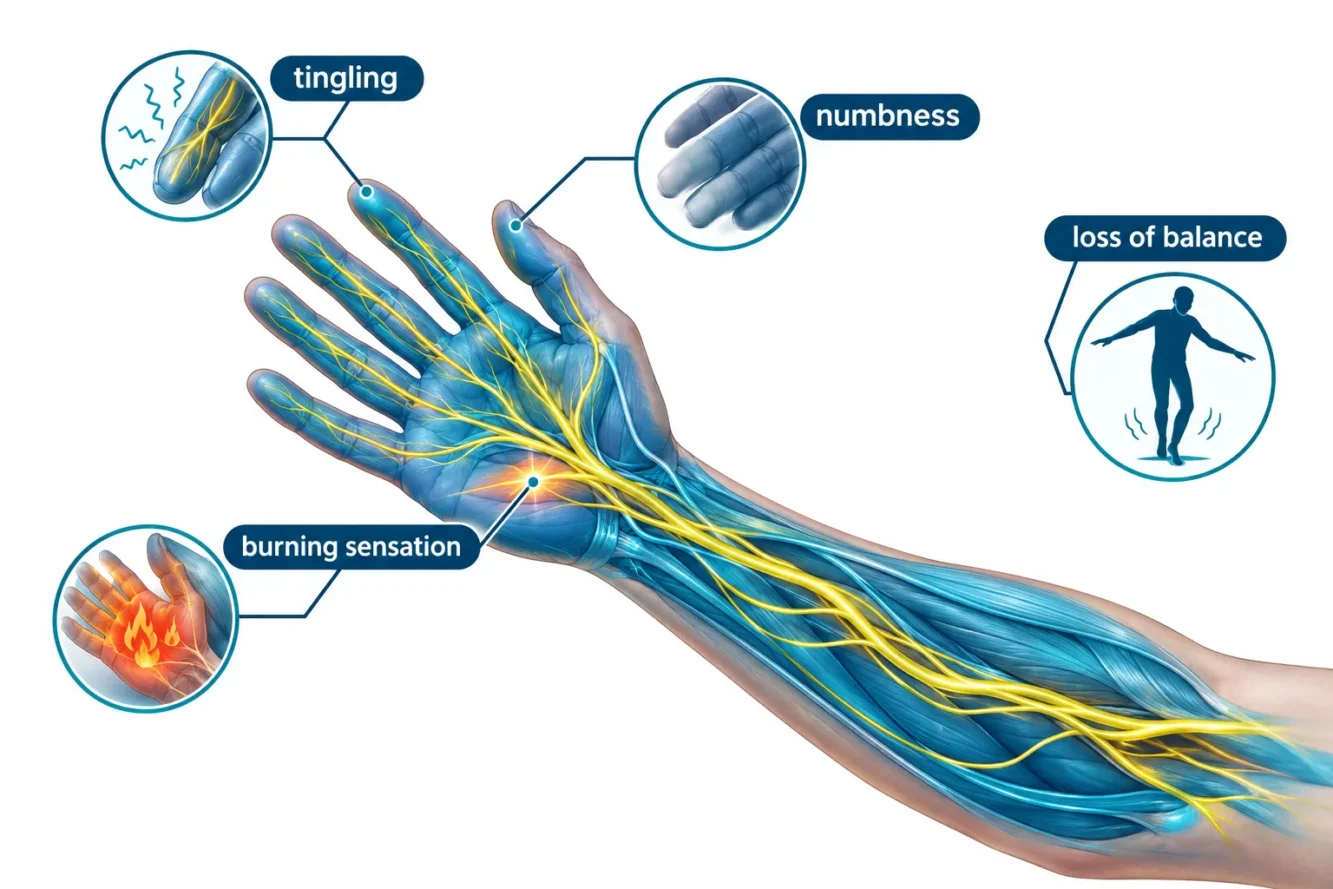
B6-related nerve damage (peripheral neuropathy) typically shows up as tingling, numbness, or a pins-and-needles sensation in the hands and feet, sometimes progressing to burning pain or unsteady walking [2]. Symptoms tend to appear gradually rather than overnight.
Common patterns reported in clinical reviews include:
- Numbness or reduced sensation in fingers and toes
- A burning or electric-shock feeling in the extremities
- Clumsiness, dropping objects, or trouble buttoning clothes
- Balance problems or an unsteady walk
- In some cases, sensitivity to touch that worsens over weeks
A clinical review of excess B6 cases found the pattern consistently pointed to too much vitamin, not too little, as the underlying trigger, a reversal of what many people assume about vitamin-related nerve issues [2].
Can Too Many B6 Supplements Cause Neuropathy
Yes. Multiple regulatory bodies now treat cumulative high-dose B6 intake as a recognized cause of peripheral neuropathy, distinct from deficiency-related nerve problems [1][2][6]. The mechanism relates to how excess pyridoxine accumulates and affects sensory nerve fibers over time.
The risk is dose- and duration-dependent: a short course of moderate-dose B6, for example in a prenatal vitamin, carries a very different risk profile than years of daily 50 mg B-complex use. Choose extra caution if a supplement has been taken daily for more than six months without a break.
Who Is at Risk for B6 Toxicity
People who stack multiple B6-containing products, use high-dose B-complex or “energy” supplements long-term, or have reduced kidney function face the highest risk for B6 toxicity [1][2]. Age and medication use also play a role.
Groups that should pay closer attention:
- Adults taking more than one supplement containing B6 (multivitamin plus B-complex, for example)
- Older adults, whose kidney clearance of B6 may be slower
- People with chronic kidney disease
- Long-term users of high-dose B-complex or “nerve support” supplements
- Anyone combining B6 supplements with certain prescription medications
What’s the Safe B6 Supplement Dose in Canada
Canada’s dietary reference intake for adults is modest, generally in the range of 1.3 to 1.7 mg per day from all sources, with a tolerable upper intake level set well above typical dietary needs [3]. Health Canada’s 2026 review, however, suggests that sustained supplemental doses near 10 mg a day may still carry risk for some individuals, prompting renewed scrutiny of labeling [1].
This means the “safe” dose depends on context: short-term use of a moderate-dose multivitamin is unlikely to be a concern, while daily use of a 25-100 mg B-complex over years is the pattern under closest review. Canadian supplemented food rules also set specific permitted B6 levels and cautionary statements for fortified products [4][5].
How Long Before B6 Causes Nerve Problems
Most documented cases of B6-related neuropathy involved months to years of daily high-dose use, not single doses or short courses [2]. There is no fixed timeline, because individual sensitivity varies.
Some adverse event reports reviewed by regulators describe symptom onset after roughly six months to two years of consistent high-intake use, though shorter periods have occasionally been reported at very high doses [6][8]. Choose a precautionary approach if a supplement regimen has run longer than six months without a check-in with a healthcare provider.
Is a B6 Supplement Necessary If You Eat Well
For most Canadians eating a varied diet with protein sources, whole grains, and vegetables, additional B6 supplementation is usually unnecessary, since food sources rarely cause toxicity [3][4]. Supplements are more relevant for specific medical conditions or diagnosed deficiency.
Good dietary sources of B6 include poultry, fish, chickpeas, potatoes, and bananas. A deficiency is uncommon in people without malabsorption issues, alcohol use disorder, or specific chronic illnesses, which is why routine high-dose supplementation is rarely justified on nutritional grounds alone.
Can B6 Nerve Damage Be Reversed
In many cases, symptoms improve after stopping the supplement, but recovery is often slow and not always complete [2]. Nerve tissue heals gradually, and some people report lingering numbness even a year after stopping.
- Mild cases: noticeable improvement within weeks to a few months after discontinuation
- Moderate to severe cases: recovery may take six months to two years
- Some individuals retain residual symptoms despite stopping the supplement
Choose medical follow-up rather than simply stopping and waiting, since a physician can track nerve function and rule out other causes.
Best B6 Supplement Brands in Canada
Rather than ranking specific brands, the safer approach is checking that any Canadian-sold product carries a Natural Product Number (NPN), lists the exact B6 milligram dose per serving, and includes any cautionary statements required under Health Canada’s supplemented food rules [4][5]. Reputable Canadian retailers and pharmacies typically stock products meeting these labeling standards.
When comparing products, prioritize low-dose formulations (under 5 mg B6 per serving) for general multivitamin use unless a physician has recommended a higher therapeutic dose for a diagnosed condition.
What Are the First Signs of B6 Toxicity
The earliest signs are usually subtle: mild tingling in fingertips or toes, slight numbness, or a sensation of “pins and needles” that comes and goes [2]. These early symptoms are easy to dismiss as fatigue or poor circulation.
Watch for these early warning signs:
- Intermittent tingling in hands or feet
- Mild numbness that worsens with continued use
- Increased clumsiness in fine motor tasks
- Sensitivity to touch in the extremities
A common mistake is attributing these symptoms to aging or unrelated conditions rather than reviewing supplement intake first.
B6 From Food Sources vs Supplements: Which Is Safer
Food-based B6 is considerably safer than supplement-based B6 because the body absorbs and regulates dietary B6 differently, and food rarely delivers doses anywhere near the toxicity threshold [3][4]. Supplements concentrate B6 into doses that can be 10 to 50 times higher than a typical meal provides.
| Source | Typical B6 amount | Toxicity risk |
|---|---|---|
| Chicken breast (100g) | ~0.5 mg | Negligible |
| Banana | ~0.4 mg | Negligible |
| Standard multivitamin | 2-10 mg | Low at typical use |
| High-dose B-complex | 25-100 mg | Elevated with long-term use |
What Medications Interact Badly With B6 Supplements
Certain medications can interact with B6 metabolism, altering how much accumulates in the body or how nerves respond to excess levels [1][2]. Anyone on long-term prescription therapy should mention B6 supplement use to their pharmacist.
Medications and conditions warranting a pharmacist conversation include:
- Anticonvulsant medications
- Certain Parkinson’s disease treatments
- Long-term diuretic use
- Any chronic kidney condition affecting drug and nutrient clearance
Why Do Some People Need More B6 Than Others
Individual B6 needs vary based on age, kidney function, pregnancy status, alcohol use, and certain genetic or metabolic conditions [2][3]. Someone with impaired kidney clearance will retain B6 longer than someone with healthy kidney function, raising their relative risk at the same dose.
This variability is exactly why Health Canada’s review emphasizes individualized risk rather than a single blanket number for everyone [1].
When Should You Stop Taking B6 Supplements
Stop and consult a pharmacist or physician promptly if new tingling, numbness, or balance changes appear, or if a high-dose B6 product has been used daily for more than six months without medical guidance [1][2]. Do not stop abruptly without informing a healthcare provider if B6 was prescribed for a diagnosed deficiency.
For more context on evolving health and regulatory news relevant to Canadians, see related coverage on IRCC updates and consumer health topics like keto diet trends.
Conclusion
Vitamin B6 supplement safety comes down to one practical habit: checking cumulative daily dose, not just trusting a single product’s label. Health Canada’s 2026 review puts renewed attention on doses at or above 10 mg a day sustained over time, a much lower threshold than many assumed [1][2]. Canadians using multivitamins, B-complex formulas, or fortified foods should add up their total daily B6, watch for early tingling or numbness, and bring any concerns to a pharmacist before symptoms progress. For most people eating a balanced diet, high-dose B6 supplementation is unnecessary and the safest path is food first, supplements only when medically indicated, and regular label checks for everything else.
References
- Ssr1773147434487. dhpp.hpfb-dgpsa.ca.
- New Cautions About Vitamin B6 and Peripheral Neuropathy. sciencebasedmedicine.org.
- Reference Values Vitamins. canada.ca.
- List Permitted Food Ingredients. canada.ca.
- 1527818 Vitamin B6 Pyridoxine Risk of Peripheral Neuropathy. npra.gov.my.
- 1527818 Vitamin B6 Pyridoxine Risk of Peripheral Neuropathy. npra.gov.my.
- 1527818 Vitamin B6 Pyridoxine Risk of Peripheral Neuropathy. npra.gov.my.
Content, illustrations, and third-party video appearing on GEORGIANBAYNEWS.COM may be generated or curated with AI assistance or reproduced pursuant to the fair dealing provisions of the Copyright Act, R.S.C. 1985, c. C-42. Attribution and hyperlinks to original sources are provided in acknowledgment of applicable intellectual property rights. Such referencing is intended to direct traffic to and support the original rights holders’ platforms.
Much Appreciate You Sharing This Post - It Helps MUCH!!!