
















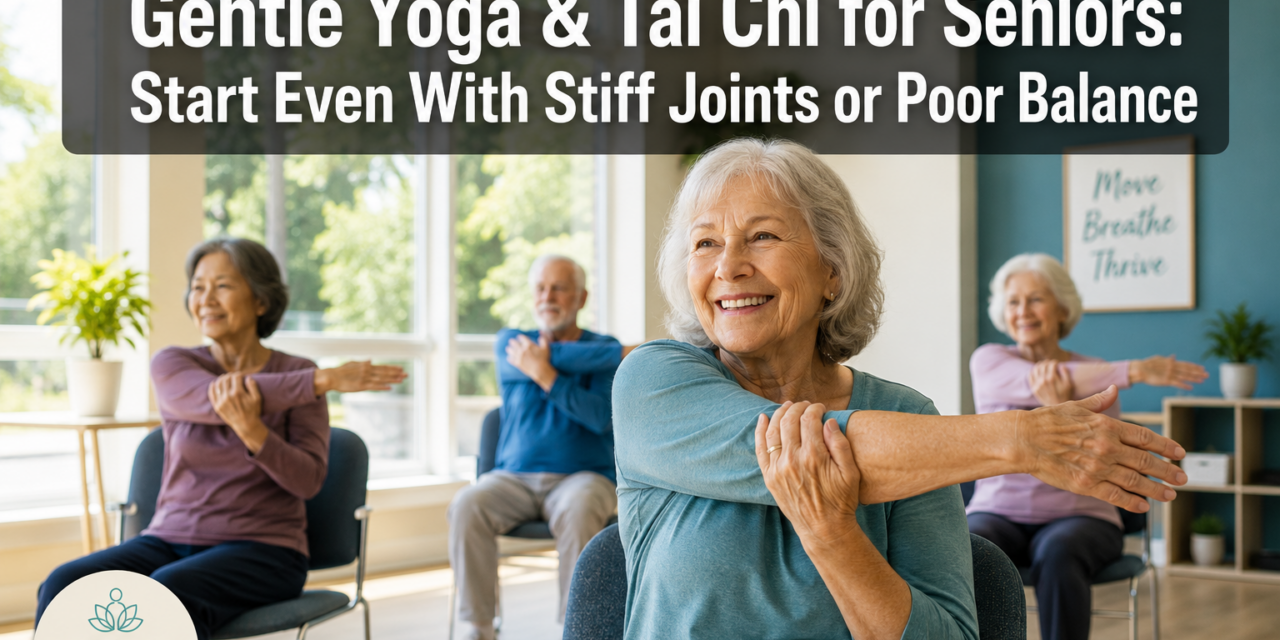
🧘♀️ Gentle Yoga and Tai Chi for Seniors: How to Start When You Have Stiff Joints or Poor Balance
Last updated: June 13, 2026
Quick Answer: Gentle yoga and tai chi are among the safest movement practices for older adults with stiff joints or poor balance. Both can be modified for chairs, walls, or limited range of motion, making them accessible even for beginners in their 70s and 80s with no prior fitness experience. Starting with just two to three short sessions per week, guided by a senior-friendly instructor or a reputable online class, is enough to see meaningful improvements in stability and joint comfort within four to six weeks.
Key Takeaways
- Gentle yoga and tai chi for seniors with stiff joints or poor balance can begin with chair-based or wall-supported versions — no floor work required.
- A 2019 review cited by the National Center for Complementary and Integrative Health found tai chi may reduce fall rates by 19% and the number of people who fall by 20% [2].
- Chair yoga for older adults with multiple health conditions has been shown to be both safe and well-received in a 2025 study [4].
- A 14-week tai chi program improved knee osteoarthritis symptoms and gait in elderly participants, according to a 2025 pilot trial [5].
- Beginners need very little equipment: a sturdy chair, non-slip mat, and comfortable clothing cover most needs.
- Two to three sessions per week, starting at 15 to 20 minutes, is a practical and evidence-informed starting point.
- Online classes designed for seniors with limited mobility are widely available and often low-cost or free.
- Certain conditions — recent surgery, uncontrolled blood pressure, severe osteoporosis — require a doctor’s clearance before starting.
- Common beginner mistakes include pushing through pain, skipping warm-ups, and choosing classes not designed for older adults.
What Is Gentle Yoga and How Is It Different from Regular Yoga
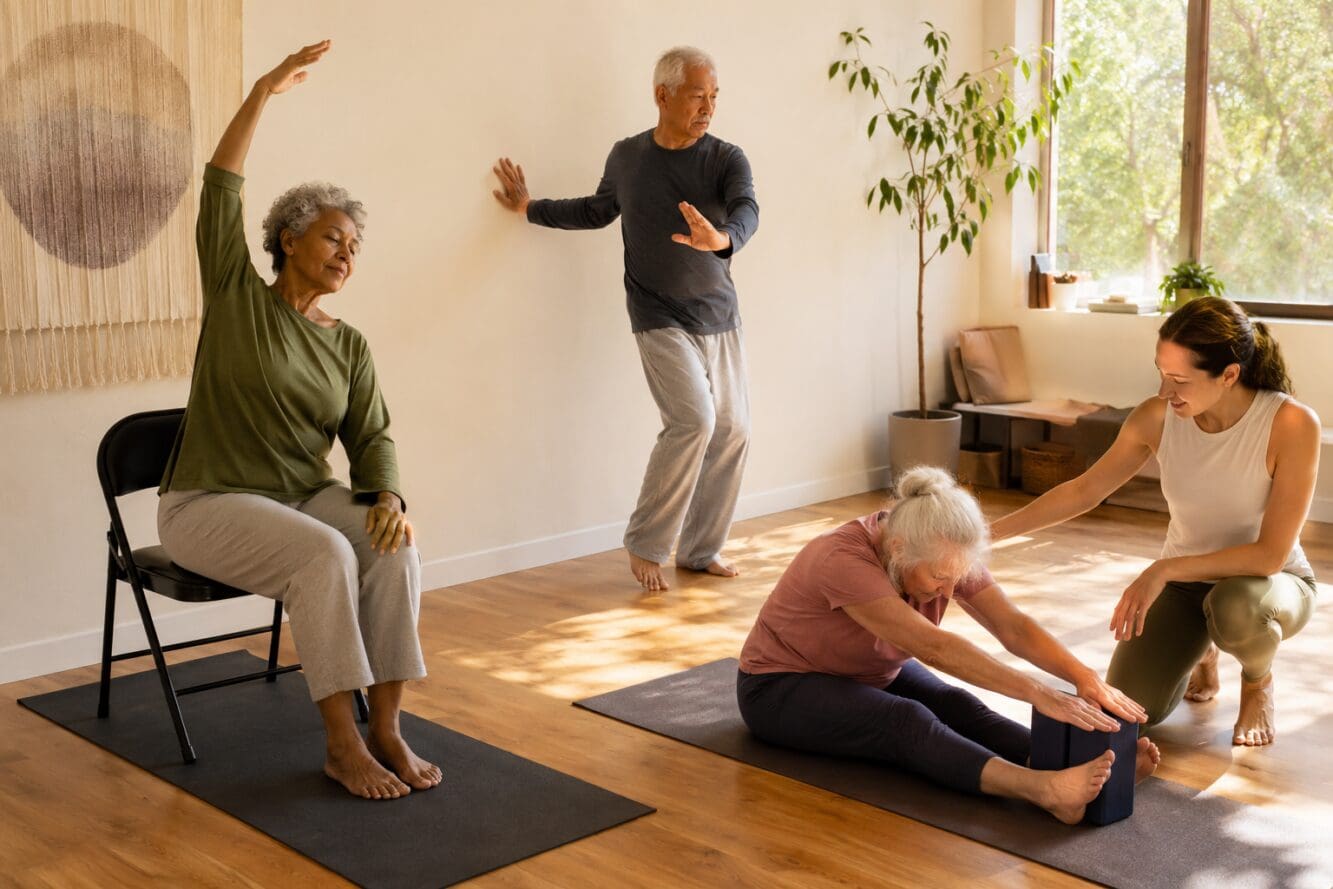
Gentle yoga is a slower, lower-intensity version of traditional yoga that prioritizes safe range of motion over flexibility or strength performance. Unlike vigorous styles such as vinyasa or hot yoga, gentle yoga holds poses for longer, avoids deep backbends or inversions, and routinely offers chair-based or wall-supported alternatives.
For seniors, the key differences are:
- Pace: Movements are slow and deliberate, with time to settle into each position.
- Props: Chairs, foam blocks, straps, and blankets replace the floor as the primary support.
- Goals: Comfort, breathing, and body awareness take priority over achieving a “perfect” pose.
Somatic chair yoga — a related approach — adds a body-awareness focus that many older adults find particularly calming and accessible.
Are Tai Chi and Yoga Safe for People with Arthritis
Yes, both practices are generally safe for people with arthritis, and both are frequently recommended as non-pharmacological options for joint pain management. A 2025 pilot randomized controlled trial found that a 14-week tai chi program produced measurable improvements in clinical symptoms and walking mechanics in elderly patients with knee osteoarthritis [5]. A 2023 systematic review and meta-analysis also confirmed that tai chi and qigong positively affect both physical and cognitive function in older adults [6].
Choose tai chi if: joint inflammation is the primary concern and standing balance is still manageable.
Choose chair yoga if: weight-bearing is painful or balance is too unstable for standing movements.
Always inform the instructor of any diagnosed joint conditions before the first class.
Which Is Better for Joint Pain: Tai Chi or Gentle Yoga
Neither is universally superior — the better choice depends on the individual’s specific limitations and preferences. Tai chi uses continuous, flowing weight shifts that build stabilizing muscle around the knees and hips, making it particularly effective for lower-body joint pain [7]. Gentle yoga, especially chair-based versions, offers more targeted stretching for the spine, shoulders, and hips, which can relieve stiffness from conditions like ankylosing spondylitis or general arthritis.
A practical decision rule:
- Tai chi suits adults whose main issue is balance and lower-body joint weakness.
- Gentle yoga suits adults who need spinal mobility, upper-body flexibility, or a stronger mind-body relaxation component.
- Both together (alternating days) can address a broader range of needs as fitness improves.
What Modifications Can I Do If I Can’t Stand or Bend Easily
Chair-based and wall-supported modifications make gentle yoga and tai chi accessible to almost any mobility level. Seated tai chi, for example, allows practitioners to focus on posture, breathing, and arm coordination from a stable chair, then progress to standing as confidence grows [1]. A 2025 study on chair-based yoga for older adults with multiple health conditions confirmed these programs are feasible and well-received [4].
Practical modifications to try:
- Seated forward fold: Hinge at the hips from a chair instead of bending from the floor.
- Wall-supported tai chi weight shift: Stand arm’s length from a wall, touch it lightly for balance during slow side-to-side weight transfers.
- Chair warrior pose: Extend one leg to the side while seated, arms open wide.
- Seated cat-cow: Arch and round the spine gently from a chair, hands on knees.
The social inclusion aspect of group classes matters too — many seniors report that the community element keeps them consistent.
Can Tai Chi Help Improve My Balance and Prevent Falls
Yes, and the evidence is specific. The National Center for Complementary and Integrative Health highlights that regular tai chi practice can improve balance and reduce fall risk in older adults. A 2019 review found tai chi may reduce the rate of falls by 19% and the number of people experiencing falls by 20% [2]. A January 2025 systematic review further confirmed that multiple tai chi styles positively affect motor function in older adults, supporting its use as a fall-prevention strategy [7].
Tai chi works by training the body to make small, continuous balance corrections — the same micro-adjustments needed to stay upright on uneven ground or when changing direction quickly [8]. Even short sessions at a higher stance (legs less bent) are sufficient to begin building this skill [10].
How Often Should Seniors Practice Gentle Movement Classes
Two to three sessions per week is the most practical and evidence-supported starting point for seniors new to gentle yoga or tai chi. Sessions of 15 to 20 minutes are enough in the first two weeks; most people can comfortably extend to 30 to 45 minutes by the end of the first month [9].
A sample first-month schedule:
WeekSessions per WeekDuration per Session1215 minutes2220 minutes3325 minutes4330 minutes
Rest days between sessions allow joints and muscles to adapt without overloading them.
What Equipment Do I Need to Start Yoga or Tai Chi at Home
Very little equipment is needed, and most of it is inexpensive or already in the home.
For gentle yoga:
- A non-slip yoga mat (or a carpeted floor)
- A sturdy chair without wheels
- One or two foam yoga blocks (optional but helpful)
- A yoga strap or a household belt for stretching
For tai chi:
- A clear floor space of roughly 6 by 6 feet
- Flat, non-slip footwear or bare feet
- A chair nearby for balance support when starting
A digital device for streaming online classes rounds out the setup. Total startup cost for home practice typically runs between $20 and $60 (Canadian), primarily for a mat and blocks.
Are There Online Classes for Seniors with Limited Mobility
Yes, and the options have expanded considerably. Many community organizations, hospital wellness programs, and dedicated senior fitness platforms offer free or low-cost streaming classes. A systematic review published in April 2026 evaluated digitalized tai chi interventions and found that while online delivery is feasible, the evidence does not yet confirm it is superior to in-person instruction for all outcomes [3]. That said, online classes remain a practical and accessible entry point, particularly for adults in rural or remote areas.
What to look for in an online class:
- Explicitly labeled “senior,” “gentle,” or “chair-based”
- An instructor with credentials in senior fitness, yoga therapy, or tai chi for health
- A free trial or preview before committing to a subscription
- Clear verbal cueing, not just visual demonstration
Local community programs in southern Georgian Bay and similar regional hubs often list free or subsidized senior wellness classes worth exploring.
How Much Do Beginner Senior Yoga Classes Cost
In-person beginner senior yoga or tai chi classes typically cost between $10 and $20 per drop-in session in Canada, or $60 to $120 per month for unlimited access at a community center or recreation facility. Many municipal recreation departments offer senior discounts that bring costs down significantly.
Online subscriptions for senior-specific platforms generally run $10 to $20 per month. Free options include YouTube channels dedicated to chair yoga and tai chi for older adults, which can serve as a no-cost starting point before investing in a structured program.
What Health Conditions Might Prevent Me from Doing Gentle Yoga
Most older adults can participate safely, but certain conditions require medical clearance or specific modifications before starting.
Consult a doctor first if you have:
- Recent joint replacement surgery (within the past 3 to 6 months)
- Uncontrolled high blood pressure or a recent cardiac event
- Severe osteoporosis with high fracture risk
- Active vertigo or inner ear disorders affecting balance
- Unhealed wounds or active infections in weight-bearing areas
Common mistake: Assuming that any pain during a class is normal. Sharp or worsening joint pain during a movement is a signal to stop and modify, not push through. Mild muscle fatigue is expected; joint pain is not.
How Do I Find a Senior-Friendly Yoga or Tai Chi Instructor
Look for instructors with specific credentials in senior fitness or adaptive movement. Relevant qualifications include Registered Yoga Teacher (RYT) with a senior or therapeutic specialization, or a tai chi instructor certified through a recognized body such as the Tai Chi for Health Institute.
Practical steps:
- Ask at local recreation centers, libraries, or senior centers for referrals.
- Check whether the instructor has experience working with adults who have arthritis, osteoporosis, or balance disorders.
- Attend one trial class and observe whether the instructor offers modifications proactively.
- Avoid classes where the instructor does not circulate among students or check in on individual needs.
Community social programs and local business directories can also be useful starting points for finding vetted instructors nearby.
What Are Common Mistakes Beginners Make in Senior Fitness Classes
The most frequent mistakes are avoidable with a little preparation.
- Skipping the warm-up: Cold joints are more prone to strain. Even five minutes of gentle seated movement before class matters.
- Choosing the wrong class level: A general adult yoga class is not the same as a senior-specific or gentle class. Always verify the class description.
- Holding the breath: Both yoga and tai chi rely on coordinated breathing. Holding the breath increases blood pressure and reduces the calming benefit.
- Comparing progress to others: Flexibility and balance vary widely between individuals. Progress is personal.
- Stopping after one bad session: The first two to three sessions often feel awkward. Consistency over four to six weeks is where benefits become noticeable [10].
Conclusion
Gentle yoga and tai chi for seniors with stiff joints or poor balance are not aspirational activities reserved for the already-fit. They are specifically designed for exactly the challenges most older adults face: reduced flexibility, joint discomfort, and fear of falling. The evidence is clear that both practices, particularly when chair-based or wall-supported modifications are used, can meaningfully improve balance, reduce fall risk, and ease joint pain within weeks of consistent practice.
Actionable next steps for 2026:
- Get a brief check-in from a family doctor if any of the flagged health conditions apply.
- Start with two 15-minute chair-based sessions this week, using a free YouTube class labeled “senior gentle yoga” or “seated tai chi.”
- Gather minimal equipment: a non-slip mat and a sturdy chair.
- By week three, look for a local or online class with a credentialed senior-fitness instructor to add structure and accountability.
- Track how balance and joint stiffness feel at the end of each week — most beginners notice a difference within the first month.
The first session does not need to be perfect. It just needs to happen.
FAQ
Q: Can I do gentle yoga if I have never exercised before?
Yes. Gentle yoga and chair-based tai chi require no prior fitness experience. Beginners in their 70s and 80s with no exercise history are a core audience for these practices [10].
Q: How long before I notice improvements in balance?
Most seniors report noticeable improvements in balance and confidence within four to six weeks of practicing two to three times per week [8].
Q: Is tai chi or yoga better for fall prevention?
Tai chi has the stronger direct evidence for fall prevention, with a 2019 review finding a 19% reduction in fall rates [2]. Gentle yoga also improves balance but through a different mechanism, primarily core stability and body awareness.
Q: Do I need to sit on the floor for yoga?
No. Chair yoga eliminates all floor-based poses. A sturdy chair is the only prop required for a complete beginner session [4].
Q: Are online tai chi classes as effective as in-person classes?
Current evidence suggests online delivery is feasible and accessible, but may not yet match in-person instruction for all physical outcomes [3]. In-person classes are preferable when available.
Q: What should I wear to a gentle yoga or tai chi class?
Comfortable, loose-fitting clothing that allows free movement of the arms and legs. Flat, non-slip footwear or bare feet work best for tai chi; socks with grip or bare feet for yoga.
Q: Can tai chi help with knee pain specifically?
Yes. A 2025 pilot trial found a 14-week tai chi program improved symptoms and walking mechanics in elderly patients with knee osteoarthritis [5].
Q: Is it safe to practice at home without an instructor?
For absolute beginners, one or two in-person or live online sessions with an instructor first is strongly recommended to establish correct posture and breathing habits before solo practice.
References
[1] Seated Tai Chi For Seniors – https://www.weiharrington.com/guides/seated-tai-chi-for-seniors/
[2] Tai Chi – https://www.healthline.com/health/senior-health/ta-chi
[3] PubMed: Digitalized Tai Chi Interventions – https://pubmed.ncbi.nlm.nih.gov/41929899/
[4] Chair-Based Yoga for Seniors with Multimorbidity – https://link.springer.com/article/10.1186/s12906-025-04838-6
[5] Tai Chi for Knee Osteoarthritis – https://www.nature.com/articles/s41598-025-03943-3
[6] Tai Chi and Qigong: Cognitive and Physical Functions – https://link.springer.com/article/10.1186/s12877-023-04070-2
[7] Tai Chi Styles and Motor Function in Older Adults – https://link.springer.com/article/10.1007/s40520-024-02894-5
[8] Tai Chi For Seniors (Beginners) – https://tai-chi-for-beginners.com/tai-chi-for-seniors
[9] Tai Chi 101 – https://www-dev.zenfit.health/learn/tai-chi/tai-chi-101
[10] Tai Chi For Seniors – https://globalmartialartsusa.com/tai-chi-for-seniors/
Content, illustrations, and third-party video appearing on GEORGIANBAYNEWS.COM may be generated or curated with AI assistance or reproduced pursuant to the fair dealing provisions of the Copyright Act, R.S.C. 1985, c. C-42. Attribution and hyperlinks to original sources are provided in acknowledgment of applicable intellectual property rights. Such referencing is intended to direct traffic to and support the original rights holders’ platforms.