


















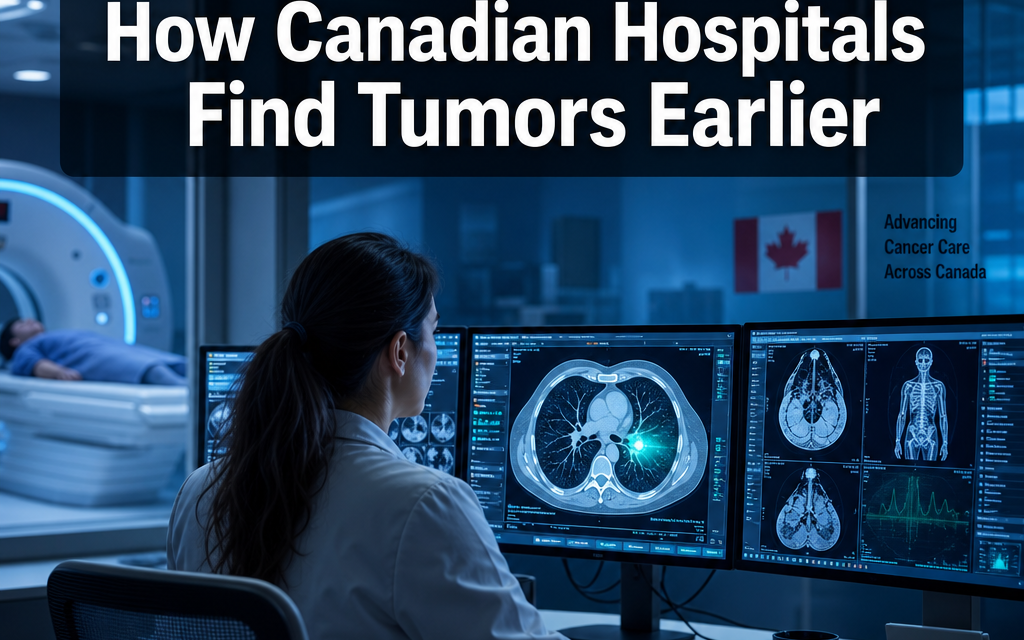
🩻 AI in Cancer Detection: How Canadian Hospitals Use Diagnostic Tools to Find Tumors Earlier
Last updated: June 5, 2026
Quick Answer
Canadian hospitals are actively deploying AI-powered diagnostic tools to catch cancer at earlier, more treatable stages. From AI-assisted mammography at North York General Hospital to AI-enhanced colonoscopies at Fraser Health and University Health Network, these systems work alongside radiologists and pathologists, not instead of them, to flag suspicious findings faster and with greater consistency. Coverage under provincial health plans varies, and access is still expanding across the country.
Key Takeaways
- North York General Hospital became the first Canadian hospital to integrate Hologic’s Genius AI Detection technology into breast screening, acting as a second reviewer for radiologists [1]
- Fraser Health invested $1.2 million in 2023 to deploy the GI Genius AI system across 12 sites for colonoscopy-based colorectal cancer detection [3]
- Medcan launched the Galleri multi-cancer blood test in Canada in October 2025, capable of screening for over 50 cancer types before symptoms appear [2]
- AI tools do not replace doctors; they flag areas of concern so clinicians can focus their attention more precisely
- Breast, colorectal, lung, cervical, and prostate cancers are currently the most supported by AI diagnostic tools in Canadian settings
- Most AI cancer screening tools are not yet universally covered by provincial health insurance; costs vary by provider and test type
- AI systems are trained on large libraries of labeled medical images and pathology samples, which directly affects their accuracy across different patient populations
- Patient acceptance of AI in diagnosis is generally positive when doctors clearly explain the AI’s supporting role

What Exactly Is AI Doing to Help Detect Cancer Faster
AI in cancer detection means software analyzes medical images, blood samples, or tissue slides to identify patterns that may indicate cancer, often before a tumor is visible to the naked eye or causes symptoms. These tools process data at a speed and consistency that complements what a human specialist can do in a busy clinical day.
In practical terms, AI tools in Canadian hospitals are doing three main jobs:
- Flagging suspicious regions in mammograms, CT scans, or colonoscopy footage for radiologists to review
- Prioritizing worklists so the most urgent cases reach specialists first
- Cross-referencing biomarkers in blood or breath samples to identify cancer signatures
For example, Hologic’s Genius AI Detection system highlights areas of concern in 3D mammography images so radiologists can review them during their normal reading workflow [7]. This is not a replacement for clinical judgment; it is a structured second opinion built into the process.
Can AI Really Catch Tumors Earlier Than Traditional Methods
Yes, in several cancer types, AI-assisted screening has demonstrated the ability to catch abnormalities at earlier stages than standard review alone. The key advantage is consistency: AI does not experience fatigue, and it applies the same detection criteria to every image it reviews.
At North York General Hospital, integrating Genius AI Detection into breast screening was specifically aimed at improving early detection rates by giving radiologists an AI-generated second read on every tomosynthesis image [1]. In colonoscopy settings, the GI Genius system has been shown in clinical studies to improve adenoma detection rates, meaning precancerous polyps are found and removed before they develop into cancer [3].
The Galleri blood test, now available through Medcan in Canada, takes a different approach entirely. It screens for cancer signal DNA shed by tumors into the bloodstream, potentially detecting over 50 cancer types before any symptoms appear [2]. This is especially significant for cancers that currently have no standard screening program.
How Accurate Are These AI Cancer Screening Tools Compared to Human Doctors
AI tools in cancer detection are generally not more accurate than experienced specialists in isolation, but the combination of AI plus a human clinician consistently outperforms either working alone. This is the model Canadian hospitals are building toward.
Key accuracy considerations:
- AI systems are validated against large datasets, but performance can vary across different patient demographics and imaging equipment
- Hologic’s Genius AI is designed specifically for tomosynthesis breast imaging and has been validated in peer-reviewed studies before hospital deployment [7]
- The Paige Prostate Suite, an AI application for reviewing prostate biopsy samples, is designed to highlight areas of suspicion for pathologists, reducing the chance of missed findings [10]
- AI tools can produce false positives, which may lead to additional testing and patient anxiety; this is a known limitation that clinical teams manage through established follow-up protocols
The Canadian Cancer Society has funded research into AI-powered breath and blood tests for lung cancer biomarkers, with the goal of improving early detection accuracy for a disease that is often caught too late [5].
Which Canadian Hospitals Are Leading in AI Cancer Detection Right Now
Several Canadian institutions are at the front of this shift. Here is a snapshot of where AI in cancer detection is being applied in real hospital workflows as of 2026:
Hospital / OrganizationAI ToolCancer TypeYear DeployedNorth York General Hospital (ON)Hologic Genius AI DetectionBreast2025 [1]Fraser Health (BC)GI GeniusColorectal2023 [3]Toronto Western Hospital / UHN (ON)AI colonoscopy systemsColorectal2024 [4]Medcan (ON)Galleri multi-cancer test50+ types2025 [2]Multiple sites (Canada/US)Imagia EVIDENS platformVarious2020 [6]
The South Georgian Bay community health landscape, like many smaller regional areas, is still in earlier stages of accessing these tools, which remain more concentrated in larger urban hospital networks for now.
What Types of Cancer Is AI Best at Detecting
AI diagnostic tools currently show the strongest performance in cancers where medical imaging or tissue analysis plays a central role in screening.
- Breast cancer: AI-assisted mammography and tomosynthesis reading is the most established application in Canada [1][7]
- Colorectal cancer: AI colonoscopy tools like GI Genius detect precancerous polyps that might be missed during standard procedures [3][4]
- Lung cancer: AI is being used to analyze CT scans and, experimentally, breath and blood biomarkers [5]
- Cervical cancer: Hologic’s Genius Digital Diagnostics System uses deep learning to identify pre-cancerous cervical cells in screening samples [9]
- Prostate cancer: The Paige Prostate Suite assists pathologists in reviewing biopsy slides for areas of concern [10]
Cancers with less standardized imaging protocols, or those that present in ways that are highly variable between patients, remain more challenging for current AI tools.
How Does AI Analyze Medical Imaging to Find Potential Tumors
AI systems used in cancer detection are trained on large libraries of labeled medical images, meaning thousands or millions of scans where radiologists or pathologists have already identified what is normal, precancerous, or malignant. The AI learns to recognize visual patterns associated with each category.
In a working hospital setting, the process looks like this:
- A patient’s scan or biopsy slide is processed through the AI system
- The AI flags regions that match patterns from its training data
- These flagged areas are highlighted for the reviewing clinician
- The clinician makes the final diagnostic decision, using the AI output as one input among several
PrediX, developed by FINOSOFT Technologies, is a Canadian-built investigational AI software designed for tumor detection across radiology and pathology, aiming to make this kind of analysis faster and more consistent across different clinical settings [8].
The quality of training data matters enormously. AI systems trained primarily on data from one demographic group may perform less accurately on patients from underrepresented populations, which is an active area of research and concern in the field.
How Much Does AI Cancer Screening Cost in Canadian Hospitals
Costs vary significantly depending on the tool, the cancer type, and whether the test is part of a provincially funded screening program. Most AI-assisted imaging (such as AI-enhanced mammography at North York General) is embedded in the existing hospital workflow and does not carry a separate patient fee when the underlying screening is covered by provincial insurance [1].
The Galleri multi-cancer early detection blood test, available through Medcan, is a private-pay service. As of its Canadian launch in October 2025, it was not covered by provincial health plans [2]. Patients seeking this test pay out of pocket, which limits access for many Canadians.
Fraser Health’s $1.2 million investment in GI Genius systems across 12 sites was funded institutionally, meaning patients undergoing covered colonoscopies at those sites benefit from AI enhancement without additional cost [3].
Are AI Cancer Detection Tools Covered by Canadian Healthcare
Provincial coverage for AI-assisted cancer screening is inconsistent and still evolving. The short answer: if the AI tool is embedded in a procedure already covered by your provincial health plan, you likely pay nothing extra. If the AI tool is a standalone test like Galleri, it is currently private pay.
Key points for Canadian patients:
- AI-enhanced mammography and colonoscopy at publicly funded hospitals are generally covered under provincial plans
- The Galleri multi-cancer blood test is private pay as of 2026 [2]
- Coverage decisions are made at the provincial level and vary by province
- Patients in rural or smaller communities may have limited access to AI-enhanced screening regardless of coverage status
Staying informed about health and longevity developments in Canada can help patients ask the right questions when booking screening appointments.
Are There Any Risks or Limitations of Using AI for Cancer Screening
AI tools in cancer detection carry real limitations that patients and clinicians should understand. No AI system is infallible, and the technology is still maturing in clinical environments.
Common limitations include:
- False positives: AI may flag benign findings as suspicious, leading to unnecessary follow-up tests or patient stress
- False negatives: AI can miss cancers, particularly in cases that fall outside its training data patterns
- Data bias: Systems trained on non-diverse datasets may underperform for certain patient groups
- Integration challenges: Implementing AI tools into existing hospital IT infrastructure is complex and resource-intensive
- Regulatory lag: Health Canada approval processes for AI medical devices are still catching up to the pace of development
AI tools like Imagia’s EVIDENS platform were adopted by hospitals specifically to apply machine learning to clinical questions, but even these require ongoing validation as patient populations and imaging technologies change [6]. The business of health technology in Canada involves significant investment and careful oversight to manage these risks responsibly.
Will AI Cancer Screening Replace Radiologists in the Future
No, at least not in any foreseeable timeline. The current model in Canadian hospitals positions AI as a support tool, not a replacement. Radiologists, pathologists, and oncologists remain responsible for all diagnostic decisions.
AI handles volume and consistency well. It can review every image with the same attention at 2 a.m. as it does at 9 a.m. What it cannot do is integrate the full clinical picture, communicate with a patient, or exercise the kind of judgment that comes from years of medical training and direct patient interaction.
The more realistic future is a hybrid model: AI handles initial screening and triage, human specialists focus their expertise on complex or flagged cases, and overall system throughput improves. This matters in Canada, where specialist wait times are a persistent challenge in the healthcare system.
Who Should Get AI-Assisted Cancer Screenings
AI-assisted cancer screening is most relevant for people who already qualify for standard cancer screening based on age, family history, or risk factors. The AI enhancement is often invisible to the patient; it simply means the screening they are already getting is analyzed with an additional layer of review.
- Adults 50 and over should discuss colorectal cancer screening with their doctor, which may now include AI-enhanced colonoscopy at some sites [3][4]
- Women eligible for mammography screening should ask whether their screening facility uses AI-assisted reading [1]
- People with a strong family history of multiple cancers may want to ask their doctor about multi-cancer early detection blood tests like Galleri, understanding it is currently private pay [2]
- High-risk lung cancer patients (long-term smokers, occupational exposures) should discuss AI-supported CT screening options
Connecting with a local community health resource is a practical first step for anyone unsure where to start.
How Do Patients Feel About AI Being Involved in Their Medical Diagnosis
Patient acceptance of AI in cancer diagnosis is generally positive, particularly when healthcare providers explain the AI’s role clearly. Most patients are reassured, not alarmed, when told that AI is providing an additional review of their scan, not making the final call.
Concerns that do arise tend to focus on:
- Privacy and how medical imaging data is stored and used to train AI systems
- Whether AI might introduce errors that a human would catch
- Uncertainty about accountability if an AI-assisted diagnosis turns out to be wrong
Transparent communication from clinical teams makes a significant difference. Patients who understand that AI is a tool their doctor uses, rather than a system making autonomous decisions, tend to report higher comfort levels with the process. This mirrors broader public attitudes toward technology and society in Canada, where trust in new tools is often tied to transparency and accountability.
What Kind of Training Data Do These AI Systems Use
AI cancer detection systems are trained on large, curated datasets of medical images, pathology slides, and clinical records that have been labeled by expert clinicians. The quality, diversity, and size of this training data directly determines how well the AI performs in real-world settings.
For breast cancer AI tools like Hologic’s Genius AI Detection, training datasets include thousands of mammography and tomosynthesis images with confirmed diagnoses [7]. For colonoscopy AI like GI Genius, training data includes annotated endoscopy video footage showing polyps of various sizes and types [3].
The Canadian Cancer Society’s funded research into lung cancer AI is working to develop training datasets that include breath and blood biomarker data, which is a newer frontier compared to imaging-based AI [5]. Ensuring that training data includes diverse patient populations, including Indigenous Canadians, rural patients, and those from various ethnic backgrounds, is an ongoing challenge that researchers and regulators are actively addressing.
Conclusion
AI in cancer detection is not a future promise in Canada; it is already operating in hospital workflows from British Columbia to Ontario. The practical impact for patients is meaningful: more consistent screening, earlier identification of suspicious findings, and new tools for cancers that previously had no early detection option.
Actionable steps for Canadians in 2026:
- Ask your doctor whether your local hospital or screening clinic uses AI-assisted tools for mammography or colonoscopy
- If you have a strong family history of multiple cancers, ask about the Galleri multi-cancer blood test and understand it is currently private pay
- Do not skip standard screening appointments; AI enhancement is only available if you show up for the underlying procedure
- Stay informed about provincial coverage updates, as health plan decisions on AI screening tools are evolving
- If you have concerns about how your medical data is used in AI training, ask your healthcare provider about your facility’s data governance policies
The goal of AI in cancer detection is straightforward: find cancer earlier, when treatment is more effective and outcomes are better. Canadian hospitals are building that capacity now, and patients who engage proactively with their screening options stand to benefit most.
FAQ
Does AI replace the radiologist reading my mammogram?
No. AI tools like Hologic’s Genius AI Detection flag areas of concern, but a radiologist reviews every image and makes the final diagnostic call [1].
Is the Galleri multi-cancer blood test available across Canada?
As of 2026, Galleri is available through Medcan in Canada but is a private-pay test not covered by provincial health insurance [2].
How does GI Genius work during a colonoscopy?
GI Genius analyzes live colonoscopy video in real time and alerts the endoscopist when it detects a potential polyp, reducing the chance of a missed lesion [3].
Can AI detect cancer in its earliest stage?
AI tools improve the detection of early-stage findings, particularly in breast and colorectal cancer, but no tool guarantees detection of every early-stage cancer.
Are AI cancer detection tools approved by Health Canada?
Tools deployed in Canadian hospitals have gone through regulatory review, but the approval landscape for AI medical devices is still developing. Patients can ask their provider about the regulatory status of any specific tool.
Who pays for AI-enhanced colonoscopy at Fraser Health sites?
The AI enhancement is built into the procedure. Patients with covered colonoscopies at Fraser Health’s 12 equipped sites do not pay extra for the GI Genius system [3].
Is AI cancer screening available in rural Canada?
Access is currently concentrated in larger urban hospitals. Rural and remote communities generally have less access to AI-enhanced screening tools, though this is expected to improve as adoption broadens.
What happens if the AI flags something that turns out to be benign?
The clinician reviews the flagged area and determines whether follow-up testing is needed. False positives can lead to additional tests, but the clinical team manages this through established protocols.
Can I request AI-assisted screening specifically?
You can ask your doctor or screening clinic whether they use AI tools, but you cannot typically request a specific AI system. Availability depends on your hospital or clinic.
Is lung cancer AI detection available in Canada right now?
AI-powered lung cancer biomarker research is underway, funded by the Canadian Cancer Society, but it is not yet a standard clinical offering [5].
References
[1] AI-Assisted Breast Screening Helps Radiologists Detect Cancer Earlier – https://www.canhealth.com/2025/11/03/ai-assisted-breast-screening-helps-radiologists-detect-cancer-earlier/?utm_source=openai
[2] Medcan Launches the Galleri Multi-Cancer Early Detection Test by GRAIL in Canada – https://www.newswire.ca/news-releases/medcan-launches-the-galleri-r-multi-cancer-early-detection-test-by-grail-in-canada-827267821.html?utm_source=openai
[3] AI Provides Second Set of Eyes in Colonoscopies – https://www.canhealth.com/2023/12/20/ai-provides-second-set-of-eyes-in-colonoscopies/?utm_source=openai
[4] UHN Using Artificial Intelligence to Help Prevent Colon Cancer – https://www.uhn.ca/corporate/News/Pages/UHN_using_artificial_intelligence_to_help_prevent_colon_cancer.aspx?utm_source=openai
[5] Using AI to Detect Lung Cancer Earlier – https://cancer.ca/en/about-us/news/2024/february/using-ai-to-detect-lung-cancer-earlier?utm_source=openai
[6] Hospitals Use Imagia’s AI Platform to Find Answers to Clinical Questions – https://www.canhealth.com/2020/02/27/hospitals-use-imagias-ai-platform-to-find-answers-to-clinical-questions/?utm_source=openai
[7] Genius AI Detection Technology – https://www.hologic.ca/en-ca/products/genius-ai-detection-technology?utm_source=openai
[8] PrediX AI – https://predix-ai.ca/?utm_source=openai
[9] Genius Digital Diagnostics System – https://www.hologic.ca/en-ca/products/genius-digital-diagnostics-system?utm_source=openai
[10] Paige Prostate Suite – https://www.ncbi.nlm.nih.gov/books/NBK608438/?utm_source=openai