






















Last updated: June 22, 2026
Quick Answer: Sleep quality in seniors declines with age due to biological shifts in circadian rhythms, reduced deep sleep, and increased medical conditions — not simply because older adults need less rest. The good news is that several evidence-backed strategies, from consistent sleep schedules and light exposure therapy to Cognitive Behavioral Therapy for Insomnia (CBT-I), can meaningfully improve sleep without relying on medication.
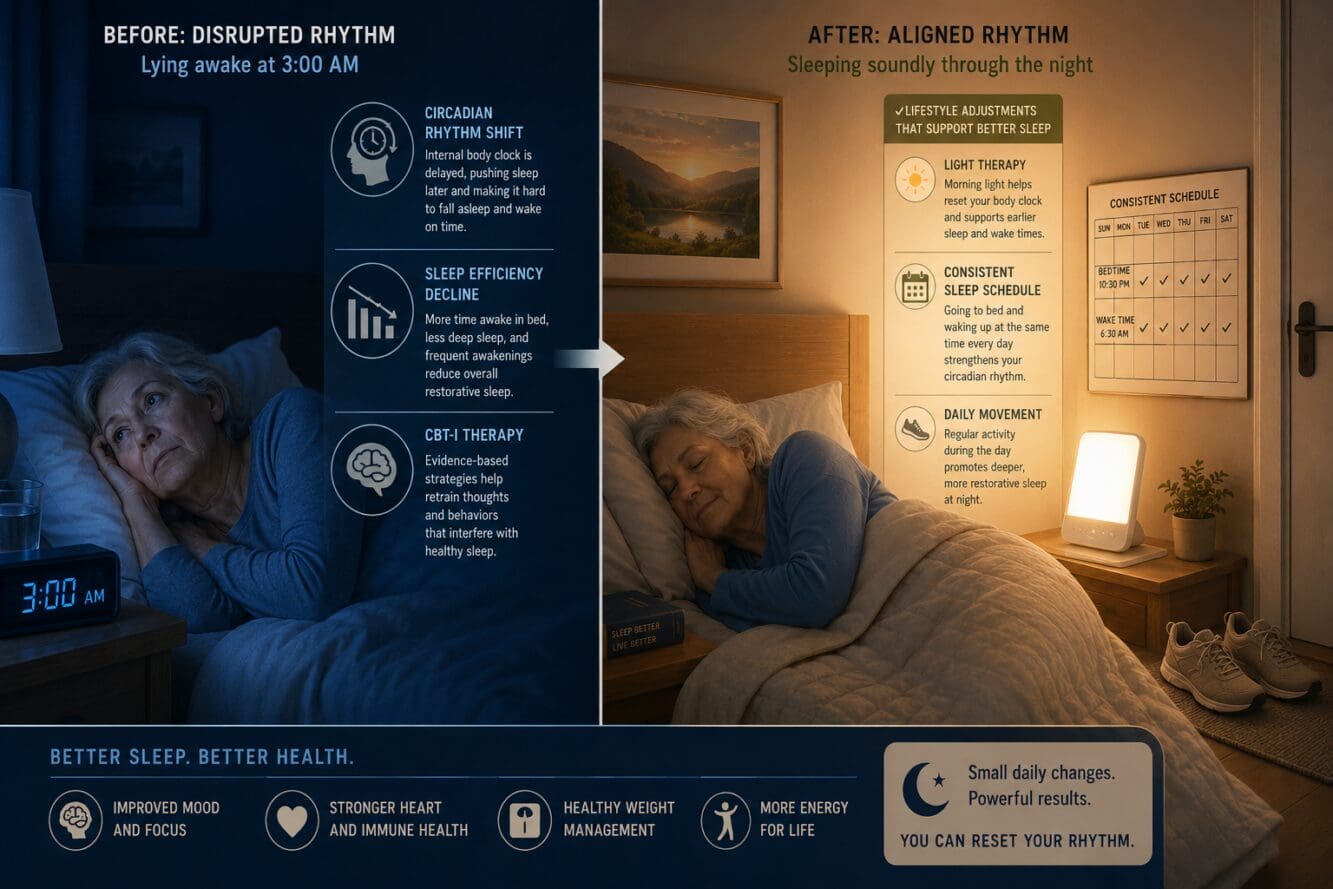
Sleep quality in seniors changes because of real biological shifts, not laziness or attitude. After 60, the brain produces less melatonin, the hormone that signals sleep onset. The body clock shifts earlier, so older adults feel sleepy by 8 or 9 p.m. and wake before dawn — a pattern called advanced sleep phase [3].
Deep sleep (slow-wave sleep) also decreases significantly with age. This is the most restorative stage, and losing it means waking up feeling less refreshed even after seven or eight hours in bed. Sleep efficiency — the percentage of time in bed actually spent sleeping — drops from around 85% in middle age to 76% in adults over 80 [5].
These changes are not signs of illness on their own, but they do make older adults more vulnerable to full insomnia when other stressors appear.
Many sleep problems in older adults trace back to a medical condition or a prescription drug, not just aging itself. Arthritis pain, heart disease, acid reflux, and frequent urination from an enlarged prostate or bladder issues all interrupt sleep directly [9].
Medications are an equally common culprit. Drugs prescribed for high blood pressure, asthma, depression, and corticosteroids can all interfere with sleep architecture. If sleep problems started or worsened after a new prescription, that connection is worth raising with a doctor.
Common medication-related sleep disruptors:
Seniors managing multiple conditions should ask their pharmacist or physician for a medication review specifically focused on sleep side effects.
CBT-I (Cognitive Behavioral Therapy for Insomnia) is the most recommended non-drug treatment for chronic insomnia in older adults. It works by identifying and changing the thought patterns and habits that keep the brain in a state of sleep-related anxiety [4].
Unlike sleeping pills, CBT-I produces lasting results without the risks of dependency, falls, or cognitive fog — all of which are heightened concerns for seniors. A trained therapist or a structured digital CBT-I program typically runs four to eight weeks.
Core CBT-I techniques:
For seniors in communities with limited specialist access, digital CBT-I programs have shown comparable results to in-person therapy.
Generic sleep hygiene advice often falls flat because it ignores the specific biology of aging. These strategies are targeted to what actually changes after 60 [1] [7]:
| Strategy | Why It Matters for Seniors | How to Apply It |
|---|---|---|
| Consistent wake time | Anchors the circadian rhythm | Same time every day, including weekends |
| Evening light exposure | Delays early melatonin release | 30 min of bright light at 7-8 p.m. [4] |
| Short naps only | Long naps reduce sleep pressure | Cap naps at 20-30 minutes before 3 p.m. [8] |
| Regular exercise | Improves sleep depth and duration | 30 min of moderate activity most days [7] |
| Cool, dark bedroom | Supports core body temperature drop | 65-68°F / 18-20°C is the target range |
| Caffeine cutoff | Caffeine half-life increases with age | No caffeine after noon |
The Stanford Sleep Medicine Centre has contributed significantly to understanding how circadian rhythm shifts affect older populations, and their research supports consistent light exposure as one of the most effective non-drug tools available.
What happens during the day directly shapes how well a senior sleeps at night. Low physical activity, excessive time in bed, and irregular meal times all weaken the body’s sleep-wake drive [7].
Substance use is another factor worth addressing honestly. Alcohol, while it may help with initial drowsiness, fragments sleep in the second half of the night and reduces REM sleep. The relationship between substance use and sleep disruption is well-documented and particularly relevant for older adults who may use alcohol as a self-prescribed sleep aid.
Daytime habits that protect nighttime sleep:
Not all sleep problems in older adults are manageable through lifestyle changes alone. Some require medical evaluation. Seek help if sleep disruption has lasted more than three months, significantly affects daytime function, or is accompanied by the following:
Sleep apnea in particular is underdiagnosed in older adults and carries serious cardiovascular risks [2]. A sleep study (polysomnography) can diagnose it, and CPAP therapy is highly effective.
Seniors living in Southern Georgian Bay communities and similar smaller regions can access sleep assessments through the South Georgian Bay Community Health Clinic or via referral from a family physician.
Sleep quality in seniors declines for specific, well-understood biological and medical reasons — and most of those reasons respond to targeted action. The key steps are: identify whether a medical condition or medication is the root cause, apply CBT-I techniques before reaching for sleeping pills, anchor the sleep-wake schedule with consistent wake times and morning light, keep naps short, and stay physically active.
Seniors who have struggled for years with poor sleep should not accept it as inevitable. A conversation with a physician, a referral to a sleep specialist, or a structured CBT-I program can produce meaningful, lasting improvement. Rest is not a luxury — for older adults, it is directly tied to fall risk, heart health, cognitive function, and quality of life.
Does aging mean you naturally need less sleep?
No. Most adults need seven to nine hours regardless of age. What changes is the ability to get that sleep, not the requirement for it [7].
Why do so many seniors wake up at 3 or 4 a.m.?
The circadian rhythm shifts earlier with age, causing earlier sleep onset and earlier waking. Reduced deep sleep also means lighter, more fragmented sleep in the second half of the night [3].
Is melatonin safe for older adults?
Low-dose melatonin (0.5 to 1 mg) is generally considered safe for short-term use and may help with circadian phase issues. However, it is not a substitute for CBT-I and should be discussed with a doctor before use [4].
Can exercise really improve sleep in seniors?
Yes. Regular moderate exercise has been shown to help older adults fall asleep faster, sleep longer, and experience better overall sleep quality [7].
How long should a nap be for a senior?
Keep naps to 20-30 minutes and schedule them before 3 p.m. Longer or later naps reduce the sleep pressure needed for nighttime sleep [8].
What is sleep efficiency and why does it matter?
Sleep efficiency is the percentage of time in bed actually spent sleeping. It drops from about 85% in middle age to 76% in adults over 80, meaning more time in bed does not equal more sleep [5].
Is it safe for seniors to take prescription sleep aids long-term?
Generally, no. Prescription sleep medications carry higher risks for older adults, including falls, dependency, and cognitive impairment. CBT-I is the preferred long-term solution [4].
Can light therapy help seniors sleep better?
Yes. Timed bright light exposure in the evening can delay early melatonin release and help shift the body clock to a more manageable schedule [4].
Does variability in sleep affect cognitive health?
Research suggests that inconsistent sleep efficiency from night to night is associated with lower cognitive function scores in older adults, making regularity as important as duration [6].
[1] Sleep Hygiene For Older Adults – https://www.healthline.com/health/senior-health/sleep-hygiene-for-older-adults
[2] Sleep Disorders In The Elderly – https://www.healthline.com/health/sleep/sleep-disorders-in-the-elderly
[3] Sleep Problems Older Adults Why It Happens What Can Help – https://www.uchealth.org/today/sleep-problems-older-adults-why-it-happens-what-can-help/
[4] Older Adults – https://www.sleepfoundation.org/insomnia/older-adults
[5] Pmc6519908 – https://pmc.ncbi.nlm.nih.gov/articles/PMC6519908/
[6] arxiv – https://arxiv.org/abs/2309.08809
[7] Aging And Sleep – https://www.sleepfoundation.org/aging-and-sleep
[8] 3 Metrics Dragging Down Your Sleep Score If Youre Over 65 – https://www.tomsguide.com/wellness/sleep-tech/3-metrics-dragging-down-your-sleep-score-if-youre-over-65-years-old-and-the-3-simple-fixes-that-can-help-turn-things-around-tonight
[9] Sleep Changes – https://www.webmd.com/sleep-disorders/features/sleep-changes
Content, illustrations, and third-party video appearing on GEORGIANBAYNEWS.COM may be generated or curated with AI assistance or reproduced pursuant to the fair dealing provisions of the Copyright Act, R.S.C. 1985, c. C-42. Attribution and hyperlinks to original sources are provided in acknowledgment of applicable intellectual property rights. Such referencing is intended to direct traffic to and support the original rights holders’ platforms.