
















⚾️ The Great History of Rawlings Baseballs Manufactured in Brantford, Ontario

Last updated: June 5, 2026
Quick Answer: Rawlings baseballs were manufactured in Brantford, Ontario, Canada, for a significant period during the mid-20th century, supplying balls to professional and amateur leagues across North America. The factory eventually closed as Rawlings shifted production to lower-cost locations, and today all official Major League Baseball (MLB) Rawlings baseballs are handcrafted in Turrialba, Costa Rica.
Key Takeaways
- Rawlings operated a baseball manufacturing facility in Brantford, Ontario, producing balls for professional and recreational use during the mid-1900s.
- The Brantford factory employed local workers and contributed meaningfully to the regional Ontario economy.
- Each baseball required approximately 10 days of hand stitching, involving 108 hand-sewn stitches per ball.
- Rawlings baseballs made in Brantford were used by major professional leagues and were considered high-quality products of their era.
- The factory’s closure followed a broader industry trend of relocating manufacturing to reduce costs.
- Today, all official MLB Rawlings baseballs are made by hand in Turrialba, Costa Rica.
- Rawlings baseballs for Minor League and recreational use are now produced in Dushan County, China.
- Vintage Brantford-made Rawlings baseballs can carry collector value depending on condition, provenance, and era.
When Did Rawlings Start Making Baseballs in Brantford?
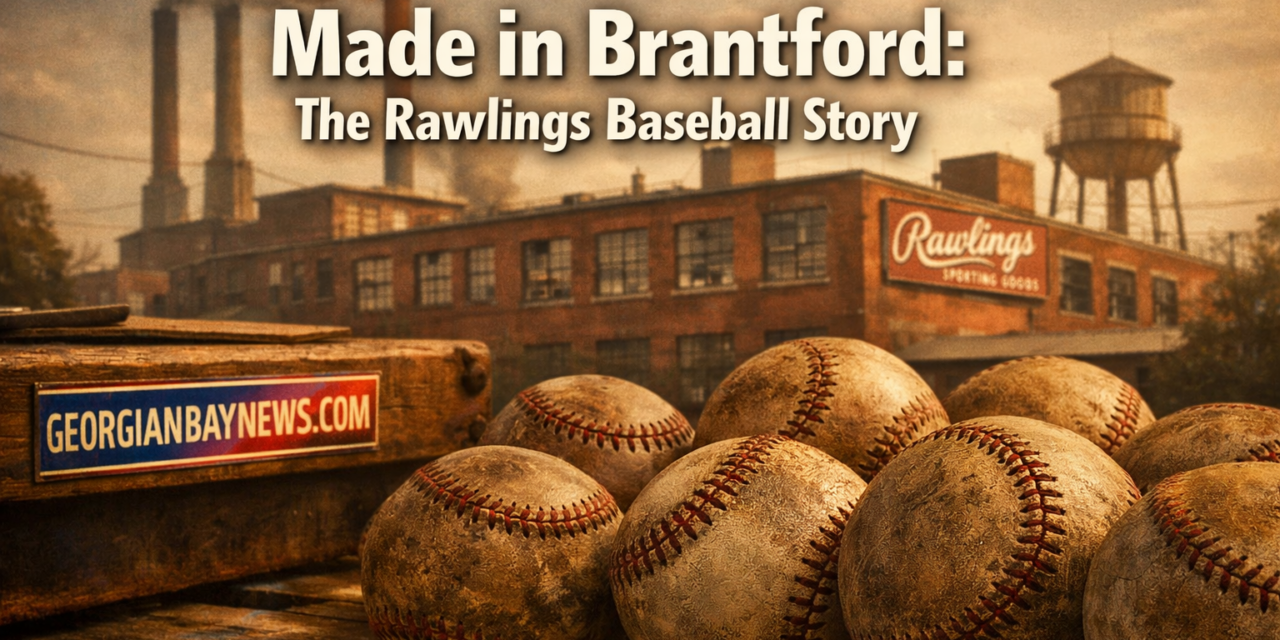
Rawlings established its Brantford, Ontario manufacturing presence during the mid-20th century, capitalizing on Canada’s skilled labor force and proximity to the large North American baseball market. The exact founding year of the Brantford operation is not independently verified in publicly available records, but historical accounts place the factory’s active period roughly between the 1940s and 1970s.
Rawlings as a company had been producing sporting goods since 1887, founded in St. Louis, Missouri. The Brantford facility represented one of the brand’s efforts to expand its manufacturing footprint beyond the United States and serve growing demand for quality baseballs across Canada and the broader continent.
Why Did Rawlings Choose Ontario for Baseball Manufacturing?
Brantford offered Rawlings a practical combination of skilled labor, established manufacturing infrastructure, and favorable access to transportation routes. Southern Ontario was already a recognized manufacturing hub by the mid-20th century, with a workforce experienced in precision handcraft work.
Key reasons Brantford made sense for Rawlings:
- Skilled workforce: The region had a tradition of detailed, craft-based manufacturing.
- Geographic advantage: Brantford sits in the heart of southern Ontario, with rail and road access to major Canadian and American markets.
- Cost structure: Canadian labor and operational costs were competitive at the time.
- Market proximity: Canadian baseball leagues and American professional teams both needed a reliable, nearby supply of quality balls.
How Were Rawlings Baseballs Made in Brantford — and What Made Them Unique?

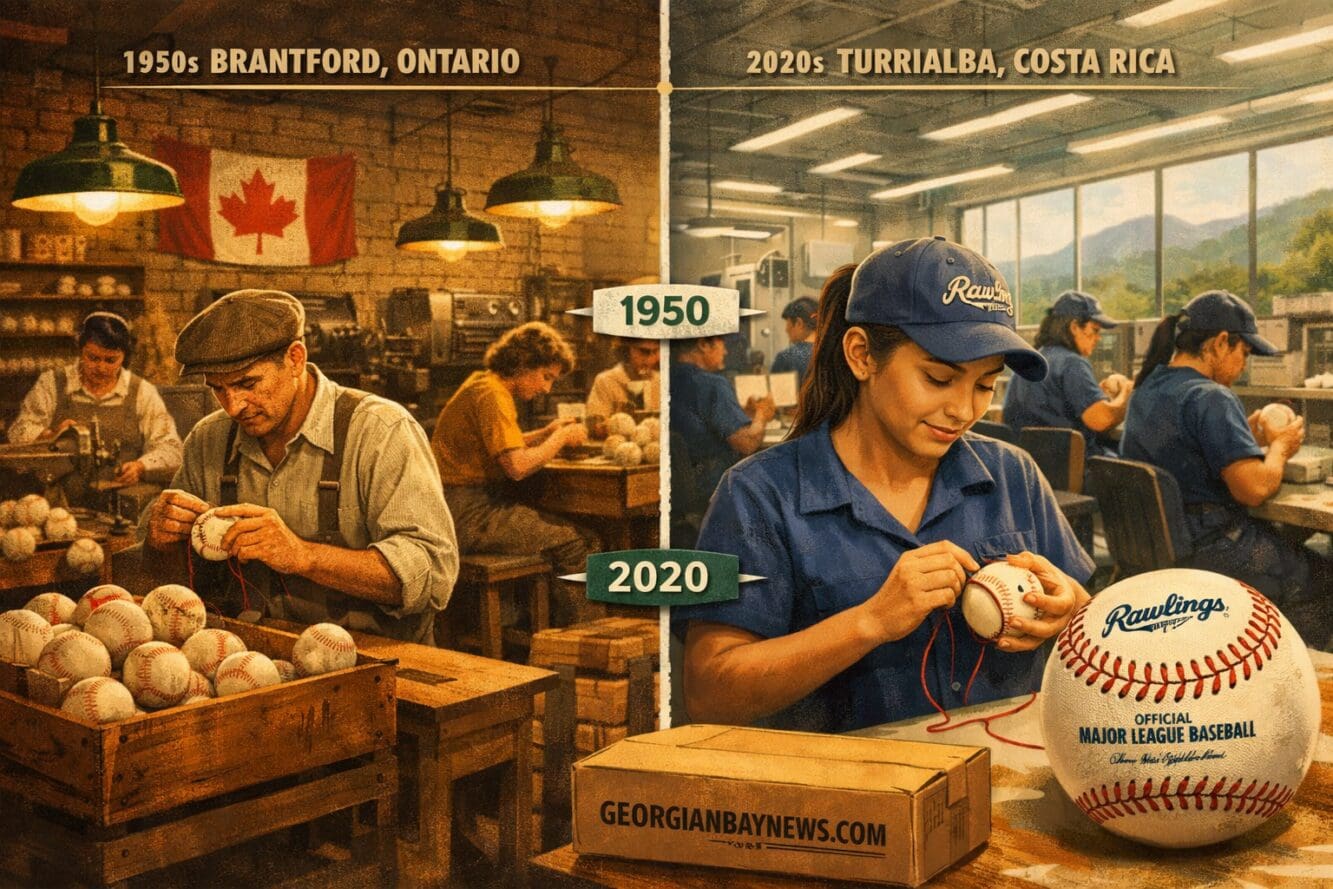
Rawlings baseballs manufactured in Brantford followed the same core construction process that defined the brand’s reputation: a cork and rubber core, wrapped in layers of wool and cotton yarn, then covered in two pieces of white cowhide leather stitched together with 108 hand-sewn red stitches.
The hand-stitching process alone took approximately 10 days per ball from start to finish, accounting for the careful winding, covering, and stitching stages. This was not a fast assembly-line product. Each ball demanded patience and precision.
What set Brantford-made Rawlings baseballs apart:
- Canadian craftsmanship: Workers developed a reputation for consistency in stitch tension and leather finishing.
- Quality control standards: Rawlings maintained strict specifications to meet professional league requirements.
- Local material sourcing: Some raw materials were sourced regionally, supporting Ontario suppliers.
Compared to competing brands of the era, Rawlings baseballs were widely regarded as the premium standard, a reputation built in part on the quality coming out of facilities like Brantford.
Which Major League Teams Used Rawlings Ontario-Made Baseballs?
Rawlings has been the official baseball supplier to Major League Baseball since 1977, but the brand supplied professional leagues well before that formal designation. During the Brantford factory’s active years, Rawlings baseballs — including those produced in Ontario — were used across professional and semi-professional leagues throughout North America.
While it is not possible to confirm with precision which specific MLB teams used balls sourced exclusively from the Brantford plant (production was distributed across facilities), the broader Rawlings supply chain served teams throughout both the American and National Leagues during that period. Canadian amateur and professional leagues were also significant customers of the Ontario facility.
What Happened to the Brantford Baseball Factory?
The Brantford factory closed as part of a broader restructuring of Rawlings’ manufacturing operations. By the latter half of the 20th century, rising labor costs in North America made it increasingly difficult to justify domestic and Canadian production for a labor-intensive product like a hand-stitched baseball.
Rawlings gradually consolidated and relocated manufacturing. The company moved significant production to Haiti and later to Costa Rica, where it found a skilled, cost-effective workforce capable of maintaining the quality standards MLB required. The Brantford facility’s closure mirrored what happened to many Ontario manufacturing operations during that era — a story familiar to anyone who has followed Ontario business history.
How Much Did Rawlings Baseballs Cost During the Brantford Era?
Retail pricing for Rawlings baseballs during the mid-20th century reflected both the labor-intensive production process and the general cost of goods at the time. A professional-grade Rawlings baseball in the 1950s and 1960s typically retailed in the range of a few dollars per ball — modest by today’s standards, but meaningful given average wages of the period.
Official MLB game balls today cost approximately $7 to $10 USD each to manufacture, with teams spending millions of dollars per season on baseballs alone. Prices during the Brantford era were a fraction of current costs, though the craftsmanship standard was comparable.
Who Worked in the Rawlings Brantford Baseball Factory?
The Brantford factory employed local Ontario workers, many of them women, who specialized in the hand-stitching process. This was common across Rawlings’ manufacturing facilities globally — the detailed needlework required for stitching 108 stitches per ball was considered skilled piecework, and female workers were historically the dominant labor force in baseball stitching operations worldwide.
Workers developed significant expertise over time. Experienced stitchers could maintain consistent tension and stitch spacing across thousands of balls, which directly affected the ball’s aerodynamic performance. The factory provided stable employment for Brantford residents and contributed to the city’s identity as a manufacturing community.
How Did the Brantford Factory Impact the Local Ontario Economy?
The Rawlings facility was a genuine contributor to Brantford’s local economy during its operating years. It provided direct employment, supported local suppliers, and added to the city’s tax base. Brantford has a long history as a manufacturing city — it was once home to Massey-Harris farm equipment and several other industrial employers — and the Rawlings operation fit naturally into that economic identity.
The factory’s closure, like many manufacturing departures from southern Ontario during the latter 20th century, left a gap in local employment. Communities like Brantford have worked steadily to diversify their economic base since that era. For readers interested in how Ontario communities have evolved, exploring stories from across the region offers useful context.
Did Rawlings Ontario Baseballs Have Any Quality Issues?
No significant, documented quality scandals are associated specifically with the Brantford production run. Rawlings maintained rigorous standards across all facilities, and the Ontario-made balls were considered reliable by the leagues that used them.
That said, hand-produced goods inherently carry some variation. Minor differences in stitch tension, leather thickness, or core compression were normal across any batch of hand-stitched baseballs — a reality that persists in MLB ball production even today. In fact, MLB has periodically investigated whether changes in ball construction affected home run rates in recent seasons, though those concerns relate to modern Costa Rica production, not the Brantford era.
Are Old Brantford Rawlings Baseballs Valuable Today?
Vintage Rawlings baseballs from the Brantford era can carry collector interest, particularly if they are in good condition, still in original packaging, or carry provenance linking them to a specific game or team. However, an unsigned, unattributed game ball from the 1950s or 1960s typically holds modest monetary value on its own.
Factors that increase value:
- Autographs from Hall of Fame players or notable figures
- Game-used documentation from a significant match
- Original packaging in excellent condition
- Rarity of the specific production run or label variation
Collectors interested in sports memorabilia and Ontario history may find the Brantford-era balls a niche but rewarding area to explore.
Where Are Rawlings Baseballs Made Today?
Rawlings baseballs are now produced in two primary locations, depending on their intended use:
UseLocationKey DetailOfficial MLB game ballsTurrialba, Costa Rica100% handcrafted, 108 hand-sewn stitchesMinor League and recreationalDushan County, ChinaMachine-assisted production
Costa Rica: The town of Turrialba has been the home of official MLB Rawlings baseball production since the 1980s. Skilled workers there hand-stitch every official game ball, maintaining the same 108-stitch standard that defined the Brantford era. The process still takes roughly 10 days from core to finished ball.
China: Rawlings baseballs for Minor League Baseball and recreational/training use are produced in Dushan County, China, where manufacturing scale and cost efficiency support high-volume output.
The shift from Ontario to these locations reflects global manufacturing economics, not a change in the fundamental craft of making a Rawlings baseball.

Conclusion
The Rawlings baseball factory in Brantford, Ontario represents a proud, if often overlooked, chapter in both Canadian manufacturing history and the story of North America’s favorite sport. For decades, skilled Ontario workers hand-stitched baseballs that met professional standards and supplied leagues across the continent. The factory’s eventual closure followed economic pressures that reshaped manufacturing across southern Ontario and beyond.
Today, the tradition of handcrafting Rawlings baseballs continues in Turrialba, Costa Rica, where each official MLB ball still requires approximately 10 days and 108 hand-sewn stitches — the same painstaking process that once defined the Brantford operation.
Actionable next steps for readers:
- If you own a vintage Rawlings baseball from the mid-20th century, consult a sports memorabilia appraiser to assess its potential value.
- Local archives in Brantford, including the Brantford Public Library and the Brant County Museum, may hold records, photographs, or oral histories related to the factory.
- For broader Ontario history and community stories, Georgian Bay News covers the region with depth and local perspective.
The Brantford factory may be gone, but the stitches it left on baseball history are still worth counting.
FAQ
When did Rawlings make baseballs in Brantford, Ontario?
Rawlings operated a baseball manufacturing facility in Brantford, Ontario, during the mid-20th century, with the active period estimated between the 1940s and 1970s, though exact dates are not confirmed in widely available public records.
Why did Rawlings close the Brantford factory?
Rising labor costs in North America made hand-stitched baseball production increasingly expensive in Canada. Rawlings relocated manufacturing to more cost-effective locations, eventually settling in Costa Rica for official MLB balls.
How long did it take to make a Rawlings baseball in Brantford?
The full production process, including core construction, yarn winding, leather covering, and hand stitching, took approximately 10 days per ball.
How many stitches are on a Rawlings baseball?
Every official Rawlings baseball has exactly 108 hand-sewn red stitches, a standard that has remained consistent across all production eras and locations.
Where are official MLB Rawlings baseballs made today?
All official Major League Baseball game balls are handcrafted in Turrialba, Costa Rica.
Where are Rawlings baseballs for recreational use made?
Rawlings baseballs for Minor League Baseball and recreational play are produced in Dushan County, China.
Are Brantford-made Rawlings baseballs worth money?
They can be, especially if autographed, game-used, or in original packaging. An unsigned, undocumented ball from the era holds modest collector value on its own.
Did Brantford Rawlings baseballs meet MLB standards?
Yes. Rawlings maintained consistent quality standards across its facilities, and Ontario-made balls were used in professional leagues and met the specifications required at the time.
Who stitched the baseballs in the Brantford factory?
Local Ontario workers, historically many of them women, performed the skilled hand-stitching work. Experienced stitchers developed significant expertise in maintaining consistent stitch tension and spacing.
How does Rawlings baseball production today compare to the Brantford era?
The core process is largely the same: hand-stitched leather over a wound core. The main differences are location, scale, and the formal MLB supply agreement Rawlings has held since 1977.
References
- Rawlings Sporting Goods Company. Official MLB baseball specifications. rawlings.com
- Society for American Baseball Research (SABR). History of the official baseball. sabr.org
- Brant County Museum and Archives. Brantford manufacturing history records.
- MLB Official Rules. Rule 3.01 — The Ball. mlb.com
Much Appreciate You Sharing This Post - It Helps MUCH!!!