
















🔥 Wildfires Do Not Recognize Borders: The Truth Behind the Canada – U.S. Wildfire Situation

by Rick Crouch | Environmental Issues
A shared wilderness, a shared challenge, and why this is not a story of government neglect.
Real estate is not confined to our homes, our weekend retreats, recreational destinations, our places of work, workship and elsewhere. It the very plant that we all all call home.
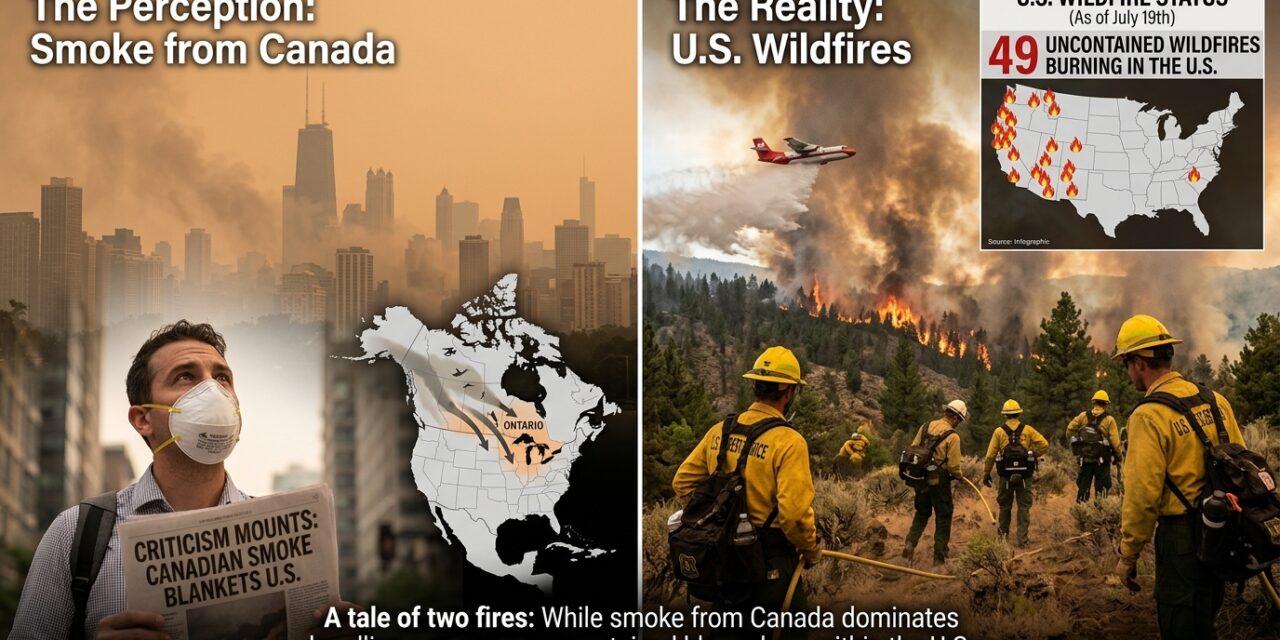
Over the past week Canada has taken considerable flack from some of our U.S. neighbours about the smoke from Ontario’s wildfires affecting the air quality in states such as Michigan, Illinois and elsewhere. Meanwhile, there has been no mention much less acknowledgement of the fact that as of July 19th, there are 49 uncontained wildfires burning in the U.S. right now.
While wildfires continue to burn across northern Minnesota and northwestern Ontario, smoke has blanketed large portions of Canada and the United States, affecting air quality, daily life in many communities, tourism, and outdoor recreation across the region. On top of this, some people have lost their homes if not their entire community.
The scale of these fires has understandably raised questions from residents on both sides of the border. However, as is often the case during major natural disasters, misinformation, political narratives and finger pointing can spread almost as quickly as the fires themselves.
One claim circulating among some U.S. political commentators is that the wildfire situation in Ontario is the result of neglect by Canadian governments. Implications have been made the situation has been caused by both our federal and provincial governments in failing to respond to our southern neighbour’s concerns going back a year or more claiming we should have done more to prevent the fires from happening. When you know where and take the initiative to look, there is often adequate information on any topic to separate fact from fiction. In this scenario, the available evidence does not support the conclusion and accusations being made.
The reality of this situation is much more complex:
These fires are being driven by weather, climate conditions, forest fuels, and geography, not by political boundaries or the action/in-action of one government.
Northern Minnesota and northwestern Ontario share one of the largest uninterrupted wilderness areas in North America. The international border between the two countries is, in many places, simply an imaginary line running through continuous boreal forest .
A wildfire does not stop because it reaches a national boundary and unlike humans, it certainly does not need a passport. When conditions become extreme, fires can move quickly across this landscape regardless of what country, province or state it may have originated in.
Wildfire behaviour is controlled by a number of factors:
- wind speed and direction,
- temperature,
- humidity,
- drought conditions,
- forest fuel availability,
- terrain.
It is not controlled by political borders much less political will.
During periods of extreme fire behaviour, a wildfire can advance many kilometres in a single day. A fire that begins in Minnesota can move into Ontario, while a fire that begins in Ontario can move southward into Minnesota. That is exactly what has happened in some instances during the current outbreak.
The current Minnesota wildfire situation
As of July 19, 2026, Minnesota has approximately 17 active wildfires, with the majority concentrated in northeastern Minnesota near the Canadian border, particularly within:
- the Superior National Forest
- the Boundary Waters Canoe Area Wilderness


The current outbreak has been described as a July Lightning Event, with many fires believed to have been started by lightning during a period of:
- extremely dry forest conditions,
- hot temperatures,
- strong winds,
- drought – stressed vegetation.
The Minnesota Incident Command System (MNICS) has reported approximately 17 active fires in the Superior National Forest and BWCAW region. The Boundary Waters Canoe Area Wilderness (BWCAW) in Minnesota and Quetico Provincial Park in Ontario form one of the most remote and heavily forested wilderness regions on the continent.


Major fires include the locations whose names are as follows:
- Camp Fire
- Thumb Fire
- Bear Trap Fire
- Little Knife Fire
- Coffin Fire
- Bug Creek Fire
- Echo 2 Fire
- Nine Fire
- Beaver Tail Fire
- Marion Creek Fire
The fires have burned tens of thousands of acres, with earlier estimates placing the combined burned area near 55,000 acres, although acreage continues to change as fire perimeters expand and are updated.


The impact if these fires have included:
- wilderness evacuations and readiness zones,
- closures within the Superior National Forest,
- significant smoke impacts throughout Minnesota, Ontario, and neighbouring regions.
Cross-border fire movement: What actually happened?
The current wildfire situation is not a single fire moving in one direction. It is a collection of fires spreading across a shared ecosystem. The evidence shows cross-border movement in both directions.
Minnesota fires crossing into Ontario
Several Minnesota fires have moved north into Ontario wilderness areas.
The best documented example involves fires originating in or near the Boundary Waters Canoe Area Wilderness that crossed the international border into areas adjacent to, or within, Quetico Provincial Park.
These fires include:
- Little Knife Fire
- Thumb Fire
- Bear Trap Fire
Fire officials from both countries have coordinated suppression efforts because portions of these fire complexes extend across the international boundary.
Ontario fires crossing into Minnesota
The movement has also occurred in the opposite direction. Some fires burning in Quetico Provincial Park have crossed south into Minnesota. This includes situations where fires that originated in Ontario have affected the Boundary Waters region.
One example is Ontario Fire FOR028, which was reported as beginning in Ontario near Ottertrack Lake and Knife Lake, immediately north of the international border.
Has a Canadian wildfire been caused by a fire that started in Minnesota?
The answer requires some clarification.
While there are documented examples of Minnesota fires crossing into Ontario, current public information does not clearly identify an Ontario Ministry of Natural Resources wildfire number where the official point of origin was determined to be Minnesota.
Ontario fire numbers are generally assigned once a fire is identified within Ontario jurisdiction. Therefore, a fire that crosses the border may be recorded as an Ontario incident even though its original ignition point was elsewhere.
The most accurate description is:
- Minnesota fires have crossed into Ontario.
- Ontario fires have crossed into Minnesota.
- Some fires have become shared international wildfire complexes.
- Canadian and American agencies are working together to manage them.
This is a regional wildfire event, not a failure of one country’s forest management or government inaction.
Why blaming Canada misses the reality of wildfire management The suggestion that these fires are occurring because Canada has failed to manage its forests ignores several important realities. Lightning – not government policy – is the primary ignition source
Many of the current fires were started by lightning strikes. No government can prevent every lightning – caused wildfire, particularly in remote wilderness areas covering millions of acres.
Northern forests naturally contain enormous fuel loads The boreal forests of Ontario and Minnesota are among the largest forest ecosystems on Earth. They are comprised of the following:
- mature trees,
- dense undergrowth,
- dead and fallen timber,
- peat and organic soils.
During drought conditions, these fuels gain strength and can support intense wildfire behaviour once ignition has taken place.
Wilderness areas cannot be managed like urban forests
The Boundary Waters and Quetico regions are protected wilderness areas. They are not forests where you send in heavy equipment for the purpose whereby every acre can be cleared, harvested, or aggressively managed. Ask yourself, is this what we want?
In many wilderness ecosystems, fire is also a natural ecological process that has shaped these forests for thousands of years.
Canada and the United States are cooperating, not blaming each other
One of the most important facts being overlooked is the cooperation occurring between agencies. Canadian and American fire crews, aircraft, incident commanders, and forestry officials routinely work together during cross-border fire events. This cooperation exists because both countries recognize a simple truth: A wildfire affecting one country can quickly become a wildfire affecting both countries.
The widespread smoke experienced across Ontario, Minnesota, and parts of the eastern United States is another reminder that wildfire impacts are regional events if not global ones when you look at the overall climate change picture.
Smoke from these fires has affected:
- communities near Lake Superior,
- northern Ontario,
- Minnesota,
- neighbouring U.S. states including Illinois, Michigan and others.
- portions of eastern Canada and the east coast of the United States have been affected.
Air quality impacts are determined by atmospheric conditions and wind patterns – not gepgraphical or political boundaries.
The bigger lesson: Nature does not follow political narratives
The current Canada – U.S. wildfire situation is a powerful reminder that some challenges cannot be reduced to political talking points. A wildfire does not know whether it is burning in Canada or the United States.
It does not recognize:
- provincial borders,
- state borders,
- political parties,
- national boundaries.
It responds only to environmental conditions.
The most accurate understanding of the current situation is this:


Extreme weather conditions, lightning ignitions, and dry forest fuels have created a major wildfire event affecting both Canada and the United States. Fire agencies from both countries are responding together to protect communities, forests, and public safety.
Rather than looking for blame, the focus should remain on science, preparation, cooperation, and supporting the firefighters working in some of the most challenging conditions imaginable.
This post is not merely an opinion of the author. Rather it’s looking at the broader picture one that will impact my chidlren, my grandchildren and yours. Of you are like me, we would like to leave this world in better condition than when we arrived. No amount of political infighting will generate that objective.
Sources and References
Much of what is contained herein as well and updates as recernmt as today came from:
- Minnesota Incident Command System (MNICS) – Superior National Forest wildfire updates and fire situation reports
- U.S. Forest Service – Boundary Waters Canoe Area Wilderness wildfire information, closures, and maps
- National Interagency Fire Center (NIFC) – national wildfire reporting
- Ontario Ministry of Natural Resources – Ontario wildfire reporting and fire numbers
- Minnesota Public Radio (MPR) – regional wildfire coverage
- Associated Press (AP) – wildfire and smoke reporting
- Quetico Superior Foundation – Boundary Waters/Quetico fire updates
- WTIP North Shore Community Radio – northeastern Minnesota incident reporting
- IQAir – wildfire smoke and air quality monitoring
NOTE: The author is a Broker, Market Value Appraiser-Residential with Sotheby’s International Realty Canada and a Past President (2008) of the One Point Association of REALTORS® 📞 Direct: 705-443-1037📧 Email: rcrouch@sothebysrealty.ca
Much Appreciate You Sharing This Post - It Helps MUCH!!!