




















✅ AI in Pathology: How Machine Learning is Catching Cancers Earlier Than Human Pathologists
Last updated: July 25, 2026
Quick Answer: AI in pathology uses machine learning algorithms to analyze digital images of tissue samples, identifying cancer cells with speed and accuracy that often matches or exceeds trained human pathologists. In 2026, the FDA has cleared several AI pathology tools for clinical use, and major health systems worldwide are deploying them to catch cancers earlier and guide treatment decisions more precisely.
Key Takeaways
- Machine learning models can scan thousands of tissue slide images in minutes, flagging suspicious cells that might be missed during a routine review
- The FDA cleared its first AI digital pathology risk test for breast cancer in early 2026, marking a major milestone for clinical adoption
- AI pathology tools are now being used to predict immunotherapy response, identify cancer subtypes, and guide prognosis across multiple cancer types [1][8]
- Human pathologists remain essential; AI works best as a decision-support tool, not a replacement
- Common AI errors include false positives on rare cancers and performance gaps when training data lacks diversity
- Major institutions including Vanderbilt University Medical Center and Stanford Medicine are actively testing and deploying AI pathology frameworks [5][6]
- Costs for AI pathology software vary widely, from subscription-based lab tools to enterprise oncology platforms
- AI models require large, diverse, well-annotated datasets to perform reliably across different patient populations.

What Is AI in Pathology and How Does It Work
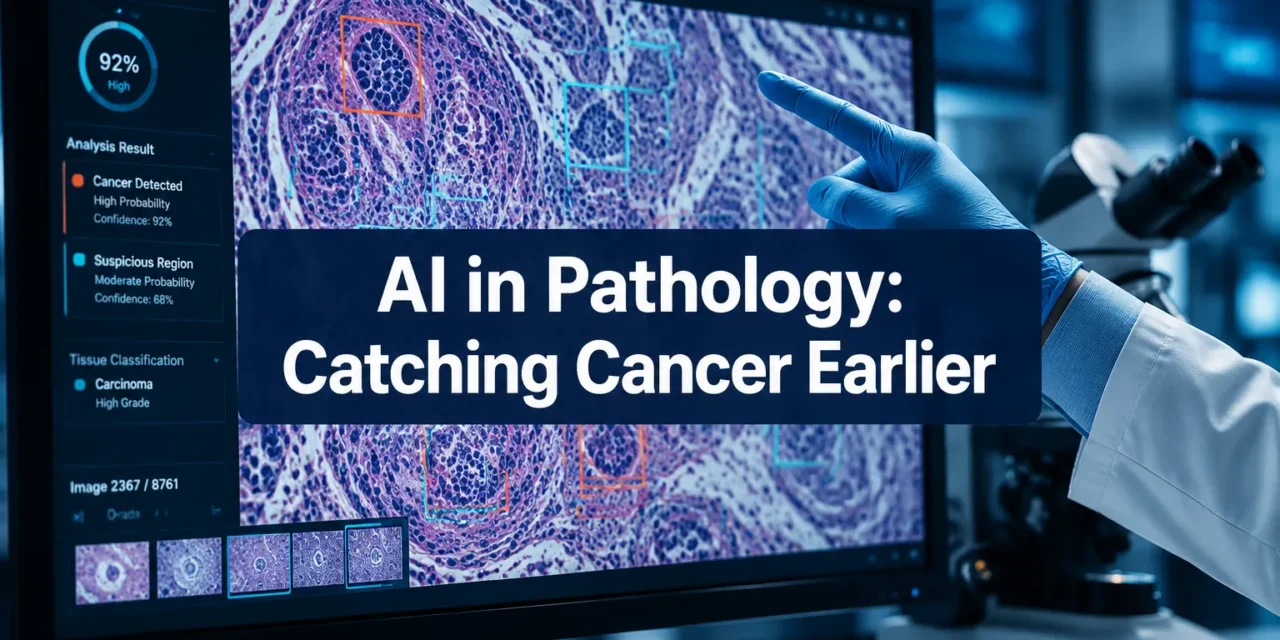
AI in pathology applies machine learning, specifically deep learning neural networks, to digitized images of tissue and cell samples. The system is trained on millions of annotated slide images, learning to recognize patterns associated with cancerous and pre-cancerous cells.
Here is the basic workflow:
- A tissue sample is taken from a patient (biopsy or surgical specimen)
- The sample is prepared and scanned into a high-resolution digital image (whole-slide imaging)
- An AI algorithm analyzes the image, pixel by pixel, identifying cellular structures, abnormalities, and spatial patterns
- The model outputs a risk score, a cancer subtype classification, or a flagged region for pathologist review
Researchers at Stanford Medicine published findings in July 2026 showing that AI frameworks can now identify biological tumor characteristics that go beyond what the naked eye can detect, offering deeper insight into tumor behavior [6]. A new framework from Vanderbilt University Medical Center also demonstrated that AI can reliably subtype cancers, with built-in confidence scoring to flag uncertain cases for human review [5].
Can Machine Learning Detect Cancer Faster Than Pathologists
Yes, in terms of raw processing speed, machine learning can analyze a whole-slide image in seconds to minutes, compared to the 20 to 30 minutes or more a pathologist may spend on a complex case. More importantly, AI does not experience fatigue, which is a known factor in diagnostic errors during high-volume workdays.
A 2026 analysis published via Medscape noted that AI tools are now reshaping oncology pathology workflows by reducing turnaround times and enabling pathologists to focus their attention on the most ambiguous cases [8]. This speed advantage is especially valuable in cancer screening programs where large volumes of slides need to be reviewed quickly.
The key distinction: Speed is not the same as accuracy. AI is fast, but the clinical value comes from its ability to catch subtle patterns consistently, not just quickly.
What Are the Main Benefits of AI Pathology for Early Cancer Detection
AI in pathology offers several concrete benefits for catching cancer at earlier, more treatable stages:
- Consistency: AI applies the same criteria every time, eliminating variability between different pathologists or between a single pathologist reviewing slides at different times of day
- Sensitivity on subtle findings: Machine learning models can detect micro-metastases and early-stage cellular changes that are easy to overlook visually
- Prognostic scoring: Beyond detection, AI can now predict how a tumor will behave, helping oncologists choose treatments earlier and more precisely [9]
- Immunotherapy response prediction: A June 2026 study showed AI pathology analysis can predict which patients are likely to respond to immunotherapy, allowing earlier and better-targeted treatment decisions [1]
- Workload relief: In regions facing pathologist shortages, AI can pre-screen slides and prioritize urgent cases, reducing diagnostic delays
For communities where access to specialist care is limited, AI pathology tools could meaningfully close the gap in cancer outcomes. This connects to broader conversations about mental health crisis and healthcare resource distribution that affect many Canadians.
How Accurate Is AI Compared to Human Pathologists
Accuracy depends heavily on the cancer type, the quality of training data, and the specific AI model. For well-studied cancers like breast, prostate, and colorectal cancer, top AI systems have demonstrated diagnostic accuracy comparable to experienced pathologists in controlled studies [2][4].
A PubMed-indexed study confirmed that deep learning models can match or exceed pathologist-level performance on specific classification tasks, particularly when analyzing large datasets [2]. However, performance can drop significantly on rare cancer subtypes or slides from populations underrepresented in training data.
Bottom line: AI is highly accurate for common cancers with abundant training data. It is less reliable for rare or poorly represented conditions, and should always be validated against local patient populations before clinical deployment.
What Types of Cancer Can AI Detect Better
AI pathology currently performs strongest in cancers where large annotated datasets exist and visual patterns are well-defined:
| Cancer Type | AI Strength |
|---|---|
| Breast cancer | High, FDA-cleared risk tools available (2026) |
| Prostate cancer | High, Gleason grading assistance widely studied |
| Colorectal cancer | High, polyp and adenoma detection |
| Lung cancer | Moderate to high, subtype classification |
| Skin cancer (histology) | Moderate, improving rapidly |
| Rare cancers | Low to moderate, limited training data |
The FDA cleared its first AI-based digital pathology risk test for breast cancer in 2026, a landmark decision that signals growing regulatory confidence in these tools [7][8]. Prognostic AI tests for multiple cancer types expanded rapidly between May and June 2026, with new tools targeting lung, colon, and bladder cancers entering clinical validation.
How Much Does AI Pathology Software Cost
AI pathology software pricing varies widely and is not always publicly listed, as many vendors sell enterprise contracts to hospital systems rather than individual labs.
General cost ranges (estimates based on industry reporting as of 2026):
- Subscription-based lab tools: Roughly $500 to $2,000 per month for smaller labs using cloud-based platforms
- Enterprise oncology platforms: Multi-year contracts for large hospital systems can range into hundreds of thousands of dollars annually
- Integrated scanner-plus-software bundles: Some whole-slide imaging vendors bundle AI analysis into hardware purchase agreements
Costs are also shaped by whether the tool is used for screening, diagnosis, or prognosis, and whether it requires additional validation studies before clinical deployment. The Roche acquisition of PathAI in 2026 signals that major diagnostics companies are investing heavily, which may eventually drive down costs through broader market competition [7].
What Are the Limitations of AI in Pathology
AI in pathology is not without real constraints. Understanding these limitations is essential for any health system considering adoption.
- Training data bias: Models trained on slides from predominantly one demographic may perform poorly on others
- Rare cancer gaps: Limited annotated data for uncommon cancers means AI confidence scores can be unreliable in these cases
- Regulatory lag: Not all AI tools are FDA-cleared or Health Canada-approved; some are used as research tools only
- Integration challenges: Connecting AI software to existing lab information systems and electronic health records can be technically complex
- Explainability: Many deep learning models are “black boxes,” making it difficult for pathologists to understand why a specific decision was made
- Liability questions: When AI contributes to a missed diagnosis, accountability frameworks are still being worked out legally and ethically
A new framework published in June 2026 from Vanderbilt specifically addresses the trustworthiness problem by building confidence scoring into AI cancer subtyping, so pathologists know when to trust the model and when to override it [5].
Is AI Pathology Approved by the FDA
Yes, selectively. The FDA has cleared specific AI pathology tools for defined clinical uses, but not all AI pathology software on the market carries FDA clearance.
The most significant 2026 milestone was FDA clearance of the first AI digital pathology risk test for breast cancer, which assesses recurrence risk from tissue slides [7][8]. This clearance applies to that specific tool and intended use, not to AI pathology broadly.
What this means for patients and providers: Always confirm whether a specific AI tool used in your care has received FDA clearance or is being used under a research or investigational framework. In Canada, Health Canada oversight applies separately, and clearance timelines may differ.
Do Pathologists Still Need Jobs If AI Takes Over
Pathologists are not being replaced. AI in pathology is designed and deployed as a decision-support tool, and every major health system using it still requires licensed pathologists to review, validate, and sign off on diagnoses.
The more accurate framing: AI is changing what pathologists spend their time on. Routine screening tasks can be partially automated, freeing pathologists to focus on complex, ambiguous, or rare cases that genuinely require expert judgment. This mirrors trends in other fields where software engineers use AI tools to handle repetitive tasks while focusing human expertise on higher-order problems.
The NCI’s June 2026 Global Cancer Research and Control Symposium highlighted AI pathology as a tool to extend the reach of pathology expertise into underserved regions, not to eliminate the profession [3].
What Mistakes Does AI Make in Cancer Detection
AI pathology systems make two main types of errors:
- False positives: Flagging normal or benign tissue as suspicious, which can lead to unnecessary follow-up procedures and patient anxiety
- False negatives: Missing a cancer that is present, which is the more dangerous error and is more common in rare or atypical presentations
Other documented error patterns include:
- Misclassifying cancer subtypes when the visual features overlap between types
- Performing poorly on slides with staining artifacts or poor image quality
- Overconfident predictions on cases that fall outside the training distribution
The Vanderbilt framework published in June 2026 was specifically designed to reduce overconfident errors by flagging cases where the AI model’s certainty is low, prompting mandatory human review [5]. This kind of uncertainty quantification is now considered a best practice in responsible AI pathology deployment.
Which Hospitals Are Using AI Pathology Right Now
Several leading academic medical centers and health systems are actively deploying or validating AI pathology tools as of 2026:
- Stanford Medicine is testing AI frameworks for tumor biology analysis that go beyond traditional morphology [6]
- Vanderbilt University Medical Center published a new trustworthiness framework for AI cancer subtyping in June 2026 [5]
- Major oncology centers in Europe and North America are piloting AI-assisted immunotherapy response prediction tools [1]
- Roche-affiliated labs, following the PathAI acquisition, are integrating AI into their global diagnostic network [7]
Community hospitals and regional cancer centers are beginning to adopt cloud-based AI screening tools, though full clinical integration remains more common at academic centers with the infrastructure to validate and monitor AI performance.
Can AI Pathology Work for Rare Cancers
AI pathology works less reliably for rare cancers, but the field is actively addressing this. The core problem is data: rare cancers have fewer annotated training samples, so models have less to learn from.
Current approaches to improve rare cancer AI performance include:
- Federated learning: Multiple institutions pool anonymized data without sharing raw patient information, building larger effective datasets
- Transfer learning: Models trained on common cancers are adapted for rare subtypes using smaller datasets
- Synthetic data generation: AI-generated slide images are used to augment limited real-world datasets
As of 2026, AI pathology for rare cancers is primarily a research application. Clinicians should not rely on AI alone for rare cancer diagnosis without robust human expert review.
What Training Data Do AI Models Need for Pathology
High-quality AI pathology models require three things from training data: volume, diversity, and accurate annotation.
- Volume: Millions of labeled slide images are typically needed to train a reliable deep learning model
- Diversity: Data must represent different patient demographics, tissue preparation methods, scanner types, and cancer stages to generalize well
- Annotation quality: Each slide must be accurately labeled by expert pathologists, which is time-consuming and expensive
The NCI and major cancer research institutions are actively building large, publicly accessible pathology datasets to support model development [3][10]. Poor training data is the single biggest driver of AI pathology failures in real-world deployment, and it is why independent validation on local patient populations is considered essential before any clinical rollout.
For readers interested in how data and technology intersect with health outcomes, related coverage on social programs and community health infrastructure provides useful context on the systemic factors shaping who benefits from these advances.
FAQ
What is digital pathology?
Digital pathology converts glass tissue slides into high-resolution digital images that can be analyzed by software, shared remotely, and processed by AI algorithms.
How long has AI been used in pathology?
Research into AI-assisted pathology began in the early 2010s, but clinical deployment accelerated significantly after 2020 with improvements in deep learning and whole-slide imaging technology.
Can AI pathology be used for blood cancers?
Yes, AI tools are being developed for hematological cancers, but most current FDA-cleared tools focus on solid tumor histology. Blood cancer AI is an active research area.
Is AI pathology covered by insurance?
Coverage varies by country and insurer. In the United States, reimbursement for AI-assisted pathology is still being established. Patients should check with their provider.
How do I know if AI was used in my pathology report?
Ask your pathologist or oncologist directly. Labs using AI tools are generally required to document this in their workflow, though patient-facing disclosure practices vary.
What is the difference between AI-assisted and AI-autonomous pathology?
AI-assisted pathology supports a human pathologist who makes the final call. AI-autonomous pathology would make diagnoses without human review, which is not currently approved for clinical use.
Does AI pathology work the same on all tissue scanners?
No. AI models trained on images from one scanner brand may perform differently on images from another. This is called the “domain shift” problem and is a key validation challenge.
What happens when AI and the pathologist disagree?
In current clinical practice, the pathologist’s judgment takes precedence. Disagreements are often flagged for second-opinion review or additional testing.
Conclusion
AI in pathology is no longer a future concept. It is a present-day clinical tool that is already changing how cancers are detected, classified, and treated. The 2026 FDA clearance of an AI breast cancer risk test, combined with rapid expansion of prognostic tools and major industry acquisitions like Roche-PathAI, signals that this technology is moving firmly into mainstream oncology.
For patients, the most actionable takeaway is this: ask your care team whether AI-assisted pathology is available at your institution, particularly if you are undergoing cancer screening or awaiting a biopsy result. For health systems, the priority should be validating AI tools on local patient populations before clinical deployment and ensuring pathologists are trained to interpret AI outputs critically.
The goal is not to replace expert judgment. It is to make expert-level cancer detection available faster, more consistently, and to more people, including those in communities that have historically had less access to specialized diagnostic care. That is a goal worth pursuing carefully and rigorously.
References
[1] 2026 06 Ai Pathology Analysis Immunotherapy Response – https://medicalxpress.com/news/2026-06-ai-pathology-analysis-immunotherapy-response.html
[2] pubmed.ncbi.nlm.nih.gov – https://pubmed.ncbi.nlm.nih.gov/41241581/
[3] June 2026 Gcrcss – https://www.cancer.gov/about-nci/organization/cgh/events/june-2026-gcrcss
[4] pubmed.ncbi.nlm.nih.gov – https://pubmed.ncbi.nlm.nih.gov/42214043/
[5] New Framework Renders Ai Trustworthy For Cancer Subtyping – https://news.vumc.org/2026/06/23/new-framework-renders-ai-trustworthy-for-cancer-subtyping/
[6] Ai Tumor Pathology – https://med.stanford.edu/news/all-news/2026/07/ai-tumor-pathology.html
[7] Digital Pathology News Round Up June 2026 Imogen Fitt Lldfc – https://www.linkedin.com/pulse/digital-pathology-news-round-up-june-2026-imogen-fitt-lldfc
[8] Pixels Prescriptions How Ai Reshaping Pathology Oncology 2026a1000akz – https://www.medscape.com/viewarticle/pixels-prescriptions-how-ai-reshaping-pathology-oncology-2026a1000akz
[9] Ai Pathology Framework For Biological Understanding Of Tumors – https://ascopost.com/news/may-2026/ai-pathology-framework-for-biological-understanding-of-tumors/
[10] 4690734d 1be0 11f1 9f14 124f0a52e769 – https://videocast.nih.gov/watch/4690734d-1be0-11f1-9f14-124f0a52e769