
















🇨🇦🧠🎯 Is rapid AI development a SMART MOVE?
By David Suzuki
We’ve been lulled into believing that all technological advancement is good — or at least inevitable. Of course, much depends on how we use and regulate it.
Many of us remember pre-internet times. It was supposed to speed things up, to make life easier for everyone. But most people are working the same number of hours as before, and spending more of those hours glued to screens. We’ve become connected to our devices and computers and disconnected from real life.
Now we’re being told to accept the inevitability of artificial intelligence, or AI — computer technology that performs tasks once requiring human intelligence. Like the internet, it will ostensibly make life easier, speeding up access to information and reducing the routine work required to create “content” and accomplish other tasks.
Will that lead to reduced work hours or better quality of life for a majority of people? If the rapid development of the internet is anything to go by, probably not. There are undeniably positive applications: “It is helping doctors detect diseases earlier, enabling scientists to analyze enormous amounts of data, improving transportation, making education more personalized, and allowing businesses to work more efficiently than ever before,” Science News Today reports.
But AI also creates many social and environmental problems. Without thoughtful implementation and regulation, it can lead to job losses, misinformation spread, algorithmic bias, cybercrime, overdependence on technology, security risks and diminished human learning and creativity, among other problems.
As for environmental issues, the massive data centres being built to facilitate it require enormous amounts of energy and water. In a world already reeling from the consequences of fossil-fuelled overheating, that should give us pause.
“The world’s data centres used about 485 terawatt-hours of electricity last year, similar to that used by Germany, and the International Energy Agency expects that to double by 2030,” a Nature article reports, adding, “Five technology companies — Amazon, Alphabet, Microsoft, Meta and Oracle — are expected to spend a total of more than US$600 billion on AI infrastructure this year; a decade ago, the same five companies spent less than $40 billion. Data centres concentrate this extraordinary energy demand on the electricity grids of the specific communities where they are built, despite concerns about water use, noise and equity.”
Opposition is growing. A recent Gallup poll found 71 per cent in the United States oppose data centres in their areas, with 48 per cent “strongly opposed.”
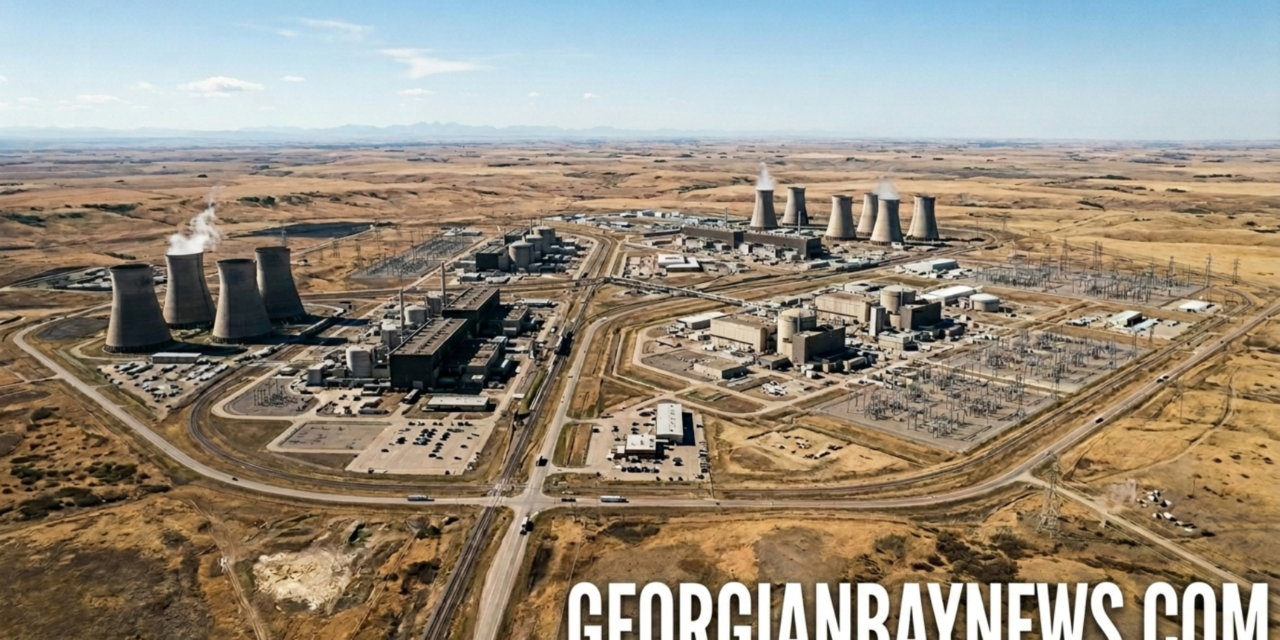
A proposed $70-billion, nine-gigawatt facility covering 65 square kilometres in drought-stricken Alberta faces opposition from First Nations and locals. The nearby Sturgeon Lake Cree Nation has expressed concerns regarding the Alberta government’s decision to exempt the Wonder Valley project from an environmental impact assessment and has applied for a judicial review regarding its water licence.
Utah State University physicist Robert Davies, commissioned by the First Nation to assess the project, warns it would be “one of the largest single-site heat sources on the planet.”
He wrote that the project, led by celebrity investor Kevin O’Leary, would layer “an enormous new thermal, acoustic, air-emissions, and water demand on top of an environment already fragmented by resource extraction — across territory in which the Cree Nation exercises Treaty and harvesting rights.”
“This is a massive project with significant emissions, water use and, most alarming, [would] create a heat island in an area already ravaged by wildfire, drought, and climate change,” Sturgeon Lake Cree Nation Chief Sheldon Sunshine said.
As well as water and energy use, AI and its data centres can worsen climate change and other environmental impacts by making it easier for the fossil fuel industry to find and exploit oil and gas wells, Bill McKibben writes.
Fears have also been raised about threats posed if AI acquires enough autonomy to harm humans. A United Nations report cautions that AI’s “capabilities are outpacing scientific understanding and governments’ ability to adapt.” But the immediate threats alone show the need for caution.
The Nature article notes that data centres, while extremely profitable, aren’t the only option. “Researchers must pioneer the adoption of open-weight AI models that run locally on institutional servers,” they write.
There may be no stopping the AI juggernaut, but we must at least demand regulations and oversight to reduce its environmental and social impacts and to slow or stop developments when risks outweigh benefits.
David Suzuki is a scientist, broadcaster, author and co-founder of the David Suzuki Foundation. Written with David Suzuki Foundation Senior Writer and Editor Ian Hanington.
Learn more at davidsuzuki.org.
– END –
EXCERPT: There may be no stopping the AI juggernaut, but we must at least demand regulations and oversight to reduce its environmental and social impacts.
KEY WORDS: artificial intelligence, cybercrime, misinformation, climate change, water, drought,
REFERENCES:
Science News Today reports:
https://www.sciencenewstoday.org/the-pros-and-cons-of-artificial-intelligence
Nature article reports:
https://www.nature.com/articles/d41586-026-02451-2
Recent Gallup poll found:
https://news.gallup.com/poll/709772/americans-oppose-data-centers-area.aspx
Sturgeon Lake Cree Nation has expressed concerns:
Applied for a judicial review:
https://www.cbc.ca/news/canada/edmonton/sturgeon-lake-cree-nation-alberta-wonder-valley-9.7228016
Utah State University physicist Robert Davies:
Bill McKibben writes:
https://billmckibben.substack.com/p/fun-with-numbers
United Nations report cautions: