





















🇨🇦 Canada’s Jeremy Hansen Joins Three NASA Astronauts on Artemis II’s 10-Day Journey Around the Moon
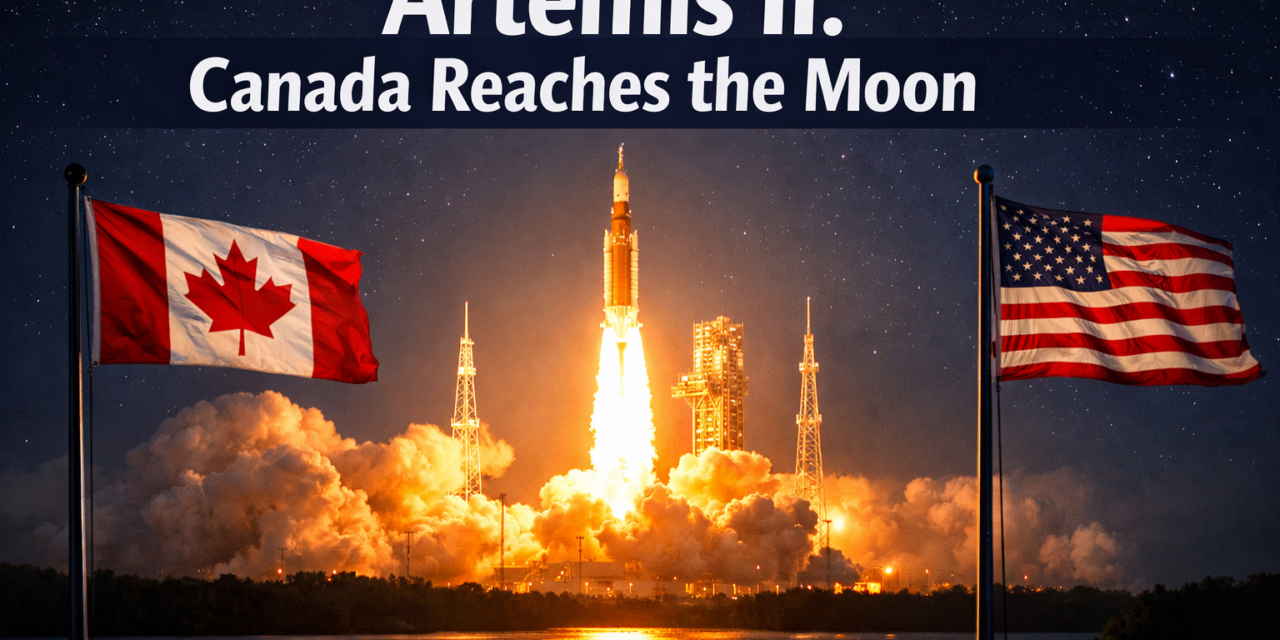
At exactly 6:35 p.m. EDT on April 1, 2026, the most powerful operational rocket on the planet roared to life — and with it, a Canadian astronaut began a journey no citizen of that country has ever made. NASA’s Artemis II Moon Mission marks the first time in more than 53 years that human beings have left low Earth orbit, and the first time ever that a non-American has been part of a Moon-bound crew [6]. The Space Launch System (SLS) rocket lifted off from Kennedy Space Center in Florida, carrying four astronauts toward the lunar vicinity aboard the Orion spacecraft [2][3]. For Canada, this is not just a space mission — it is a defining national moment.
Key Takeaways 🚀
- Historic launch: Artemis II launched April 1, 2026, sending humans beyond low Earth orbit for the first time since Apollo 17 in December 1972 [1][6].
- Canadian milestone: Mission Specialist Jeremy Hansen of the Canadian Space Agency (CSA) became the first Canadian astronaut to travel to the Moon [4].
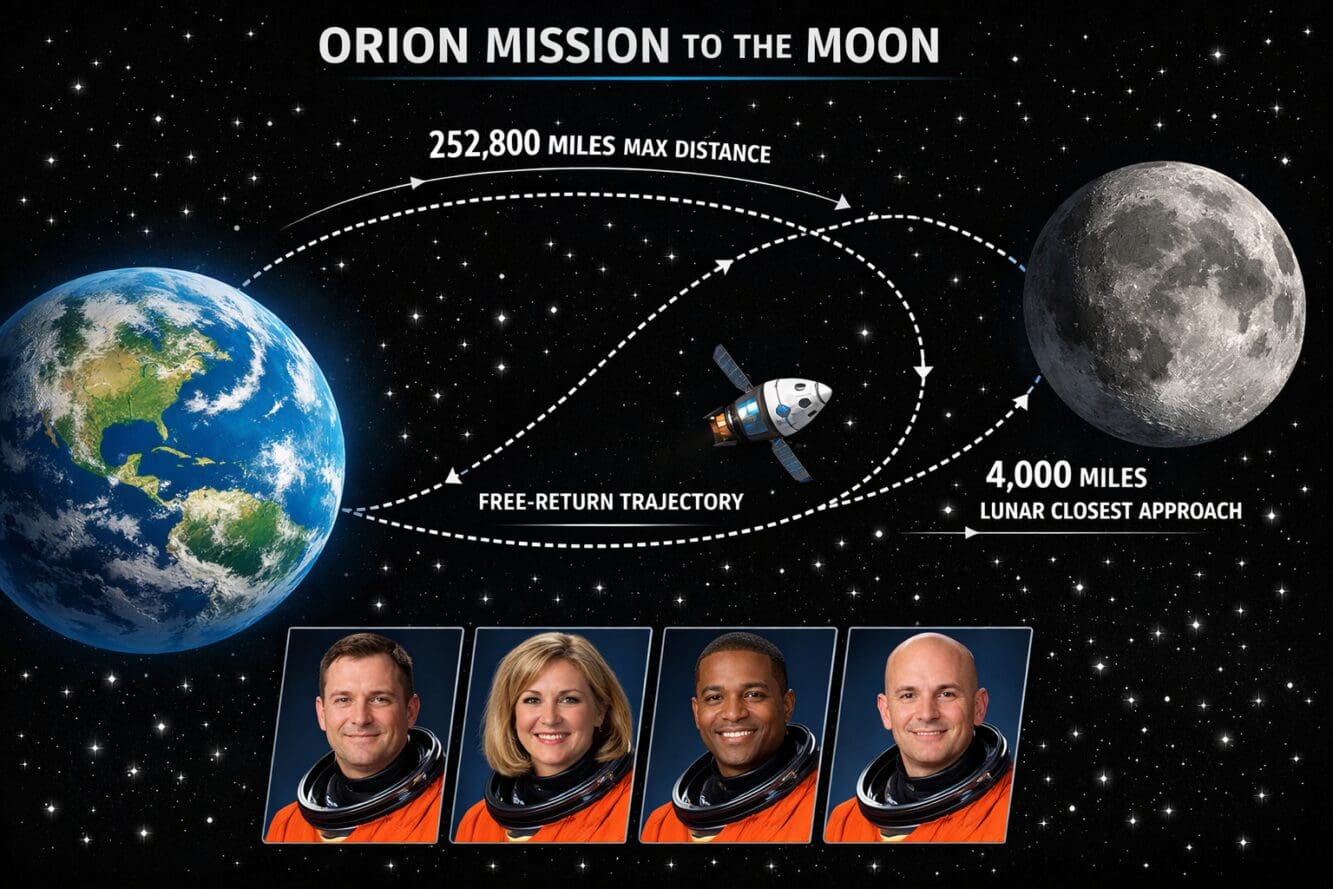
- Distance record broken: The Orion spacecraft reached approximately 252,800 miles from Earth, surpassing the Apollo 13 record of 248,655 miles set in 1970 [3].
- No lunar landing — yet: The crew will fly by the Moon, passing within 4,000 miles of its surface, but will not land or enter orbit. The mission is a critical systems test for future surface missions [3][6].
- 10-day mission: The full journey includes a three-day transit to the Moon, a far-side flyby, and a return to Earth [1][2].
Meet the Crew: Who Is Flying on NASA’s Artemis II Moon Mission?
The four-person crew represents some of the most experienced astronauts in North America. Here is a quick breakdown:
| Role | Astronaut | Agency |
|---|---|---|
| Commander | Reid Wiseman | NASA |
| Pilot | Victor Glover | NASA |
| Mission Specialist 1 | Christina Koch | NASA |
| Mission Specialist 2 | Jeremy Hansen | CSA |
Commander Reid Wiseman is a former Navy test pilot with extensive spaceflight experience. Pilot Victor Glover made history as the first Black astronaut on a long-duration International Space Station mission. Christina Koch holds the record for the longest single spaceflight by a woman. And then there is Jeremy Hansen — a Canadian Forces fighter pilot, engineer, and now the person carrying an entire nation’s space ambitions on his shoulders [1][2].
🍁 “Jeremy Hansen’s selection represents the strongest signal yet that Canada is a serious partner in humanity’s return to the Moon.”
Backup crew members were also named: Jenni Gibbons of the CSA was designated as Hansen’s backup in November 2023, while Andre Douglas was named backup for the three NASA astronauts in July 2024 [1].
Canada’s involvement in this mission is directly tied to the country’s contribution of the Canadarm3 robotic system to the planned Lunar Gateway station. In the broader context of how nations are positioning themselves in the new global order, Canada’s seat on Artemis II is a powerful statement about the value of international partnerships.
The Flight Plan: How the 10-Day Lunar Journey Unfolds
Understanding the mission timeline helps explain why this flight matters so much for future exploration.
Day 1: Launch and Earth Orbit (April 1)
The SLS rocket launched at 6:35 p.m. EDT, placing the Orion spacecraft into low Earth orbit [2][6]. The crew spent the initial hours checking spacecraft systems and preparing for the next critical step.
Day 2: Translunar Injection (April 2)
At 7:49 p.m. EDT on April 2, the Interim Cryogenic Propulsion Stage fired for five minutes and 49 seconds. This burn changed the spacecraft’s velocity by 1,274 feet per second, sending the crew out of Earth orbit and onto a path toward the Moon [5]. This was the moment the mission truly became historic — humans were once again heading for deep space.
Days 3–5: Transit to the Moon
Over three days, the Orion spacecraft traveled across roughly a quarter-million miles of space. During this transit, the crew tested life support systems, communication links, and navigation procedures [3][6]. Every system check was essential for validating the spacecraft’s readiness for future missions that will actually put boots on the lunar surface.
Days 5–6: Lunar Flyby
The spacecraft passed within approximately 4,000 miles of the Moon’s surface during its closest approach [3]. The crew observed the far side of the Moon — areas never seen up close by human eyes [1]. This flyby used the Moon’s gravity to redirect the spacecraft back toward Earth in what is known as a free-return trajectory.
Days 7–10: Return to Earth
After the flyby, the crew began the journey home. The Orion capsule is expected to splash down in the Pacific Ocean, completing the approximately 10-day mission [1][2].
🌕 At its maximum distance of 252,800 miles from Earth, the Artemis II crew became the humans who have traveled the farthest from home in all of history [3].
Why Artemis II Matters: More Than a Test Flight
Some may wonder: if the crew is not landing on the Moon, what is the point? The answer is straightforward — this mission is the critical bridge between concept and reality.
Testing Orion with a Human Crew
Artemis I, which flew uncrewed in 2022, proved the SLS rocket and Orion capsule could survive the journey. Artemis II is the first time the spacecraft carries a human crew, and that changes everything [1][6]. Life support systems, cabin pressure, temperature regulation, radiation shielding, and emergency procedures all need to be validated with actual people on board.
Proving Mission Control Procedures
Flight controllers on the ground are running real-time operations for a crewed deep-space mission for the first time in over five decades [3][6]. The communication delay between Earth and the Moon — about 1.3 seconds each way — requires updated protocols that did not exist during Apollo.
Paving the Way for Artemis III
The data gathered during Artemis II will directly inform Artemis III, which aims to land astronauts on the lunar south pole. Without a successful Artemis II, no landing mission can proceed with confidence.
This kind of incremental, high-stakes progress mirrors how innovation often comes with hidden costs and challenges — but the payoff can reshape entire industries.
Canada’s Role in the New Space Race 🇨🇦
Jeremy Hansen’s presence aboard Orion is not symbolic — it is contractual. Canada committed to building the Canadarm3 robotic system for the Lunar Gateway, a small space station that will orbit the Moon and serve as a staging point for surface missions. In exchange, a Canadian astronaut received a seat on Artemis II [4].
This arrangement positions Canada as a Tier 1 partner in lunar exploration alongside the United States, the European Space Agency, and Japan. For a country with a population smaller than California’s, this is a remarkable achievement.
The mission has sparked renewed interest in STEM education across Canada and has become a source of national pride. Much like how leadership milestones inspire broader movements, Hansen’s flight is expected to motivate a new generation of Canadian scientists and engineers.
The Canadian Space Agency has been actively communicating the mission’s significance to the public, framing it as a moment of unity and ambition.
What Comes Next After Artemis II?
The Artemis program has an ambitious roadmap:
- Artemis III — First crewed lunar landing since 1972, targeting the south pole
- Artemis IV — First mission to dock with the Lunar Gateway station
- Artemis V and beyond — Sustained lunar presence and preparation for Mars missions
Each step depends on the success of the one before it. Artemis II’s safe completion would unlock the most exciting era of human space exploration since the 1960s.
The shift toward cleaner energy and sustainable technology also plays a role here — future lunar operations will rely on solar power and advanced battery systems, including next-generation battery technology being developed on Earth.
Conclusion
NASA’s Artemis II Moon Mission: Canadian Astronaut Aboard as Historic 10-Day Lunar Journey Launches April 1, 2026 is far more than a test flight — it is the moment humanity officially returned to deep space. With Jeremy Hansen making history for Canada, a distance record being shattered, and critical spacecraft systems being validated with a live crew, this mission lays the foundation for everything that comes next in lunar exploration.
Here is what to do now:
- Follow the mission live on NASA’s official channels and the Canadian Space Agency’s website for real-time updates.
- Share the story — this is a once-in-a-generation event that deserves attention.
- Stay informed about Artemis III, which will attempt the first crewed lunar landing in over 50 years.
- Engage young people — use this mission as a springboard for conversations about science, engineering, and what the future holds.
The Moon is no longer a memory. It is a destination again. 🌕
References
[1] Artemis Ii – https://en.wikipedia.org/wiki/Artemis_II
[2] Artemis Ii Astronauts Launch To Moon – https://www.nasa.gov/image-article/artemis-ii-astronauts-launch-to-moon/
[3] Artemis 2 Crew Blasts Off On Historic Moon Mission – https://spaceflightnow.com/2026/04/02/artemis-2-crew-blasts-off-on-historic-moon-mission/
[4] Artemis Ii – https://www.asc-csa.gc.ca/eng/missions/artemis-ii/
[5] Artemis Ii Flight Update Perigee Raise Burn Complete – https://www.nasa.gov/blogs/missions/2026/04/02/artemis-ii-flight-update-perigee-raise-burn-complete/
[6] Liftoff Nasa Launches Astronauts On Historic Artemis Moon Mission – https://www.nasa.gov/news-release/liftoff-nasa-launches-astronauts-on-historic-artemis-moon-mission/
Content, illustrations, and third-party video appearing on GEORGIANBAYNEWS.COM may be generated or curated with AI assistance or reproduced pursuant to the fair dealing provisions of the Copyright Act, R.S.C. 1985, c. C-42. Attribution and hyperlinks to original sources are provided in acknowledgment of applicable intellectual property rights. Such referencing is intended to direct traffic to and support the original rights holders’ platforms.