


















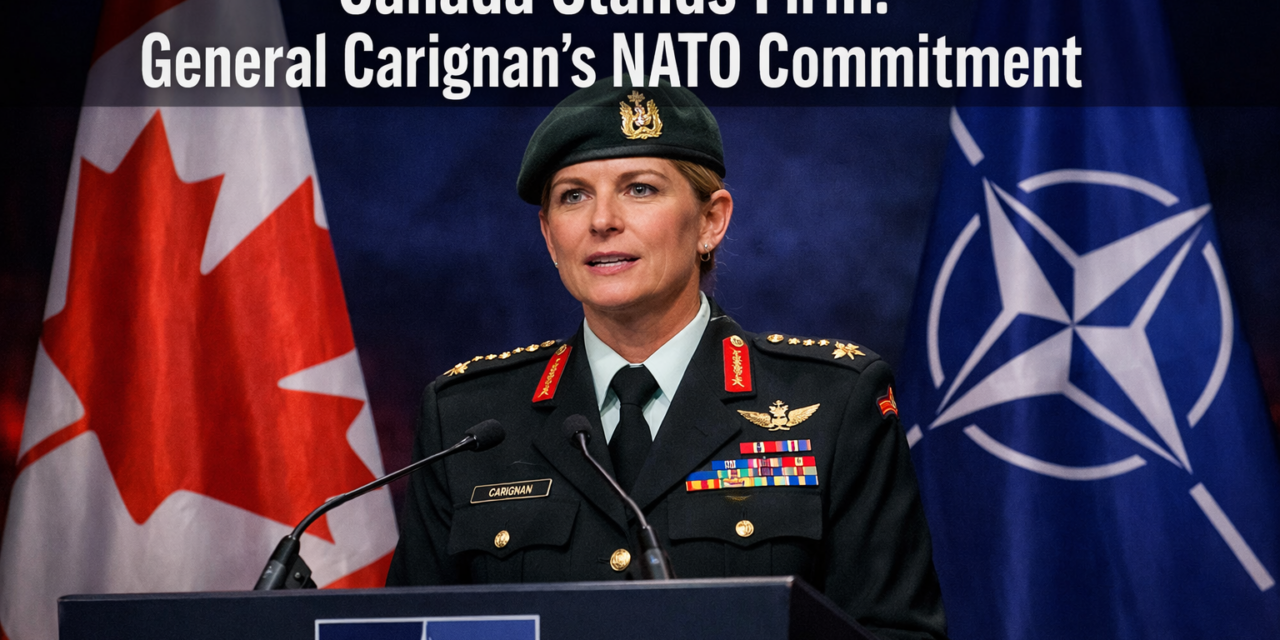
🇨🇦 General Jennie Carignan Says Canada Remains Committed to NATO | Building a 300,000 Member Strategic Reserve Force?

Last updated: April 16, 2026
Quick Answer: General Jennie Carignan, Chief of the Defence Staff, has publicly reaffirmed that Canada remains committed to NATO at a time of rising global tensions. Beyond words, she has announced plans to build a 300,000-member strategic reserve force — a move that signals Canada is preparing its military for a more dangerous world, not stepping back from it.

Key Takeaways
- 🇨🇦 General Jennie Carignan says Canada remains committed to NATO, directly countering speculation about wavering Canadian support for the alliance.
- 🪖 Canada is designing a 300,000-strong strategic reserve to bolster its defence capacity.
- The reserve plan reflects a broader shift in Western military thinking, driven by conflicts in Ukraine and rising tensions globally.
- Canada has pledged to increase defence spending toward NATO’s 2% of GDP target, a long-standing source of alliance friction.
- The announcement positions Canada as a serious defence partner, not just a political one.
- Carignan’s statements come amid pressure from NATO allies — especially the United States — for members to contribute more.
- The strategic reserve would draw on civilian expertise and trained reservists to expand Canada’s wartime capacity rapidly.
- This is one of the most significant Canadian military announcements in a generation.
Why General Jennie Carignan Says Canada Remains Committed to NATO
Canada’s top military officer isn’t just making a political statement — she’s backing it with a structural plan. General Jennie Carignan, Chief of the Defence Staff, confirmed that Canada’s alliance commitments are firm and that the Canadian Armed Forces are actively redesigning their force structure to reflect a more volatile global security environment.
The announcement matters because NATO allies have grown increasingly vocal about burden-sharing. Several member nations have questioned whether Canada pulls its weight, given that Canada has historically fallen short of the alliance’s 2% of GDP defence spending benchmark. Carignan’s declaration — paired with concrete reserve-building plans — is a direct answer to those concerns.
For Canadians who want to understand what national sovereignty and collective defence mean in 2026, this is a defining moment. You can explore more about what it means to keep Canada strong and free in the current geopolitical climate.

What Is the 300,000-Strong Strategic Reserve?
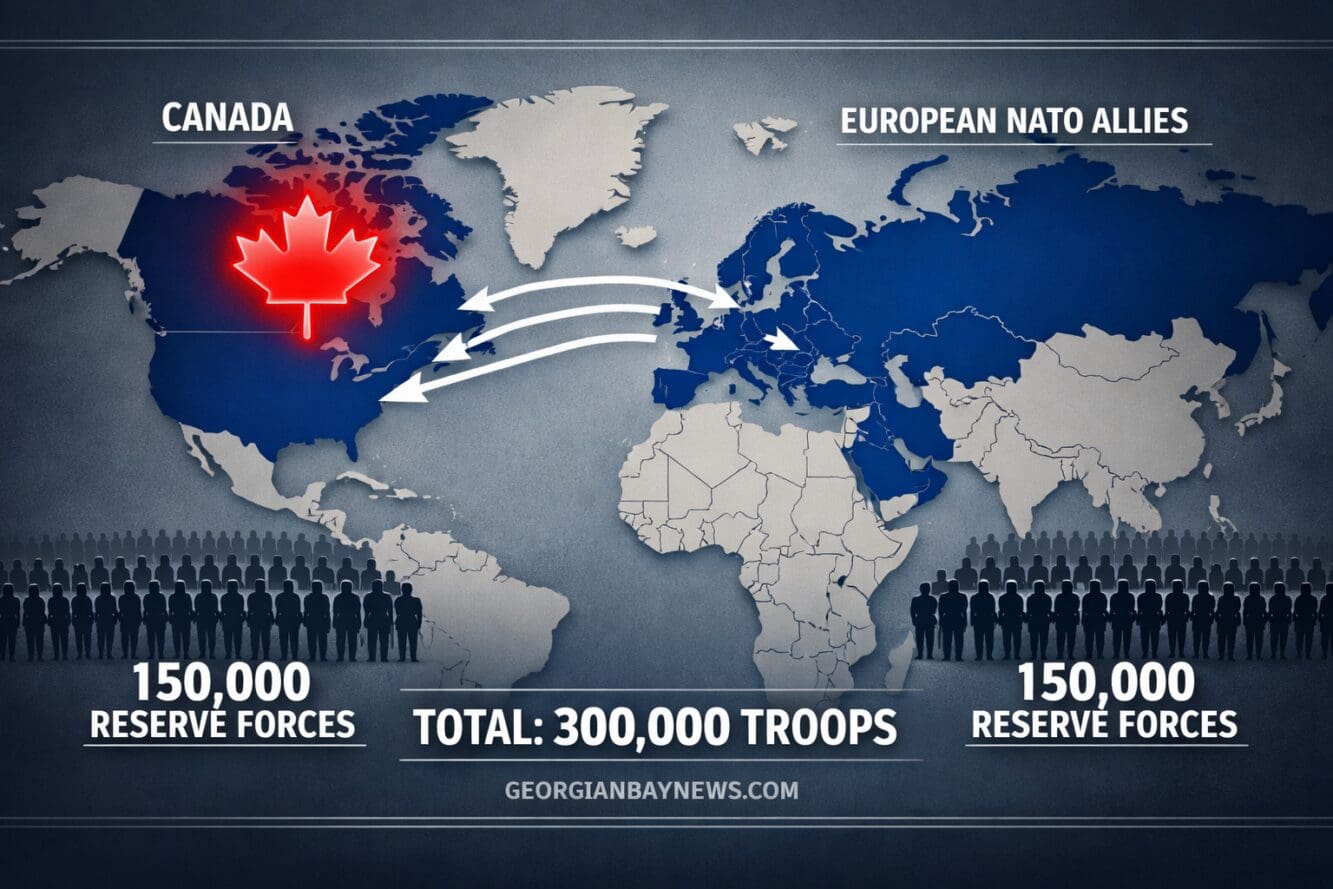
Canada is designing a strategic reserve of up to 300,000 personnel — a force that would exist alongside the regular military and primary reserve, deployable in a national emergency or large-scale conflict.
Here’s what is known about the plan:
| Element | Detail |
|---|---|
| Target size | Up to 300,000 personnel |
| Purpose | Strategic depth for high-intensity or prolonged conflict |
| Composition | Trained reservists, veterans, civilian specialists |
| Timeline | Design phase underway as of 2026 |
| Oversight | Led by the Canadian Armed Forces under General Carignan |
Why 300,000? The number reflects lessons from Ukraine, where large-scale mobilization proved critical to sustaining a war effort. Western planners now recognize that smaller professional armies, while effective in limited engagements, may lack the depth needed for prolonged high-intensity warfare.
“The world is preparing for war. Canada must be ready.” — the underlying message from General Carignan’s public statements in 2026.
This isn’t about aggression. It’s about deterrence. A credible reserve signals to adversaries that Canada can sustain a fight, not just start one.
How Does This Fit Canada’s NATO Spending Commitments?
NATO members agreed at the 2014 Wales Summit to move toward spending 2% of GDP on defence. Canada has consistently fallen short of that target, drawing criticism from allies — most pointedly from the United States.
General Jennie Carignan says Canada remains committed to NATO, and the reserve plan is part of a broader effort to demonstrate that commitment in practical terms, not just diplomatic language. Canada has announced increased defence budgets in recent years, with the trajectory pointing toward the 2% target, though the timeline remains debated domestically.
Common mistake to avoid: Confusing spending pledges with actual capability. The strategic reserve plan is notable because it focuses on structural capacity — the ability to field large numbers of trained personnel — rather than just equipment procurement or budget lines.
For context on how Canada’s national identity intersects with its defence posture, see the history of Canada Day and national unity.
What Global Pressures Are Driving This Decision?
The world in 2026 looks markedly different from a decade ago. Several converging pressures explain why General Carignan is making these announcements now:
- The war in Ukraine demonstrated that large-scale conventional warfare is not a relic of the past.
- Rising tensions in the Indo-Pacific have stretched alliance attention and resources.
- U.S. political pressure on NATO allies to increase burden-sharing has intensified.
- Arctic sovereignty concerns place Canada in a strategically sensitive position.
- Cybersecurity and hybrid warfare have expanded the definition of what “defence readiness” means.
Canada’s geographic position — bordering both the Atlantic and Arctic — makes its NATO commitment strategically significant beyond just troop numbers. The America is about to crash into a brick wall analysis offers broader context on the geopolitical and economic pressures reshaping Western alliances right now.

Who Is General Jennie Carignan?
General Jennie Carignan is Canada’s Chief of the Defence Staff — the highest-ranking officer in the Canadian Armed Forces. She made history as the first woman to hold the position, appointed in 2023. Her background includes operational experience in Afghanistan and extensive work in military engineering and leadership development.
Her public statements on NATO and the strategic reserve carry institutional weight. When General Jennie Carignan says Canada remains committed to NATO, it reflects official Canadian defence policy, not personal opinion.
Key facts:
- First woman to serve as Canada’s Chief of the Defence Staff
- Appointed 2023; continues in role through 2026
- Advocate for modernizing Canadian military structure
- Vocal on the need to prepare for high-intensity conflict scenarios
What Does This Mean for Ordinary Canadians?
Most Canadians won’t be called to serve in the strategic reserve. But the plan affects everyone in indirect ways:
- Tax dollars will fund the reserve’s development and training infrastructure.
- Veterans and reservists may have clearer pathways to contribute in a national emergency.
- Canada’s international standing improves when allies see credible defence commitments.
- Arctic and border security — issues that touch daily Canadian life — become better resourced.
The reserve plan also raises questions worth tracking: How will recruitment work? What civilian skills qualify? How does the reserve interact with provincial emergency management systems? These details are still being worked out in the design phase.
Conclusion: Canada Is Signalling It’s Serious
General Jennie Carignan says Canada remains committed to NATO — and the 300,000-strong strategic reserve plan transforms that commitment from a talking point into a structural reality. In a world where deterrence depends on credible capacity, Canada is moving to demonstrate it has both the will and the means to contribute meaningfully to collective defence.
Actionable next steps for engaged Canadians:
- Follow defence budget announcements — watch for how reserve funding appears in federal budgets.
- Learn about the Primary Reserve — if you’re interested in contributing, Canada’s existing reserve system is the entry point.
- Engage with your MP — defence policy decisions benefit from informed public input.
- Stay informed on NATO developments — alliance decisions affect Canadian foreign policy directly.
Canada’s role in NATO is not a footnote. In 2026, it’s becoming a central chapter in how the country defines itself on the world stage. For more on Canada’s national identity and values, read about celebrating what makes Canada strong.
FAQ
Q: What exactly did General Jennie Carignan say about NATO?
A: General Carignan publicly confirmed that Canada remains committed to its NATO obligations and announced plans to build a 300,000-member strategic reserve force to strengthen Canada’s defence capacity.
Q: What is a strategic reserve force?
A: A strategic reserve is a large pool of trained personnel — drawn from reservists, veterans, and civilians — that can be mobilized during a major conflict or national emergency to supplement the regular military.
Q: Why is Canada building a 300,000-strong reserve now?
A: The plan responds to lessons from the Ukraine war, increased NATO burden-sharing pressure, and a broader recognition among Western militaries that large-scale conflict scenarios require deep personnel reserves.
Q: Does Canada currently meet NATO’s 2% GDP spending target?
A: As of 2026, Canada has not consistently met the 2% target but has announced increased defence spending with a stated trajectory toward that goal.
Q: Who is General Jennie Carignan?
A: She is Canada’s Chief of the Defence Staff — the top military officer in the Canadian Armed Forces and the first woman to hold that position, appointed in 2023.
Q: Will ordinary Canadians be required to join the strategic reserve?
A: No mandatory service is planned. The reserve is designed as a voluntary structure drawing on trained reservists, veterans, and civilians with relevant skills.
Q: How does Canada’s strategic reserve compare to other NATO allies?
A: Several European NATO members, including Finland and Sweden, maintain large reserve systems. Canada’s planned 300,000-member force would bring it closer to that model of strategic depth.
Q: When will the strategic reserve be operational?
A: The force is currently in its design phase as of 2026. A full operational timeline has not been publicly confirmed.
References
- NATO. (2014). Wales Summit Declaration. NATO Official Website. https://www.nato.int/cps/en/natohq/official_texts_112964.htm
- Department of National Defence, Canada. (2024). Canada’s Defence Policy Update. Government of Canada. https://www.canada.ca/en/department-national-defence/news/2024/04/our-north-strong-and-free.html
- CBC News. (2025). General Jennie Carignan outlines strategic reserve plans. CBC. https://www.cbc.ca
- NATO. (2023). Vilnius Summit Communiqué. NATO Official Website. https://www.nato.int
Content, illustrations, and third-party video appearing on GEORGIANBAYNEWS.COM may be generated or curated with AI assistance or reproduced pursuant to the fair dealing provisions of the Copyright Act, R.S.C. 1985, c. C-42. Attribution and hyperlinks to original sources are provided in acknowledgment of applicable intellectual property rights. Such referencing is intended to direct traffic to and support the original rights holders’ platforms.
Much Appreciate You Sharing This Post - It Helps MUCH!!!