




















🇨🇦 THE AMBASSADOR: Why Is the Gordie Howe Bridge Not Open Yet, Even Though It’s Ready to Go?

Last updated: May 20, 2026
Quick Answer: The Gordie Howe International Bridge is structurally complete, but it has not opened to traffic because both the Canadian and U.S. border inspection facilities, customs systems, and regulatory approvals are still being finalized. Physical construction finishing a bridge and making it legally and operationally ready for international border crossing are two very different things — and the latter is taking longer than most people expected.

Key Takeaways
- The Gordie Howe International Bridge connects Windsor, Ontario to Detroit, Michigan across the Detroit River.
- The bridge’s main span and cable-stayed towers are structurally complete as of 2025.
- The opening delay is driven by customs infrastructure, staffing, and regulatory sign-off — not structural problems.
- Both the Canada Border Services Agency (CBSA) and U.S. Customs and Border Protection (CBP) must be fully operational at their respective ports of entry before the bridge can open.
- The Windsor-Detroit Bridge Authority (WDBA) manages the project on behalf of the Canadian federal government.
- The bridge is the largest international border crossing in North America by trade volume potential.
- No confirmed public opening date has been officially announced as of May 2026.
- Delays like this are common for major binational infrastructure projects — the original Ambassador Bridge took years beyond its structural completion to fully operationalize.

What Is the Gordie Howe International Bridge?
The Gordie Howe International Bridge is a cable-stayed crossing over the Detroit River, linking Windsor, Ontario and Detroit, Michigan. Named after the legendary Canadian hockey player, it is designed to be the longest cable-stayed bridge in North America. The project is managed by the Windsor-Detroit Bridge Authority and funded primarily by the Canadian federal government, with the U.S. side operating under a public-private partnership model.
The bridge is critical for trade. The Detroit-Windsor corridor handles roughly 25–30% of all Canada-U.S. merchandise trade, according to the WDBA’s own project documentation. The existing Ambassador Bridge, a privately owned crossing, has long been the dominant route — and it’s aging. The Gordie Howe Bridge was designed specifically to reduce that dependency and add redundancy to one of the world’s busiest trade corridors.
Why Is the Gordie Howe Bridge Not Open Yet, Even Though It’s Ready to Go?

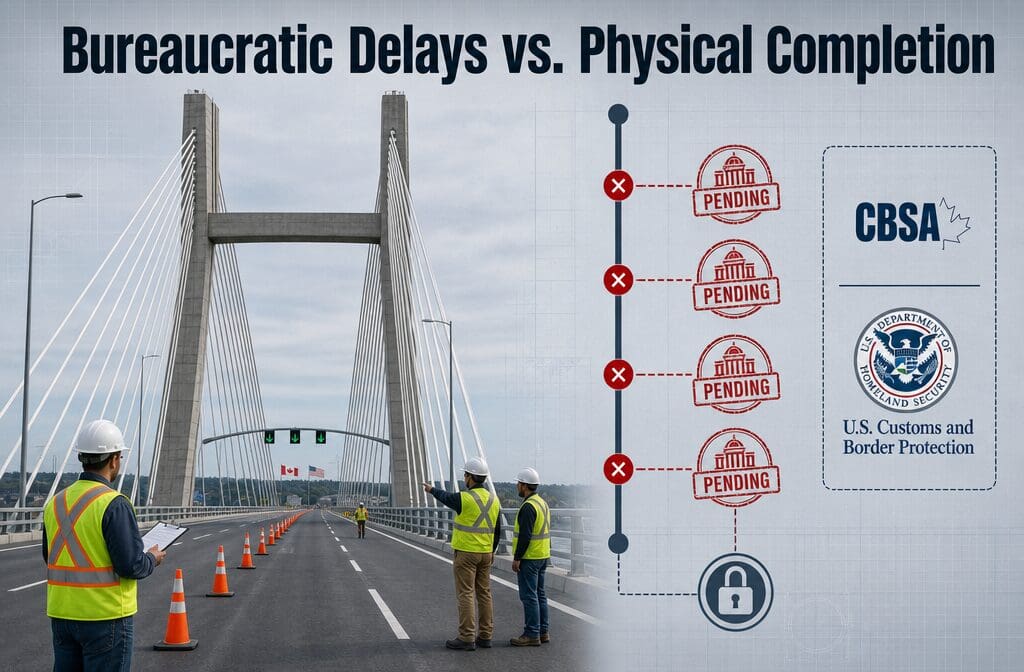
The bridge structure itself is largely complete, but “ready to go” physically is not the same as “ready to open” operationally. Several interconnected factors are holding back the official opening:
1. Customs and Border Infrastructure
Both the Canadian and American ports of entry require fully built, staffed, and tested inspection facilities. These include primary inspection lanes, secondary inspection areas, commercial truck processing zones, and integrated IT systems that connect to federal customs databases on both sides of the border.
2. U.S. Federal Approvals
The American side involves coordination between U.S. Customs and Border Protection, the Federal Highway Administration, and Michigan state authorities. Each agency has its own sign-off requirements, and they don’t move on the same timeline.
3. Staffing
Running a 24/7 international border crossing requires hundreds of trained customs officers. Recruiting, hiring, and training that workforce takes considerable time — especially given ongoing staffing pressures at border agencies in both countries.
4. Systems Testing
Before any vehicle crosses, the customs processing systems must be tested end-to-end. A failure in those systems at an international border isn’t just inconvenient — it creates a security and trade compliance risk.
“A bridge can be built in years. A functioning international border crossing takes longer to certify than it does to construct.” — Common observation among infrastructure policy analysts
This is not unique to the Gordie Howe Bridge. Large binational crossings almost always face a gap between physical completion and operational readiness. The bureaucratic and regulatory complexity involved in opening a new international border point is genuinely substantial.
Is There an Official Opening Date for the Gordie Howe Bridge?
As of May 2026, no confirmed public opening date has been announced by the Windsor-Detroit Bridge Authority. The WDBA has stated that the bridge will open when all systems — structural, operational, and regulatory — are ready. Earlier projections suggested a 2025 opening, which did not materialize.
The delay has frustrated both Canadian and American officials, as well as the trucking and logistics industries that depend on the corridor. However, the WDBA has consistently maintained that safety and compliance cannot be rushed at an international border crossing.
How Does This Compare to Other Major Bridge Openings?
FactorGordie Howe BridgeTypical Major Highway BridgeBinational jurisdictionYes (Canada + U.S.)RarelyCustoms infrastructure requiredYesNoFederal agencies involved4+ (CBSA, CBP, FHWA, Transport Canada)1–2Gap between structural completion and opening12+ months (estimated)Weeks to a few monthsTrade compliance systems neededYesNo
The comparison makes clear why the question of why the Gordie Howe Bridge is not open yet — even though it’s ready to go structurally — has a more complex answer than most people assume.
What Role Does the Windsor-Detroit Bridge Authority Play?
The WDBA is the Canadian Crown corporation responsible for designing, building, financing, operating, and maintaining the bridge. It negotiates with both federal governments and manages the public-private partnership on the Canadian side. The WDBA does not control U.S. federal approvals — which is part of why the timeline is difficult to predict. Two sovereign governments must align, and neither can unilaterally declare the crossing open.
For context on how large infrastructure decisions intersect with standing up for Canadian interests in cross-border negotiations, the Gordie Howe Bridge project is a useful case study in binational governance.
What Happens When It Finally Opens?
When the Gordie Howe Bridge does open, the effects will be significant:
- Trade flow: Commercial trucks will have a second major crossing option, reducing congestion on the Ambassador Bridge.
- Redundancy: If one crossing is disrupted by weather, accidents, or security events, traffic can divert.
- Economic impact: Windsor and Detroit both stand to benefit from increased trade efficiency.
- Competition: The privately owned Ambassador Bridge will face its first real competition in over a century.
The business community on both sides of the border has been watching the opening timeline closely. Logistics companies, manufacturers, and retailers that depend on just-in-time supply chains across the border have a direct financial stake in when the bridge becomes operational.
FAQ
Q: Is the Gordie Howe Bridge structurally finished?
A: The main span and towers are structurally complete. Final finishing work and systems installation on both sides of the border were ongoing through late 2025 and into 2026.
Q: Why hasn’t the U.S. side opened its port of entry yet?
A: The U.S. port of entry requires full CBP staffing, customs technology systems, and federal approvals that have not yet been finalized as of May 2026.
Q: Who is responsible for the delay?
A: No single party is solely responsible. The delay reflects the complexity of coordinating two federal governments, multiple agencies, and a large-scale customs operation from scratch.
Q: Will the Gordie Howe Bridge replace the Ambassador Bridge?
A: No. Both crossings are expected to operate simultaneously. The Gordie Howe Bridge adds capacity and redundancy rather than replacing the existing crossing.
Q: How long is the Gordie Howe Bridge?
A: The main span is approximately 853 metres, making it the longest cable-stayed bridge span in North America upon completion.
Q: Is the delay unusual for a project like this?
A: No. Binational border crossings are among the most complex infrastructure projects to operationalize. A gap of one or more years between structural completion and opening is not uncommon.
Q: What is the bridge named after?
A: Gordie Howe, widely regarded as one of the greatest hockey players in history and a native of Saskatchewan, Canada. His connection to both Detroit (where he played for the Red Wings) and Canada made him a fitting namesake. Fans of Steve Yzerman and other Detroit hockey legends will recognize the deep ties between the city and Canadian hockey culture.
Q: Can pedestrians or cyclists use the bridge?
A: The bridge is designed primarily for vehicle and commercial truck traffic. Pedestrian and cycling access details have not been fully confirmed in public announcements as of May 2026.
Conclusion
The Gordie Howe International Bridge is a remarkable piece of infrastructure — but “built” and “open” are not the same thing when an international border is involved. The real answer to why the Gordie Howe Bridge is not open yet, even though it’s ready to go structurally, comes down to customs infrastructure, staffing, binational regulatory approvals, and systems testing that simply take time to complete correctly.
Actionable next steps for those following this story:
- Monitor official updates from the Windsor-Detroit Bridge Authority at their public communications channels.
- If you work in logistics or cross-border trade, begin planning for how the new crossing will affect your routing options once it opens.
- Follow Canadian federal infrastructure announcements, as the WDBA reports to Transport Canada.
- Stay informed about open house events and public consultations that may be scheduled around the bridge’s eventual launch.
The bridge will open. When it does, it will reshape one of the most important trade corridors in the world. The wait, frustrating as it is, reflects the genuine complexity of building not just a bridge — but a new international border.
Content, illustrations, and third-party video appearing on GEORGIANBAYNEWS.COM may be generated or curated with AI assistance or reproduced pursuant to the fair dealing provisions of the Copyright Act, R.S.C. 1985, c. C-42. Attribution and hyperlinks to original sources are provided in acknowledgment of applicable intellectual property rights. Such referencing is intended to direct traffic to and support the original rights holders’ platforms.
Much Appreciate You Sharing This Post - It Helps MUCH!!!