



















🇨🇦 Why Are the U.S. and Japan Propping Up the Yen, and What Does It Mean for Canada?

Last updated: August 14, 2026
Quick Answer
The U.S. and Japan have been propping up the yen through coordinated currency market interventions because the yen’s sharp decline against the dollar threatened Japan’s financial stability and created ripple effects across global trade. For Canada, yen volatility affects export competitiveness, commodity demand, and Japanese investment flows into Canadian industries.
Key Takeaways
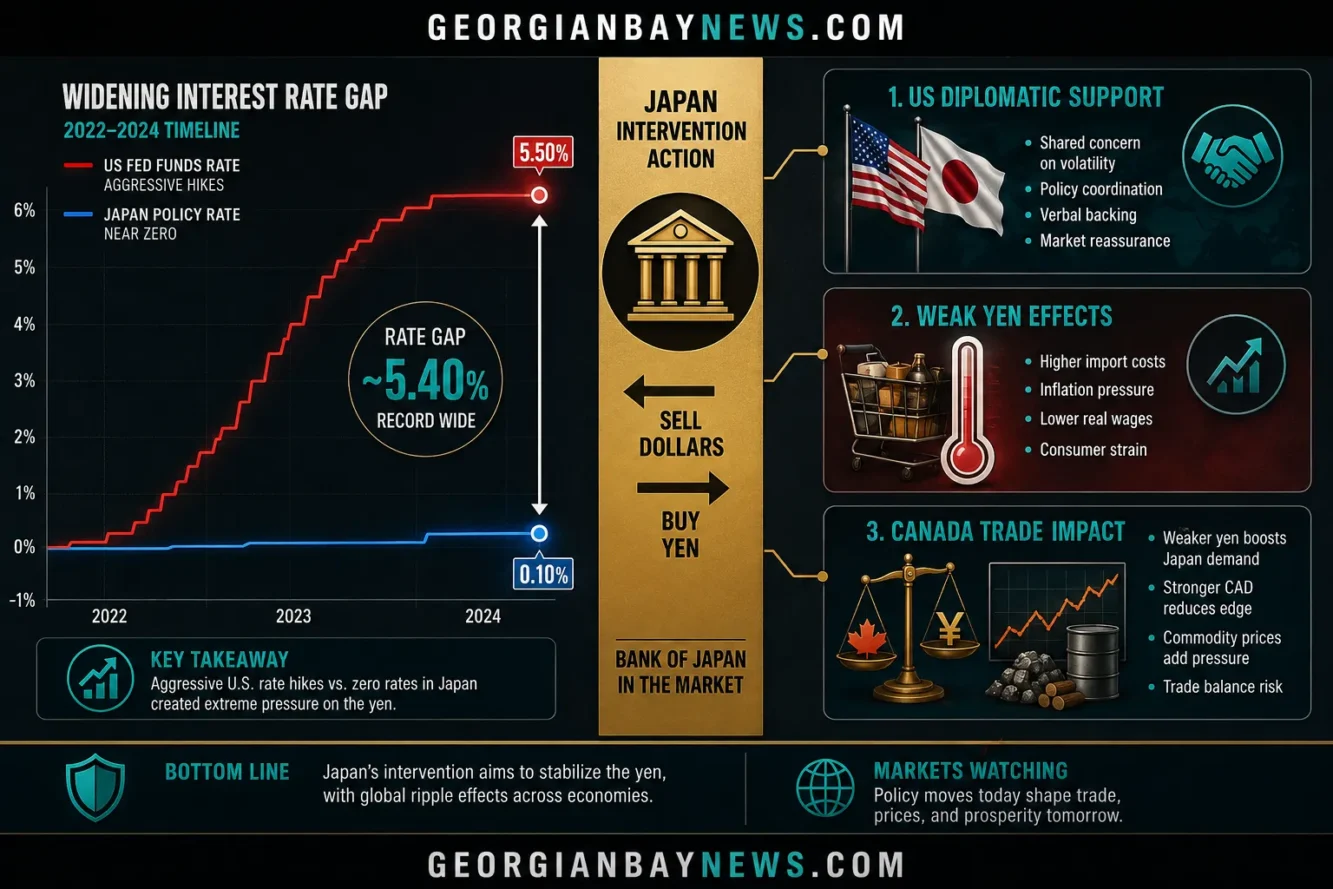
- The yen weakened dramatically in 2022-2024 due to widening interest rate gaps between Japan and the U.S.
- Japan intervened by selling dollars and buying yen to push its currency’s value higher
- The U.S. has expressed diplomatic support for Japan’s interventions, a notable shift in posture
- A weak yen raises import costs in Japan, squeezing households and small businesses
- Canadian exporters face headwinds when the yen is weak because Japanese buyers find Canadian goods more expensive
- A stronger yen could boost Japanese investment in Canadian energy and infrastructure projects
- Currency intervention is expensive, temporary, and carries risks if economic fundamentals don’t shift
- The Bank of Canada monitors yen movements for their effect on inflation and trade balances
Why Is the Yen Weakening Against the Dollar?
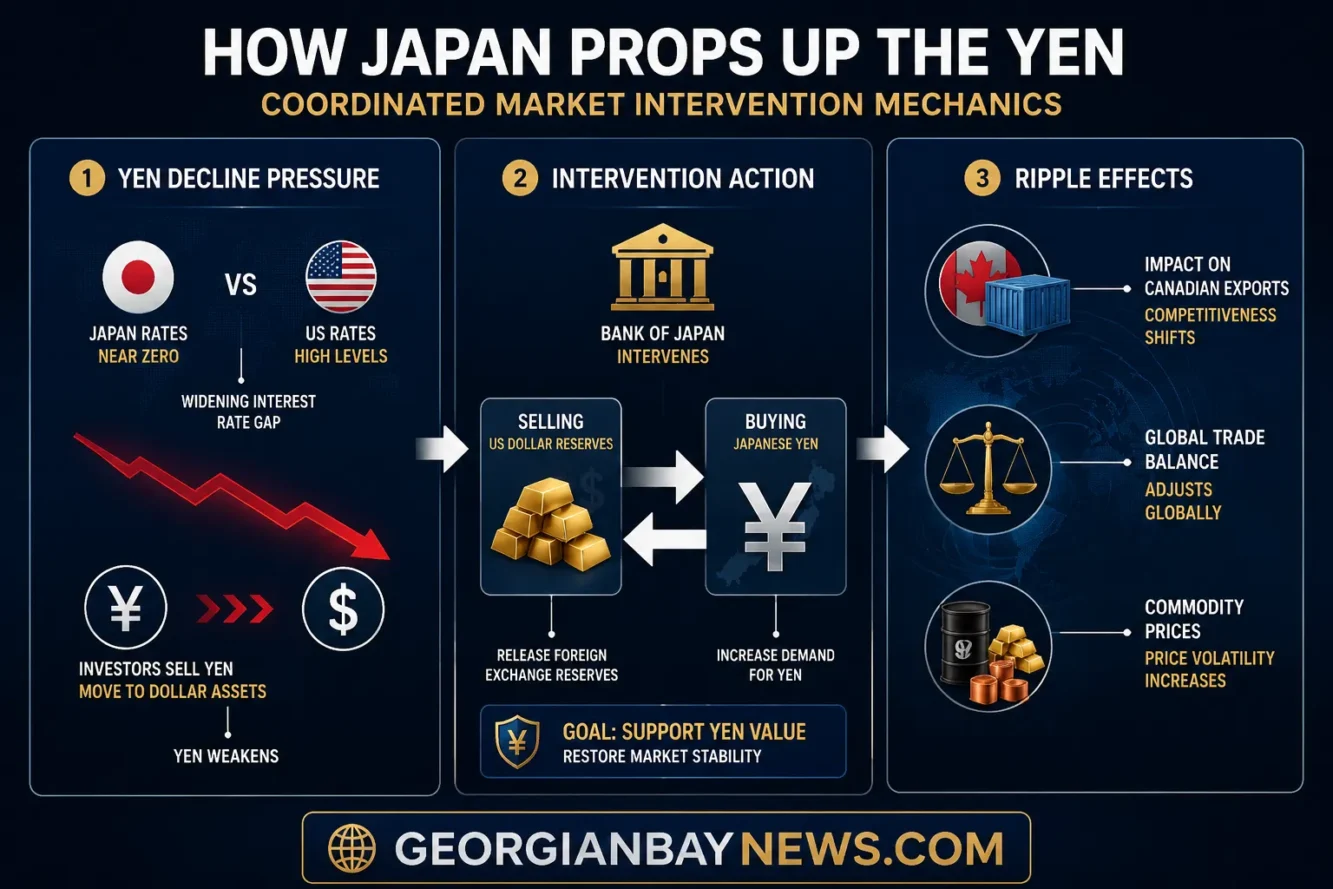
The yen has weakened against the dollar because Japan kept interest rates near zero while the U.S. Federal Reserve raised rates aggressively from 2022 through 2024. This widening gap pushed investors to sell yen and buy dollar-denominated assets for higher returns.
The Bank of Japan maintained ultra-low rates for years, even as other major central banks hiked rates to fight inflation. Japan’s inflation was historically lower than in the U.S. and Europe, giving the BOJ less pressure to tighten. The result was a persistent interest rate differential that made the yen less attractive to hold.
In 2024, the yen fell to around 160 per dollar, its weakest level in decades. The BOJ ended negative interest rates in March 2024, but the move was too gradual to close the gap with U.S. rates. Speculators piled into carry trades, borrowing yen cheaply to invest in higher-yielding currencies elsewhere.
How a weak yen affects the Japanese economy: A weaker yen makes Japanese exports cheaper abroad, which initially helped major exporters like Toyota and Sony. But it also raised the cost of imported energy, food, and raw materials, squeezing Japanese households and small businesses that depend on imports.
What Does Propping Up the Yen Actually Mean?
Propping up the yen means Japan’s government takes direct action in foreign exchange markets to increase its currency’s value. In practice, this involves selling U.S. dollars from Japan’s reserves and buying yen to drive up demand for the Japanese currency.
Currency intervention is different from monetary policy. Interest rate changes work indirectly by influencing borrowing costs and investment flows. Intervention works directly by changing the supply and demand for currencies in the market.
How central banks intervene in currency markets: The process is straightforward in concept but complex in execution. Japan’s Ministry of Finance instructs the Bank of Japan to enter foreign exchange markets and place large buy orders for yen while selling dollars. This reduces the supply of yen in circulation, pushing its price higher.
Japan holds over a trillion dollars in foreign reserves, giving it substantial firepower. But intervention is expensive and can fail if market forces are stronger than the intervention itself.
Common mistake: Assuming intervention permanently reverses a currency trend. In reality, it usually buys time for fundamental changes, like rate hikes or fiscal shifts, to take hold. Without those changes, the currency often resumes its prior trajectory.
Why Is Japan Propping Up the Yen Right Now?
Japan wants a stronger yen because the weak currency has pushed import costs to painful levels for households and businesses, threatening economic stability and political support for the ruling party.
The weak yen has been a double-edged sword. While exporters benefit, the costs have mounted. Japan imports nearly all its oil and gas, and a weaker yen makes these essentials more expensive. Food prices have also risen, hitting consumers directly and denting household confidence.
How a stronger yen affects Japanese companies abroad: Japanese companies with overseas operations earn profits in dollars and euros. When they convert those profits back to yen, a weaker yen actually boosts their reported earnings. But a stronger yen reduces this accounting boost, which is why some corporate leaders welcomed the weak yen. The tension between exporter interests and consumer welfare has made yen policy politically charged.
Japan’s government has also faced pressure from trading partners who see the weak yen as an unfair competitive advantage in exports. A stronger yen would ease those trade tensions.
What’s the US Role in Propping Up the Yen?
The U.S. has signaled support for Japan’s yen interventions, a notable shift from its usual stance of letting markets set currency values. This support matters because unilateral intervention is less effective than coordinated action.
Historically, the U.S. Treasury has been skeptical of currency intervention, preferring market-determined exchange rates. But in 2024, U.S. officials expressed understanding of Japan’s actions, stopping short of full coordination but offering political backing.
What’s the history of US-Japan currency intervention: The two countries have a long history of currency coordination. The 1985 Plaza Accord saw the U.S., Japan, and other G5 nations agree to push the dollar down against the yen and other currencies. In the late 1990s, Japan intervened to weaken the yen, and the U.S. occasionally joined. More recently, Japan intervened unilaterally in 2022 and 2024 to support the yen.
When did Japan last try to prop up the yen: Japan intervened in September and October 2022, spending billions to buy yen. It intervened again in April, May, and July 2024 as the yen slid toward 160 per dollar. These were the first yen-buying interventions since 1998, underscoring the severity of the situation.
The U.S. role is mostly diplomatic. By not opposing Japan’s actions, the U.S. reduces the risk of market speculation that could undermine the intervention. Direct U.S. participation would signal stronger commitment but remains unlikely under current policy.
What Happens to the Canadian Dollar When the Yen Strengthens?
When the yen strengthens, the Canadian dollar can face mixed effects. A stronger yen often reflects broader dollar weakness, which can lift the Canadian dollar. But the specific dynamics depend on trade flows, commodity prices, and investor sentiment.
Canada and Japan are significant trading partners. Japan is one of Canada’s largest export markets in Asia, particularly for energy products, agricultural goods, and raw materials. When the yen strengthens, Japanese buyers have more purchasing power for Canadian exports.
How yen weakness impacts Canadian exports: When the yen is weak, Canadian goods become more expensive for Japanese importers. This can reduce demand for Canadian lumber, wheat, coal, and seafood. Canadian companies that price in dollars face lower sales volumes or pressure to cut prices. A stronger yen reverses this dynamic, making Canadian products more affordable in Japan.
The Canadian dollar itself is influenced by multiple factors, including oil prices, U.S. dollar movements, and Bank of Canada policy. Yen movements are one piece of a larger puzzle, but they matter for specific sectors.
| Factor | Weak Yen Effect | Strong Yen Effect |
|---|---|---|
| Canadian exports to Japan | Lower demand | Higher demand |
| Japanese investment in Canada | Potentially reduced | Potentially increased |
| Commodity prices (Japan demand) | Downward pressure | Upward support |
| Canadian dollar vs. yen | CAD stronger | CAD weaker |
Why Should Canadians Care About Yen Exchange Rates?
Canadians should care about yen exchange rates because Japan is a major trading partner, a significant investor in Canadian projects, and a key player in global commodity markets that affect the Canadian economy.
Japan is among Canada’s top five trading partners in Asia. Canadian energy exports, including liquefied natural gas, are increasingly important as Japan diversifies its energy sources. Yen strength or weakness directly affects how much Japanese companies can spend on Canadian resources. For broader context on Canadian economic positioning, see Standing Up For Canada.
Japanese investment in Canada spans sectors from energy to technology. Canadian communities that host Japanese-owned businesses feel the impact when currency shifts change investment decisions. Canada’s own economic strategy, including major investments like Small Nuclear Reactors Why Canada Is Investing Billions, intersects with global currency trends that affect capital flows.
Quick example: A Japanese automaker with plants in Canada might shift production based on currency levels. A weak yen makes it cheaper to produce in Japan and export, potentially reducing Canadian operations. A strong yen makes Canadian production more attractive.
Canadian political leaders have also weighed in on trade and currency issues. The Conservative Party Of Canada has historically emphasized export competitiveness, which ties directly to exchange rate dynamics with trading partners like Japan.
For Canadians concerned about economic security and retirement planning amid global volatility, understanding these connections matters. Currency shifts can affect everything from pension fund returns to the cost of imported goods, as explored in our coverage of Social Security and economic safety nets.
What Are the Risks of Propping Up the Yen?
Currency intervention carries significant risks, including depleted reserves, market retaliation, and the possibility that intervention fails to change the underlying economic fundamentals driving the currency.
Key risks include:
- Burning through reserves: Japan spends billions per intervention. If the yen keeps falling, those reserves shrink without lasting results.
- Speculator testing: Currency traders may test the central bank’s resolve, selling yen aggressively to see if intervention holds.
- Moral hazard: Markets may expect future bailouts, encouraging riskier carry trades.
- Political friction: Trading partners may view intervention as currency manipulation, triggering disputes.
How long does currency intervention usually last: Intervention effects are typically short-lived, often lasting days to weeks unless backed by fundamental policy changes. The 2022 interventions briefly strengthened the yen, but the currency resumed its decline within months. The 2024 interventions had similar mixed results. Lasting change requires interest rate adjustments or fiscal policy shifts that address the root causes of currency weakness.
Japan’s strategy through 2025 has been to combine intervention with gradual rate hikes, aiming for a more sustainable yen recovery. Whether this succeeds depends on how quickly Japan’s rates converge with U.S. rates. For Canada, the lesson is that currency management is a balancing act, and the Bank of Canada watches these dynamics for their effect on Canadian inflation and financial stability. Broader economic planning, as discussed in our Master Plan coverage, must account for these global currency currents.
FAQ
Why is the yen so weak compared to the dollar?
The yen is weak because Japan kept interest rates near zero while the U.S. raised rates sharply. Investors moved money to dollar assets for higher returns, selling yen and driving its value down.
What does propping up the yen mean?
Propping up the yen means Japan’s government buys yen and sells dollars in currency markets to increase the yen’s value, countering market forces pushing it lower.
How does yen weakness affect Canadian consumers?
Yen weakness can lower prices of Japanese imports like electronics and cars in Canada, but it can also reduce demand for Canadian exports, potentially slowing economic growth in export-dependent regions.
Has the U.S. ever directly intervened to support the yen?
The U.S. participated in coordinated interventions in the 1990s and the 1985 Plaza Accord, but recent U.S. support has been diplomatic rather than direct market participation.
Can Japan sustain yen intervention indefinitely?
No. Japan has large reserves but not unlimited funds. Sustained intervention without policy changes would eventually deplete reserves and could trigger market backlash.
What should Canadian businesses do about yen volatility?
Canadian businesses trading with Japan should use currency hedging tools, diversify export markets, and monitor BOJ policy decisions to manage yen-related risks.
Conclusion
The U.S. and Japan are propping up the yen because its decline threatened Japan’s economic stability and created global trade imbalances. For Canada, yen movements affect export competitiveness, commodity demand, and Japanese investment in Canadian industries. While intervention provides temporary relief, lasting yen strength depends on Japan closing its interest rate gap with the U.S.
Actionable next steps for Canadians:
- Monitor Bank of Japan rate decisions, as they signal future yen direction
- If exporting to Japan, consider currency hedging to protect against yen swings
- Watch commodity prices, as yen strength often correlates with higher Japanese demand for Canadian resources
- Stay informed about Canadian trade policy responses and how global currency trends shape domestic economic planning
Understanding currency dynamics helps Canadians make better business and investment decisions in an interconnected global economy.
Sources
- Bank of Japan, Statement on Monetary Policy, 2024
- U.S. Department of the Treasury, Report on Macroeconomic and Foreign Exchange Policies, 2024
- International Monetary Fund, Japan: Article IV Consultation, 2024
- Statistics Canada, Canadian International Merchandise Trade Database, 2024
Content, illustrations, and third-party video appearing on GEORGIANBAYNEWS.COM may be generated or curated with AI assistance or reproduced pursuant to the fair dealing provisions of the Copyright Act, R.S.C. 1985, c. C-42. Attribution and hyperlinks to original sources are provided in acknowledgment of applicable intellectual property rights. Such referencing is intended to direct traffic to and support the original rights holders’ platforms.