





















🇨🇦 Young Canadians Leading Climate Action Projects That Actually Changed Their Communities

Sharing is SO MUCH APPRECIATED!


Last updated: June 15, 2026
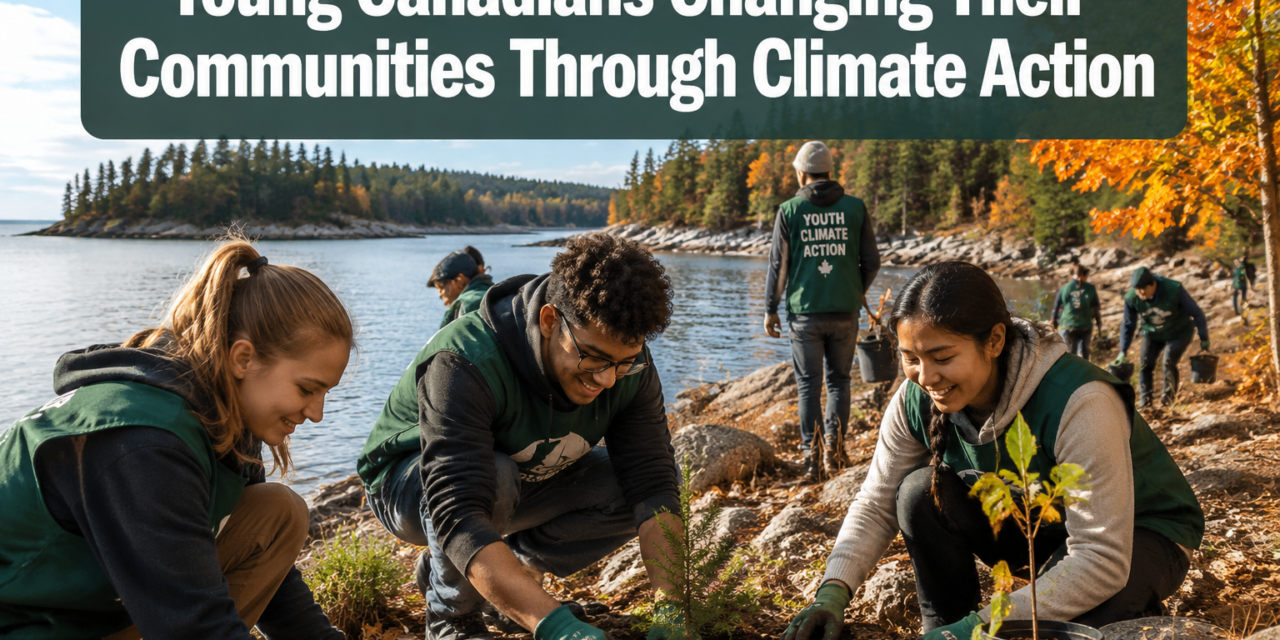
Quick Answer: Young Canadians leading climate action projects that actually changed their communities have moved well beyond symbolic gestures. From paid wildfire preparedness crews in British Columbia to youth-run composting programs in New Westminster, these initiatives have produced measurable environmental results, engaged hundreds of thousands of participants, and reshaped how local governments think about youth leadership. The projects work best when they combine hands-on work, community buy-in, and access to real funding.
Key Takeaways
- Youth Climate Corps BC has logged over 10,000 working days across more than ten communities since 2020, covering wildfire prep, energy retrofits, and ecosystem restoration [1]
- The GenAction initiative engaged more than 288,740 young Canadians in climate education through 30 science centres and museums, surpassing its original goal of 200,000 [2]
- The Climate75 Fellowship, launched in 2026 by The Starfish Canada, gives youth aged 18-25 an eight-month structured path from idea to community showcase [3]
- Youth Climate Lab has directly engaged over 3,500 youth under 30 across 55 programs, paying 206 young contributors for their work [4]
- Youth Challenge International has united over 110,000 volunteer hours from young Canadians working with more than 25 government and community partners [10]
- Small-town climate projects succeed most when they focus on one visible, local problem rather than broad policy goals
- Most starter projects need between $500 and $5,000; government grants and municipal youth funds are the most accessible entry points
- Schools that embed climate action into curricula, not just clubs, produce more sustained community impact
- The biggest mistake new youth activists make is skipping the community consultation step before launching a project
- Provinces like British Columbia, Ontario, and Quebec have the most active youth climate funding streams, but national programs are expanding
What Are Some Successful Youth Climate Projects in Canada
Several youth-led climate projects in Canada have produced results that go beyond awareness campaigns. The most effective ones involve paid work, measurable outputs, and partnerships with local governments or environmental organizations.
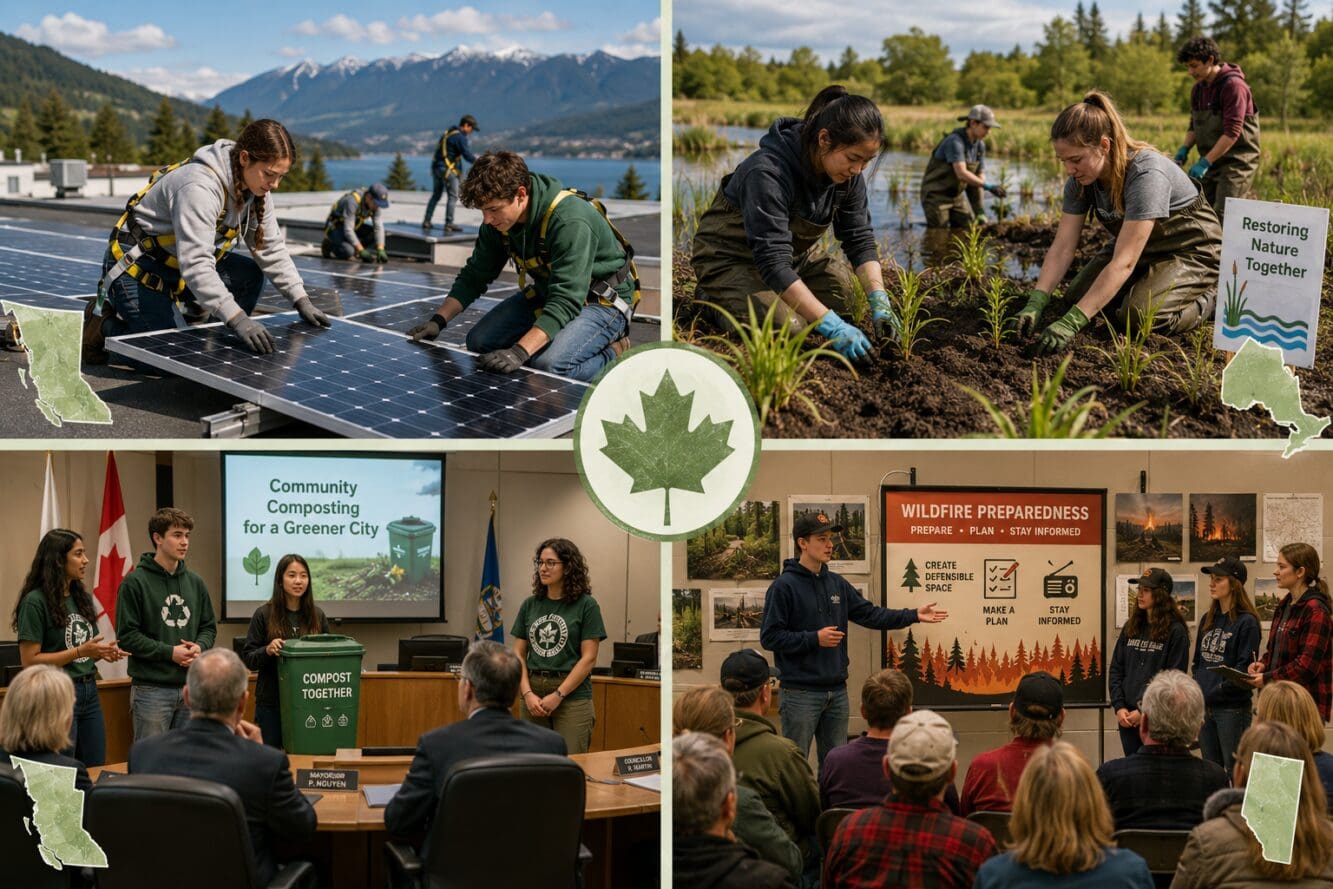
Youth Climate Corps BC (YCCBC) stands out as one of the strongest examples. Since 2020, it has engaged over 100 young British Columbians in paid, hands-on climate work across more than ten communities. Participants have completed 10,000 working days on projects including wildfire preparedness, energy retrofits, ecosystem restoration, and local food systems [1]. The “paid” element matters: it removes financial barriers and signals that youth contributions are professional, not charitable.
Human Nature Projects (HNP) Canada, celebrating its fifth year in 2026, has involved over 10,000 youth in environmental education, conservation, and restoration globally, while hosting more than 30 events and securing over $20,000 in funding [5].
In New Westminster, eight youth groups implemented ten projects in 2024 through the Bloomberg Philanthropies-supported Youth Climate Action Fund, covering green spaces, environmental awareness, and community resilience [7].

How Do Teenagers Actually Make a Difference in Local Environmental Issues
Teenagers make a real difference when they focus on specific, local problems with clear before-and-after outcomes. General advocacy matters, but local action with a defined scope, such as restoring a pollinator garden, reducing school food waste, or mapping urban tree canopy, produces the kind of visible change that builds community trust and political support.
Key approaches that work:
- Partnering with an existing organization to access tools, liability coverage, and mentorship
- Choosing a project with measurable outcomes (tonnes of waste diverted, hectares restored, kilowatt-hours saved)
- Presenting results to local councils to build credibility for future funding
- Using social media strategically to document progress and attract community volunteers
The Waves of Change initiative, run by Ocean Wise with TakingITGlobal and GreenLearning, shows how digital engagement combined with in-person events can connect youth to ocean health and climate science in ways that translate into local action [8].
Which Canadian Youth Climate Activists Have Created Real Community Change
Young Canadians leading climate action projects that actually changed their communities come from every province, but a few programs have produced particularly well-documented results.
Youth Climate Lab, operating since 2017, has run 55 unique programs and directly engaged over 3,500 youth under 30. Notably, they have paid 206 young thought-leaders, artists, activists, and wellness practitioners for their contributions, reaching youth in 105 countries through more than 100 global partners [4].
Green Mind Canada, founded in 2023, addresses the mental health dimension of climate change. By 2026, it has reached over 4,500 young people through workshops, toolkits, and creative resources, and has published three books with national recognition [6]. This matters because burnout is a real barrier to sustained climate leadership.
Youth Challenge International’s Climate Action Network has united over 110,000 volunteer hours from young Canadians, working alongside more than 25 government and community partners to accelerate green innovation through human-centered design [10].
Are Youth Climate Initiatives Really Effective or Just Symbolic
Youth climate initiatives are genuinely effective when they are structured around tangible deliverables, not just symbolic. The evidence from Canadian programs is clear: projects with paid participants, defined scopes, and community partnerships produce measurable environmental and social outcomes.
The GenAction initiative is a useful benchmark. Launched in 2021 through 30 science centres and museums, it surpassed its goal of engaging 200,000 young Canadians, ultimately reaching over 288,740 youth in climate action education [2]. Education-focused programs build the pipeline for future project leaders.
Symbolic actions, such as one-day rallies without follow-up plans, tend to fade quickly. Projects that embed youth into ongoing community systems, like southern Georgian Bay communities environmental stewardship programs, tend to last longer and produce compounding benefits.
Decision rule: Choose a project structure that has a defined end date, a measurable output, and a plan for what happens after the project closes. If none of those exist, the initiative risks staying symbolic.
How Much Money Do Youth Climate Projects Typically Need to Get Started
Most youth climate projects can launch with between $500 and $5,000. Larger programs with paid staff or equipment needs may require $10,000 to $50,000, but many impactful community projects start small.
Common startup cost categories:
Cost CategoryTypical RangeMaterials and supplies$200 – $2,000Event or workshop costs$300 – $1,500Communications and printing$100 – $500Transportation$200 – $1,000Paid youth stipends (if applicable)$2,000 – $20,000+
HNP Canada has secured over $20,000 in total funding across its programs, showing that even modest amounts can support meaningful work [5]. The Youth Climate Action Fund in New Westminster demonstrates that municipal partnerships can unlock Bloomberg Philanthropies-level support for youth groups [7].
What Government Grants Exist for Youth Environmental Projects
Several government and foundation grants are accessible to young Canadians starting climate projects. The most relevant include:
- Environment and Climate Change Canada’s EcoAction Community Funding Program: supports community-based environmental projects
- Youth Climate Action Fund (Bloomberg Philanthropies, via municipal partnerships): available to cities that apply and then distribute to youth groups [7]
- Provincial environment ministries: British Columbia, Ontario, and Quebec each have youth-specific environmental funding streams
- Municipal sustainability offices: many cities offer small grants ($500-$5,000) directly to youth groups
Checking the subsidies and grants landscape at the municipal level is often the fastest path to early funding. National programs exist but tend to have longer application timelines.
What Kinds of Climate Projects Work Best in Small Canadian Towns
In small Canadian towns, the most effective youth climate projects are hyper-local, low-cost, and tied to something residents already care about. Projects that work well include:
- Native plant restoration along local waterways or roadsides
- Community composting programs that reduce landfill pressure
- Wildfire preparedness education in fire-prone regions (especially relevant in BC and Alberta)
- Energy audit programs for community buildings, partnered with local contractors
- Pollinator gardens at schools or municipal parks
Small-town projects benefit from tighter community networks. A teenager presenting a habitat restoration plan to a local council in a town of 3,000 people has a much shorter path to a “yes” than in a major city. Areas like southern Georgian Bay have seen youth-led environmental stewardship take root precisely because the community scale makes collaboration easier.
Common mistake: Trying to replicate a large urban program in a small town without adjusting the scope. A composting program that works for 50,000 households needs significant redesign before it fits a community of 2,000.
What Challenges Do Young Climate Activists Face in Canada
Young climate activists in Canada face real structural barriers, not just motivational ones. The most common challenges include:
- Funding gaps: Many programs rely on short-term grants that don’t cover multi-year projects
- Burnout and eco-anxiety: Green Mind Canada was founded specifically to address the mental health toll of climate work [6]
- Credibility barriers: Adults and institutions sometimes dismiss youth-led proposals without proper review
- Geographic isolation: Youth in rural or northern communities have fewer mentorship networks and fewer grant programs designed for their context
- Volunteer fatigue: Projects that rely entirely on unpaid labour struggle to retain participants beyond the first season
The shift toward paid youth climate work, as modeled by Youth Climate Corps, directly addresses the sustainability problem. When participants receive a living wage, projects run longer and produce better outcomes [1][9].
How Can High School Students Start Their Own Climate Action Group
High school students can start a climate action group in five practical steps. The Climate75 Fellowship and Youth Climate Lab both offer structured support for youth who want to move from idea to action [3][4].
- Identify one specific local problem (a polluted creek, excessive school food waste, lack of tree cover in a neighbourhood)
- Find two or three committed peers who will share the workload
- Connect with an existing organization (a local environmental nonprofit, a school sustainability coordinator, or a municipal green team) for mentorship and credibility
- Apply for a small grant through the municipal sustainability office or a provincial youth fund
- Set a 90-day milestone with a visible, photographable outcome to build momentum and attract more supporters
The social inclusion aspect of building a group matters as much as the environmental goal. Groups that welcome diverse participants and make meetings accessible tend to sustain longer than those built around a single passionate individual.
How Do Schools Help Students Develop Climate Action Skills
Schools that go beyond awareness campaigns and embed climate action into coursework produce students who are better prepared to lead real projects. The most effective school-based approaches include:
- Project-based learning tied to local environmental issues (mapping local biodiversity, calculating school carbon footprints)
- Partnerships with municipal sustainability offices to give student projects real-world application
- Dedicated teacher champions who connect students to external funding and mentorship networks
- Cross-curricular integration (science, social studies, communications, and economics all apply to climate projects)
The GenAction program, delivered through 30 science centres and museums, shows how formal educational institutions can scale climate engagement beyond what individual schools can do alone [2].
What Climate Projects Have Actually Reduced Local Carbon Emissions
Projects that have documented carbon reductions tend to share three features: they target energy use or waste, they involve measurable baselines, and they report outcomes publicly.
Youth Climate Corps BC’s energy retrofit projects are among the most directly documented, with participants completing hands-on work that reduces building energy consumption in communities across British Columbia [1][9]. Energy retrofits on community buildings, when completed, produce annual emissions reductions that can be calculated and reported.
Composting and food waste diversion programs also produce verifiable results. When organic waste is diverted from landfill, methane emissions from decomposition are reduced. Youth groups that partner with municipal waste departments can access the data needed to quantify their impact.
The Youth Challenge International Climate Action Network’s focus on human-centered design and green innovation has contributed to community-level sustainability improvements across more than 25 government and community partnerships [10].
FAQ
What is Youth Climate Corps Canada?
Youth Climate Corps Canada is a national program offering paid, community-based climate action work for young Canadians. It expanded from a successful BC pilot and focuses on wildfire preparedness, energy retrofits, ecosystem restoration, and local food systems while paying participants a living wage [9].
How many young Canadians are involved in climate action programs?
The GenAction initiative alone has engaged over 288,740 young Canadians through 30 science centres and museums [2]. Across all major programs, the total number of youth engaged in structured climate action in Canada runs well into the hundreds of thousands.
What age group do most Canadian youth climate programs target?
Most programs target youth between 15 and 30. The Climate75 Fellowship specifically serves ages 18-25 [3], while programs like GenAction reach younger students through school and museum partnerships [2].
Do youth climate projects need to be registered as nonprofits?
No. Many youth groups start as informal community organizations or operate under the umbrella of an existing nonprofit or school. Registering as a nonprofit becomes useful when applying for larger grants, but it is not a requirement to start.
Which Canadian provinces have the strongest youth climate support?
British Columbia, Ontario, and Quebec have the most developed youth climate funding streams and organizational infrastructure. However, national programs like Youth Climate Lab and Youth Challenge International operate coast to coast [4][10].
How long does it take to see results from a youth climate project?
Most projects show visible results within 90 days if the scope is well-defined. Ecosystem restoration projects take longer, often two to five years, before ecological outcomes are measurable.
What is the Climate75 Fellowship?
The Climate75 Fellowship is an eight-month program introduced by The Starfish Canada in 2026 for youth aged 18-25. Fellows complete workshops and projects in climate communications, project design, and community engagement, finishing with a capstone showcase [3].
Can youth climate projects in small towns access the same funding as urban projects?
Many national grants are open to all Canadian communities regardless of size. However, small-town groups may need to apply through their municipal government or partner with a regional organization to access certain funds. Municipal sustainability offices are often the best first contact.
What is Green Mind Canada?
Green Mind Canada is a national youth-led initiative founded in 2023 that addresses the mental health impacts of climate change. By 2026, it has reached over 4,500 young people through workshops, toolkits, and three published books [6].
How does the Youth Climate Action Fund work?
The Youth Climate Action Fund, supported by Bloomberg Philanthropies, is distributed through participating municipalities. In New Westminster, eight youth groups implemented ten projects in 2024 covering sustainability, climate action, and community resilience [7].
Conclusion
Young Canadians leading climate action projects that actually changed their communities are not waiting for permission. From paid wildfire crews in BC to youth-designed green spaces in New Westminster, the evidence in 2026 shows that structured, funded, community-rooted projects produce real environmental outcomes.
Actionable next steps for readers:
- If you are a young person with a project idea, start by identifying one specific local problem and connecting with your municipal sustainability office this week
- If you are a teacher or school administrator, explore the GenAction program and Youth Climate Lab resources to integrate project-based climate learning into existing courses
- If you are a community organization or local government, consider partnering with youth groups to co-design projects, not just approve them after the fact
- If you are in the southern Georgian Bay region, local environmental stewardship networks and social community organizations are natural starting points for connecting youth to existing projects
The gap between climate concern and climate action closes fastest at the community level, and young Canadians are proving that every week.
References
[1] Youth Climate Corps – https://clean50.com/projects/youth-climate-corps/?utm_source=openai
[2] Over 200000 Young Canadians Pledge Their Commitment To Climate Action – https://canadiansciencecentres.ca/news/over-200000-young-canadians-pledge-their-commitment-to-climate-action/?utm_source=openai
[3] Climate75 – https://thestarfish.ca/climate75?utm_source=openai
[4] Impact – https://www.youthclimatelab.org/impact?utm_source=openai
[5] hnpcanada.ca – https://www.hnpcanada.ca/?utm_source=openai
[6] greenmindcanada – https://greenmindcanada.com/?utm_source=openai
[7] Youth Climate Action Fund – https://www.newwestcity.ca/youth-climate-action-fund?utm_source=openai
[8] Waves Of Change – https://ocean.org/climate-change/waves-of-change/?utm_source=openai
[9] youthclimatecorps – https://www.youthclimatecorps.com/?utm_source=openai
[10] Climate Action Network – https://yci.org/find-an-opportunity/climate-action-network/?utm_source=openai
Sharing is SO MUCH APPRECIATED!