
















🤷♂️ Rogers’ Massive 10,000 Employee Buyouts: Telecom Layoff Wave Explained and Job Market Impacts
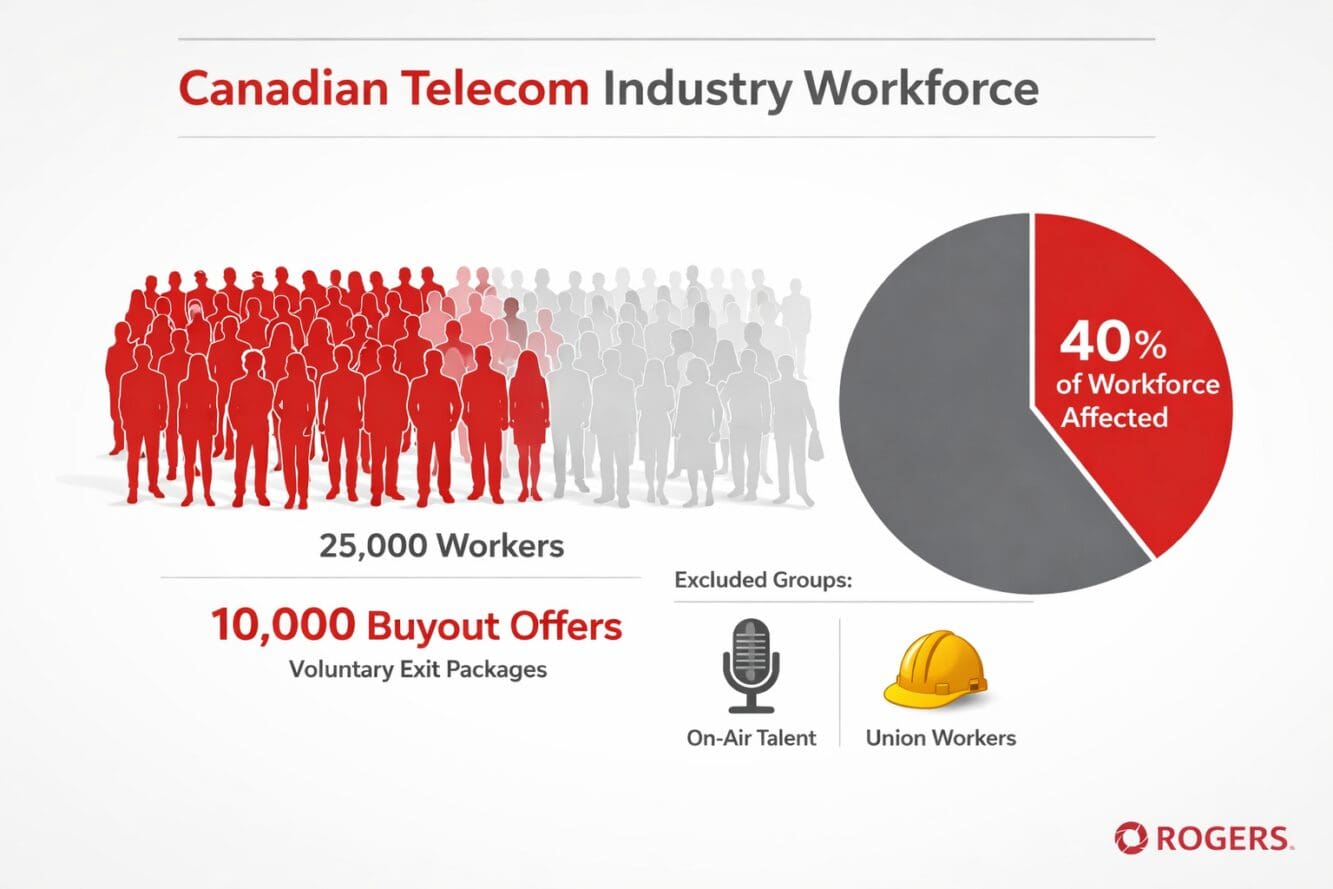
Half. That’s the proportion of Rogers Communications’ entire workforce that just received a voluntary buyout offer—approximately 10,000 employees out of a 25,000-person company [1][2]. No Canadian telecom has ever attempted workforce restructuring at this scale, and the ripple effects across the country’s job market are only beginning to surface. Rogers’ Massive 10,000 Employee Buyouts: Telecom Layoff Wave Explained and Job Market Impacts represents a seismic shift not just for one company, but for an entire industry grappling with AI automation, post-merger integration costs, and fierce competitive pressure.
Key Takeaways
- 📊 Rogers is offering voluntary buyouts to ~10,000 employees, roughly half its total workforce [1][2]
- 🏢 Cost-cutting is the stated driver, with Rogers citing the need to “adjust its cost structure to reflect the business realities of the current environment” [2]
- 🚫 Not everyone is eligible—on-air talent, sports employees, and union workers are excluded from the buyout program [2]
- 🤖 AI and automation are accelerating the restructuring timeline across Canada’s telecom sector
- 💼 Thousands of displaced workers will flood an already competitive Canadian job market in 2026
Why Rogers Is Offering Buyouts to Nearly Half Its Workforce
Rogers Communications didn’t arrive at this decision overnight. The company’s spokesperson stated plainly: “Rogers is taking steps to adjust its cost structure to reflect the business realities of the current environment” [2]. But what are those “business realities”?
Several converging forces pushed Rogers toward this unprecedented move:
| Factor | Impact on Rogers |
|---|---|
| Shaw merger integration | Duplicate roles across combined entity |
| AI & automation adoption | Reduced need for customer service and back-office staff |
| Competitive pricing pressure | Margins squeezed by rivals and MVNOs |
| Debt servicing costs | $20B+ debt from Shaw acquisition requires savings |
| Shifting consumer behavior | Cord-cutting reduces traditional media revenue |
The voluntary buyout approach allows Rogers to reduce headcount without the legal complexities and public relations damage of mass involuntary layoffs. By offering packages to 10,000 workers [1], the company likely expects a fraction—perhaps 3,000 to 5,000—to accept, achieving meaningful cost reductions while maintaining operational continuity.
Who Is Affected and Who Is Protected?
Not all Rogers employees face the same uncertainty. The company has explicitly excluded several groups from the buyout offer [2]:
- ❌ On-air talent (broadcasters, hosts, journalists)
- ❌ Sports division employees (tied to long-term content rights)
- ❌ Union workers (protected by collective bargaining agreements)
This means the buyout targets are concentrated among:
- ✅ Corporate and administrative staff
- ✅ Middle management
- ✅ Customer service representatives
- ✅ IT and network operations personnel
- ✅ Retail and sales support teams
- ✅ Marketing and communications departments
“The exclusion of union workers and on-air talent tells us exactly where Rogers sees redundancy—in the corporate middle layer that AI tools can increasingly replace.” — Industry analyst perspective
The pattern is clear. Roles that involve repetitive processes, data management, customer interactions, or administrative coordination are most vulnerable. These are precisely the functions where generative AI and automation tools have made the greatest inroads in 2025-2026.
Understanding the Buyout Package Details
While Rogers has not publicly disclosed the exact financial terms of every package, voluntary buyout programs in Canadian telecom typically include:
Standard components of telecom buyout packages:
- Severance pay — Usually 1-4 weeks per year of service
- Extended benefits — Health and dental coverage for 3-12 months
- Pension bridge payments — For employees near retirement age
- Outplacement services — Career coaching and job search support
- Lump-sum incentives — Additional payment to encourage voluntary departure
For a mid-career Rogers employee with 15 years of service, a typical package could represent 6-12 months of total compensation. Senior employees closer to retirement may receive even more generous terms, as their departure creates the largest ongoing salary savings.
The “voluntary” nature is key. Employees who decline the buyout keep their jobs—for now. However, industry precedent suggests that voluntary programs are often followed by involuntary reductions if targets aren’t met.
Rogers’ Massive 10,000 Employee Buyouts: Telecom Layoff Wave Explained and Job Market Impacts on Canada’s Economy
The scale of this restructuring sends shockwaves well beyond Rogers’ corporate headquarters. Here’s what the broader Canadian job market faces:
Immediate Labor Market Effects
- Thousands of skilled workers entering the job market simultaneously
- Downward pressure on salaries in telecom, IT, and customer service sectors
- Geographic concentration in Toronto, where Rogers is headquartered
- Increased competition for mid-level corporate positions across industries
The Telecom Domino Effect
Rogers rarely acts alone. When one major Canadian telecom restructures, competitors typically follow. BCE (Bell) has already conducted significant layoffs in recent years, and Telus has been shifting toward AI-driven customer service. The entire sector employs over 100,000 Canadians, and industry-wide cuts of 10-15% are now plausible within 2026-2027.
Sectors Absorbing Displaced Workers
| Receiving Industry | Relevant Skills | Hiring Outlook |
|---|---|---|
| Cloud computing | Network engineering, IT ops | Strong 🟢 |
| Fintech | Customer service, data analysis | Moderate 🟡 |
| Government/public sector | Admin, project management | Stable 🟡 |
| AI/ML companies | Technical roles, data science | Strong 🟢 |
| Healthcare tech | IT infrastructure, support | Growing 🟢 |
The AI Factor: Why This Is More Than Cost-Cutting
While Rogers frames the buyouts as cost adjustment [2], the deeper story involves artificial intelligence fundamentally reshaping telecom operations. In 2026, AI tools can now:
- Handle 70-80% of customer service inquiries without human intervention
- Automate network monitoring and maintenance scheduling
- Generate marketing content and campaign analytics
- Process billing disputes and account modifications
- Predict and prevent network outages through machine learning
Each of these capabilities directly replaces human roles that Rogers currently staffs. The 10,000-employee buyout isn’t just about today’s balance sheet—it’s about building a leaner organization designed for an AI-first future.
The telecom industry is experiencing what manufacturing went through in the 1990s: a permanent structural reduction in human labor requirements.
What Affected Employees Should Do Now
For the thousands of Rogers employees weighing their options, timing and strategy matter enormously:
If Considering Accepting the Buyout:
- Calculate the full package value — Include severance, benefits continuation, pension impacts, and tax implications
- Assess the job market — Research demand for your specific skills before deciding
- Negotiate if possible — Initial offers are sometimes flexible, especially for senior staff
- Consult a financial advisor — Understand how the lump sum affects taxes and retirement planning
- Upskill immediately — Invest in AI literacy, cloud certifications, or adjacent technical skills
If Planning to Stay:
- Document your value — Make your contributions visible to decision-makers
- Diversify your skills — Learn AI tools relevant to your function
- Build internal networks — Relationships matter during restructuring
- Prepare a backup plan — Involuntary cuts may follow if targets aren’t met
Rogers’ Massive 10,000 Employee Buyouts: Telecom Layoff Wave Explained and Job Market Impacts — What Comes Next?
The coming months will reveal whether Rogers’ gamble pays off. Key milestones to watch:
- Q2 2026: Buyout acceptance deadline and initial departure numbers
- Q3 2026: First earnings report reflecting restructuring costs
- Q4 2026: Potential involuntary layoffs if voluntary targets fall short
- 2027: Competitor responses from Bell and Telus
The Canadian government may also face pressure to respond. With thousands of well-paying telecom jobs disappearing, calls for retraining programs, extended EI benefits, or tech sector investment incentives will likely intensify.
Conclusion
Rogers’ decision to offer buyouts to 10,000 employees [1] marks a turning point for Canada’s telecom industry and its workforce. Driven by AI adoption, post-merger redundancies, and competitive pressure, this restructuring signals that the traditional telecom employment model is permanently changing.
Actionable next steps for stakeholders:
- 🎯 Affected employees: Evaluate buyout packages carefully, upskill in AI-adjacent areas, and explore growing sectors like cloud computing and healthtech
- 📈 Job seekers: Monitor telecom hiring freezes and target companies absorbing displaced talent
- 🏛️ Policymakers: Prepare workforce transition programs for structural industry shifts
- 💼 Investors: Watch for short-term restructuring charges followed by improved margins
The 10,000-employee buyout isn’t the end of this story—it’s the beginning of a new chapter in how Canada’s largest companies balance human talent against technological capability.
References
[1] Rogers To Offer Voluntary Buyouts To 10 000 Employees – https://www.lightreading.com/cable-technology/rogers-to-offer-voluntary-buyouts-to-10-000-employees
[2] Watch – https://www.youtube.com/watch?v=vVg0nJadcYs
Content, illustrations, and third-party video appearing on GEORGIANBAYNEWS.COM may be generated or curated with AI assistance or reproduced pursuant to the fair dealing provisions of the Copyright Act, R.S.C. 1985, c. C-42. Attribution and hyperlinks to original sources are provided in acknowledgment of applicable intellectual property rights. Such referencing is intended to direct traffic to and support the original rights holders’ platforms.