




















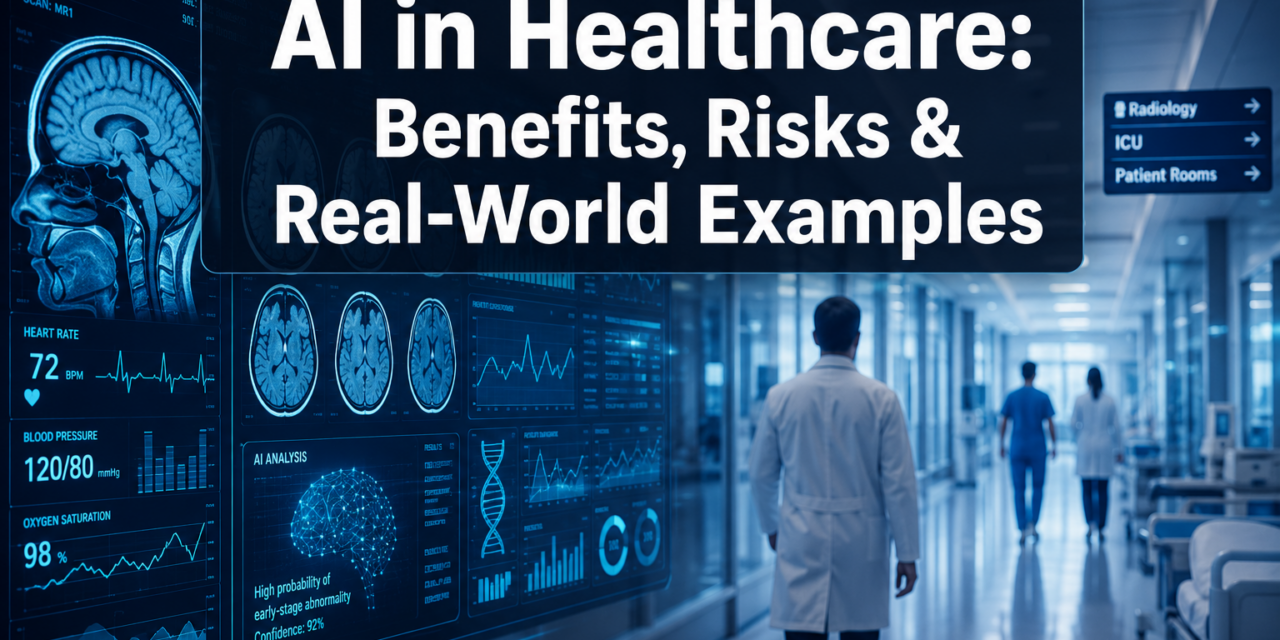
🩺 AI in Healthcare: Benefits, Risks, and Real-World Examples for Patients and Clinicians

Last updated: May 26, 2026
Quick Answer: AI in healthcare is already operating inside hospitals, clinics, and diagnostic labs — not as a replacement for doctors, but as a tool that catches what humans miss, speeds up routine tasks, and flags patients at risk before a crisis hits. The benefits are real and measurable, but so are the risks: data privacy gaps, algorithmic bias, and the danger of patients overtrusting AI-generated advice. This guide maps both sides clearly for patients and clinicians alike.
Key Takeaways
- The FDA had cleared over 1,350 AI-enabled medical devices by December 2025, most concentrated in radiology [2]
- Clinicians using AI assistance improved cancer detection accuracy from 67% to 79% and cut false positives from 18% to 13% [2]
- Only about 4% of healthcare organizations have achieved meaningful scaled AI impact despite billions invested [7]
- 25% of U.S. adults used AI tools for health information in a single 30-day period as of April 2026 [5]
- AI can predict patient deterioration hours before symptoms appear, enabling earlier intervention [2]
- Privacy risks are significant: fragmented electronic medical record (EMR) systems remain a major barrier to safe AI deployment [7]
- Patients with rare diseases may benefit most from AI’s ability to cross-reference massive datasets
- Physicians are warming up — 35% reported enthusiasm outweighing concern in 2024, up from 30% in 2023 [4]

What Exactly Is AI Doing in Hospitals Right Now?
AI in hospitals today handles three broad categories: diagnostics, administration, and patient monitoring. It is not one single system — it is dozens of specialized tools, each trained for a narrow task.
Here is what is actually running in clinical settings in 2026:
- Medical imaging analysis: AI scans X-rays, MRIs, and CT images to flag abnormalities, acting as a second reader for radiologists [3]
- Sepsis and deterioration prediction: Algorithms monitor vitals in real time and alert staff hours before a patient’s condition becomes critical [2]
- Triage and patient routing: AI-assisted consultation tools sort incoming patient requests and match them to the right clinician, cutting wait times [8]
- Administrative automation: Scheduling, billing codes, and clinical note summarization are increasingly handled by AI, freeing up clinician time
- Mental health chatbots: AI-powered virtual assistants provide immediate support in areas with limited mental health resources [9]
- Drug discovery acceleration: AI has cut drug development timelines by up to 50% by identifying viable compounds faster [3]
As of February 2026, 63% of healthcare professionals reported their organizations were prepared to adopt generative AI for clinical decision-making and triage [1].
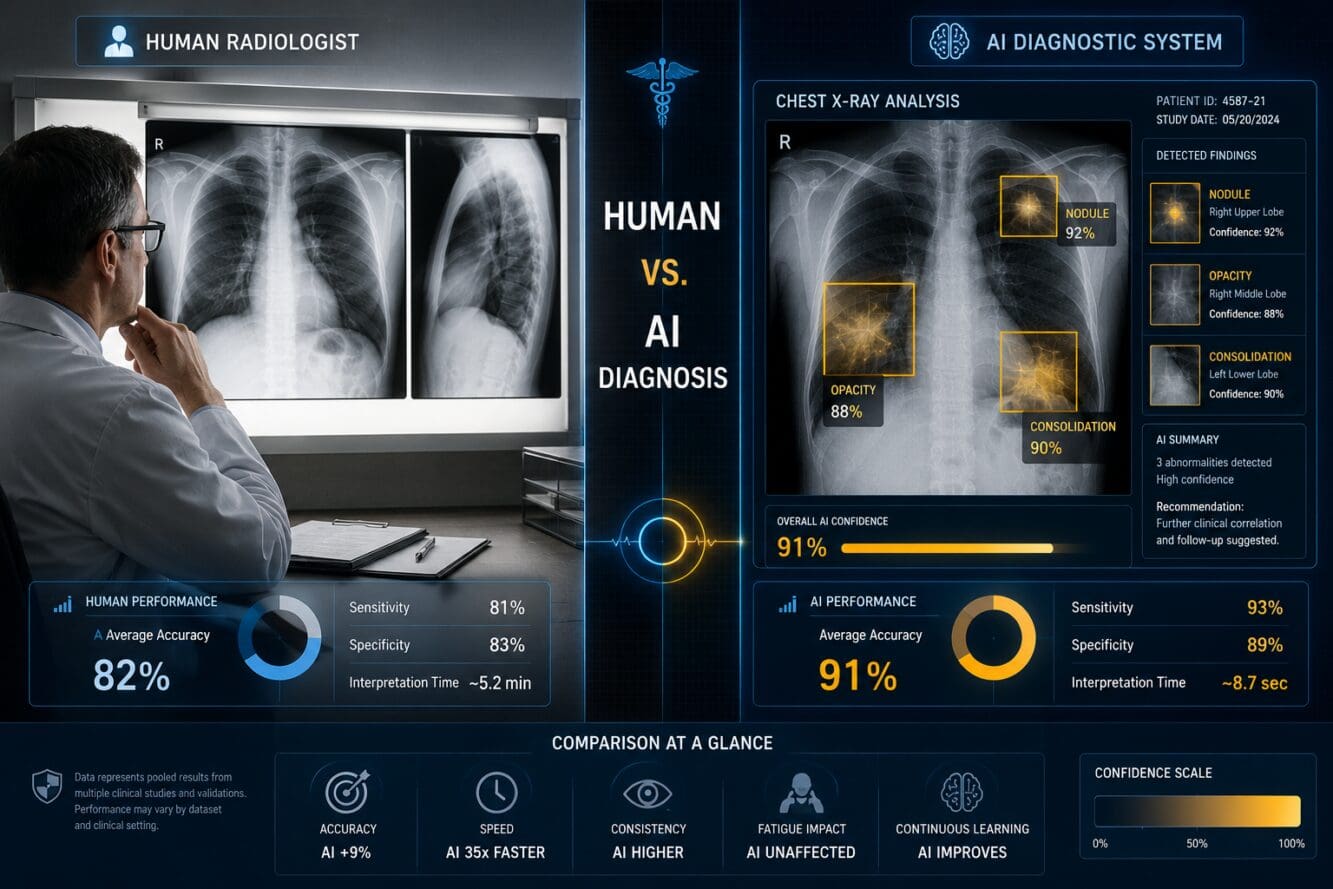
How Accurate Are AI Diagnostic Tools Compared to Human Doctors?
AI diagnostic tools are not universally better or worse than human clinicians — accuracy depends heavily on the task, the training data, and whether a human remains in the loop.
A systematic review found that clinicians using AI assistance improved cancer detection accuracy from 67% to 79% and reduced false positives from 18% to 13% [2]. The key word is using — AI paired with a clinician consistently outperforms either working alone.
Where AI performs strongly:
- Detecting diabetic retinopathy in eye scans
- Identifying lung nodules in chest CT images
- Flagging abnormal cardiac rhythms in ECG data
Where AI still struggles:
- Rare presentations that fall outside training data
- Patients with multiple overlapping conditions
- Cases requiring emotional context or patient history nuance
Decision rule: Trust AI-assisted diagnostics most when the tool has been FDA-cleared for that specific use case and a trained clinician reviews the output.
Can AI Detect Diseases Earlier — and Can It Predict Health Risks Before Symptoms Appear?
Yes, and this is one of the most clinically significant benefits of AI in healthcare. AI systems are already predicting patient deterioration hours before visible symptoms emerge, giving care teams time to intervene [2].
Beyond acute deterioration, AI is being applied to:
- Cancer screening: Identifying early-stage tumors in mammograms and colonoscopy footage that human reviewers might miss
- Cardiovascular risk: Analyzing retinal scans to estimate heart disease risk without a blood test
- Sepsis onset: Monitoring ICU patients and flagging early infection markers in lab trends
For patients in communities with limited specialist access — including those served by clinics like the South Georgian Bay Community Health Clinic — early AI-assisted screening could mean catching conditions before they require emergency care.
What Medical Specialties Are Using AI the Most?
Radiology leads by a wide margin. The majority of the FDA’s 1,350+ cleared AI medical devices are concentrated in imaging analysis [2]. Pathology, cardiology, and ophthalmology follow closely.
SpecialtyPrimary AI ApplicationRadiologyScan analysis, anomaly detectionCardiologyECG interpretation, risk scoringOncologyTumor detection, treatment responseOphthalmologyDiabetic retinopathy screeningPsychiatryMental health chatbots, risk flaggingPrimary CareTriage tools, chronic disease management
Are There AI Tools That Help Patients Manage Chronic Diseases?
Yes. Chronic disease management is one of the fastest-growing areas of patient-facing AI. Tools exist for diabetes, hypertension, asthma, and mental health conditions.
Examples in active use:
- Continuous glucose monitors paired with AI that predicts blood sugar swings and suggests adjustments
- AI coaching apps for hypertension that track medication adherence and lifestyle factors
- Mental health platforms using AI chatbots to provide between-session support for anxiety and depression [9]
For patients interested in staying healthier long-term, these tools work best as a complement to regular clinical care, not a substitute.
What Are the Privacy Risks of Using AI in Medical Records?
Privacy risk is the most serious and least-discussed concern in AI in healthcare. AI systems require access to large volumes of patient data to function — and that data is sensitive, regulated, and frequently stored in fragmented systems.
Key risks include:
- Data breaches: Centralized AI training datasets become high-value targets
- Re-identification: Even anonymized records can sometimes be traced back to individuals using AI
- Third-party access: Many AI health tools are built by private companies with their own data policies
- EMR fragmentation: Incompatible electronic medical record systems create insecure data handoffs [7]
Only about 4% of healthcare organizations have achieved meaningful scaled AI impact, partly because the EMR divide makes safe, consistent data sharing extremely difficult [7]. Patients should ask any AI health tool: Who owns my data, and how is it stored?
What Mistakes Do Hospitals Make When Implementing Medical AI?
The biggest mistake is treating AI as a plug-and-play solution. Most failed implementations share the same patterns.
Common implementation errors:
- Skipping staff training — clinicians who don’t understand a tool’s limitations will either over-rely on it or ignore it
- Poor data quality — AI trained on incomplete or biased records produces unreliable outputs
- No feedback loop — deploying AI without a system to catch and correct errors in real time
- Ignoring workflow fit — tools that don’t integrate with existing EMR systems create friction rather than efficiency [7]
- Assuming one model fits all — an algorithm trained on urban hospital data may perform poorly in rural or Indigenous health contexts
The $40 billion invested in healthcare AI has largely underdelivered because of these structural gaps [7].
Which Patients Should Be Cautious About AI Medical Recommendations?
Most patients benefit from AI-assisted care, but certain groups face higher risk from errors or bias.
Be more cautious if you:
- Have a rare or poorly documented condition (AI training data may not include your presentation)
- Are elderly, pregnant, or pediatric (these groups are often underrepresented in training datasets)
- Belong to a demographic group historically underrepresented in medical research
- Are using a consumer AI tool (like a chatbot) rather than a clinically validated, regulated device
A 2024 study found that participants frequently could not tell the difference between AI-generated and doctor-written medical responses — and sometimes overtrusted AI advice even when it was wrong [6]. That gap in discernment is a real safety concern.
How Do Doctors Feel About AI Replacing Some of Their Diagnostic Work?
Most physicians are cautiously supportive, not alarmed. A 2024 survey found that 35% of physicians reported enthusiasm for healthcare AI exceeding their concerns, up from 30% in 2023 [4]. That is a meaningful shift, though it also means the majority still hold reservations.
Common physician concerns include:
- Liability when AI makes an error they acted on
- Loss of clinical skill if AI handles too much routine work
- Algorithmic bias affecting patient outcomes
- Lack of transparency in how AI reaches a conclusion (“black box” problem)
The emerging consensus among clinicians is that AI should function as a decision-support tool, not an autonomous decision-maker. Research from institutions like Stanford University School of Medicine has been central to shaping that framework.
What Are the Biggest Ethical Concerns With AI in Healthcare?
The ethical concerns in AI in healthcare for patients and clinicians go beyond privacy. They include fairness, accountability, and consent.
Top ethical issues:
- Algorithmic bias: AI trained on data from predominantly white, male, or urban populations may perform worse for other groups
- Informed consent: Patients often don’t know their data is being used to train AI systems
- Accountability gaps: When AI contributes to a diagnostic error, who is responsible — the developer, the hospital, or the clinician?
- Access inequality: Hospitals with bigger budgets deploy better AI, potentially widening health outcome gaps between wealthy and underserved communities
- Over-automation: Reducing human contact in care can harm patient trust and wellbeing
Addressing these concerns requires regulatory oversight, transparent AI auditing, and genuine community input — including from rural and remote communities where health access is already strained.
How Much Does AI Medical Screening Cost?
Costs vary widely depending on the tool, the healthcare system, and whether the patient is in a publicly or privately funded system.
- Hospital-integrated AI tools (e.g., radiology AI): Costs are typically absorbed by the institution and not billed separately to patients
- Consumer AI health apps: Range from free (basic chatbots) to $30–$150/month for premium chronic disease management platforms
- AI-assisted diagnostics in private clinics: May add $50–$300 to a specialist visit, depending on jurisdiction
- Drug discovery AI benefits patients indirectly through faster, potentially cheaper drug development [3]
In Canada, most AI tools used within provincially funded hospitals are not direct patient costs. However, consumer-facing apps sit outside provincial coverage.
Is AI Good for Patients With Rare Conditions?
AI offers genuine promise for rare disease patients, though it is not a solved problem. Rare conditions are, by definition, underrepresented in training data — which creates a paradox.
Where AI helps rare disease patients:
- Cross-referencing symptoms against global case databases to suggest diagnoses clinicians might not consider
- Identifying genetic markers associated with rare syndromes
- Connecting patients to clinical trials based on their profile
Where it falls short:
- Small training datasets mean lower confidence scores and higher error rates
- AI may default to common diagnoses, delaying rare disease identification
For rare disease patients, AI works best as a research aid used alongside a specialist, not as a primary diagnostic tool.
Conclusion: What Patients and Clinicians Should Do Next
AI in healthcare is neither the cure-all its promoters claim nor the threat its critics fear. It is a set of specific tools with specific strengths, specific failure modes, and a clear need for human oversight.
Actionable next steps:
- Patients: Ask your care provider whether any AI tools are used in your diagnosis or treatment, and what safeguards are in place. Be skeptical of consumer AI health apps that are not clinically validated.
- Clinicians: Advocate for AI tools that are transparent, audited for bias, and integrated into — not bolted onto — your existing workflow.
- Healthcare administrators: Invest in EMR interoperability before scaling AI. The data foundation matters more than the algorithm.
- Everyone: Stay informed. AI in healthcare is moving fast, and the patients and clinicians who understand it will be better positioned to benefit from it safely.
For community health updates relevant to the Georgian Bay region, follow coverage at Georgian Bay News.
Much Appreciate You Sharing This Post - It Helps MUCH!!!