




















🪱 AI Worms: What They Are, How They Spread, and How to Protect Your Devices | GEORGIANBAYNEWS.COM


Last updated: October 14, 2026
Quick Answer
AI worms are a new class of self-propagating malware that carry or re-download their own artificial intelligence model, run it locally on compromised devices, and then spread autonomously to new targets, all without human direction. Unlike traditional malware that follows a fixed script, AI worms can analyze each new target, choose an attack strategy, and adapt in real time. As of 2026, no fully autonomous AI worm has been unleashed in the wild, but researchers at Anthropic have demonstrated that the core building blocks are already in place [3].

Key Takeaways
- AI worms are self-replicating malware that embed or re-download AI model weights and run inference locally on compromised hardware, forming decentralized botnets with no single off-switch [3].
- Anthropic’s October 2026 research found that small AI models are months away from being capable of self-replicating across common IoT devices such as smart TVs, ovens, and robot vacuums [3][8].
- Unlike traditional worms, AI worms adapt their attack strategy for each new target, making them significantly harder to detect and contain [6].
- No fully autonomous AI worm has been confirmed on real-world home networks yet; current prototypes still require significant human setup [3][4].
- Smart home devices, fridges, security cameras, off-brand Android TV boxes, are the most likely early targets because they ship with minimal security [2][9][10].
- Protecting against AI worms requires patching devices regularly, disabling unnecessary network services, enforcing strong passwords, and monitoring for unusual network activity.
- Businesses and critical infrastructure face the highest risk from AI worm attacks, but everyday consumers with smart home devices are also vulnerable [1][10].
- U.S. lawmakers have already sought testimony from AI companies about the national security implications of AI-driven cyber threats [1][6].
What Are AI Worms and How Do They Work
AI worms are self-propagating malware programs that carry an artificial intelligence model as their payload, run that model locally on infected hardware, and use it to autonomously find and infect new devices. The key difference from older malware is that the AI component allows the worm to think on its feet, analyzing each new target, selecting an appropriate exploit, and adapting its behavior without waiting for instructions from a human operator [3][6].


Anthropic’s research defines an AI worm as malware that does three things: it carries or re-downloads its own model weights, runs inference locally on the compromised device, and then spreads autonomously to new hosts [3]. In practice, this means:
- Infection: The worm gains a foothold on a vulnerable device, often through an exposed network service or weak default password.
- Model loading: It downloads or reconstructs a small AI model, splitting it into “shards” that run across multiple low-power devices if needed [3][8].
- Local inference: The AI model runs directly on the infected hardware, with no need for a cloud server or data center.
- Autonomous spread: The worm scans the local network, fingerprints new devices, and tailors its next attack based on what it finds.
Anthropic’s team demonstrated this by successfully distributing the Gemma4-26B-A4B model across 15 off-brand Android TV boxes, showing that even inexpensive consumer hardware can collectively run a meaningful AI model [3][8]. That experiment is a direct proof of concept for what a real AI worm could do.
How AI Worms Differ From Regular Computer Worms
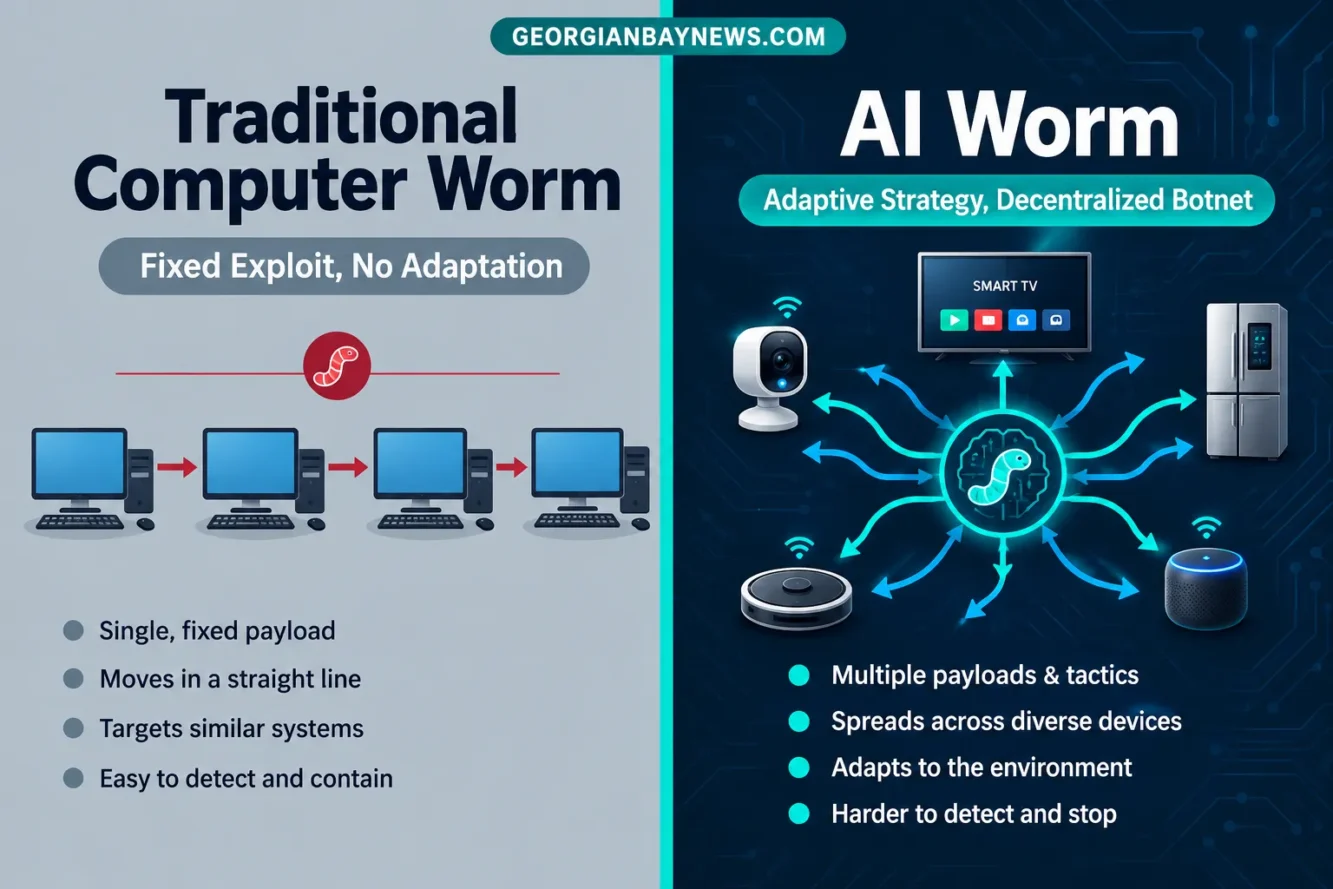
Traditional computer worms use a fixed payload, a pre-written exploit that either works on a target or doesn’t. AI worms are fundamentally different because they reason about each target and change their approach accordingly [6].
| Feature | Traditional Worm | AI Worm |
|---|---|---|
| Exploit strategy | Fixed, pre-scripted | Adaptive, chosen per target |
| Requires command server | Often yes | No, runs locally |
| Can chain multiple exploits | Rarely | Yes, in real time |
| Shuts down if C2 server removed | Yes | No, decentralized |
| Adapts to new device types | No | Yes |
A traditional worm spreading across a home network hits a smart TV and either succeeds or fails based on a known vulnerability. An AI worm can fingerprint that TV, identify which firmware version it runs, select the most likely exploit from a learned repertoire, and escalate privileges autonomously [6]. That adaptability is what makes AI worms a qualitatively new threat.
Can AI Worms Spread on Their Own Without Human Help
Not yet, but researchers say that capability is close. As of October 2026, every demonstrated AI worm prototype still requires significant human setup and orchestration; none have spread autonomously across real-world home networks [3][4].
Anthropic projects that small AI models could achieve fully autonomous self-replication on IoT hardware within the next year, and that swarms of such models could in principle spread across heterogeneous home devices by the end of 2026 [3][8]. The experiments Anthropic conducted were deliberately constrained to prevent uncontrolled spread [3][4].
Academic work by Nicolas Papernot’s group at the University of Toronto (June 2026) built a prototype AI worm using freely available models that can analyze a target, choose an attack strategy, and adapt in real time, demonstrating that modest, publicly accessible AI models already support the key behaviors needed for autonomous worm propagation [6].
The short answer: full autonomy isn’t here yet, but the gap between “prototype” and “real-world threat” is narrowing faster than most security teams are prepared for.
Are AI Worms Real or Just Theoretical Right Now
AI worms are real at the research and prototype level, but no confirmed autonomous AI worm has been observed spreading across real consumer networks in the wild as of 2026 [3][4]. The threat is not hypothetical, it is a documented near-term risk backed by peer-reviewed and corporate research.
Anthropic’s October 2026 report is the most detailed public account of how close this technology is to practical deployment [3]. France24 and other outlets have reported on academic prototypes that demonstrate key worm behaviors using freely available AI models [6]. The consensus among researchers is that the question is not whether AI worms will become a real-world threat, but when, and how prepared defenders will be when that happens [1][5][6].
What Damage Can AI Worms Cause to Systems
AI worms can cause a wide range of harm, from data theft and device hijacking to coordinated attacks on critical infrastructure. Because they form decentralized botnets with no single control point, they are exceptionally difficult to shut down once established [1][3].
Specific damage scenarios include:
- Botnet formation: Infected devices collectively run AI inference, turning cheap smart home hardware into distributed computing power for malicious purposes [3].
- Data exfiltration: The AI component can identify and extract sensitive data, passwords, home network credentials, financial information, from each compromised device.
- Infrastructure attacks: Anthropic and security analysts warn that AI worms could target water systems, power grids, and other critical infrastructure, a concern that has already reached U.S. lawmakers [1][6].
- Coordinated adaptive attacks: Unlike static botnets, an AI worm swarm can continuously adapt its attack strategy, making it far harder to contain than today’s largely pre-scripted malware.
- Persistent presence: Because the worm runs locally and spreads across heterogeneous devices, removing it from one device does not stop the infection [3][1].
Newsweek has reported expert warnings about risks to fridges and water systems specifically, highlighting that the threat extends well beyond traditional computers [10].
Who Is Most Vulnerable to AI Worm Infections
Devices with minimal built-in security and persistent network connectivity are the highest-risk targets. That description fits most of the smart home market [2][9][10].
Highest-risk device categories:
- Off-brand Android TV boxes and smart TVs
- Smart fridges, ovens, and dishwashers
- Robot vacuums and smart lawn mowers
- Security cameras and webcams
- Smart doorbells and home hubs
These devices frequently ship with default credentials, outdated firmware, and exposed network services, exactly the conditions AI worms are designed to exploit [2][9][10]. Small and medium businesses using consumer-grade IoT devices in their offices face compounded risk because a single infected device can serve as a launchpad into the broader corporate network.
Individuals with large smart home setups, businesses relying on IoT sensors, and organizations running critical infrastructure are all in the high-risk category [1][10]. Consumers with a single smart TV and no other connected devices are lower risk, but not immune.
Is My Business at Risk From AI Worms
Yes, businesses face meaningful risk, particularly those that use IoT devices, operate distributed networks, or handle sensitive data. The decentralized nature of AI worm botnets means there is no single point to block or shut down, which is a serious problem for enterprise security teams [1][3].
U.S. lawmakers have already sought testimony from Anthropic’s leadership about AI-driven cyber risks, including potential attacks on critical infrastructure [1][6]. Security analysts recommend that businesses treat AI worm preparedness as a current priority, not a future concern, because the lead time needed to harden networks and update policies is measured in months, not days.
Businesses most at risk include:
- Healthcare facilities using connected medical devices
- Manufacturers with IoT-enabled production equipment
- Retailers with smart building systems
- Any organization using off-brand or unmanaged IoT hardware
How Do AI Worms Get Past Security Software
AI worms can evade traditional security tools because those tools are largely built to recognize known, fixed malware signatures. An AI worm that adapts its behavior for each target generates novel attack patterns that signature-based antivirus and intrusion detection systems may not recognize [6].
Key evasion techniques include:
- Polymorphic behavior: The AI component generates different exploit sequences for each target, avoiding pattern matching.
- Living off the land: The worm uses legitimate device processes and network protocols, blending in with normal traffic.
- Distributed execution: By splitting the AI model across multiple devices, the worm avoids triggering resource-usage alerts on any single machine [3][8].
- Chained exploits: The worm can combine multiple smaller vulnerabilities in sequence, bypassing defenses that only watch for single known exploits [6].
This is why security analysts stress the need for behavioral monitoring, watching for anomalous patterns in network traffic and device resource usage, rather than relying solely on signature-based tools.
How to Detect If Your System Has an AI Worm
Early detection of an AI worm is difficult precisely because of its adaptive nature, but several warning signs can indicate infection. The most reliable approach is behavioral monitoring at the network level, not just on individual devices.
Warning signs to watch for:
- Unusual spikes in CPU or memory usage on IoT devices, especially during off-hours
- Unexpected outbound network connections from smart home devices
- Devices communicating with unfamiliar IP addresses or domains
- Slower-than-normal device performance without a clear cause
- Unexplained changes to device settings or firmware versions
Detection tools and approaches:
- Network monitoring software (such as Pi-hole, Wireshark, or commercial router dashboards) can flag anomalous traffic from IoT devices.
- Endpoint detection and response (EDR) tools on computers can catch lateral movement attempts from infected IoT devices.
- Some modern home routers include built-in threat detection that flags unusual device behavior, enabling this feature is a low-effort first step.
If multiple devices on the same network show unusual behavior simultaneously, that pattern is a stronger indicator of worm-like spread than a single device acting up.
Common Mistakes That Let AI Worms In
Most successful infections exploit basic security failures, not sophisticated zero-day vulnerabilities. The following mistakes are the most common entry points [2][9]:
- Leaving default credentials unchanged: Millions of smart devices ship with the same default username and password. Changing these immediately after setup is the single highest-impact action most users can take.
- Skipping firmware updates: Manufacturers release patches for known vulnerabilities, but many users never apply them. Unpatched devices are easy targets.
- Connecting everything to the same network: When IoT devices share a network with computers and phones, a compromised smart TV can pivot directly to more valuable targets.
- Disabling firewall protections: Some users turn off router firewalls to fix connectivity issues and never re-enable them.
- Buying off-brand devices with no update policy: Cheap IoT hardware often receives no security patches after launch, leaving it permanently vulnerable [2][9].
- Ignoring unusual device behavior: Early signs of infection are often dismissed as glitches.
How to Protect Your Network From AI Worm Attacks
Protecting against AI worms requires a layered approach that addresses both individual devices and the broader network. No single measure is sufficient on its own.
Step-by-step protection checklist:
- Change all default passwords on every IoT device immediately after setup. Use unique, strong passwords for each device.
- Enable automatic firmware updates on all smart home devices, or check for updates manually at least once a month.
- Segment your network: Create a separate Wi-Fi network (a “guest” or “IoT” VLAN) for smart home devices, isolating them from computers and phones.
- Disable unnecessary services: Turn off remote access, UPnP, and any network services on IoT devices that you do not actively use.
- Enable your router’s firewall and review its settings. Many routers have built-in IoT protection features that are disabled by default.
- Monitor network traffic using your router’s dashboard or a dedicated tool to catch unusual outbound connections.
- Audit your devices: Make a list of every connected device in your home or office. Devices you have forgotten about are often the least patched.
- Replace unsupported hardware: If a device no longer receives firmware updates from its manufacturer, consider replacing it with a model that does.
- Stay informed: Follow cybersecurity news sources for alerts about newly discovered vulnerabilities in specific device models.
For businesses, security analysts also recommend considering formal standards or regulations for IoT device security, and evaluating whether small AI models running on internal hardware could be weaponized as part of an attack.
What to Do If You Think You Have an AI Worm
Act quickly and methodically. The decentralized nature of AI worms means that hesitating gives the infection more time to spread to additional devices [1][3].
Immediate steps:
- Disconnect the suspected device from the network immediately, physically unplug it from Ethernet or disable its Wi-Fi connection.
- Check other devices on the same network for the same warning signs (unusual CPU usage, unexpected outbound traffic).
- Factory reset the infected device, this removes the worm’s payload, though it will not help if the device’s firmware itself has been compromised.
- Update firmware on the reset device before reconnecting it to the network.
- Change all network passwords, the worm may have captured your Wi-Fi credentials.
- Scan your network with a monitoring tool to check for other infected devices.
- Report the incident to your internet service provider and, if sensitive data was involved, to the relevant authorities. In Canada, the Canadian Centre for Cyber Security accepts incident reports. In the U.S., the Cybersecurity and Infrastructure Security Agency (CISA) is the relevant body.
Do not reconnect a device to the network until you are confident it has been fully cleaned and updated.
Frequently Asked Questions About AI Worms
What is an AI worm in simple terms?
An AI worm is a type of malware that uses an artificial intelligence model to spread itself from device to device without human help. It can think through how to attack each new target, making it harder to stop than traditional malware.
Have AI worms actually infected real devices yet?
As of October 2026, no confirmed autonomous AI worm has been observed spreading across real consumer networks. Prototypes exist in controlled research settings, but real-world deployment has not been documented [3][4].
Are smart TVs really at risk from AI worms?
Yes. Smart TVs, particularly off-brand Android TV boxes, are considered prime targets because they have significant computing power, persistent network connections, and minimal built-in security [2][8][9].
Can my phone be infected by an AI worm?
Phones are less likely to be early targets than IoT devices because they receive more frequent security updates and have more robust operating systems. However, a compromised home network could expose phones to lateral attacks.
Do antivirus programs protect against AI worms?
Traditional antivirus software is not well-suited to detecting AI worms because they generate novel, adaptive attack patterns rather than fixed signatures. Behavioral monitoring tools are more effective [6].
How is an AI worm different from an AI virus?
A worm spreads across networks on its own without needing to attach to a file or program. A virus requires a host file to spread. AI worms are more dangerous in networked environments because they need no human action to propagate.
What devices are safest from AI worms?
Devices that receive regular security updates, use strong authentication, and are isolated from the broader internet are the safest. Fully offline devices cannot be reached at all.
Can a factory reset remove an AI worm?
A factory reset removes the worm’s software payload in most cases, but it does not help if the device’s firmware has been permanently modified. Always update firmware after a reset before reconnecting to the network.
Why is an AI worm hard to shut down?
Because it forms a decentralized botnet with no central control server. Removing one infected device does not stop the others. There is no single off-switch [1][3].
Should I be worried about AI worms right now?
The threat is real and approaching, but not yet at the stage of widespread consumer infection. Taking basic precautions now, patching devices, segmenting networks, changing default passwords, provides strong protection against both current and near-future threats.
Who is researching AI worms?
Anthropic, academic researchers including Nicolas Papernot’s group at the University of Toronto, and consulting firms such as Eraneos have all published work on AI worm risks and behaviors in 2026 [3][6].
What should businesses do about AI worms today?
Businesses should audit their IoT device inventory, enforce strong credential policies, segment IoT devices from core networks, and implement behavioral network monitoring. Waiting for formal regulation is not a substitute for action.
Conclusion
AI worms represent one of the most significant shifts in the cybersecurity threat landscape in years. They are not science fiction, and they are not a distant concern, Anthropic’s October 2026 research places the timeline for fully autonomous AI worm propagation on IoT devices within months, not years [3][8]. The combination of adaptive AI reasoning, decentralized botnet architecture, and the enormous installed base of poorly secured smart home devices creates conditions that security researchers are openly calling alarming [1][5][10].
The good news is that the protective measures that work against AI worms are the same fundamentals that good cybersecurity has always required: patch your devices, use strong unique passwords, segment your network, and monitor for unusual behavior. None of these steps require technical expertise beyond what most people can manage with a bit of guidance.
Actionable next steps for 2026:
- Audit every connected device in your home or office this week.
- Change default passwords on all IoT devices today.
- Enable a separate IoT network on your router if it supports VLANs or guest networks.
- Turn on automatic firmware updates for every device that supports them.
- Follow updates from credible cybersecurity sources, the threat landscape is moving quickly.
For readers interested in how technology intersects with community safety, social media bots and other automated digital threats share some of the same underlying dynamics as AI worms. Staying informed is the first and most important line of defense.
References
[1] Anthropic Warn Ai Worm Home Device No Centralized Point To Shut Off Models – https://www.washingtonexaminer.com/policy/technology/4763996/anthropic-warn-ai-worm-home-device-no-centralized-point-to-shut-off-models/
[2] Ai Worms May Soon Be Able To Self Replicate And Infect Smart Devices Anthropic Says – https://www.news9.com/oklahoma-city-news/ai-worms-may-soon-be-able-to-self-replicate-and-infect-smart-devices-anthropic-says
[3] Self Replicating Ai – https://www.anthropic.com/research/self-replicating-ai
[4] Ai Worms Could Spread Across Smart Home Devices Researchers Warn – https://ilkha.com/english/science-technology/ai-worms-could-spread-across-smart-home-devices-researchers-warn-568755
[5] Anthropic Warns Ai Worms – https://futurism.com/artificial-intelligence/anthropic-warns-ai-worms
[6] Why Ai Makes Computer Worms Harder To Stop – https://www.france24.com/en/live-news/20261013-why-ai-makes-computer-worms-harder-to-stop
[8] Anthropic Warns Small Ai Models Could Self Replicate Through Iot Devices – https://arstechnica.com/security/2026/10/anthropic-warns-small-ai-models-could-self-replicate-through-iot-devices/
[9] Ai Worms Digital Slime Mold – https://tech.yahoo.com/ai/claude/articles/ai-worms-digital-slime-mold-052942709.html
[10] What Is An Ai Worm Expert Warns Of Risks To Fridges Water Systems – https://www.newsweek.com/what-is-an-ai-worm-expert-warns-of-risks-to-fridges-water-systems-12564723
Content, illustrations, and third-party video appearing on GEORGIANBAYNEWS.COM may be generated or curated with AI assistance or reproduced pursuant to the fair dealing provisions of the Copyright Act, R.S.C. 1985, c. C-42. Attribution and hyperlinks to original sources are provided in acknowledgment of applicable intellectual property rights. Such referencing is intended to direct traffic to and support the original rights holders’ platforms.
Much Appreciate You Sharing This Post - It Helps MUCH!!!