



















2026 Canada Census Launch: Key Questions, Participation Guide, and Early Insights on National Demographics
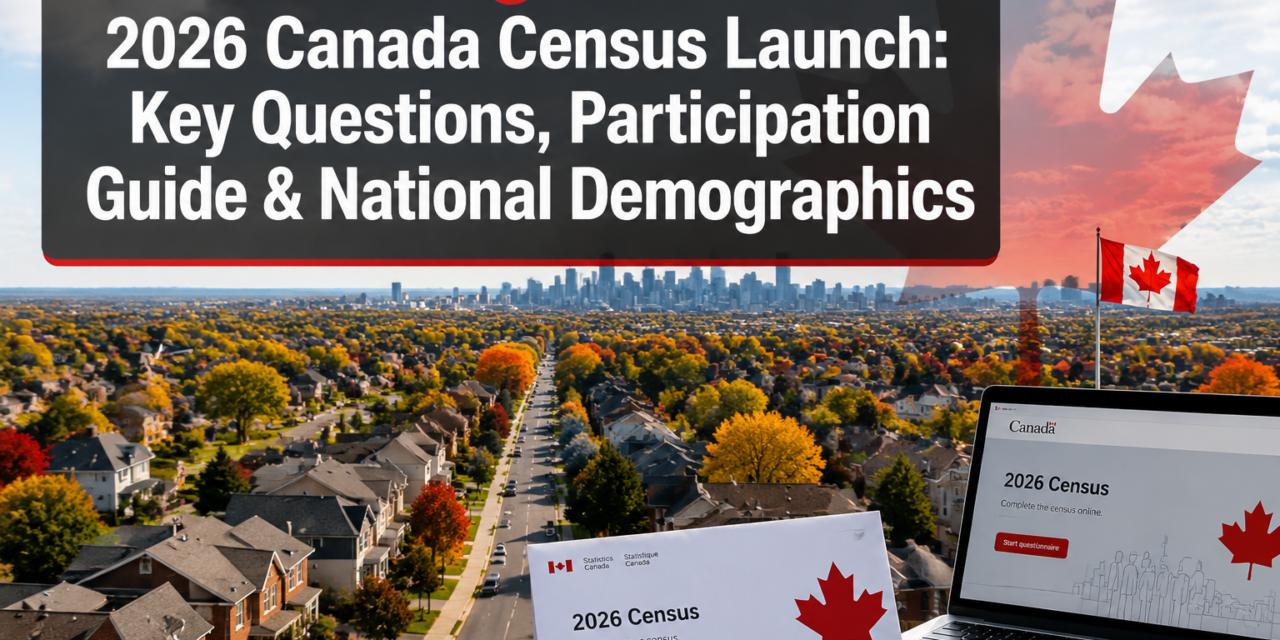
Every five years, roughly 16 million Canadian households receive a single envelope that will quietly reshape billions of dollars in federal spending. That envelope arrived again on May 4, 2026, marking the official start of Canada’s 24th national census — and this time, the questionnaire asks questions the country has never posed before [1]. The 2026 Canada Census Launch: Key Questions, Participation Guide, and Early Insights on National Demographics is not just a data-collection exercise; it is the statistical backbone that will drive policy decisions on immigration, urban planning, healthcare, and social services for the next half-decade.
Whether the census form is already sitting on the kitchen counter or still sealed in its envelope, this guide breaks down everything needed to participate correctly, on time, and with confidence.
Key Takeaways 📌
- Census Day was May 4, 2026, with a reference completion date of May 12, 2026 — but it is not too late to respond [4].
- 75% of households received a short-form questionnaire (20 questions); the remaining 25% received a long-form version with 70 questions [4].
- New topics this cycle include sexual orientation, health status, and homelessness [4].
- Participation is mandatory by law; fines for non-compliance can reach $500–$1,000 [4].
- Responses can be submitted online, by phone, or on paper — with support in 28 languages plus 15 Indigenous languages [1][5].
Why the 2026 Canada Census Matters More Than Ever
The census is far more than a headcount. Data collected in 2026 will directly influence:
| Policy Area | How Census Data Is Used |
|---|---|
| Immigration | Setting annual intake targets and settlement-service funding |
| Urban Planning | Zoning decisions, transit expansion, and housing development |
| Healthcare | Hospital capacity planning and mental-health resource allocation |
| Education | School-board funding formulas and language-program investments |
| Social Services | Eligibility thresholds for benefits like the Canada Child Benefit |
This year’s census is Canada’s 24th since Confederation, continuing a tradition conducted every five years to build a comprehensive statistical portrait of the nation’s population, demographics, and economy [3].
“The census is the foundation for evidence-based decision-making in Canada.” — Statistics Canada [1]
With new questions on sexual orientation, health status, and homelessness, the 2026 cycle promises the most detailed demographic snapshot the country has ever produced [4]. These additions reflect growing public demand for data that captures the full diversity of Canadian life.
Step-by-Step Participation Guide: How to Complete the 2026 Census
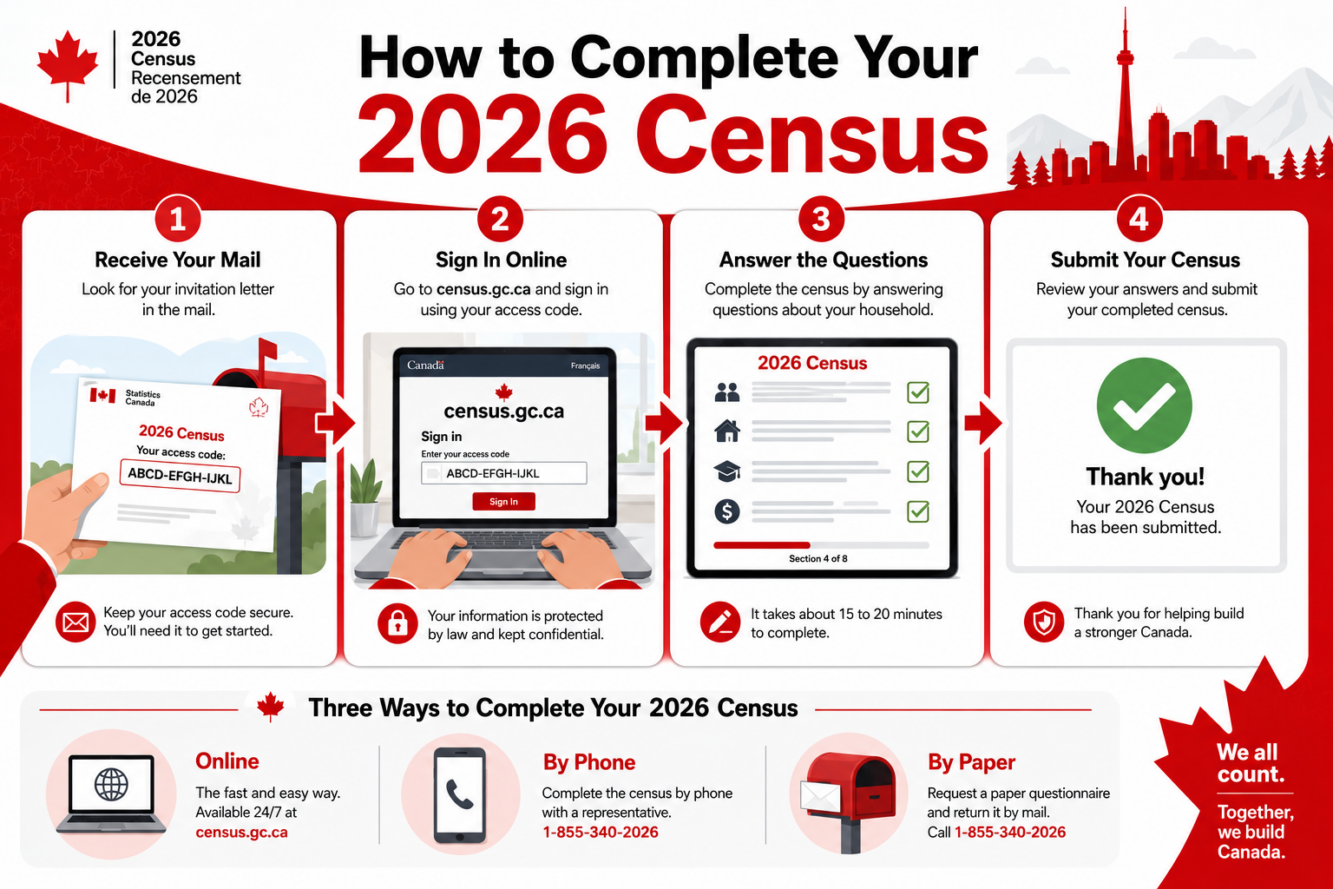
Filling out the census is straightforward. Here is exactly how to do it. 👇
Step 1: Locate the Invitation Letter 📬
Every household received a letter from Statistics Canada containing a unique 16-digit secure access code [1]. This code links the response to a specific address. If the letter has been misplaced, contact Statistics Canada directly for a replacement.
Step 2: Choose a Submission Method
There are three ways to complete the census:
- Online (recommended) — Visit census.gc.ca and enter the 16-digit code [2].
- By phone — Call 1-833-852-2026 to complete the questionnaire with an agent [2].
- Paper form — Request a printed questionnaire by calling 1-833-663-2026 [2].
For those with hearing or speech impairments, a TTY line is available at 1-833-830-3109 [1].
Step 3: Answer All Questions Honestly
- Short-form households (75%) answer 20 questions covering age, gender, sex at birth, language, and household composition [4].
- Long-form households (25%) answer 70 questions that also cover education, employment, housing costs, commuting, and the new topics introduced this cycle [4].
Step 4: Submit Before Follow-Up Begins
Statistics Canada set May 12, 2026 as the reference date for completion. However, this is not a hard deadline — it is the date by which responses are encouraged [4]. Households that have not responded will be contacted by census representatives, and potential penalties may apply around July 2026 [4].
⚠️ Important: Participation is legally required under the Statistics Act. Refusing to respond or providing false information can result in fines up to $500. Denying access to records or obstructing census workers can lead to fines up to $1,000 [4].
Key Questions on the 2026 Census: What’s New and What’s Familiar
Traditional Questions (Short Form & Long Form)
These core questions have appeared in previous census cycles:
- Full legal name, date of birth, and sex at birth
- Marital and common-law status
- Languages spoken at home and first language learned
- Relationship to other household members
New and Expanded Questions (Long Form) 🆕
The 2026 Census breaks new ground with questions on:
- Sexual orientation — A first for the Canadian census
- Health status — Self-assessed general health and disability information
- Homelessness — Designed to capture data on people experiencing housing instability
These additions respond to years of advocacy from community organizations and researchers who argued that policy gaps exist precisely because the data has never been collected at this scale [4].
Census of Agriculture 🌾
Running concurrently, the 2026 Census of Agriculture requires all farm operators across Canada to complete a separate online questionnaire. A dedicated help line (1-855-859-6273) is available through the end of July 2026 [2].
Multilingual and Accessibility Support: Reaching Every Canadian
Canada’s census is one of the most linguistically inclusive surveys in the world. In 2026, reference materials are available in 28 languages, and questionnaires have been translated into 15 Indigenous languages for respondents in northern and remote communities [1][5].
Early collection in these areas began in February 2026, with enumerators hand-delivering invitation letters and offering in-person assistance to residents who may lack reliable internet access [5].
To support the massive operation, Statistics Canada recruited approximately 32,000+ temporary workers, including enumerators and crew leaders, deployed across every province and territory [4].
Early Insights: How 2026 Census Data Could Shape Federal Policy
While final results will not be published until 2027, the expanded scope of the 2026 Census allows for early predictions about its policy impact.
🏠 Housing and Urban Planning
With housing affordability dominating national debate, detailed data on housing costs, dwelling types, and homelessness will give municipalities hard evidence to support zoning reforms, density targets, and affordable-housing investments.
🌍 Immigration and Settlement
Updated population counts — especially data on language proficiency, country of origin, and employment — will help the federal government calibrate immigration levels and allocate settlement-service funding where it is needed most.
🏥 Healthcare and Social Services
For the first time, large-scale data on health status and sexual orientation will allow provinces to identify underserved populations and direct funding toward mental-health programs, LGBTQ+ services, and disability support.
📊 Economic Planning
Long-form data on education, employment, and commuting patterns will inform workforce-development strategies and infrastructure spending, particularly as remote work continues to reshape Canadian cities.
Follow-Up Procedures: What Happens If You Don’t Respond
Statistics Canada does not simply move on when a household fails to respond. Here is the escalation timeline:
- Reminder letters are sent shortly after the May 12 reference date.
- Census representatives visit non-responding households in person [1].
- Legal enforcement may begin around July 2026, with fines of up to $500 for refusal and $1,000 for obstructing census workers [4].
The goal is always to help residents complete the form — not to punish them. But the legal requirement exists because incomplete data undermines the accuracy of the entire census.
Conclusion
The 2026 Canada Census Launch: Key Questions, Participation Guide, and Early Insights on National Demographics represents a pivotal moment for the country. With groundbreaking new questions on identity, health, and housing, this census will produce the most comprehensive portrait of Canadian society ever assembled.
Actionable next steps:
✅ Complete the census now at census.gc.ca using the 16-digit code from the invitation letter. ✅ Call for help if needed: online support at 1-833-852-2026, paper forms at 1-833-663-2026, or TTY at 1-833-830-3109. ✅ Spread the word — remind family, friends, and neighbours that participation is mandatory and that every response shapes the future of Canadian policy.
The data collected today will determine how billions of dollars are spent tomorrow. Make sure your household counts. 🍁
References
[1] The 2026 Census Of Population And The Census Of Agriculture Begin Today – https://www.canada.ca/en/statistics-canada/news/2026/05/the-2026-census-of-population-and-the-census-of-agriculture-begin-today.html
[2] 2026 05 04 Census 2026 Collection Population Agriculture Begin Backgrounder – https://www.statcan.gc.ca/en/about/statistical-announcements/2026-05-04-census-2026-collection-population-agriculture-begin-backgrounder
[3] 2026 Census – https://www.census.gc.ca/en/about/2026-census
[4] 2026 Census An Ultimate Guide To What Canadians Should Read To Properly And Punctually Fill It Out – https://ca.news.yahoo.com/2026-census-an-ultimate-guide-to-what-canadians-should-read-to-properly–and-punctually–fill-it-out-180045961.html
[5] 2026 Census Collection Begins Early In Canadas North – https://www.canada.ca/en/statistics-canada/news/2026/02/2026-census-collection-begins-early-in-canadas-north.html