

















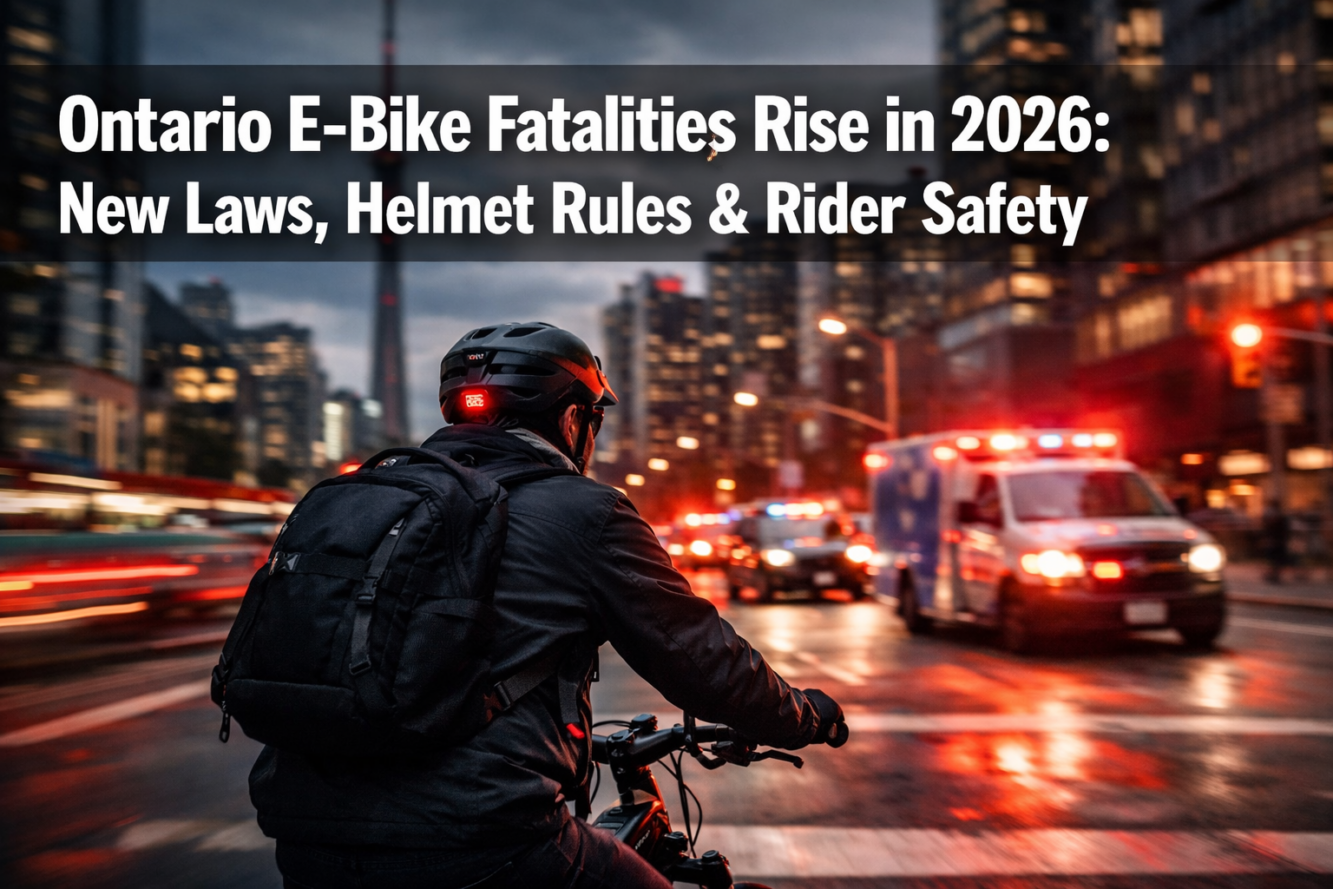
Ontario E-Bike Fatalities Rise in 2026: New 500W Laws, Helmet Enforcement, and Rider Safety Crash Analysis
Last updated: March 5, 2026
Key Takeaways
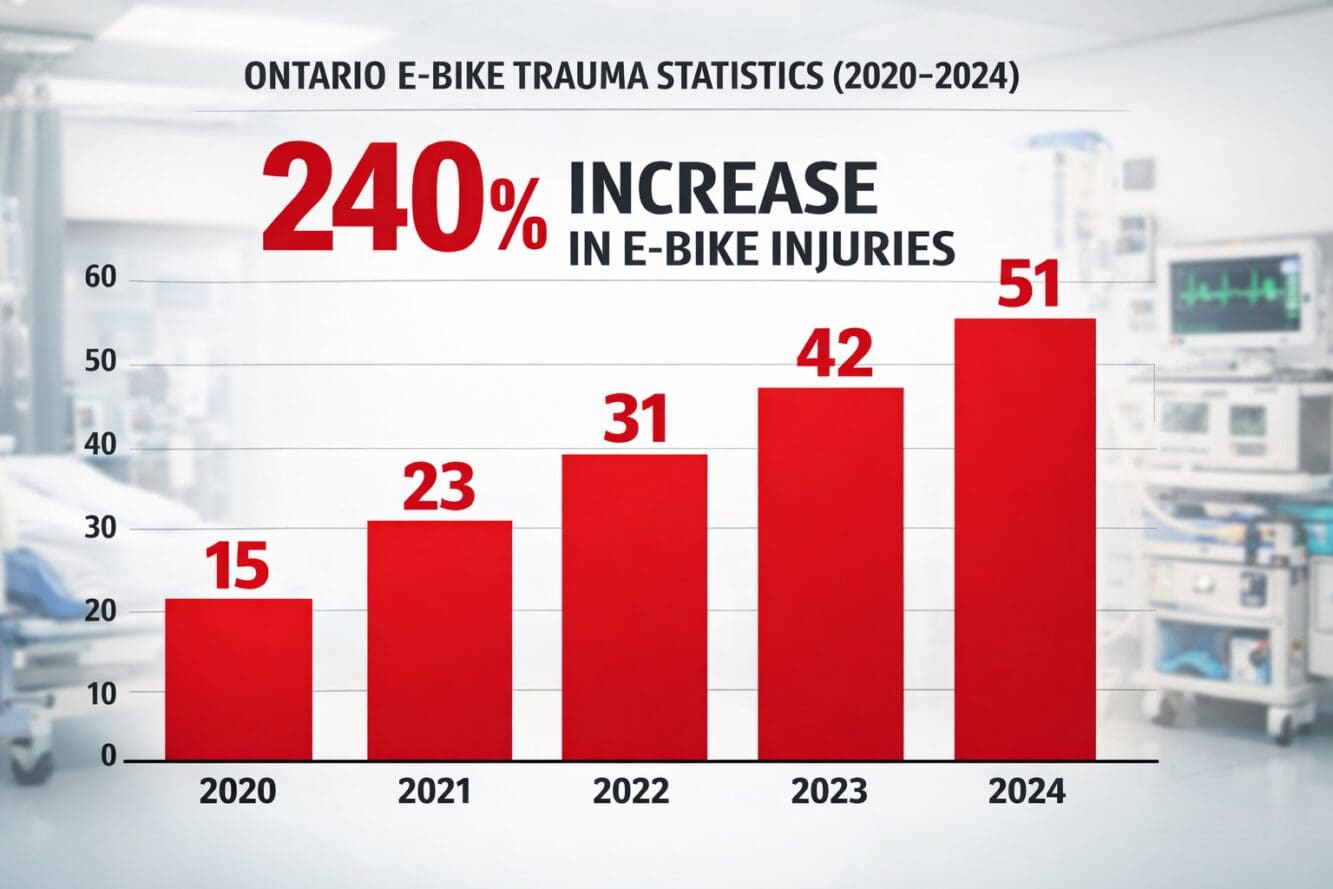
- E-bike trauma cases surged 240% at St. Michael’s Hospital between 2020 and 2024, jumping from 15 to 51 cases[1]
- New 500W motor limits are now strictly enforced across Ontario, with non-compliant e-bikes facing fines and impoundment
- Helmet usage remains critically low at only 1-2% among rental e-scooter riders, despite mandatory helmet laws[1]
- Young male riders account for 81% of e-scooter injuries, with children aged 10-13 representing nearly half of pediatric cases[1]
- Severe injuries dominate emergency rooms, including shattered collarbones, 6-7 rib fractures, destroyed ankles, and internal bleeding[1]
- Path-sharing conflicts between e-bike riders and pedestrians have intensified enforcement of shared-use regulations
- Insurance requirements now mandate liability coverage for e-bikes classified as motor vehicles under certain conditions
- 617 total fatalities were recorded in Ontario traffic collisions during 2024, highlighting broader road safety concerns[3]
Quick Answer
Ontario E-Bike Fatalities Rise in 2026: New 500W Laws, Helmet Enforcement, and Rider Safety Crash Analysis reveals a public health crisis driven by surging e-bike and e-scooter adoption. Trauma cases at major hospitals jumped 240% between 2020 and 2024, prompting stricter enforcement of 500-watt motor limits, mandatory helmet laws, and new insurance requirements. The majority of injuries involve young riders who aren’t wearing helmets, and collision patterns show dangerous conflicts with pedestrians on shared pathways.
What’s Driving the Sharp Increase in Ontario E-Bike Fatalities and Injuries?
The rise in Ontario e-bike fatalities and serious injuries stems from three converging factors: explosive growth in e-bike and e-scooter adoption, dangerously low helmet compliance rates, and infrastructure that wasn’t designed for high-speed micromobility devices.
St. Michael’s Hospital in Toronto documented a 240% increase in e-bike trauma cases, rising from just 15 in 2020 to 51 in 2024[1]. E-scooter injuries climbed even more dramatically, surging nearly 600% from 4 cases to 28 in the same period[1]. These aren’t minor scrapes—emergency physicians report seeing shattered collarbones requiring surgery, multiple rib fractures, destroyed ankles, and internal bleeding[1].
Key contributing factors include:
- Speed mismatch: E-bikes can reach 32 km/h, far faster than traditional bicycles, creating dangerous speed differentials on shared paths
- Inexperienced riders: Many users treat e-bikes like bicycles but lack the skills to handle motor-assisted acceleration and braking
- Invisible risks: Riders underestimate stopping distances and overestimate their ability to avoid collisions
- Infrastructure gaps: Bike lanes designed for 15 km/h cyclists can’t safely accommodate 32 km/h e-bikes mixed with pedestrians
Common mistake: Treating an e-bike rental like a casual bike share. E-bikes require the same risk assessment as riding a motorcycle at city speeds—protective gear, defensive riding, and route planning are essential.
How Do Ontario’s New 500W Motor Laws Change E-Bike Regulations in 2026?
Ontario’s 500-watt motor limit defines the legal boundary between a power-assisted bicycle and a motor vehicle. E-bikes with motors exceeding 500W now require registration, insurance, and a driver’s license—regulations that most riders aren’t prepared to meet.
The 500W threshold applies to continuous rated power, not peak power. Many imported e-bikes marketed as “500W” actually deliver 750W or more at peak output, making them illegal for use on Ontario roads and bike paths. Provincial enforcement has intensified in 2026, with police conducting roadside motor inspections and impounding non-compliant bikes.
What the 500W law means for riders:
- Compliant e-bikes: No license, registration, or insurance required; allowed on bike paths and roads with speed limits up to 50 km/h
- Non-compliant e-bikes (over 500W): Classified as motor vehicles; require M or M2 license, registration, insurance, and are banned from bike paths
- Fines: Operating an unregistered motor vehicle carries fines starting at $500, plus vehicle impoundment
- Speed limit: All e-bikes are capped at 32 km/h regardless of motor size
Choose compliant if: You want legal access to bike infrastructure without licensing hassles. Choose a higher-wattage setup only if you’re prepared to register it as a motorcycle and stay off bike paths entirely.
Why Is Helmet Enforcement Critical Despite Low Compliance Rates?
Helmet use among e-bike and e-scooter riders remains shockingly low, with only 1-2% of rental e-scooter users wearing helmets even when they’re provided free[1]. This compliance gap directly correlates with the severity of head injuries seen in emergency departments.
Ontario law requires helmets for all e-bike riders, but enforcement has been inconsistent—until recent GTA collisions forced a policy shift. Toronto, Ottawa, and other municipalities have launched targeted helmet enforcement campaigns in 2026, issuing $85 fines for non-compliance and partnering with rental companies to improve helmet distribution.
Why riders skip helmets:
- Rental convenience: Carrying a helmet negates the spontaneity of rental e-scooters
- Perceived safety: Riders incorrectly assume low speeds mean low risk
- Social factors: Helmet use isn’t normalized in urban micromobility culture
- Hygiene concerns: Shared rental helmets face cleanliness resistance
Injury data tells the real story: SickKids Hospital reports that nearly half of injured e-scooter riders were children aged 10-13, with 81% being male[1]. Head injuries dominate severe cases, and helmeted riders experience significantly fewer critical outcomes.
Edge case: Some municipalities allow helmet-free riding for adults on e-scooters under 24 km/h, but Ontario provincial law supersedes local bylaws for e-bikes, making helmets mandatory regardless of speed or age.
What Are the Most Common E-Bike Crash Patterns in Ontario?
E-bike collisions in Ontario follow predictable patterns that reveal infrastructure and behavior gaps. Understanding these crash types helps riders avoid high-risk scenarios.
Top crash scenarios:
- Dooring incidents: Riders hit car doors opened into bike lanes (40% of urban e-bike collisions)
- Intersection conflicts: Left-turning vehicles fail to yield to straight-moving e-bikes
- Pedestrian collisions: E-bikes strike pedestrians on shared-use paths, especially at blind corners
- Solo crashes: Riders lose control on wet surfaces, gravel, or during emergency braking
- Rear-end collisions: Cars misjudge e-bike speed and strike from behind at intersections
Time and location risk factors:
- Peak danger hours: 4-6 PM during rush hour accounts for 35% of serious collisions
- High-risk locations: Intersections without dedicated bike signals, shared paths near transit hubs, roads with parking lanes
- Weather impact: Wet conditions triple the risk of solo crashes due to reduced tire traction
Decision rule: If you’re riding faster than 20 km/h on a shared path with pedestrians, you’re creating collision risk. Slow to walking speed near transit stops, playgrounds, and blind corners, or choose road routes instead.
How Do Path-Sharing Conflicts Between E-Bikes and Pedestrians Escalate?
Shared-use paths designed for casual cyclists and pedestrians can’t safely accommodate e-bikes traveling at 32 km/h. The speed differential creates dangerous close-pass situations, especially when riders fail to signal or slow down.
Toronto’s Martin Goodman Trail and Ottawa’s Rideau Canal pathway have seen multiple serious pedestrian-e-bike collisions in 2025-2026, prompting new enforcement of path-sharing bylaws. Riders now face fines for:
- Excessive speed on multi-use paths (over 20 km/h)
- Failure to yield to pedestrians at crossings
- Passing without warning (bell or verbal signal required)
- Riding in pedestrian-only zones during peak hours
Conflict triggers:
- E-bikes approach silently, startling pedestrians who step into the path
- Riders assume pedestrians will hear them and move aside
- Children and dogs create unpredictable movements
- Narrow path sections force dangerous passing maneuvers
Best practice: Treat shared paths like school zones. If you can’t stop within your line of sight, you’re going too fast. On crowded paths, dismount and walk your e-bike through congestion points.
What Insurance Coverage Do Ontario E-Bike Riders Actually Need?
Most e-bike riders don’t realize they may need insurance depending on their bike’s classification. Standard homeowner’s or tenant insurance typically excludes motorized vehicles, leaving riders personally liable for damages.
Insurance requirements by e-bike type:
| E-Bike Classification | Insurance Required? | Coverage Type | Typical Annual Cost |
|---|---|---|---|
| 500W or less, pedal-assist | No mandatory insurance | Optional liability recommended | $150-$300 |
| Over 500W motor | Yes, mandatory auto insurance | Full motor vehicle policy | $800-$1,500 |
| Rental e-bike/scooter | Included in rental | Limited liability (check terms) | Included |
| Modified/custom build | Depends on specs | May require motor vehicle policy | Varies |
What liability coverage should include:
- Third-party bodily injury: Minimum $1 million (pedestrian collision protection)
- Property damage: Coverage for vehicles, buildings, or infrastructure you damage
- Medical payments: Your own injury costs if you’re at fault
- Legal defense: Representation if you’re sued after a collision
Common gap: Homeowner’s insurance may cover theft of an e-bike stored at home but won’t cover liability if you injure someone while riding. A standalone personal liability policy or e-bike-specific insurance fills this gap.
Choose motor vehicle insurance if: Your e-bike exceeds 500W, has been modified for higher speeds, or you regularly ride in high-traffic areas where collision risk is elevated. For more details on understanding complex legal and regulatory frameworks, see our guide to navigating regulatory changes.
What Safety Gear and Equipment Actually Reduce E-Bike Injury Risk?
Beyond helmets, a comprehensive safety setup dramatically reduces injury severity. Emergency physicians treating e-bike trauma cases consistently note that riders with proper gear experience fewer critical injuries[1].
Essential safety equipment:
- Certified helmet: Look for CPSC, ASTM, or Snell certification (not generic bike helmets)
- Reflective clothing: High-visibility vest or jacket with 360-degree reflectivity
- Front and rear lights: Minimum 500-lumen front, flashing rear LED (required by law after dusk)
- Mirrors: Bar-end or helmet-mounted mirrors for rear visibility
- Gloves: Padded cycling gloves protect hands in falls (most common injury point)
- Eye protection: Clear or tinted glasses prevent debris-related crashes
Gear that prevents common injuries:
- Elbow and knee pads: Reduce fracture risk in solo crashes (especially for new riders)
- Reinforced footwear: Ankle boots prevent the “destroyed ankle” injuries physicians report[1]
- Phone mount with navigation: Reduces distracted riding while checking directions
- Bell or horn: Required by law; prevents pedestrian conflicts on shared paths
Maintenance safety checks:
- Brake test: Squeeze brakes before every ride; you should stop within 3 meters at 20 km/h
- Tire pressure: Under-inflated tires cause 60% of solo crashes in wet conditions
- Light function: Test all lights weekly; dead batteries create invisible rider scenarios
- Chain tension: Loose chains can jam and cause sudden stops
Edge case: If you’re riding an e-cargo bike with children, add a flag pole and additional rear lighting. Cargo bikes sit lower and are harder for drivers to see.
Frequently Asked Questions
Are e-bikes allowed on Ontario sidewalks?
No. E-bikes are banned from sidewalks across Ontario. Riders must use bike lanes or roads, except where municipal bylaws specifically permit sidewalk riding for traditional bicycles.
What’s the maximum speed for e-bikes in Ontario?
32 km/h (20 mph) is the legal maximum assisted speed. Motors must cut out at this speed, though riders can pedal faster without assistance.
Do I need a license to ride a 500W e-bike?
No license is required for e-bikes with motors 500W or less. You must be at least 16 years old and wear a helmet.
Can police impound my e-bike for speeding?
Yes. If your e-bike exceeds 500W or has been modified to exceed legal speed limits, it’s classified as a motor vehicle and can be impounded for operating without registration.
What happens if I hit a pedestrian while riding an e-bike?
You’re personally liable for damages and injuries. Without liability insurance, you could face lawsuits for medical costs, lost wages, and pain and suffering—potentially hundreds of thousands of dollars.
Are rental e-scooters legal in all Ontario cities?
No. Each municipality decides whether to permit rental e-scooter programs. Toronto, Ottawa, and Waterloo have active programs, but many smaller cities have banned them.
How much does a good e-bike helmet cost?
Quality certified helmets range from $60-$150. Multi-impact rated helmets designed for e-bikes (not regular bike helmets) start around $100.
Can I ride my e-bike in winter?
Yes, but winter riding requires studded tires, reduced speeds, and extra caution. Most e-bike batteries lose 20-40% capacity in freezing temperatures.
What should I do immediately after an e-bike collision?
Call 911 if anyone is injured. Exchange information with all parties. Document the scene with photos. Report the collision to police if damage exceeds $2,000 or if there are injuries.
Are throttle-controlled e-bikes legal in Ontario?
Yes, but only if they also have functional pedals and meet the 500W/32 km/h limits. Throttle-only operation without pedaling is permitted.
Do e-bike riders have to follow all traffic laws?
Yes. E-bikes must obey stop signs, traffic signals, lane markings, and all rules that apply to bicycles and motor vehicles.
What’s the penalty for riding without a helmet?
Fines start at $85 for helmet violations. Repeat offenders may face higher fines and mandatory safety courses.
Conclusion
Ontario E-Bike Fatalities Rise in 2026: New 500W Laws, Helmet Enforcement, and Rider Safety Crash Analysis demonstrates that the province’s micromobility boom has outpaced safety infrastructure and rider education. With trauma cases surging 240% in just four years and helmet compliance remaining dangerously low at 1-2%, the current trajectory points toward more preventable deaths and life-altering injuries[1].
The new 500W motor limits, stricter helmet enforcement, and insurance requirements represent necessary regulatory responses to a public health crisis. But regulations alone won’t solve path-sharing conflicts, dooring incidents, or the inexperience gap that leaves riders unprepared for emergency situations.
Actionable next steps for safer riding:
- Verify your e-bike’s motor rating and ensure it complies with 500W limits before your next ride
- Invest in certified safety gear including a proper e-bike helmet, lights, and reflective clothing
- Check your insurance coverage and add liability protection if you’re riding regularly
- Practice emergency braking in a safe area until you can stop confidently within 3 meters
- Choose routes strategically by avoiding high-conflict shared paths during peak pedestrian hours
- Take a cycling safety course specifically designed for e-bike riders (many municipalities offer free programs)
The data is clear: e-bikes and e-scooters aren’t going away, and neither are the risks they create. Riders who treat these devices with the same respect as motorcycles—proper gear, defensive riding, route planning—will avoid becoming another statistic in Ontario’s growing e-bike trauma numbers. For insights into how infrastructure changes can improve safety outcomes, explore our coverage of Collingwood’s speed limit review process.
References
[1] E Scooter E Bike Injuries Ontario – https://www.mcleishorlando.com/accident-prevention/e-scooter-e-bike-injuries-ontario/
[2] Motor Vehicle Fatalities On Rise In Canada – https://www.preszlerlaw.com/blog/motor-vehicle-fatalities-on-rise-in-canada/
[3] Mto Orsar Preliminary Selected Statistics En 2024 2026 02 05 – https://www.ontario.ca/files/2026-02/mto-orsar-preliminary-selected-statistics-en-2024-2026-02-05.pdf
Content, illustrations, and third-party video appearing on GEORGIANBAYNEWS.COM may be generated or curated with AI assistance or reproduced pursuant to the fair dealing provisions of the Copyright Act, R.S.C. 1985, c. C-42. Attribution and hyperlinks to original sources are provided in acknowledgment of applicable intellectual property rights. Such referencing is intended to direct traffic to and support the original rights holders’ platforms.