


















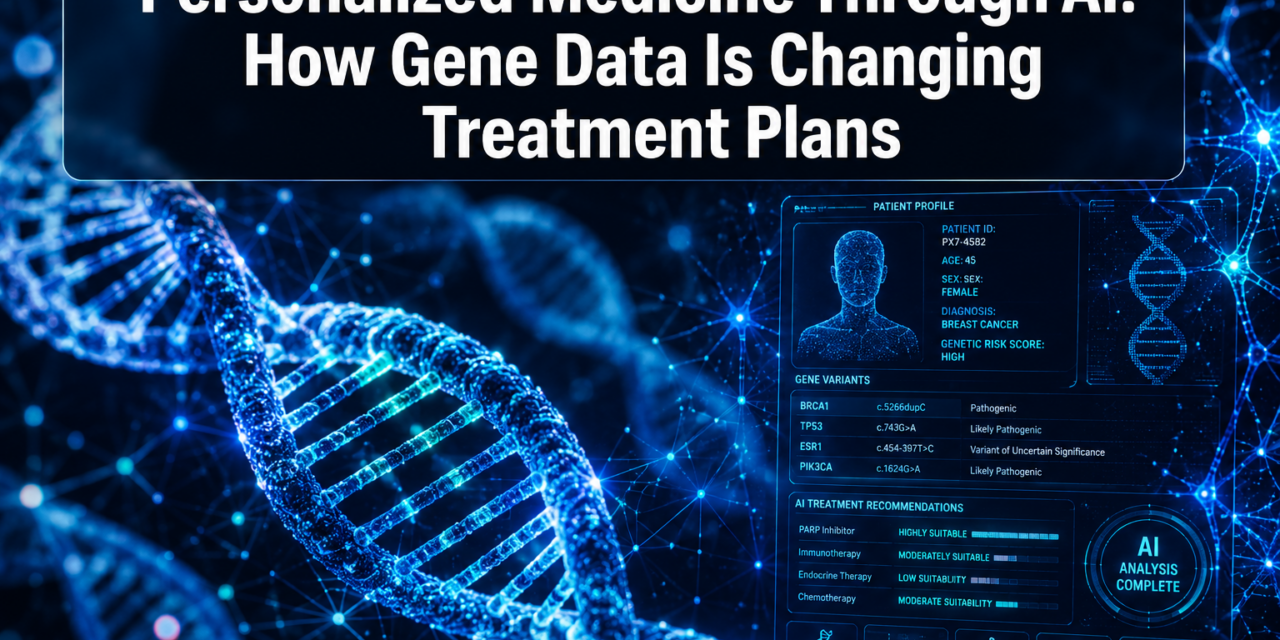
Personalized Medicine Through AI: How Gene Data Is Changing Treatment Plans
Last updated: June 27, 2026
Quick Answer: Personalized medicine through AI uses a patient’s genetic data, medical history, and biomarkers to tailor treatments, dosing, and risk assessments to the individual rather than applying a standard protocol. AI platforms can now analyze thousands of genetic variants in hours, helping doctors choose drugs that are more likely to work and less likely to cause harm. This approach is already in clinical use for cancer, mental health, and cardiovascular conditions, though access and cost vary widely.
Key Takeaways
- Personalized medicine matches treatments to a patient’s unique genetic profile rather than using population-wide averages.
- AI can analyze hundreds or thousands of genetic variants far faster than any manual review, flagging drug interactions and dosing risks in real time.
- Adverse drug events cause an estimated 250,000 deaths annually in the U.S.; AI-driven pharmacogenomics aims to reduce that number significantly [6].
- Platforms like Medzown report a 67% average savings on complex-member healthcare spend by matching patients to appropriate therapies faster [3].
- The global average efficacy rate for prescribed medications sits around 38%, meaning most drugs fail most patients; personalized genomics aims to fix that [5].
- Genetic testing for personalized medicine ranges from consumer-grade DNA kits to clinical-grade pharmacogenomic panels, with very different levels of clinical reliability.
- AI recommendations are decision-support tools, not replacements for physician judgment.
- Cancer treatment is currently the most advanced application of AI-guided personalized medicine.
- Privacy protections matter: reputable platforms process genetic data locally or under strict encryption standards.
- Not everyone benefits equally; rare genetic variants and underrepresented populations remain areas of active research.
What Is Personalized Medicine and How Does It Work
Personalized medicine, also called precision medicine, tailors medical treatment to the individual characteristics of each patient. Instead of prescribing the same drug at the same dose to everyone with a given diagnosis, clinicians use genetic, environmental, and lifestyle data to predict which treatment will work best for that specific person.
Here is how the process typically works:
- Genetic sample collection – A saliva swab, blood draw, or tumor biopsy provides DNA.
- Sequencing and variant analysis – Lab equipment reads the patient’s genetic code and flags relevant variants.
- AI analysis – Algorithms cross-reference variants against databases of known drug responses, disease risks, and gene interactions.
- Clinical recommendation – The system generates a report that a physician reviews before making prescribing decisions.
Platforms like GeneOps have analyzed over 1,866 genetic variants and generated more than 13,083 health recommendations across 41 health categories, illustrating how much data AI can process in a single patient workup [4].
How Does AI Analyze Genetic Data for Treatment
AI processes genetic data by comparing a patient’s variants against large, curated databases of gene-drug and gene-disease associations. The result is a ranked list of treatment options, risk flags, and dosing adjustments.
Key methods AI uses:
- Pharmacogenomics – Identifies how a patient’s genes affect drug metabolism (fast metabolizer vs. slow metabolizer).
- Variant-trait mapping – Primordial AI, for example, has identified over 373,000 gene variant-trait associations using multi-omics datasets.
- Pathway analysis – Graphen’s platform integrates genetic, proteomic, and environmental data to map disease pathways and suggest patient-specific drug targets [9].
- Organoid modeling – GenEZ combines genomic data with lab-grown tissue models to test drug responses before prescribing, aiming to move beyond the 38% global medication efficacy average [5].
AI does not diagnose on its own. It surfaces patterns that a clinician then interprets in the context of the full patient picture.
What Is the Difference Between Personalized Medicine and Traditional Treatment
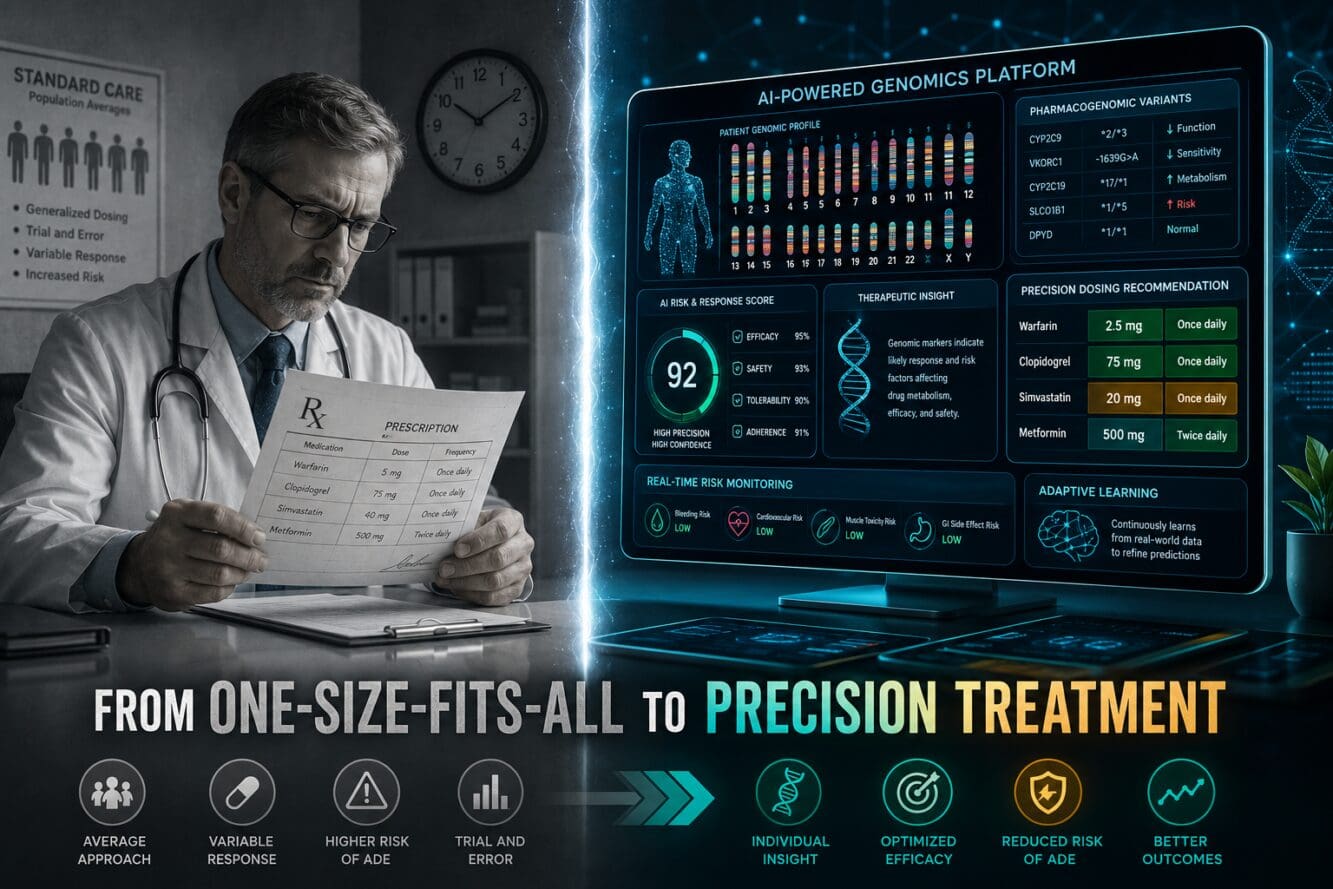
Traditional treatment uses clinical guidelines built from population-level studies, meaning the recommended drug is the one that worked best on average across thousands of trial participants. Personalized medicine asks a different question: what works best for this patient’s biology?
| Feature | Traditional Medicine | Personalized Medicine |
|---|---|---|
| Basis | Population averages | Individual genetics and biomarkers |
| Drug selection | Guideline-driven | Genomics-informed |
| Dosing | Standard weight/age formulas | Metabolizer status and gene variants |
| Trial and error | Common | Reduced |
| Cost | Lower upfront | Higher upfront, potentially lower long-term |
The practical gap is significant. Adverse drug events linked to one-size-fits-all prescribing account for roughly 3.2 million hospital and ER visits annually in the U.S., according to Genomind [10].
How Much Does Personalized Medicine Cost
Costs vary considerably depending on the type of testing and the platform used. Consumer DNA kits from services like 23andMe start under $200, but these are wellness-grade, not clinical-grade. Clinical pharmacogenomic panels used in hospital settings can range from a few hundred to several thousand dollars, and insurance coverage is inconsistent.
Cost considerations:
- Some AI platforms, like GENO, allow users to upload existing raw DNA files from consumer services, reducing the need for new testing [1].
- Medzown reports a 67% average savings on complex-member spend by efficiently matching patients to appropriate therapies, suggesting that upfront genomic investment can reduce downstream costs [3].
- Vytality’s comprehensive longevity panels, which analyze over 300 lab biomarkers alongside genetic data, represent a premium tier of personalized medicine [7].
Choose personalized testing if: you have a chronic condition, are managing cancer treatment, or have experienced multiple drug failures. For general wellness curiosity, consumer-grade options may be sufficient, but they should not drive clinical decisions.
Can AI Predict Which Treatments Will Work Best for You
AI can significantly narrow the field of likely-effective treatments, but it cannot guarantee outcomes. It works best as a probability engine, not a crystal ball.
Avenir’s platform has matched over 3,400 patients with more than 250 candidate therapies using intelligent matching under right-to-try legislation, demonstrating real-world applicability beyond theoretical promise [2]. Medzown’s AI-powered system matches patients to appropriate clinical trials and treatments within hours, not weeks [3].
The accuracy of these predictions depends on:
- Quality and completeness of the patient’s genetic data
- Size and diversity of the reference database
- Whether the condition has well-studied genetic markers
For conditions like certain breast cancers or leukemias, predictive accuracy is high. For complex multifactorial conditions like depression, AI guidance is useful but less definitive.
What Are the Risks of Using AI for Medical Decisions
AI in medicine carries real risks, and understanding them helps patients ask better questions. The main concerns are algorithmic bias, data errors, and over-reliance on automated recommendations.
- Bias in training data – If the genomic database was built predominantly from one ethnic group, predictions for underrepresented populations may be less accurate.
- Data errors – Emyra’s platform specifically targets the problem of adverse drug events caused by incorrect prescribing, noting that over 250,000 deaths annually in the U.S. are linked to these events [6].
- Privacy risks – Genetic data is uniquely personal. Reputable platforms like GENO process data entirely within the user’s browser to avoid third-party exposure [1].
- Over-reliance – AI outputs are recommendations, not orders. A physician must still apply clinical judgment.
The mental health crisis intersects with these risks directly, since pharmacogenomic tools for psychiatric medications are promising but still developing in accuracy.
Is Personalized Medicine Available Right Now or Still Experimental
Personalized medicine is available now in several clinical contexts, though the breadth of application varies. It is not uniformly experimental.
Currently in clinical use:
- Oncology (cancer genomics for targeted therapy selection)
- Pharmacogenomics (psychiatric and cardiovascular drug matching)
- Rare disease diagnosis and treatment matching
- Clinical trial enrollment matching
Still largely experimental or emerging:
- Real-time AI dosing adjustment during treatment
- Whole-genome sequencing as a routine first-line diagnostic tool
- AI-driven drug development tailored to individual genotypes
Platforms like GenieMD are already integrating AI-powered personalized prevention plans into telehealth and chronic care management workflows [8], signaling that precision care is moving into mainstream primary care.
How Accurate Is AI at Reading Genetic Information and What Genetic Tests Are Needed
AI accuracy in reading genetic variants depends heavily on the type of test used and the depth of analysis. Clinical-grade whole-exome or whole-genome sequencing is the most comprehensive. Targeted gene panels focus on specific known variants relevant to a condition or drug class.
Common test types:
- Pharmacogenomic panels – Focused on drug metabolism genes (CYP450 family). Used by platforms like Genomind to tailor psychiatric and cardiovascular medications [10].
- Tumor genomic profiling – Used in oncology to identify mutations driving cancer growth.
- Consumer raw DNA files – Lower resolution, but platforms like GENO and Refract can still extract useful health insights from them [1].
AI accuracy is high for well-characterized variants but drops for rare or novel mutations. Databases are growing, so accuracy improves over time as more diverse patient data is added.
Does Personalized Medicine Work for Cancer Treatment
Cancer is the strongest current application of AI-guided personalized medicine. Tumor genomic profiling can identify specific mutations that make a cancer responsive to targeted therapies, avoiding chemotherapy regimens that are unlikely to work for that patient’s tumor type.
Graphen’s AI integrates gene mutation analysis, pathway identification, and patient-specific drug development, with a particular focus on rare and complex conditions including certain cancers [9]. This approach allows oncologists to match patients with therapies that target the exact molecular driver of their tumor rather than using a broad-spectrum protocol.
The practical benefit is real: patients avoid ineffective treatments with serious side effects, and treatment timelines can shorten considerably.
What Happens If AI Gets Genetic Data Wrong, and Who Should Be Cautious
If AI misreads or misinterprets genetic data, the consequences can range from a missed drug optimization opportunity to a harmful prescribing decision. This is why AI outputs always require physician review before clinical action.
Who should be cautious:
- Patients from ethnic groups underrepresented in genomic databases (predictions may be less reliable)
- People with rare genetic variants not yet catalogued in reference databases
- Anyone using consumer-grade DNA data for clinical decisions without physician oversight
Who may not benefit as much:
- Patients with conditions that have no known genetic component
- Those seeking quick answers without willingness to engage a clinician in interpreting results
The strategic food choices and lifestyle factors that influence gene expression also matter here: genetic data is one input, not the whole picture.
How Do Doctors Use AI Recommendations Alongside Their Own Judgment
Doctors use AI-generated genomic reports as one layer of clinical evidence, not as a final answer. The report flags relevant variants, suggests drug options, and highlights risks. The physician then weighs that against the patient’s full history, current medications, comorbidities, and personal preferences.
Emyra’s platform is designed specifically to integrate pharmacogenomic insights directly into electronic health record (EHR) workflows, making it easier for clinicians to act on AI recommendations without leaving their standard tools [6]. Genomind similarly provides reports structured for provider interpretation, not direct patient self-prescribing [10].
The model is collaborative: AI handles the data volume; the physician handles the context and the relationship.
Common Mistakes People Make About Personalized Medicine
Several widespread misconceptions slow adoption and sometimes lead to poor decisions.
- Treating consumer DNA kits as medical-grade diagnostics – They are not. A 23andMe result should not drive medication changes without clinical validation.
- Assuming AI means no side effects – AI reduces the probability of a poor drug match; it does not eliminate risk entirely.
- Ignoring privacy terms – Not all platforms protect genetic data equally. Always check whether data is processed locally or shared with third parties.
- Expecting instant results – Comprehensive genomic analysis and clinical interpretation take time, even when AI speeds up the data processing step.
- Thinking it only applies to rare diseases – Common conditions like hypertension, depression, and Type 2 diabetes all have pharmacogenomic applications in active clinical use today.
Research from Stanford University and other leading institutions continues to expand the evidence base, but patients should verify that any platform they use draws on peer-reviewed, clinically validated data rather than proprietary algorithms with no external scrutiny.
FAQ
What is the simplest definition of personalized medicine?
Personalized medicine uses a patient’s genetic and biological data to choose treatments that are most likely to work for that specific individual, rather than applying a standard protocol designed for the average patient.
Do I need a doctor to use AI-based genetic health tools?
For consumer wellness platforms, no. For any clinical decision including medication changes, yes. AI reports require physician interpretation before being acted upon.
How long does it take to get results from an AI genomics platform?
Platforms like Refract deliver actionable health plans within 48 hours of data submission. Clinical genomic panels in hospital settings may take one to two weeks.
Is my genetic data safe with these platforms?
It depends on the platform. GENO processes all data within the user’s browser, meaning no genetic information leaves the device [1]. Always review a platform’s privacy policy before uploading DNA files.
Can personalized medicine help with mental health treatment?
Yes. Pharmacogenomic testing can identify which psychiatric medications a patient is likely to metabolize effectively, reducing the trial-and-error period that often frustrates mental health treatment.
Does insurance cover genetic testing for personalized medicine?
Coverage varies by country, insurer, and clinical indication. Cancer-related genomic testing has the broadest coverage. General pharmacogenomic panels are increasingly covered but not universally.
What is pharmacogenomics?
Pharmacogenomics is the study of how a person’s genes affect their response to drugs. It is a core tool in personalized medicine, helping clinicians select and dose medications based on a patient’s metabolizer profile.
Is personalized medicine only for wealthy patients?
Access is unequal today, but costs are falling. Consumer DNA uploads to platforms like GENO make basic genomic health insights accessible at low cost. Clinical-grade testing remains more expensive and coverage-dependent.
Can AI find genetic diseases before symptoms appear?
AI can flag elevated genetic risk for certain conditions, but genetic risk is not the same as a diagnosis. Elevated risk means closer monitoring and preventive action, not a certainty of disease.
What conditions benefit most from personalized medicine right now?
Cancer, cardiovascular disease, psychiatric conditions, and rare genetic disorders currently have the strongest evidence base for AI-guided personalized treatment.
Conclusion
Personalized medicine through AI is no longer a distant promise. It is a practical, expanding toolkit that is already changing how oncologists select therapies, how psychiatrists choose medications, and how rare disease patients find clinical trials. The core shift is from treating the average patient to treating the actual patient in front of you, guided by their unique genetic blueprint.
Actionable next steps for readers:
- If you have an existing consumer DNA file from 23andMe, AncestryDNA, or MyHeritage, explore platforms like GENO to extract health insights at no additional testing cost [1].
- If you are managing a chronic condition or have experienced multiple drug failures, ask your physician about clinical pharmacogenomic testing.
- If you are navigating cancer treatment, ask your oncologist whether tumor genomic profiling is appropriate for your case.
- Always verify that any AI health platform you use has transparent privacy practices and draws on clinically validated data.
- Treat AI recommendations as a starting point for a conversation with your doctor, not a final answer.
The gap between one-size-fits-all medicine and truly individualized care is closing, and understanding how gene data and AI work together puts patients in a stronger position to ask better questions and make more informed choices.
References
[1] genohealth.app – https://genohealth.app/?utm_source=openai
[2] avenir.tech – https://www.avenir.tech/?utm_source=openai
[3] medzown – https://medzown.com/?utm_source=openai
[4] geneops.ai – https://geneops.ai/?utm_source=openai
[5] genez.ai – https://genez.ai/?utm_source=openai
[6] emyra – https://www.emyra.com/?utm_source=openai
[7] vytality.ai – https://vytality.ai/?utm_source=openai
[8] geniemd – https://www.geniemd.com/?utm_source=openai
[9] Personalized Medicine – https://www.graphen.ai/drugomics/personalized-medicine?utm_source=openai
[10] genomind – https://genomind.com/?utm_source=openai
Content, illustrations, and third-party video appearing on GEORGIANBAYNEWS.COM may be generated or curated with AI assistance or reproduced pursuant to the fair dealing provisions of the Copyright Act, R.S.C. 1985, c. C-42. Attribution and hyperlinks to original sources are provided in acknowledgment of applicable intellectual property rights. Such referencing is intended to direct traffic to and support the original rights holders’ platforms.