



















Strait of Hormuz Blockade Impact on Canadian Grocery Prices: Fuel Surcharges and Cost Inflation Timeline
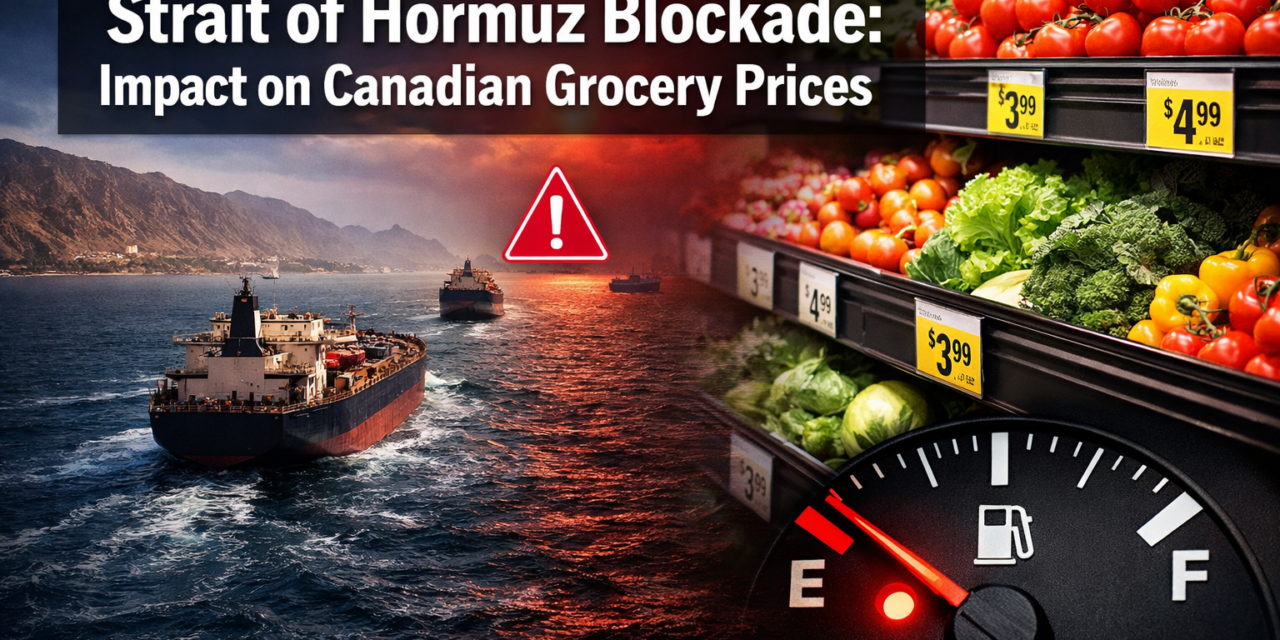
One-fifth of the world’s oil supply now sits behind a geopolitical chokepoint — and Canadian families are about to feel it at the checkout counter. Since March 2026, the Strait of Hormuz blockade has disrupted global energy markets, and major Canadian food suppliers have already begun passing costs to retailers through new fuel surcharges. Understanding the Strait of Hormuz blockade impact on Canadian grocery prices: fuel surcharges and cost inflation timeline is now essential for every household trying to budget through this crisis.
The Strait of Hormuz carries roughly 20% of the world’s oil and nearly 30% of globally traded fertilizers [3]. When that flow stops, the ripple effects reach far beyond gas stations. They land squarely on dinner tables across Canada.
Key Takeaways
- 🛢️ Three major Canadian food suppliers — Tree of Life, Maple Leaf Foods, and Sunrise Farms — have implemented fuel surcharges between April 6 and April 22, 2026 [1][2].
- 📈 Overall grocery inflation could climb to 6%–8%, adding several hundred dollars per year to the average family’s food bill [3].
- 🥩 Fresh produce, meat, and dairy face the steepest increases, ranging from 4% to 15% depending on the category [3].
- 🏪 Smaller independent grocers will be hit hardest due to limited bargaining power with suppliers [1].
- ⚔️ Major retailers Loblaw and Sobeys are publicly pushing back against supplier surcharges [2].
How the Strait of Hormuz Blockade Disrupts Canadian Food Supply Chains
The crisis began in March 2026 when Iran’s new supreme leader, Mojtaba Khamenei, initiated a blockade of the Strait of Hormuz in response to military strikes from the United States and Israel. By mid-April, the U.S. had begun its own counter-blockade [2]. This dual disruption effectively sealed off one of the most critical energy corridors on the planet.
But why does a conflict thousands of kilometres away affect what Canadians pay for bread and chicken?
The answer is energy dependency. Every stage of the food supply chain — from growing crops with petroleum-based fertilizers, to processing meat in energy-intensive facilities, to shipping temperature-controlled goods across the country — relies on affordable fuel. When oil prices surge, so does the cost of getting food from farm to fork.
“Every sustained 25% increase in oil prices typically adds $150 to $200 annually to the average Canadian grocery bill.” [3]
This pattern has played out before, but the current disruption is especially severe because the Strait of Hormuz also controls a massive share of global fertilizer trade. That means the blockade hits food costs from two directions at once: higher transportation fuel and higher crop production costs [3].
For context on how global supply chain pressures and geopolitical dependencies affect Western economies, the interconnected nature of modern trade means no country is truly insulated.
Fuel Surcharges and Cost Inflation Timeline: Which Suppliers Are Charging What?
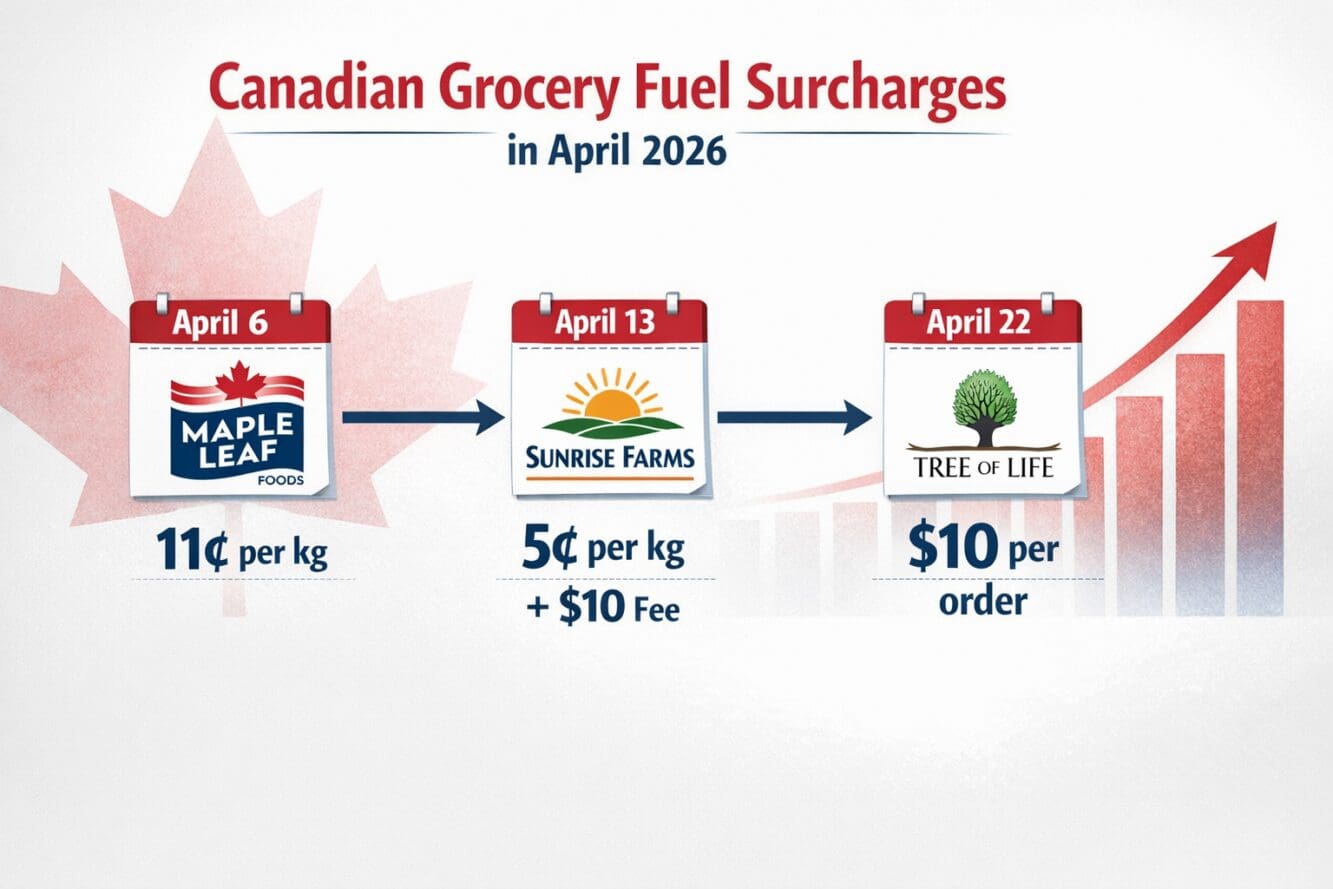
Canadian food suppliers have moved quickly to protect their margins. Here is the complete timeline of surcharges announced so far:
| Date | Supplier | Surcharge Details | Conditions for Removal |
|---|---|---|---|
| April 6, 2026 | Maple Leaf Foods | 11¢ per kg on all prepared meat and fresh poultry | Will decrease as fuel prices lower [1][2] |
| April 13, 2026 | Sunrise Farms | 5¢ per kg + $10 fuel surcharge per shipment | Per-kg rate adjusted biweekly based on fuel markets [2] |
| April 22, 2026 | Tree of Life | $10 per order | Will not be removed until Canadian fuel costs return to an average of $1.20/litre [1] |
These surcharges may seem small individually, but they compound across thousands of products moving through the supply chain daily. A single grocery store may receive dozens of shipments per week, and each added cost gets layered into the final shelf price.
Why Smaller Grocers Face a Bigger Burden
Major chains like Loblaw and Sobeys have the volume and leverage to negotiate with suppliers — and both have publicly pushed back against these surcharges [2]. Independent and smaller grocers, however, lack that bargaining power. They are expected to absorb a larger share of these costs or pass them directly to consumers [1].
This creates an uneven playing field where neighbourhood grocery stores may see prices rise faster than big-box competitors, potentially driving more customers toward large chains.
Category-by-Category Price Increase Forecast
Not all grocery items will be affected equally. Here is what analysts project for the coming months [3]:
🥬 Fresh Produce: 5%–15% Increase
Fruits and vegetables face the steepest potential hikes. Most imported produce travels long distances in temperature-controlled trucks and containers, making it extremely fuel-sensitive. Expect tropical fruits, out-of-season vegetables, and imported berries to see the sharpest jumps.
🥩 Meat and Seafood: 5%–10% Increase
Beef is expected to lead the way. Meat production is energy-intensive at every stage — from growing animal feed to operating processing plants to maintaining cold-chain logistics. Seafood, much of which is imported, faces similar pressures.
🥛 Dairy Products: 4%–8% Increase
While Canada’s supply-managed dairy system provides some insulation, rising energy costs still affect processing and distribution. Expect gradual increases over the next few quarters rather than sudden spikes.
🍞 Bread and Cereals: 3%–6% Increase
The fertilizer connection is key here. With nearly 30% of globally traded fertilizers flowing through the Strait of Hormuz, grain production costs are climbing worldwide [3]. This translates into higher prices for flour, bread, pasta, and breakfast cereals.
The Broader Economic Picture: What 6%–8% Grocery Inflation Means
Historically, sustained oil price increases add one to three percentage points to food inflation in Canada [3]. Current conditions suggest grocery inflation could reach 6% to 8% — a level not seen since the post-pandemic inflation spike.
For a family spending $12,000 per year on groceries, that translates to an additional $720 to $960 annually. For lower-income households already stretched thin, this could mean difficult choices between nutrition and other essentials.
The situation also intersects with broader concerns about energy infrastructure strain and the cascading effects of energy disruptions on everyday life. Meanwhile, climate-related policy decisions and industry accountability remain central to how Canada navigates its long-term energy and food security.
What Canadian Consumers Can Do Right Now
While no individual can control geopolitics, there are practical steps to soften the blow:
- Buy local and seasonal 🇨🇦 — Locally grown produce has shorter supply chains and lower fuel exposure.
- Stock up strategically — Non-perishable staples like rice, canned goods, and frozen vegetables are less volatile. Buying now before further increases can save money.
- Compare prices across retailers — With major chains pushing back on surcharges, pricing may vary significantly between stores.
- Reduce food waste — The average Canadian household wastes approximately $1,300 worth of food per year. Cutting waste is like giving yourself a raise.
- Watch for biweekly adjustments — Sunrise Farms’ surcharge adjusts every two weeks [2], meaning prices could fluctuate. Stay informed.
Community-level responses matter too. Supporting local food initiatives and community organizations can help build resilience against global supply shocks.
How Long Will This Last?
The duration of the Strait of Hormuz blockade impact on Canadian grocery prices depends on several unpredictable factors:
- Diplomatic resolution — If the blockade ends quickly, fuel prices could stabilize within weeks, though grocery prices typically lag by 30–90 days.
- Prolonged conflict — A months-long disruption would embed higher costs into supplier contracts, potentially keeping prices elevated well into 2027.
- Tree of Life’s benchmark — Their surcharge remains until Canadian fuel averages $1.20/litre [1], providing a clear marker to watch.
The bottom line: even in the best-case scenario, Canadian grocery prices will remain elevated through at least summer 2026.
Conclusion
The Strait of Hormuz blockade impact on Canadian grocery prices is not a distant geopolitical abstraction — it is arriving on store shelves right now through concrete fuel surcharges and measurable cost inflation. With three major suppliers already implementing charges and analysts forecasting 6%–8% overall grocery inflation [3], Canadian families need to plan accordingly.
Actionable next steps:
- ✅ Review your monthly grocery budget and adjust for a potential $60–$80 per month increase
- ✅ Prioritize local, seasonal, and less fuel-dependent food options
- ✅ Monitor fuel price benchmarks — particularly the $1.20/litre threshold — for signs of relief
- ✅ Stay alert for emerging scams that exploit consumer anxiety during price crises
- ✅ Advocate for transparent pricing from both suppliers and retailers
The weeks ahead will test Canadian household budgets. Being informed is the first line of defence.
References
[1] Watch – https://www.youtube.com/watch?v=281o3m790KE
[2] Two Major Canadian Grocers Fuel Surcharges – https://www.blogto.com/eat_drink/2026/04/two-major-canadian-grocers-fuel-surcharges/
[3] How Strait Of Hormuz Tensions Are Set To Raise Grocery Prices In Canada – https://retail-insider.com/retail-insider/2026/04/how-strait-of-hormuz-tensions-are-set-to-raise-grocery-prices-in-canada/
[4] Canadas Food Suppliers Add Fuel Surcharges Amid Hormuz Closure – https://globalnews.ca/video/11803587/canadas-food-suppliers-add-fuel-surcharges-amid-hormuz-closure
[5] Global Food Emergency How Bad Strait Hormuz Grocery Prices Shortages – https://fortune.com/2026/04/09/global-food-emergency-how-bad-strait-hormuz-grocery-prices-shortages/
[6] Watch – https://www.youtube.com/watch?v=GAYg69VBT30
Content, illustrations, and third-party video appearing on GEORGIANBAYNEWS.COM may be generated or curated with AI assistance or reproduced pursuant to the fair dealing provisions of the Copyright Act, R.S.C. 1985, c. C-42. Attribution and hyperlinks to original sources are provided in acknowledgment of applicable intellectual property rights. Such referencing is intended to direct traffic to and support the original rights holders’ platforms.