



















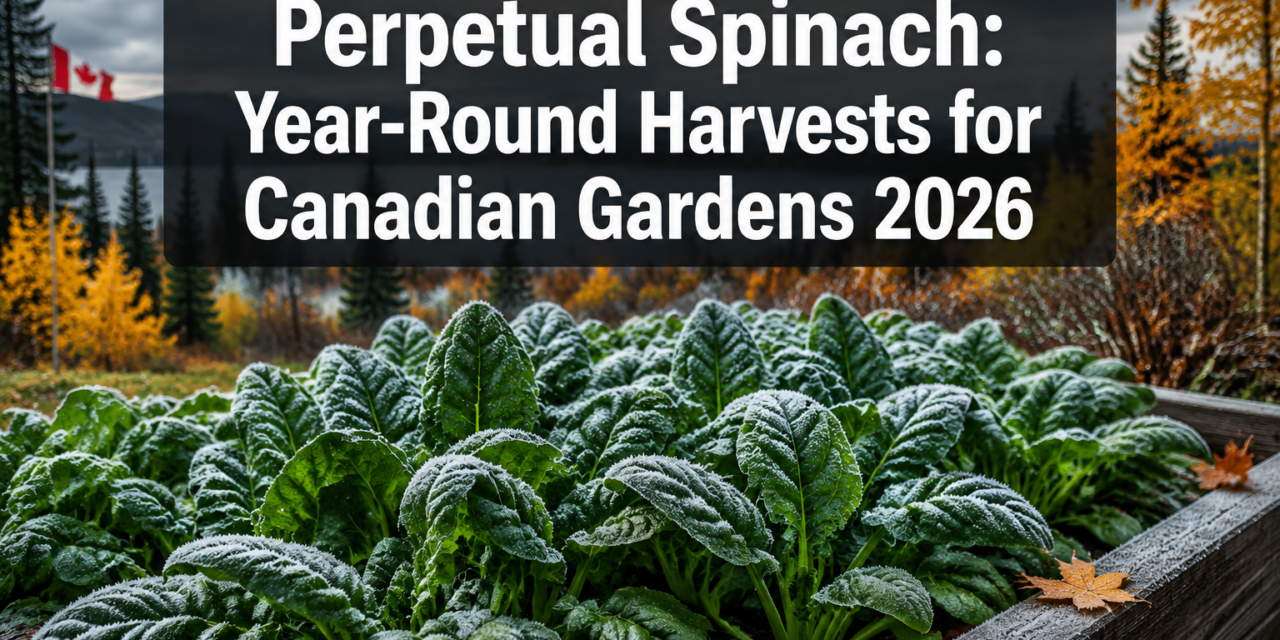
Perpetual Spinach for Year-Round Canadian Vegetable Gardens: 2026’s Low-Maintenance Leafy Green
Last updated: May 13, 2026
Quick Answer: Perpetual spinach is a variety of Swiss chard (Beta vulgaris) bred to taste and behave like spinach, but with far greater heat tolerance and bolt resistance. For Canadian gardeners, it produces harvestable leaves for up to nine months, survives light frosts, and keeps growing through summer heat that destroys true spinach. It’s one of the most practical leafy greens available for cold-climate, year-round growing in 2026.
Key Takeaways
- 🌿 Not true spinach: Perpetual spinach is botanically a leaf beet/Swiss chard, but mimics spinach in flavor and use.
- ❄️ Cold-hardy: Tolerates light frost, making it ideal for Canadian springs and autumns.
- ☀️ Bolt-resistant: Unlike true spinach, it won’t go to seed in summer heat.
- 📅 Long harvest window: Produces leaves continuously for approximately nine months per plant [2].
- 🕐 Fast to harvest: First leaves are ready in about 55–65 days from sowing [3].
- 🌑 Shade-tolerant: Grows well in partial shade, useful during peak summer [5].
- 🌱 Succession planting works: Stagger sowings in spring and late summer for near-continuous supply.
- 🍽️ Versatile in the kitchen: Use young leaves raw in salads; larger leaves suit sautéing, soups, and stews [3].
- 💧 Low maintenance: Needs consistent moisture and occasional fertilizing — that’s essentially it.
- 🇨🇦 Canadian climate fit: Performs across USDA-equivalent hardiness zones found in Ontario, BC, and the Maritimes.
What Exactly Is Perpetual Spinach — and Why Does It Matter for Canadian Gardeners?
Perpetual spinach (Beta vulgaris subsp. cicla) is not true spinach. It’s a variety of Swiss chard and leaf beet, selectively bred to produce tender, mildly flavored leaves that closely resemble spinach in taste and texture [5]. The key difference is resilience: where true spinach bolts (goes to seed) in warm weather and struggles through Canadian summer heat, perpetual spinach keeps producing.
For Canadian vegetable gardeners dealing with short growing seasons, late frosts, and unpredictable summers, Perpetual Spinach for Year-Round Canadian Vegetable Gardens: 2026’s Low-Maintenance Leafy Green solves a real problem. It bridges the gap between early spring harvests and autumn root vegetables, filling the plate when other greens fail.
How Does Perpetual Spinach Outperform True Spinach in Canadian Conditions?
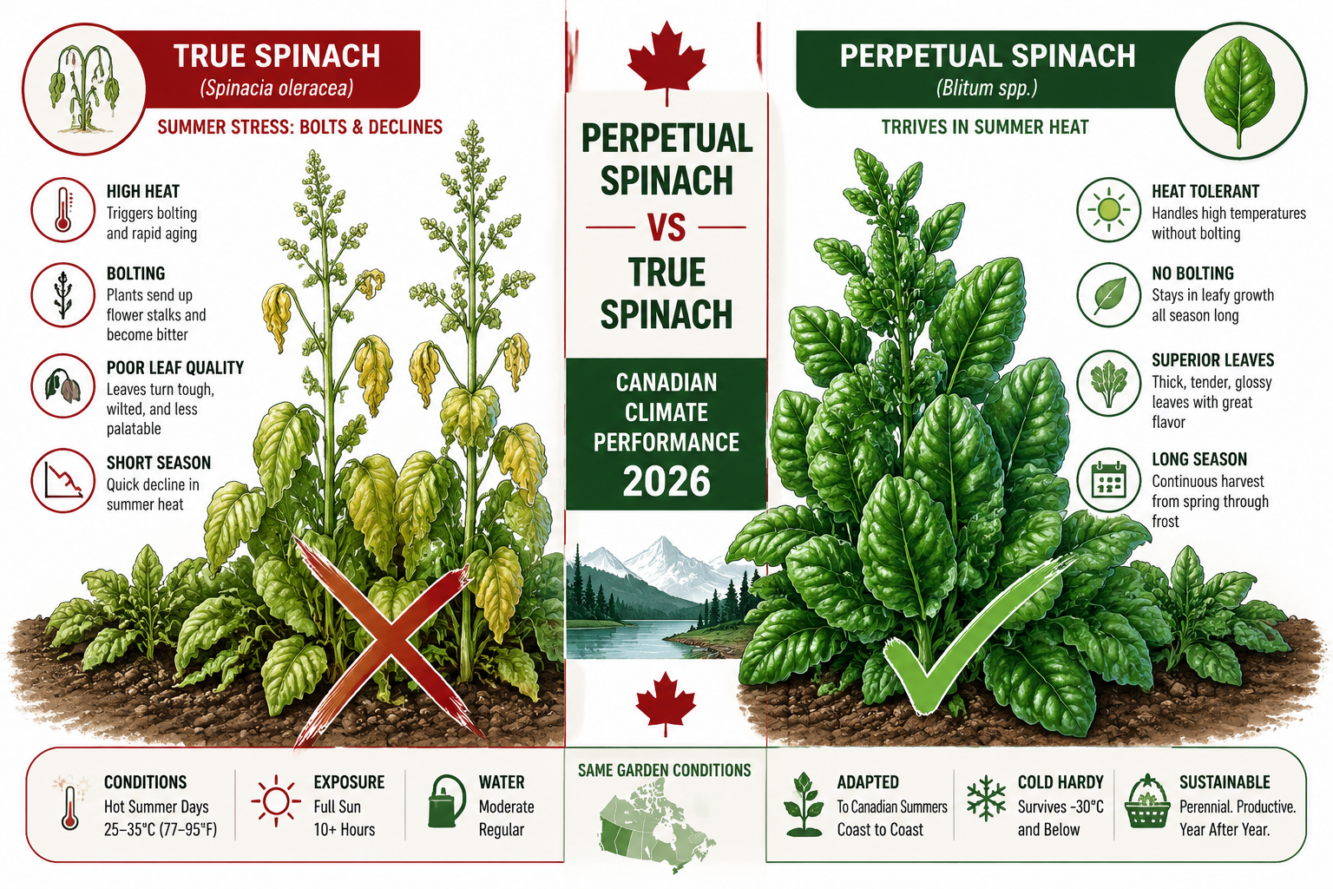
True spinach bolts quickly once temperatures rise above roughly 24°C — a common occurrence across most Canadian provinces from June through August. Perpetual spinach offers strong bolt resistance and heat tolerance, continuing to produce fresh leaves through conditions that would end a true spinach crop [4].
Key performance advantages for Canadian growers:
| Feature | True Spinach | Perpetual Spinach |
|---|---|---|
| Bolt resistance | Low | High |
| Frost tolerance | Moderate | Moderate–Good |
| Harvest window | 6–8 weeks | Up to 9 months [2] |
| Shade tolerance | Low | Good [5] |
| Soil requirements | Rich, precise | Flexible [3] |
| Summer performance | Poor | Strong |
Common mistake: Many Canadian gardeners plant true spinach in late spring, watch it bolt by July, and give up on leafy greens until fall. Switching to perpetual spinach eliminates that gap entirely.
When and How Should Canadian Gardeners Sow Perpetual Spinach?
Sow perpetual spinach directly into the garden — it doesn’t transplant as reliably as it germinates in place. For spring and summer harvests, sow in early spring as soon as the soil is workable. For the heaviest autumn and overwintering production, sow after midsummer (late July to early August in most Canadian zones) [3].
Direct sowing steps:
- Prepare a well-drained bed with added compost or aged manure.
- Sow seeds in furrows approximately 2 cm deep.
- Space rows 30 cm apart; thin seedlings to 20 cm between plants after germination [2].
- Germination takes roughly one week under good conditions.
- Expect first harvestable leaves in 55–65 days [3].
Succession planting tip: Sow a new batch every 3–4 weeks from April through August to maintain a continuous supply. This is the single most effective strategy for year-round Canadian harvests.
What Are the Soil, Water, and Light Requirements?
Perpetual spinach is forgiving compared to most vegetables, but a few conditions matter. It prefers well-worked soil with good drainage and reasonable organic content. It does not perform well in acidic soil, so add garden lime if your pH is below 6.0. It tolerates poorer soils better than most leafy greens [3].
Care essentials:
- Watering: Keep soil consistently moist. If the soil dries out completely, leaves turn tough and bitter. Mulching with straw or compost significantly helps retain moisture [5].
- Light: Full sun is ideal, but partial shade works well — especially useful in Canadian midsummer when heat stress is a concern [5].
- Feeding: A balanced fertilizer or compost side-dressing every 4–6 weeks supports continuous leaf production.
How Should You Harvest Perpetual Spinach to Maximize Production?
Always harvest outer leaves first, and never remove more than one-third of the plant at a single harvest [2]. This approach keeps the plant actively growing and producing new leaves from the center.
As flower stalks appear, remove them immediately. Allowing the plant to flower redirects energy away from leaf production and accelerates the end of the plant’s productive life. With consistent harvesting and stalk removal, a single plant can produce for up to nine months [2].
Choose this method if: You want the longest possible harvest window. Cutting the whole plant back (as some gardeners do with lettuce) shortens perpetual spinach’s productive life significantly.
How Nutritious Is Perpetual Spinach Compared to Regular Spinach?
Perpetual spinach delivers a nutritional profile very similar to true spinach and Swiss chard: it’s a good source of iron, calcium, vitamins A, C, and K, and dietary fiber. Because it’s harvested fresh over a long season rather than stored, the nutrient density of home-grown perpetual spinach is generally high.
For Canadian gardeners interested in biodiversity in their food systems, growing perpetual spinach alongside other crops supports a more varied and resilient home garden diet.
Can Perpetual Spinach Grow Indoors or in Containers During Canadian Winters?
Yes, with some planning. Perpetual spinach grows reasonably well in deep containers (at least 30 cm deep) placed near a south-facing window or under grow lights. It won’t produce as prolifically indoors as outdoors, but it can extend the harvest into the colder months for Canadian gardeners who want fresh greens year-round.
For those exploring best winter weekend activities in Ontario or simply looking to stay productive through the cold months, maintaining a small indoor perpetual spinach container is a practical and low-cost option.
What Are the Best Culinary Uses for Perpetual Spinach?
Young, tender leaves work well raw in salads. Larger, more mature leaves are best cooked: sautéed with garlic, added to soups and stews, steamed, or braised. The stalks, which are similar to Swiss chard stems, can be prepared similarly to asparagus — roasted or lightly sautéed [3].
Quick culinary guide:
- Raw (young leaves): Salads, wraps, smoothies
- Sautéed: With olive oil, garlic, lemon
- Soups/stews: Added in the last 5 minutes of cooking
- Stalks: Roasted at 200°C for 15 minutes with olive oil and salt
Conclusion: Make Perpetual Spinach the Backbone of Your 2026 Canadian Garden
Perpetual Spinach for Year-Round Canadian Vegetable Gardens: 2026’s Low-Maintenance Leafy Green is not a trend — it’s a practical solution to one of Canadian gardening’s most persistent frustrations: the mid-season leafy green gap. With a nine-month harvest window, strong bolt resistance, shade tolerance, and minimal care requirements, it outperforms true spinach in almost every Canadian growing condition.
Actionable next steps:
- Order seeds now for a spring sowing — look for “perpetual spinach” or “leaf beet” varieties from reputable Canadian or international seed suppliers.
- Plan two sowing dates: one in early spring and one in late July for continuous harvests.
- Prepare a bed with compost, check soil pH, and add lime if needed.
- Mulch around plants after thinning to retain moisture through summer.
- Harvest outer leaves consistently and remove flower stalks as they appear.
For Canadian gardeners interested in biodiversity loss and building more resilient local food systems, perpetual spinach is a small but meaningful step toward growing more of your own food through every season.
FAQ
Q: Is perpetual spinach actually spinach? No. It’s a variety of Swiss chard and leaf beet (Beta vulgaris), bred to mimic spinach’s flavor. It’s more heat-tolerant and longer-producing than true spinach [5].
Q: How long does perpetual spinach produce leaves? Approximately nine months before the plant bolts and reaches end-of-life [2].
Q: When should Canadian gardeners sow perpetual spinach? Sow in early spring for summer harvests, and again in late July or early August for autumn and overwintering production [3].
Q: Does perpetual spinach survive Canadian winters? It tolerates light frost well, but hard freezes will kill it. In milder Canadian zones (southern BC, parts of Ontario), it may overwinter with protection. In colder zones, grow it indoors through winter.
Q: Can perpetual spinach grow in partial shade? Yes. It produces well in partial shade, making it one of the few vegetables suited to shadier garden spots [5].
Q: How do I stop perpetual spinach from bolting? Remove flower stalks as soon as they appear. This redirects the plant’s energy back into leaf production [2].
Q: How far apart should I plant perpetual spinach? Sow in rows 30 cm apart and thin plants to 20 cm spacing within the row after germination [2].
Q: Can I grow perpetual spinach in containers? Yes, in containers at least 30 cm deep. Yield will be lower than in-ground, but it’s a viable option for balcony or indoor winter growing.
Q: What’s the best way to harvest perpetual spinach? Always take outer leaves first and never remove more than one-third of the plant at one time [2].
Q: Is perpetual spinach nutritious? Yes. Like true spinach and Swiss chard, it’s a good source of iron, calcium, and vitamins A, C, and K.
Q: What soil does perpetual spinach prefer? Well-drained soil with good organic content and a neutral to slightly alkaline pH. It tolerates poorer soils better than most vegetables [3].
Q: Where can I buy perpetual spinach seeds in Canada? Look for “perpetual spinach,” “spinach beet,” or “leaf beet” seeds at local garden centers or through online seed suppliers that ship to Canada.
References
[1] All About Perpetual Spinach A Reliable Leafy Green Perennial – https://caledonianhorticulture.co.uk/all-about-perpetual-spinach-a-reliable-leafy-green-perennial/ [2] How To Grow Organic Spinach – https://growitlocal.com/how-to-grow-organic-spinach [3] Spinach – https://www.quickcrop.ie/learning/plant/spinach [4] Perpetual Spinach Seeds Leaf Beet Garden Variety – https://evergrowseeds.com/products/perpetual-spinach-seeds-leaf-beet-garden-variety [5] Perpetual Spinach Spinach Beet – https://vegplotter.com/grow-guides/perpetual-spinach-spinach-beet [6] Chard Perpetual Spinach Seeds – https://www.dtbrownseeds.co.uk/products/chard-perpetual-spinach-seeds