


















🩸 The Tiny Daily Habit That Keeps Your Arteries Flexible After 60
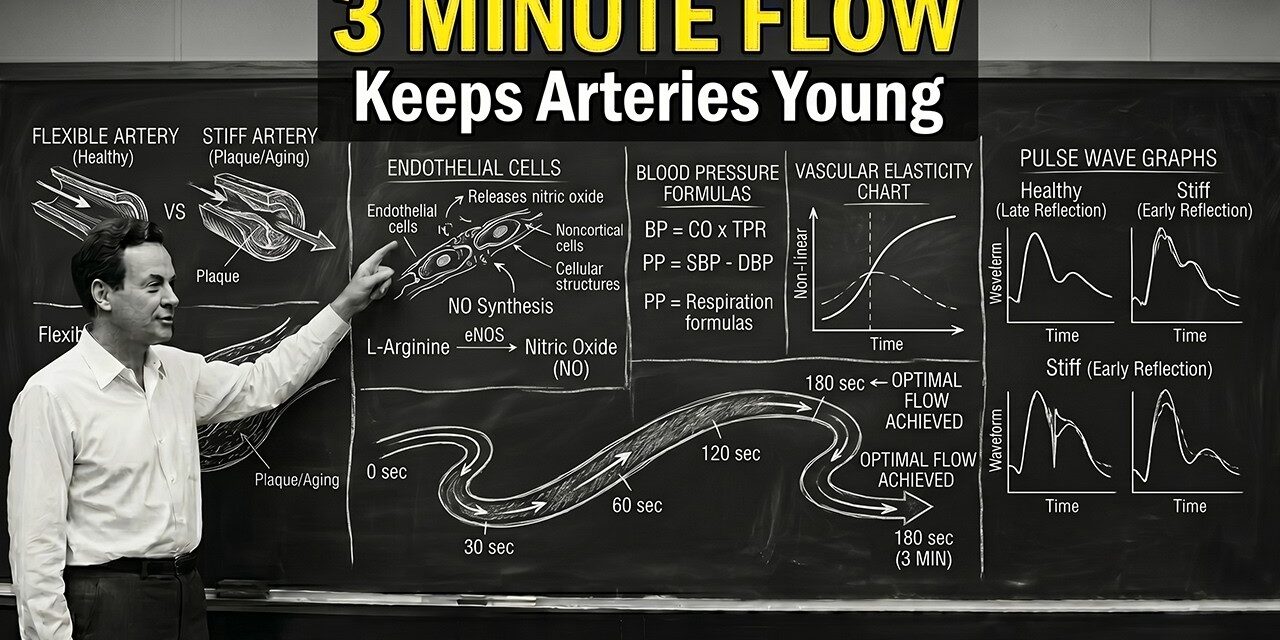
Discover the physics of blood flow and what happens to your body the moment you start a brisk walk.
This video explores endothelial shear stress, the glycocalyx “mechanical antennae,” and pulse wave velocity. Learn why 20 minutes of daily movement reverses years of sedentary arterial stiffening, and find out how your heart, brain, and kidneys simultaneously receive the opposite of everything sitting has been doing to them.
Whether you are curious about what is really happening inside your body, fascinated by the physics of everyday movement, or looking for explanations that actually make sense, this will change how you understand your own cardiovascular system. Watch now to discover what nobody tells you about the simplest daily habit in biology.
📚 References & Scientific Sources Shear Stress & Glycocalyx: (Paragraphs 1-3) Explains how flowing blood creates physical drag (shear stress) that bends the sugary coating of the endothelium (glycocalyx), converting mechanical force into biological signals. Nitric Oxide Mechanism: (Paragraphs 8-10) References the 1998 Nobel Prize (Furchgott, Ignarro, Murad) for discovering that the endothelium acts as a factory, using the eNOS enzyme to produce nitric oxide gas which relaxes arteries. Arterial Stiffness & Pulse Wave Velocity: (Paragraph 17) Identifies Pulse Wave Velocity (PWV) as the “gold standard” physiological measurement for tracking how fast a pulse travels through stiff vs. flexible arteries.
The 20-Minute Walking Prescription: (Paragraphs 18-20) Cites decades of research by exercise physiologists Hirofumi Tanaka and Douglas Seals, proving that 20-30 minutes of daily moderate movement directly reduces arterial stiffness and protects downstream organs. #feynman#scienceexplained#yourbody#physics#humanbody