
















AI in Hospitals and Clinics: How Machine Learning Is Improving Diagnosis, Patient Flow, and Treatment Decisions
Last updated: July 16, 2026
Quick Answer: Machine learning is already active inside hospitals and clinics, reading medical images, predicting patient admissions, flagging missed diagnoses, and helping doctors choose treatments faster. In June 2026, two AI clinical co-pilot systems matched or outperformed panels of physicians on diagnostic accuracy across hundreds of emergency cases [2][6]. The technology is not replacing doctors, but it is changing how clinical decisions get made.
Key Takeaways
- AI clinical co-pilot systems like MIRA achieved roughly 87-88% diagnostic accuracy versus about 78% for a panel of six physicians across more than 500 emergency room cases [2][6].
- Boston Children’s Hospital and OpenAI’s o3 model identified 18 new diagnoses in 376 children with previously unsolved rare genetic diseases, a 4.8% additional diagnostic yield [1].
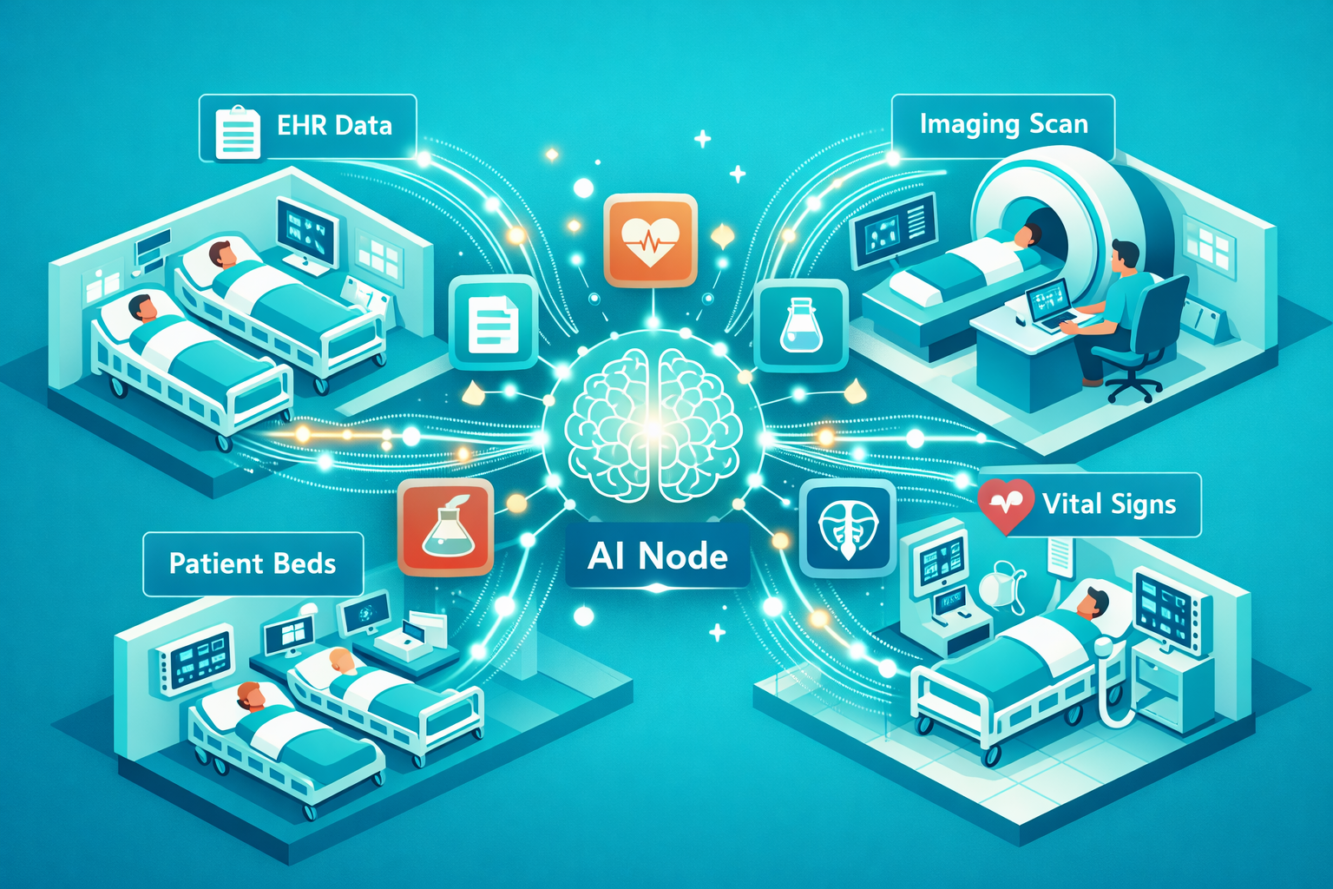
- AI patient-flow tools use EHR data (age, diagnosis, vitals, length of stay) to forecast bed needs and reduce bottlenecks, replacing manual tracking with data-driven allocation [8][10].
- Hospital AI models for admission prediction have reached 85-95% accuracy using random forests and neural networks, outperforming traditional statistical methods [5].
- AI is not replacing radiologists or physicians. It flags, prioritizes, and suggests. A human clinician reviews every output before action is taken [3][9].
- Key risks include biased training data, integration costs, staff resistance, and patient privacy concerns under regulations like HIPAA and PIPEDA.
- Hospitals that see the fastest results focus on a single high-value use case first, such as imaging triage or lung nodule detection, before expanding.
What Is Machine Learning in Healthcare and How Does It Work
Machine learning in healthcare means training computer models on large sets of clinical data so they can recognize patterns, make predictions, and support decisions. Unlike traditional software that follows fixed rules, these models improve as they process more data.
In a hospital setting, the inputs are things clinicians already collect: lab results, imaging files, vital signs, medication records, and notes inside electronic health records (EHRs). The model finds statistical relationships in that data and produces an output, such as a risk score, a suggested diagnosis, or a predicted discharge date.
Three common model types used in hospitals:
- Random forests and gradient boosting: Strong for structured data like lab values and admission records [5][10].
- Convolutional neural networks (CNNs): Designed for image analysis, including X-rays, CT scans, and pathology slides [4].
- Large language models (LLMs): Used for summarizing notes, generating differential diagnoses, and processing free-text clinical records [1][2].
The key constraint: a model is only as reliable as its training data. If that data reflects historical care gaps or demographic imbalances, the model inherits those problems.
How AI Is Being Used to Improve Patient Diagnosis in Hospitals
AI diagnostic tools are already embedded in clinical workflows at major health systems. They read imaging, flag abnormalities, and surface diagnoses that might otherwise be delayed.
RAK Hospital in Ras Al Khaimah rolled out an AI-powered enterprise imaging platform in June 2026 that flags abnormalities, prioritizes urgent scans, and speeds reporting across cardiology, neurosciences, orthopedics, and urology [14, see source note below]. Forrest Health deployed an AI navigator inside its Epic EHR that flagged 173 incidental lung nodules in just six weeks, with each case reviewed by a human clinician before routing [3].
AI-supported clinical decision support (CDS) tools also analyze chest X-rays alongside vital signs to rapidly suggest possible pneumonia diagnoses and prioritize sicker patients. The U.S. Agency for Healthcare Research and Quality (AHRQ) has issued guidance emphasizing that these tools work best when clinicians remain in the loop [9].
For readers interested in how local clinics are adapting to new health technologies, coverage of the South Georgian Bay Community Health Clinic offers a community-level perspective on healthcare delivery.
Can AI Actually Catch Diseases Earlier Than Doctors
Yes, in specific contexts, AI catches findings that human reviewers miss or would catch later. The evidence is strongest in imaging and rare disease identification.
In June 2026, Boston Children’s Hospital and OpenAI reported that the o3 model helped geneticists identify 18 new diagnoses in 376 children with previously unsolved rare genetic diseases. That is a 4.8% additional diagnostic yield beyond prior specialist work. All hypotheses were confirmed in certified labs under established clinical genetics criteria [1].
An NHS Knowledge Network report from Autumn 2025 found that the AI tool AIDMAN achieved around 95% diagnostic accuracy (AUC 0.96) for malaria detection, and other AI systems showed high performance for pulmonary embolism identification and systemic disease detection via imaging [4].
Where early detection works best:
- Radiology: lung nodules, fractures, retinal disease
- Pathology: cancer cell classification
- Rare disease genomics: pattern matching across large variant databases
- Sepsis and deterioration alerts in ICUs
How Accurate Is AI Diagnosis Compared to Human Doctors
AI diagnostic accuracy depends heavily on the task. For narrow, well-defined problems with large training datasets, AI often matches or exceeds average physician performance.
Google’s AMIE and the MIRA system were both reported in Nature in June 2026 as performing at least as well as physicians across diagnosis, test ordering, and treatment decisions. MIRA achieved about 87-88% diagnostic accuracy versus roughly 78% for a panel of six physicians over more than 500 emergency room cases and 85,000 possible management actions [2][6].
That said, these benchmarks apply to structured test conditions. Real-world performance varies based on patient population, data quality, and how well the tool integrates into clinical workflow.
Is AI Replacing Radiologists and Doctors
No. AI in hospitals and clinics is functioning as a support layer, not a replacement. Every major deployment reviewed for this article includes a human review step before clinical action.
Forrest Health’s AI lung nodule tool flagged cases and routed them for physician review. It did not make treatment decisions independently [3]. AHRQ’s 2026 guidance on AI-enabled patient-centered CDS explicitly frames these tools as aids for speeding diagnosis, treatment selection, and reminders while keeping clinicians in the loop [9].
The more accurate framing: AI handles volume and pattern recognition at scale. Doctors handle judgment, context, patient communication, and accountability.
How Does Machine Learning Help With Patient Flow and Wait Times
AI patient-flow tools forecast movement from admission to discharge using EHR data and predict bed needs before bottlenecks form. This replaces manual tracking with proactive, data-driven resource allocation [8][10].
A 2025 systematic review found AI models for hospital admission prediction achieved 85-95% accuracy, with random forests and neural networks outperforming traditional statistical approaches. These tools enable earlier admission planning and capacity management for emergency and inpatient services [5].
Practical applications:
- Predicting which patients will need ICU beds within 24 hours
- Estimating discharge dates to coordinate housekeeping and transport
- Routing incoming emergency patients based on predicted severity
- Flagging patients at risk of readmission before they leave
What Are the Best AI Tools Hospitals Are Using Right Now
Several AI tools have moved from pilot to active clinical use as of 2026.
| Tool / System | Primary Use | Notable Feature |
|---|---|---|
| MIRA | Emergency diagnosis | 87-88% accuracy across 500+ ER cases [2] |
| Google AMIE | Diagnosis and treatment planning | Matches physician performance in structured tests [6] |
| OpenAI o3 (clinical) | Rare disease genetics | 4.8% additional diagnostic yield [1] |
| Epic AI (embedded) | EHR-based care gap detection | Flagged 173 lung nodules in 6 weeks [3] |
| PaxeraHealth platform | Enterprise imaging | Prioritizes urgent scans, unifies imaging sources |
| AIDMAN | Infectious disease (malaria) | ~95% diagnostic accuracy, AUC 0.96 [4] |
What Are the Costs of Implementing AI in Hospitals
Implementation costs vary widely based on scope, vendor, and existing infrastructure. A single AI imaging module may cost tens of thousands of dollars annually. A full enterprise AI platform integrated across an EHR system can run into the millions when accounting for licensing, integration, staff training, and ongoing validation.
Smaller community hospitals and clinics in regions like Southern Georgian Bay often face a harder cost-benefit calculation than large academic medical centres, because they have fewer cases to justify the investment and less IT infrastructure to support integration.
Cost factors to account for:
- Software licensing or API fees
- EHR integration and data migration
- Staff training and change management
- Ongoing model monitoring and revalidation
- Regulatory compliance (privacy, clinical safety)
What Are the Risks and Limitations of Using AI in Clinical Settings
AI in hospitals and clinics carries real risks that hospitals must manage actively, not just acknowledge on paper.
Key risks:
- Bias in training data: Models trained on non-representative populations can underperform for certain patient groups.
- Alert fatigue: Too many AI flags can cause clinicians to ignore warnings, including important ones.
- Integration failures: Poorly integrated tools disrupt workflow rather than improve it.
- Overreliance: Clinicians who trust AI outputs without critical review may miss errors the model makes confidently.
- Accountability gaps: When an AI-assisted decision leads to harm, responsibility can be unclear.
The NHS Knowledge Network’s 2025 review notes that AI tools in intensive care settings must account for the complexity of time-critical decisions and the risk of automation bias among nursing staff [4].
How Do Hospitals Handle Patient Privacy With AI Systems
Patient privacy in AI systems is governed by existing health data regulations, including HIPAA in the United States and PIPEDA in Canada, plus emerging AI-specific guidance from regulators.
In practice, hospitals use de-identified or anonymized data for model training, and production systems must meet the same data governance standards as any other clinical system. Vendors increasingly offer on-premise or private-cloud deployments to keep patient data from leaving the hospital’s control.
The risk is not just external breach. Internal misuse, inadequate access controls, and model outputs that re-identify patients through inference are all active concerns that compliance teams must address.
What Training Do Doctors Need to Use AI Diagnostic Tools
Doctors do not need to understand how to build AI models, but they do need enough literacy to use AI outputs critically. That means understanding what the tool was trained on, what its known failure modes are, and when to override it.
AHRQ’s 2025 guidance recommends that clinical AI tools include transparent documentation of performance benchmarks, intended populations, and limitations so clinicians can make informed decisions about when to trust the output [9].
Most health systems are introducing AI literacy modules into continuing medical education (CME). The practical skills being taught include interpreting confidence scores, recognizing out-of-distribution cases, and documenting AI-assisted decisions for audit purposes.
Are There Hospitals Not Using AI Yet and Why
Many hospitals, particularly smaller community facilities and rural health centres, have not yet adopted clinical AI tools. The barriers are real and not simply a matter of being behind the curve.
Common reasons for delayed adoption:
- Limited IT infrastructure and EHR interoperability
- Budget constraints, especially in publicly funded systems
- Shortage of data science and informatics staff
- Uncertainty about regulatory approval for specific tools
- Justified caution about deploying unvalidated tools on vulnerable populations
For communities served by smaller regional facilities, such as those covered through the Stonetree Clinic, the gap between large academic medical centres and local care providers is a real and growing concern.
How Long Does It Take to See Results After Implementing Hospital AI
For narrow, well-scoped use cases, hospitals can see measurable results within weeks. Forrest Health’s AI lung nodule navigator flagged 173 cases in six weeks of deployment [3].
For broader implementations covering patient flow, multi-department imaging, or clinical decision support across an EHR, meaningful results typically take six to eighteen months, accounting for integration, staff training, workflow adjustment, and validation cycles.
Realistic timelines:
- Imaging triage tool (single department): 4-12 weeks to first measurable output
- EHR-embedded care gap detection: 2-6 months
- Hospital-wide patient flow optimization: 12-24 months
- Full AI clinical co-pilot integration: 18 months or more
What Common Mistakes Do Hospitals Make When Adopting AI Technology
The most common mistake is treating AI adoption as a technology project rather than a clinical change management project. The tool is rarely the problem. The workflow, culture, and accountability structures around it usually are.
Mistakes to avoid:
- Deploying AI without defining a specific clinical problem it solves
- Skipping clinician involvement in tool selection and validation
- Underestimating training time and staff resistance
- Failing to monitor model performance after deployment (models drift as patient populations change)
- Assuming vendor-provided accuracy benchmarks apply to your specific patient population
Hospitals that see the best results start with one high-value, well-scoped use case, measure it rigorously, and expand from there.
FAQ
Q: Is AI in hospitals safe for patients right now?
AI tools approved for clinical use have passed regulatory review, but safety depends on how they are implemented. Human oversight at every decision point is the current standard of care.
Q: Can AI diagnose cancer?
AI tools can flag suspicious findings in imaging and pathology slides with high accuracy in controlled settings. Final cancer diagnosis still requires a pathologist or specialist to confirm.
Q: Does AI work the same in rural hospitals as in large urban centres?
No. AI performance depends on data volume and quality. Smaller hospitals with fewer cases and less diverse patient data may see lower accuracy than large academic centres.
Q: Who is liable when an AI makes a wrong diagnosis?
Liability frameworks are still evolving. In most jurisdictions, the treating physician retains clinical responsibility. Hospitals and vendors share liability depending on how the tool was represented and deployed.
Q: How does AI handle patients who speak languages other than English?
Most current clinical AI tools were trained primarily on English-language data. Performance for non-English-speaking patients is an active area of concern and ongoing research.
Q: Will AI lower healthcare costs?
Early evidence suggests AI can reduce redundant tests and speed diagnosis, which lowers costs in specific areas. But implementation costs are significant, and overall system savings depend on scale and workflow integration.
Q: Can patients opt out of AI-assisted care?
Policies vary by institution and jurisdiction. Patients generally have the right to ask how their data is used, but opting out of AI-assisted triage or imaging analysis may not always be operationally feasible.
Q: What happens when an AI tool gives a wrong recommendation?
Clinicians are trained to treat AI output as one input among many. Hospitals are required to log AI-assisted decisions and track adverse events tied to AI recommendations.
Conclusion
AI in hospitals and clinics is past the pilot stage. Machine learning is now embedded in imaging platforms, EHR systems, emergency triage, and rare disease diagnosis at health systems around the world. The evidence from 2025 and 2026 shows real performance gains, but also real constraints: biased data, integration costs, staff training gaps, and the non-negotiable need for human oversight.
Actionable next steps for different readers:
- Patients: Ask your care team whether AI tools are used in your diagnosis or treatment planning, and what oversight processes are in place.
- Clinicians: Seek out AI literacy training through your CME program. Understanding a tool’s limitations is as important as knowing its strengths.
- Hospital administrators: Start with one high-value, measurable use case. Define success criteria before deployment, not after.
- Community health advocates: Push for transparency about which AI tools are in use at local facilities and how performance is monitored for your specific patient population.
The technology will keep advancing. The gap between what AI can do in a research lab and what works reliably in a community clinic is closing, but it has not closed yet. Staying informed is the most practical thing anyone connected to healthcare can do right now.
References
[1] OpenAI AI for Science Brief June 2026 – https://featureddaily.com/news/openai-ai-for-science-brief-june-2026
[2] Medical AI’s Diagnosis Treatment Decisions – https://medicalxpress.com/news/2026-06-medical-ais-diagnosis-treatment-decisions.html
[3] AI Adoption Meets Bedside Reality Week of June 22 – https://buttondown.com/carechronicle/archive/ai-adoption-meets-bedside-reality-week-of-june-22/
[4] AI Healthcare Autumn 2025 – https://www.knowledge.scot.nhs.uk/media/egmbo5ck/ai-healthcare-autumn-2025.pdf
[5] PubMed – Hospital Admission Prediction AI Review – https://pubmed.ncbi.nlm.nih.gov/40774167/
[6] Medical AI Outperforms Six Doctors in Diagnosis – https://en.sedaily.com/technology/2026/06/20/medical-ai-outperforms-six-doctors-in-diagnosis-stuns
[8] NIH NCBI Bookshelf – AI Patient Flow – https://www.ncbi.nlm.nih.gov/books/NBK604824/
[9] AHRQ AI and Patient-Centered CDS – https://cdsic.ahrq.gov/sites/default/files/2025-06/IAS%20Topic%20Highlight%20AI%20and%20PC%20CDS_508%20Compliant.pdf
[10] PMC – AI in Hospital Operations – https://pmc.ncbi.nlm.nih.gov/articles/PMC8559147/
Content, illustrations, and third-party video appearing on GEORGIANBAYNEWS.COM may be generated or curated with AI assistance or reproduced pursuant to the fair dealing provisions of the Copyright Act, R.S.C. 1985, c. C-42. Attribution and hyperlinks to original sources are provided in acknowledgment of applicable intellectual property rights. Such referencing is intended to direct traffic to and support the original rights holders’ platforms.