



















Algonquin College Cuts 30 More Programs: Financial Crisis Deepens, Student Transfers, and Ottawa Job Market Fallout
Last updated: March 4, 2026
Algonquin College’s Board of Governors approved sweeping program eliminations on March 2, 2026, permanently canceling seven programs and suspending 23 others starting Fall 2026. This decision affects students across multiple faculties and raises serious questions about post-secondary education funding in Ontario, even after the province announced $6.4 billion in new funding just weeks earlier.
Key Takeaways
- 30 programs affected total: 7 permanently canceled, 23 suspended (including 1 apprenticeship program) as of Fall 2026 [1]
- No new admissions to affected programs starting Fall 2026, but current students can complete their studies through teach-out plans [1]
- Board decision proceeded despite Ontario’s February 12, 2026 announcement of $6.4 billion in additional college and university funding [2]
- Nine programs in Arts and Media Design face suspension, including Journalism, Music Industry Arts, and Illustration [2]
- Seven Pembroke Campus programs suspended, though most remain available at Ottawa Campus or through AC Online [1]
- Horticulture programs eliminated despite being the only offerings in eastern Ontario and among just 20 across Canada [2]
- Individual student outreach underway from Registrar’s Office with alternative program options and transfer pathways [1]
- Ottawa job market faces potential skills gap in specialized fields like horticulture, museum studies, and culinary arts
- Financial sustainability cited as primary driver, emphasizing alignment with enrollment demand and labor market needs [1]
- Timing criticized as Board meeting occurred online during mid-term break, limiting student participation [2]
Quick Answer
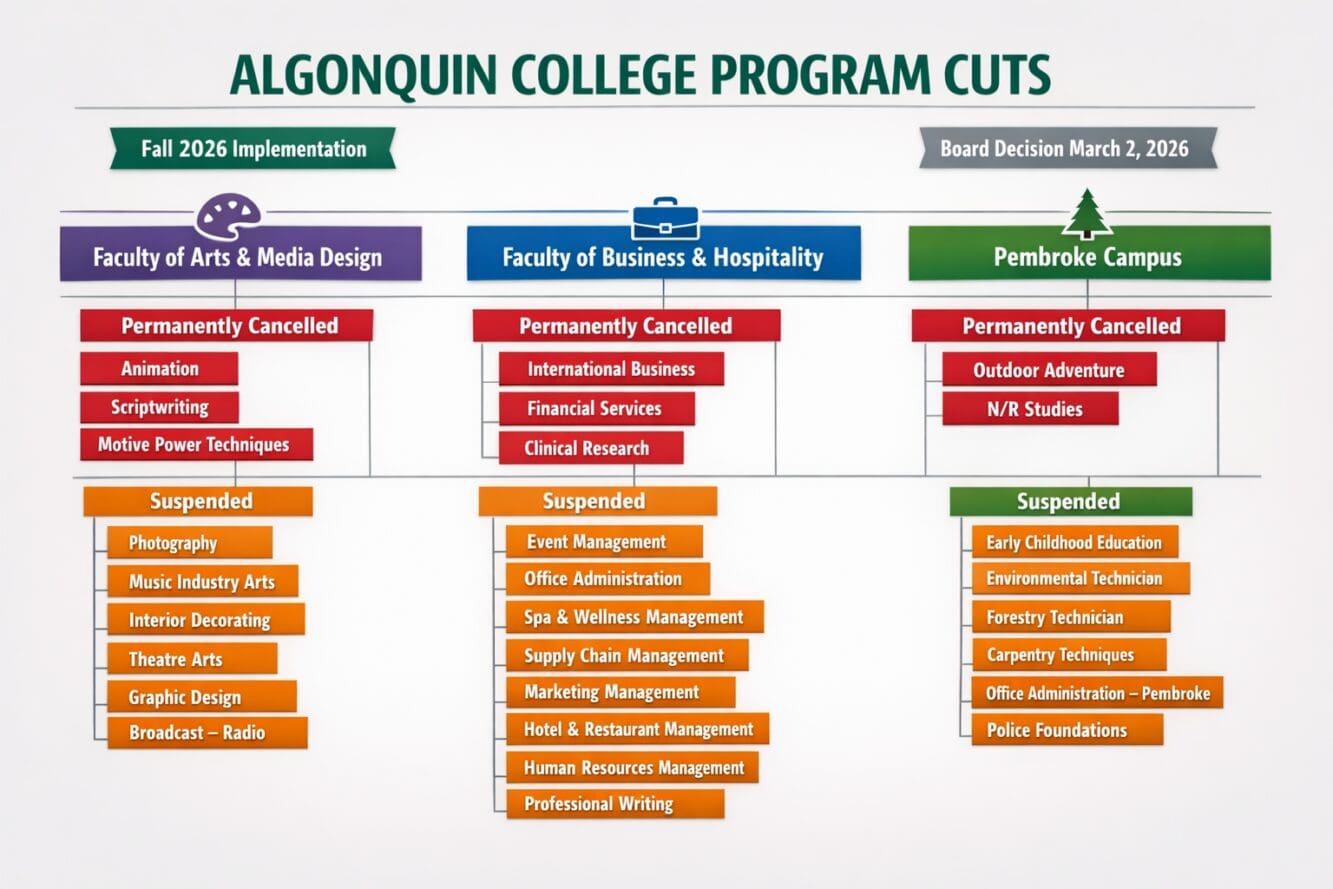
Algonquin College is cutting 30 programs (7 permanently, 23 suspended) starting Fall 2026 due to financial pressures, despite recent provincial funding increases. Current students can finish their studies, but no new admissions will be accepted. The cuts span Arts and Media Design, Business and Hospitality, and Pembroke Campus programs, potentially creating workforce gaps in Ottawa’s specialized sectors.
What Programs Are Being Cut at Algonquin College?
The Board of Governors approved eliminating 30 programs across multiple faculties, with seven facing permanent cancellation and 23 being suspended. These cuts affect specialized fields from horticulture to journalism to culinary arts [1].
Programs by Faculty:
- Arts and Media Design (9 programs): Pathways to Indigenous Empowerment, Applied Museum Studies, Design Foundations, Journalism, Music Industry Arts, Illustration and Concept Art, and others [2]
- Business and Hospitality (9 programs): Bachelor of Culinary Arts & Food Science (Honours), Bartending, Hospitality Hotel and Restaurant Operations Management, Law Clerk, Paralegal [2]
- Pembroke Campus (7 programs): Business, Business Fundamentals, Computer Programming, Environmental Management and Assessment (though these remain available at Ottawa Campus or AC Online) [1]
- Horticulture Programs: Both Horticulture Techniques and Horticultural Industries at the Algonquin Centre for Construction Excellence [2]
Common mistake: Assuming all suspended programs are gone permanently. In reality, seven are permanently canceled while 23 are suspended, meaning they could potentially return if circumstances change. Additionally, several Pembroke programs remain available through other delivery methods.
Choose permanent cancellation vs. suspension based on: Whether the program appears on the college’s future offerings list and if alternative delivery options exist at other campuses.
Why Is Algonquin College Cutting Programs Despite New Provincial Funding?
The college moved forward with cuts even after Ontario announced $6.4 billion in additional funding for colleges and universities on February 12, 2026, and lifted the tuition freeze. The decision reflects deeper structural financial challenges beyond immediate funding [2].
According to the college’s official communications, the cuts address “shifts in learner demand, changes in federal policy and provincial funding, and focus on programs that support strong career pathways” [2]. The college emphasized “long-term sustainability” and alignment with “enrollment demand, labor market needs, Provincial priorities, and financial reality” [1].
Key financial factors:
- Declining enrollment in specific programs
- Federal policy changes affecting international student intake
- Need to redirect resources to high-demand programs
- Multi-year budget pressures predating the recent funding announcement
- Operational costs exceeding revenue in low-enrollment programs
The timing suggests the provincial funding, while substantial, didn’t address the specific program-level financial challenges driving these cuts. Institutions facing similar challenges across Ontario may be watching closely to see if broader economic pressures continue affecting post-secondary education.
What Happens to Current Students in Affected Programs?
Current students and those already admitted for Spring 2026 can complete their studies through “teach-out” plans guided by Ministry of Colleges, Universities, Research Excellence and Security policies. No new admissions will be accepted starting Fall 2026 [1].
Student support measures:
- Individual outreach: Registrar’s Office contacting affected students with personalized alternative program options [1]
- Teach-out plans: Structured completion pathways ensuring current students can graduate
- Co-op continuation: Students in co-op placements can continue work-integrated learning if they meet academic requirements, with support from Co-op Student Advisors and the Co-op & Career Centre [1]
- Transfer options: Alternative programs available at different campuses (Ottawa vs. Pembroke) or through AC Online delivery [1]
- Academic advising: Enhanced support for students considering program changes
Decision rule: Choose to complete your current program if you’re within one year of graduation and the teach-out plan is confirmed. Consider transferring if you’re in early stages and a related program better aligns with current job market demand.
Edge case: Students in suspended (not canceled) programs at Pembroke Campus may have the option to continue the same program at Ottawa Campus, though this requires relocation or commuting considerations.
How Will These Cuts Affect Ottawa’s Job Market?
The elimination of specialized programs creates potential workforce gaps in sectors where Algonquin served as a primary training pipeline for Ottawa and eastern Ontario employers.
High-impact sectors:
- Horticulture: Loss of the only program in eastern Ontario and one of approximately 20 across Canada affects landscaping, greenhouse operations, and urban agriculture sectors [2]
- Museum and cultural institutions: Applied Museum Studies suspension impacts Ottawa’s robust museum sector, including national institutions
- Legal services: Law Clerk and Paralegal program cuts affect access to trained legal support staff
- Hospitality and culinary: Ottawa’s tourism and restaurant industries lose local training pipeline for chefs and hospitality managers
- Journalism: Local media outlets face reduced access to trained multimedia journalists
Choose alternative training based on: Whether you’re willing to relocate to other Ontario colleges offering these programs, pursue private training options, or enter the field through apprenticeship or on-the-job training routes.
Employers in these sectors may need to expand recruitment beyond Ottawa or invest more heavily in internal training programs. This shift could mirror broader workforce challenges affecting specialized skill development.
What Alternative Options Do Affected Students Have?
Students facing program suspensions have several pathways forward, depending on their stage of study and career goals.
Transfer within Algonquin:
- Campus transfers: Pembroke students can access equivalent programs at Ottawa Campus [1]
- AC Online: Some suspended programs available through online delivery
- Related programs: College offering alternative pathways in similar fields
- Dual enrollment: Possibility of combining programs for broader credentials
Transfer to other institutions:
- Other Ontario colleges offering equivalent programs
- University pathways for students seeking degree programs
- Private career colleges for specific vocational training
- Out-of-province options for unique specializations like horticulture
Alternative career pathways:
- Apprenticeship programs in trades-related fields
- Industry certifications and professional development courses
- Direct employment with employer-sponsored training
- Online learning platforms for skill development
Common mistake: Waiting too long to explore alternatives. Students should contact the Registrar’s Office immediately to understand their specific options and timelines for decision-making.
Why Did the Board Vote During Mid-Term Break?
The Board of Governors held its March 2, 2026 meeting online during mid-term break week, a timing choice that drew criticism from students and faculty who felt the college was avoiding public scrutiny [2].
The decision followed the college’s January 22, 2026 memo from Senior Vice-President of Academic Julie Beauchamp communicating the original recommendation for 30 program suspensions to staff [2]. The weeks between that memo and the Board vote included Ontario’s major funding announcement, yet the college proceeded with minimal public consultation.
Timeline of events:
- January 22, 2026: Internal memo announces proposed program suspensions
- February 12, 2026: Ontario announces $6.4 billion in new post-secondary funding and lifts tuition freeze
- Late February 2026: Students report college “quietly moving forward” with vote [2]
- March 2, 2026: Board of Governors approves cuts during mid-term break
Critics argue this approach limited student presence and meaningful input into decisions affecting their education and career prospects. The online format during a break week particularly restricted in-person advocacy and demonstration opportunities.
Understanding how institutions navigate difficult decisions can provide context for governance challenges, though transparency remains a key concern for affected stakeholders.
What Does This Mean for Ontario’s Post-Secondary Education System?
Algonquin’s cuts signal broader challenges facing Ontario colleges despite increased provincial funding, suggesting systemic issues beyond immediate budget allocations.
Sector-wide implications:
- Funding model sustainability: Questions about whether current funding formulas adequately support specialized, lower-enrollment programs with high community value
- Program rationalization trend: Other colleges may follow similar consolidation strategies
- Regional access gaps: Rural and satellite campuses facing disproportionate cuts
- International student dependency: Federal policy changes creating revenue instability
- Career pathway alignment: Increased emphasis on high-demand, high-enrollment programs over niche specializations
The $6.4 billion provincial investment clearly didn’t prevent these cuts, indicating that colleges face multi-layered financial pressures requiring more than increased base funding. Issues include aging infrastructure, deferred maintenance, technology investments, and competitive pressures for faculty and staff.
Choose to advocate for change if: You’re affected by cuts and want to engage with student associations, faculty unions, or provincial representatives about funding formula reforms and program protection mechanisms.
Conclusion
Algonquin College’s decision to cut 30 programs represents a significant shift in Ontario’s post-secondary landscape, affecting hundreds of students and creating potential workforce gaps in specialized sectors across Ottawa and eastern Ontario. Despite recent provincial funding increases, the college proceeded with seven permanent cancellations and 23 suspensions, citing enrollment trends, federal policy changes, and financial sustainability concerns.
Immediate action steps for affected students:
- Contact the Registrar’s Office immediately to understand your specific options and timelines
- Review teach-out plans if you’re close to graduation and want to complete your current program
- Explore transfer options at Ottawa Campus, through AC Online, or at other Ontario colleges
- Connect with Co-op advisors if you’re in work-integrated learning to ensure continuity
- Research alternative career pathways including apprenticeships, certifications, and direct employment options
- Document everything related to your program status and communications with the college
- Join student advocacy groups if you want to participate in broader discussions about post-secondary funding and access
For employers and community stakeholders:
- Begin planning for reduced local talent pipelines in affected fields
- Consider partnerships with remaining programs or other institutions
- Explore apprenticeship and internal training program expansion
- Engage with provincial representatives about workforce development concerns
The long-term impact of these cuts will depend on whether suspended programs eventually return, how effectively students transition to alternatives, and whether Ontario addresses the underlying financial pressures facing its college system. As economic challenges continue reshaping institutions, students and communities must stay informed and engaged in decisions affecting educational access and workforce development.
FAQ
Will suspended programs ever return to Algonquin College?
Suspended programs could potentially return if enrollment demand increases, labor market needs shift, or financial circumstances improve. However, the seven permanently canceled programs are unlikely to be reinstated. The college hasn’t provided specific criteria or timelines for reconsidering suspended programs.
Can I still graduate if I’m currently enrolled in an affected program?
Yes. Current students and those admitted for Spring 2026 can complete their studies through teach-out plans guided by Ministry policies. The college has committed to providing pathways for completion, though you should confirm your specific situation with the Registrar’s Office.
Are there other colleges in Ontario offering the canceled programs?
Most programs have equivalents at other Ontario colleges, though geographic accessibility varies. Horticulture programs are particularly rare with only about 20 across Canada. Contact the Registrar’s Office for specific transfer options and credit recognition agreements.
Why did the college cut programs after receiving more provincial funding?
The $6.4 billion provincial funding didn’t address specific program-level challenges including declining enrollment, federal international student policy changes, and operational costs exceeding revenue in certain programs. The college cited need for long-term sustainability beyond immediate funding increases.
What happens to faculty teaching in canceled programs?
The college hasn’t publicly detailed faculty transition plans. Typically, institutions reassign faculty to other programs, offer retraining, or implement workforce reductions through attrition or buyouts, depending on collective agreements and seniority provisions.
Can Pembroke Campus students transfer to Ottawa Campus?
Yes. Seven suspended Pembroke programs remain available at Ottawa Campus or through AC Online. Students should contact the Registrar’s Office to understand transfer processes, credit recognition, and whether relocation or commuting is feasible for their circumstances.
How will this affect my co-op placement if I’m in an affected program?
Current co-op students can continue work-integrated learning if they meet academic requirements. Co-op Student Advisors and the Co-op & Career Centre will provide support. Contact them directly to confirm your specific placement status and completion pathway.
Will tuition be refunded for students who must switch programs?
The college hasn’t announced specific refund policies for affected students. Tuition treatment typically depends on when you withdraw, whether you transfer to another Algonquin program, and individual circumstances. Contact Student Financial Services for personalized guidance.
What’s the difference between permanently canceled and suspended programs?
Permanently canceled programs (7 total) are being eliminated with no planned return. Suspended programs (23 total) are paused but could theoretically resume if conditions change, though the college hasn’t provided specific criteria or timelines for reconsideration.
How can I advocate against these cuts?
Connect with the Algonquin Students’ Association, attend public Board of Governors meetings, contact Ontario MPPs about post-secondary funding concerns, and engage with faculty unions supporting affected programs. Document your concerns in writing to college administration and provincial representatives.
Are other Ontario colleges making similar cuts?
While Algonquin’s cuts are significant, other Ontario colleges face similar financial pressures from enrollment shifts and federal policy changes. Sector-wide trends suggest program rationalization may continue across institutions, though each college’s specific decisions vary based on local circumstances.
What support is available for mental health during this transition?
Algonquin offers counseling services through Student Support Services. The uncertainty and disruption of program cuts can be stressful, so reach out to counselors, academic advisors, and peer support networks. External resources include Ontario’s mental health crisis lines and community counseling services.
References
[1] Faqs – https://www.algonquincollege.com/operational-updates/faqs/
[2] Students Say Algonquin College Quietly Moves Forward With Vote On Program Suspensions – https://ottawa.citynews.ca/2026/02/28/students-say-algonquin-college-quietly-moves-forward-with-vote-on-program-suspensions/
Content, illustrations, and third-party video appearing on GEORGIANBAYNEWS.COM may be generated or curated with AI assistance or reproduced pursuant to the fair dealing provisions of the Copyright Act, R.S.C. 1985, c. C-42. Attribution and hyperlinks to original sources are provided in acknowledgment of applicable intellectual property rights. Such referencing is intended to direct traffic to and support the original rights holders’ platforms.