






















Bird-Friendly Garden Layers: Shrubs, Trees, and Feeders for Canadian Species Through All Seasons
Last updated: February 28, 2026
A well-layered garden can feed and shelter Canadian birds year-round, even without a single feeder. By stacking native trees, understory shrubs, and ground-level plantings into stratified habitats, gardeners across Canada create migration corridors and permanent homes for chickadees, finches, hummingbirds, and dozens of other species. This guide covers bird-friendly garden layers: shrubs, trees, and feeders for Canadian species through all seasons, including feeder-free strategies, invasive plant avoidance, and seasonal planning from coast to coast.
Key Takeaways
- Layered planting (canopy, understory, shrub, ground cover) mimics natural forest edges and attracts the widest range of bird species.
- Native plants outperform feeders for long-term bird support because they also sustain the insects birds need for protein [1].
- Winter-berry shrubs like winterberry holly and highbush cranberry keep fruit available when birds need it most.
- Leaving seed heads and fallen leaves in autumn provides food and insect habitat through winter [1].
- Water features with movement (drippers, bubblers) attract more species than still water [3].
- Pesticide-free gardens support richer bird diversity by preserving insect food webs [1].
- Window collision prevention requires visual markers spaced no more than 2 inches apart on glass surfaces [1].
- Birds Canada’s plant selector covers 500+ native species across 22 regional garden zones, making local plant choices straightforward [1][3].
- Cat deterrence and entanglement hazards are manageable with dense brush piles and removal of loose netting [1].
Quick Answer
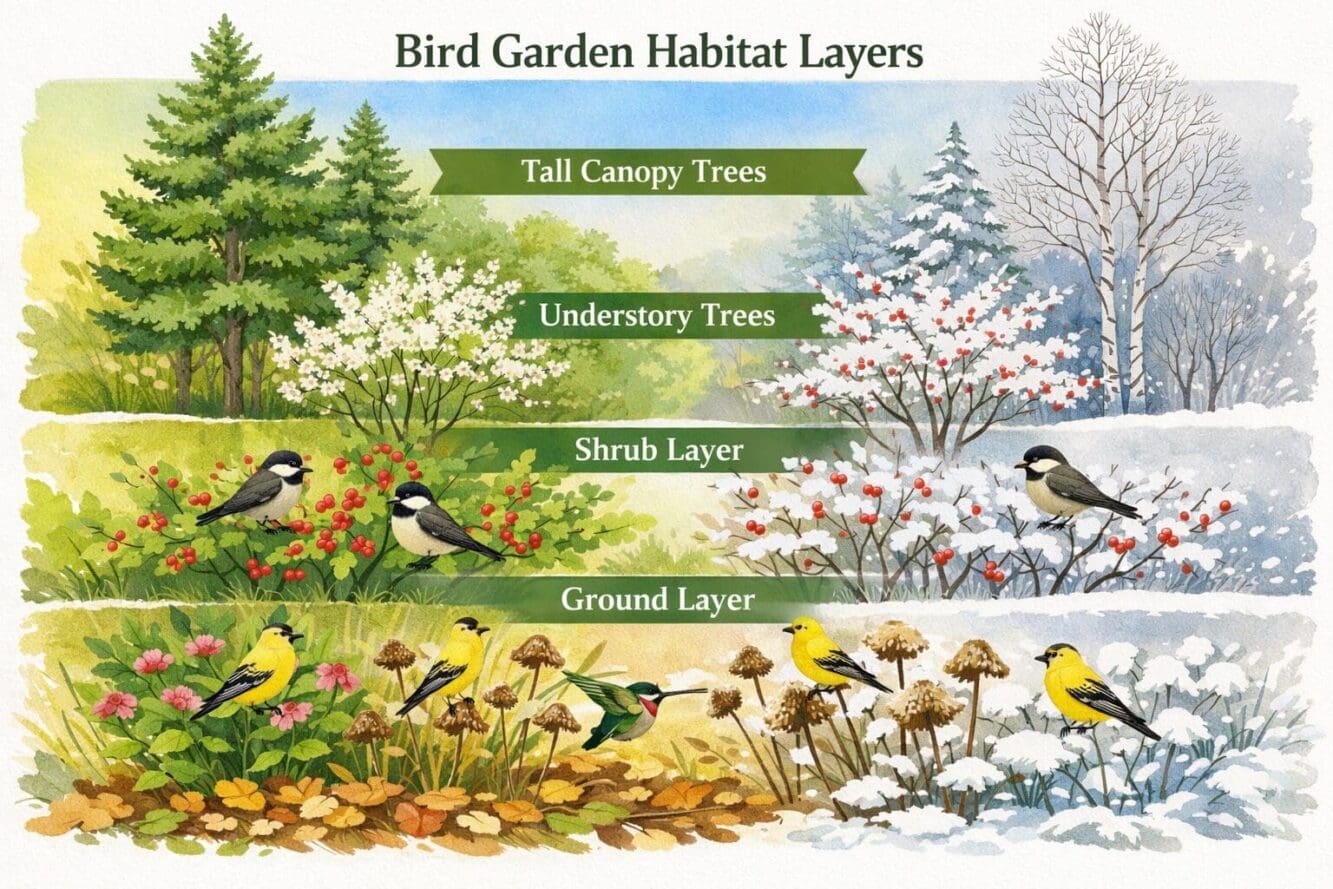
Building bird-friendly garden layers means planting in vertical tiers: tall canopy trees for nesting, understory trees for fruit and shelter, shrubs for cover and berries, and ground-level plants for seeds and insects. Choose native species matched to your Canadian region, ensure food is available across all four seasons, and eliminate hazards like pesticides, loose netting, and unshielded glass. Feeders are optional when the plant layers are right.
Why Do Stratified Habitat Layers Matter for Canadian Birds?
Birds don’t live in one flat plane. Different species occupy different vertical zones, and a garden that only offers one layer will only attract a narrow set of visitors.
Black-capped chickadees forage in shrubs and low branches. American goldfinches prefer seed heads at mid-height. Ruby-throated hummingbirds visit flowering plants from ground level to tree canopy. Dark-eyed juncos scratch through leaf litter on the ground. A single-layer lawn with one feeder misses most of these niches.
The three-component framework for bird-friendly gardens centres on food, water, and shelter working together [1]. Stratified planting delivers all three simultaneously:
- Canopy trees (white spruce, paper birch, sugar maple) provide nesting sites, wind protection, and seeds or cones
- Understory trees (serviceberry, chokecherry, mountain ash) offer fruit and mid-level shelter
- Shrubs (winterberry, dogwood, elderberry) create dense cover and berry crops
- Ground layer (native grasses, wildflowers, leaf litter) supports insects and ground-nesting species
This vertical structure also functions as a migration corridor, giving travelling birds food and rest stops, which is especially valuable in suburban areas where natural habitat is fragmented.
Which Native Trees and Shrubs Support Canadian Bird Species Through All Seasons?
Native plants are the foundation. They provide seeds, cones, berries, fruits, and nectar while also supporting the caterpillars and insects that birds feed to their young [1]. Plant selection should ensure natural foods are available from spring through autumn, with winter persistence built in [3].
Recommended Native Plants by Layer and Season
| Layer | Species | Key Birds Served | Season of Peak Value |
|---|---|---|---|
| Canopy | White spruce | Crossbills, chickadees, nuthatches | Winter (cones) |
| Canopy | Paper birch | Redpolls, goldfinches | Autumn/winter (catkins) |
| Canopy | Sugar maple | Evening grosbeaks, warblers | Spring (insects on buds) |
| Understory | Serviceberry (Amelanchier) | Cedar waxwings, robins | Summer (berries) |
| Understory | Chokecherry | Thrushes, vireos | Late summer |
| Shrub | Winterberry holly (Ilex verticillata) | Waxwings, robins | Winter (persistent fruit) |
| Shrub | Red-osier dogwood | Flickers, bluebirds | Autumn |
| Shrub | Highbush cranberry | Grosbeaks, waxwings | Late winter |
| Ground | Wild columbine | Hummingbirds | Spring/summer (nectar) |
| Ground | Black-eyed Susan | Goldfinches | Autumn (seed heads) |
| Ground | Native grasses (switchgrass) | Sparrows, juncos | Winter (seeds, cover) |
Decision rule: Choose winterberry holly or highbush cranberry if your primary goal is winter bird support. These shrubs hold their fruit well into February and March, when other food sources are exhausted.
Birds Canada maintains a plant selector tool with 500+ native Canadian plant species organized by 22 regional bird garden zones [1][3]. Start there to match species to your specific climate and soil conditions.
Common mistake: Planting non-native ornamental shrubs like Japanese barberry or burning bush. These provide some berries but don’t support the native insect populations that breeding birds depend on. Worse, several are invasive in Ontario and other provinces.
How Do You Design Bird-Friendly Garden Layers Without Feeders?
Feeders are helpful but not necessary. A well-designed native planting scheme can sustain birds year-round without supplemental feeding.
The feeder-free approach works when:
- At least 3 vertical layers of native plants are present
- Seed heads, stems, and fallen leaves are left standing through winter [1]
- Berry-producing shrubs include species with persistent fruit (winterberry, highbush cranberry)
- At least one reliable water source is available
Steps to build a feeder-free bird garden:
- Assess your space. Even a 10-by-10-foot area can support two layers. Balcony gardens can use container-grown native shrubs.
- Select plants for sequential bloom and fruit. Aim for at least one food source per season.
- Add micro-habitats. Open sandy areas for dust baths, raised berms for lookout spots, and stumps or logs for perching and foraging [3].
- Stop fall cleanup. Leave seed heads on coneflowers, black-eyed Susans, and native grasses. Leave leaf litter under shrubs.
- Eliminate pesticides and herbicides. Organic practices support the insect food web that birds rely on [1].
For those who enjoy spending time in nature, a feeder-free garden offers daily birdwatching without the maintenance of filling and cleaning feeders.
What Feeder Setup Works Best When You Do Want Supplemental Feeding?
If you choose to add feeders, match feeder type to your target species and place them within or adjacent to your planted layers for safety.
- Tube feeders with nyjer seed: Goldfinches, pine siskins, redpolls
- Hopper feeders with black oil sunflower: Chickadees, nuthatches, cardinals
- Suet cages: Woodpeckers, nuthatches, chickadees (especially valuable in winter)
- Nectar feeders (sugar water, no dye): Ruby-throated hummingbirds (spring through early autumn)
Placement matters. Position feeders within 3 feet of windows or more than 30 feet away to reduce collision risk. The in-between zone is the most dangerous because birds build enough speed to injure themselves but can’t stop in time.
Edge case: In bear country (much of northern Ontario, British Columbia, and parts of the Maritimes), feeders should be removed from April through November. This is another strong argument for feeder-free native plantings.
How Do You Provide Water for Birds in Canadian Winters?
Moving water attracts more bird species than still water [3]. A simple dripper or bubbler added to a birdbath will draw in species that might otherwise fly past.
Winter water tips:
- Use a heated birdbath designed for outdoor use. These are widely available at Canadian garden centres and prevent freezing down to about -25°C.
- Store concrete birdbaths indoors during winter to prevent ice-related cracking [1][3].
- Place water sources near shrub cover so birds can escape predators quickly.
- Change water every 2-3 days in summer to prevent mosquito breeding.
Water is one of the three core components of bird-friendly gardens [1], and it’s often the element gardeners overlook. A reliable water source in January can attract species that no feeder will.
Which Invasive Plants Should You Remove from a Bird Garden?
Invasive plants undermine bird habitat even when they appear to provide food. They displace the native plants that support insect populations, and some directly harm birds.
Plants to remove or avoid in Canadian bird gardens:
- Common burdock (Arctium minus): Burrs entangle small birds, sometimes fatally [1]
- Japanese barberry: Invasive in Ontario; provides poor-quality food and harbours ticks
- European buckthorn: Aggressive spreader; berries have laxative effect on birds, reducing nutrient absorption
- Garlic mustard: Suppresses native ground-layer plants
- Dog-strangling vine (pale swallowwort): Traps monarch butterflies and displaces native milkweed
Also remove: Loose netting, plastic decorations, and stringy materials that can entangle birds [1]. This includes poorly maintained fruit tree netting and decorative garden mesh.
Community efforts like those supporting climate action and sustainable development often include invasive species removal as a core activity.
How Do You Reduce Window Collisions and Other Hazards?
Window strikes kill an estimated hundreds of millions of birds across North America annually. In a bird-friendly garden, attracting more birds to your yard means taking collision prevention seriously.
Window collision solutions:
- Apply visual markers spaced no more than 2 inches apart on exterior glass surfaces [1]. Options include UV-reflective decals, tape strips, or external screens.
- Treat glass balcony railings the same way, as birds don’t perceive transparent glass as a barrier.
- Close blinds or curtains when possible, especially on windows facing garden plantings.
Light pollution management:
- Avoid upward-facing outdoor lights [1]
- Use timers and motion sensors to limit unnecessary nighttime illumination
- Excessive light disorients migrating birds and reduces insect populations that birds feed on
Predator management:
- Keep cats indoors. Free-roaming cats are the leading human-related cause of bird mortality in Canada.
- Build dense brush piles using twigs, pinecones, and prickly trimmings around garden edges to provide escape cover [1].
These steps align with broader conservation priorities. Organizations like those behind the Save Georgian Bay initiative emphasize that habitat protection starts at the backyard level.
What Does a Seasonal Maintenance Calendar Look Like?
A bird-friendly garden requires different actions in each season. Here’s a practical checklist:
Spring (March-May)
- Clean and refill birdbaths; install drippers
- Put out nectar feeders for returning hummingbirds (typically mid-May in southern Ontario)
- Delay garden cleanup until temperatures consistently reach 10°C so overwintering insects can emerge
- Plant new native shrubs and trees
Summer (June-August)
- Maintain water sources; change water frequently
- Avoid pruning shrubs where birds may be nesting
- Let native wildflowers go to seed rather than deadheading
- Monitor for invasive plant encroachment
Autumn (September-November)
- Leave seed heads, stems, and fallen leaves in place [1]
- Plant spring-blooming bulbs and native ground covers
- Store concrete birdbaths; set up heated winter baths [3]
- Add fresh brush piles for winter shelter
Winter (December-February)
- Maintain heated water source
- Observe which persistent-fruit shrubs are being used (this guides future planting)
- Avoid disturbing brush piles or leaf litter where birds shelter
- Plan next season’s additions using the Birds Canada plant selector [3]
Gardening through the seasons connects well with other community celebrations of the outdoors, such as Meaford’s seasonal festivals and local environmental fundraisers.
How Does This Approach Fit Small Urban Spaces?
You don’t need acreage. Balconies, small patios, and narrow side yards can all support bird-friendly layers at a reduced scale.
- Containers: Grow native shrubs like red-osier dogwood or low-bush blueberry in large pots. Add a small bubbling water feature.
- Vertical space: Train native vines (Virginia creeper, not English ivy) up walls or trellises to create a shrub-equivalent layer.
- Window boxes: Plant native wildflowers like wild columbine for hummingbirds.
- Shared spaces: Advocate for native plantings in condo common areas and municipal parks.
Choose container planting if you rent, have limited ground space, or live above the second floor. Choose in-ground planting if you own the property and can commit to a 3-5 year establishment period.
Even in urban settings, finding calm through nature connection is enhanced when birds are regular visitors to your space.
Frequently Asked Questions
How many plant species do I need for a bird-friendly garden?
Aim for a minimum of 8-12 native species across at least 3 vertical layers. More diversity means more bird species supported and more consistent food availability across seasons.
Do I need both male and female winterberry holly plants?
Yes. Winterberry holly is dioecious, meaning you need at least one male plant for every 5-6 female plants to produce berries. Without a male pollinator nearby, female plants won’t fruit.
Can I use bird-friendly garden layers in USDA Zone 3 (northern Prairies, northern Ontario)?
Absolutely. White spruce, paper birch, highbush cranberry, red-osier dogwood, and native willows all thrive in Zone 3. The Birds Canada plant selector filters by region [3].
How long before a new garden attracts birds?
Expect noticeable bird activity within the first growing season if you include at least one water source and some berry-producing shrubs. Full establishment of canopy trees takes 5-10 years.
Should I leave my garden “messy” in winter?
Yes. Standing seed heads, leaf litter, and brush piles provide critical food and shelter. This is one of the most impactful things a gardener can do for overwintering birds [1].
Are hummingbird feeders safe?
They’re safe when cleaned every 3-5 days in warm weather and filled with plain sugar water (4 parts water to 1 part white sugar). Never use red dye. Better yet, plant native tubular flowers like wild columbine and bee balm.
What about bird houses and nesting boxes?
Nesting boxes help cavity-nesting species like chickadees, wrens, and tree swallows. Match hole size to target species (1-1/8 inch for chickadees, 1-1/2 inch for tree swallows). Clean boxes annually in late winter.
Do bird-friendly gardens increase property value?
Native landscaping generally reduces maintenance costs and can increase property appeal. No verified Canadian-specific data on property value increases is available, but reduced lawn area means lower water and mowing costs.
How do I keep squirrels off feeders?
Baffle-mounted pole feeders placed at least 10 feet from the nearest tree branch are the most effective solution. But in a feeder-free garden, this problem doesn’t exist.
Conclusion
Building bird-friendly garden layers: shrubs, trees, and feeders for Canadian species through all seasons comes down to three actions. First, plant native species in vertical tiers so food and shelter are available from ground level to canopy, spring through winter. Second, add a reliable water source with movement. Third, remove hazards: pesticides, loose netting, unshielded glass, and invasive plants.
Start this week:
- Visit the Birds Canada gardening page and enter your region to get a customized native plant list [3].
- Choose one winter-persistent berry shrub (winterberry holly or highbush cranberry) and one canopy tree native to your area.
- Stop your next fall cleanup. Leave the seed heads and leaves where they fall.
These small changes compound over seasons. Within 2-3 years, a layered native garden will support more bird species than any feeder arrangement alone, and it will do so with less ongoing effort and cost.
References
[1] 03 Bird Friendly Gardens – https://ecologicaldesignlab.ca/site/uploads/2024/12/03_bird-friendly-gardens.pdf
[2] Design – https://cwf-fcf.org/en/explore/gardening-for-wildlife/tools/design.html
[3] Gardening For Birds – https://www.birdscanada.org/gardening-for-birds
[4] Bird Friendly Strategy – https://naturecanada.ca/news/blog/bird-friendly-strategy/
Content, illustrations, and third-party video appearing on GEORGIANBAYNEWS.COM may be generated or curated with AI assistance or reproduced pursuant to the fair dealing provisions of the Copyright Act, R.S.C. 1985, c. C-42. Attribution and hyperlinks to original sources are provided in acknowledgment of applicable intellectual property rights. Such referencing is intended to direct traffic to and support the original rights holders’ platforms.