






















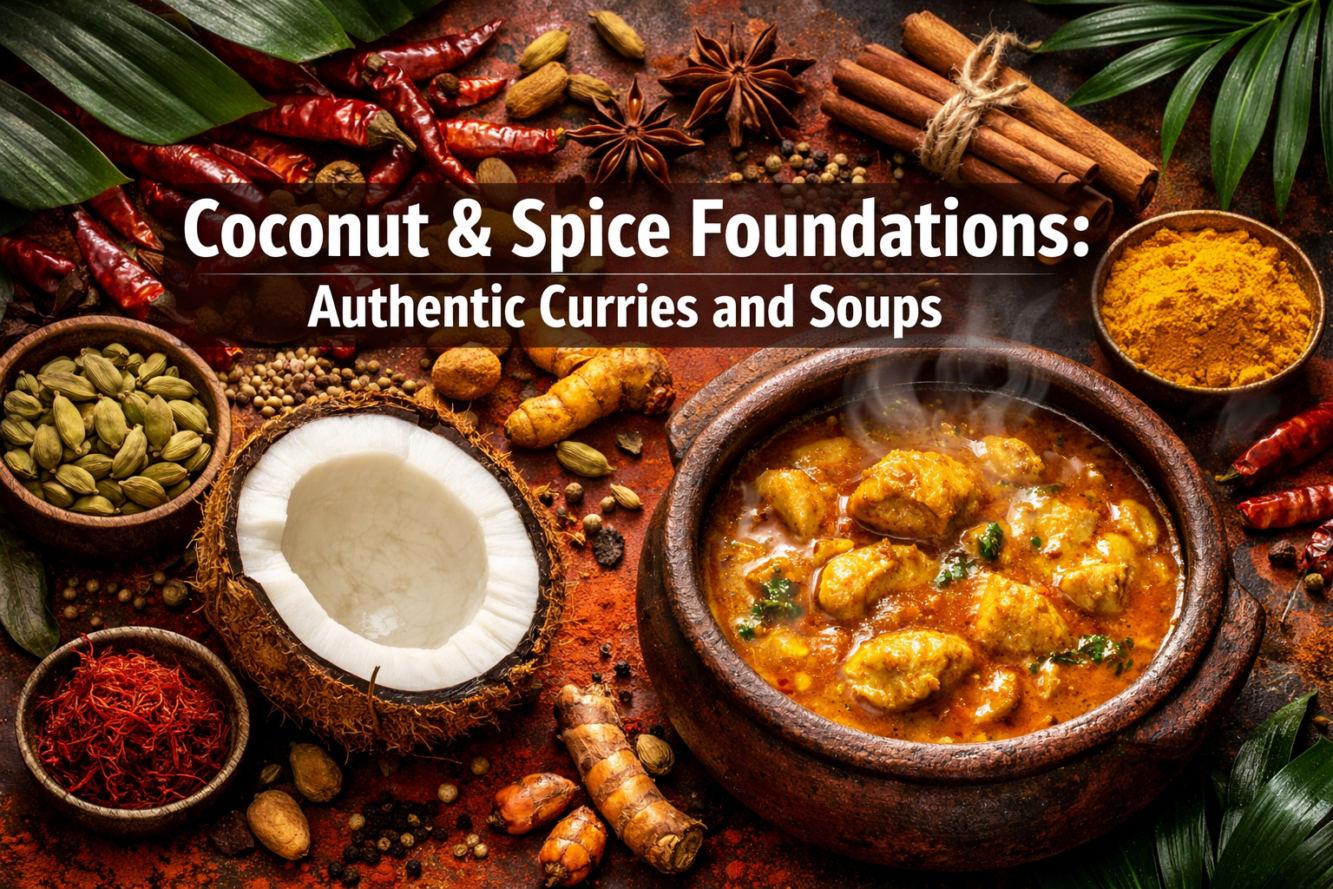
What if the secret to the world’s most beloved curries and soups could be traced back to just two core elements — coconut and spice? Across Southeast Asia, India, and the Caribbean, cooks have spent centuries perfecting the art of layering these foundations into dishes that are deeply aromatic, richly textured, and unforgettably complex. Mastering Coconut and Spice Foundations is not just about following recipes — it is about understanding why each step matters.
Not all coconut milk is created equal. The difference between a flat, watery curry and a silky, restaurant-quality bowl often comes down to the coconut milk used [3].
| Type | Fat Content | Best Use |
|---|---|---|
| Full-fat canned | 17–22% | Curries, soups, rich sauces |
| Light canned | 5–10% | Lighter soups, dressings |
| Fresh-pressed | 20–25% | Traditional dishes, desserts |
| Carton/shelf-stable | 1–4% | Smoothies, beverages only |
💡 Pro tip: Shake the can before opening. If it sounds thick and dense, the fat content is high — exactly what authentic curries need [3].
For Southeast Asian dishes like Thai green curry or Indonesian rendang, full-fat coconut milk is non-negotiable. In Caribbean traditions, fresh coconut milk is often simmered directly with aromatics to create a deeply flavored base. Indian cooking, particularly in Kerala and Goa, uses coconut milk in two stages — thick “first press” milk added at the end, and thinner “second press” milk used for cooking [3].
If you enjoy creamy, vegetable-forward soups, this same principle of building a rich base applies beautifully — much like the technique behind a creamy roasted cauliflower soup, where the base liquid defines the entire dish.
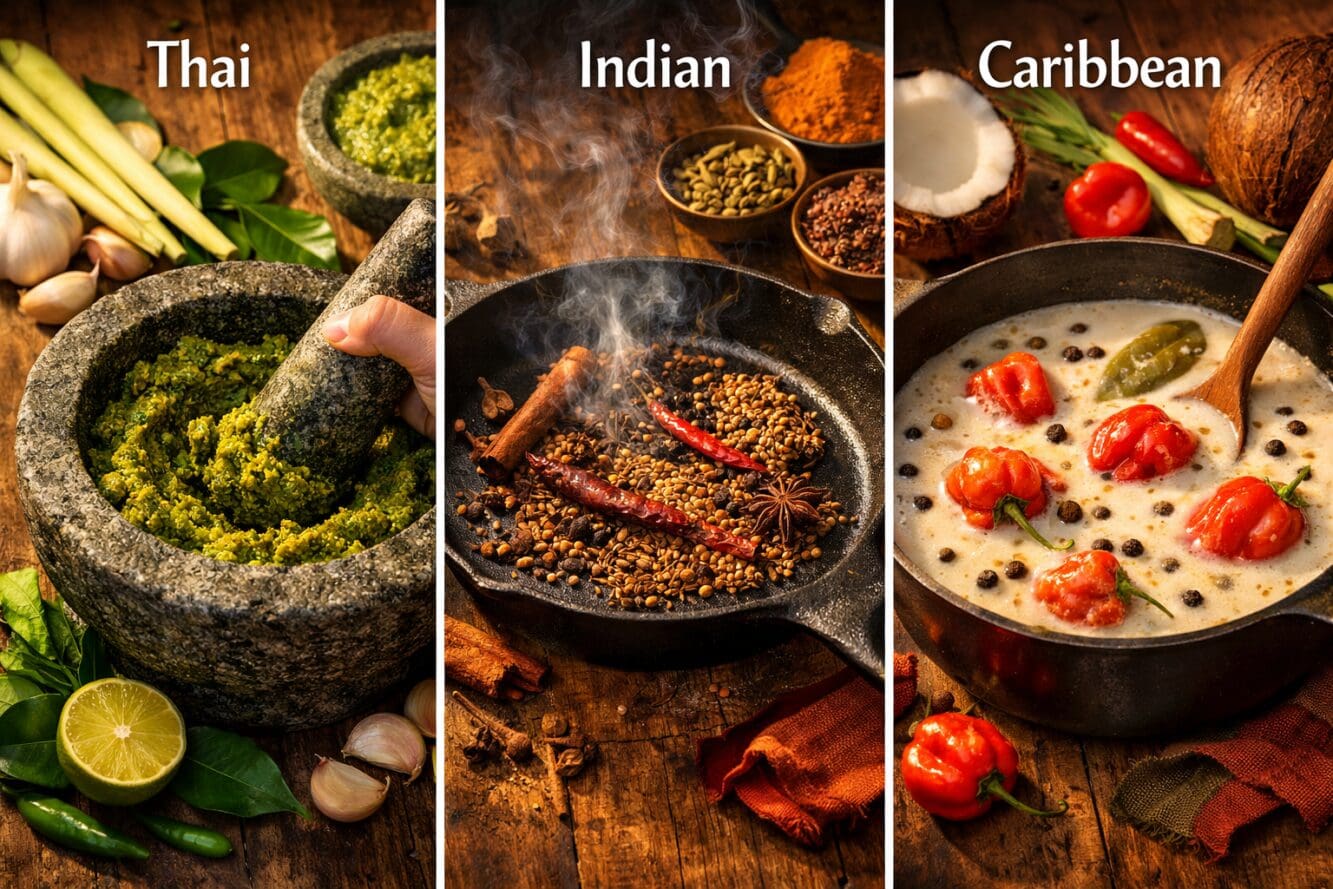
Dry-toasting whole spices is the single most transformative technique in coconut and spice foundations cooking. Heat activates volatile aromatic compounds — the very molecules responsible for depth, warmth, and complexity [1].
The food industry is paying attention. According to the Food Flavour Outlook 2026, global demand for bold, authentic spice profiles — particularly from South and Southeast Asian cuisines — is accelerating as consumers seek genuine culinary experiences over generic flavors [1].
Indonesian culinary traditions, as explored in depth by author Lara Lee, show how coconut and spice combinations like sambal form the backbone of entire regional cuisines — with each island having its own signature blend [2].
Understanding Coconut and Spice Foundations: Building Authentic Curries and Soups from Southeast Asian, Indian, and Caribbean Traditions means recognizing that each culture layers flavor differently.
Build a paste first — blend lemongrass, galangal, chilies, and shallots into a smooth base. Fry this paste in oil until fragrant before adding coconut milk. This “frying the paste” step is critical and often skipped by beginners.
Follow the “bloom-then-build” approach: temper whole spices in oil or ghee, add aromatics (onion, garlic, ginger), cook down tomatoes, then introduce ground spice powders before any liquid. Coconut milk enters last in South Indian preparations.
Start with a “green seasoning” base — a blended herb mixture — then build with aromatics, whole spices, and coconut milk simultaneously. The slow simmer does the layering work.
“The best curries are not made in a hurry — they are made in layers.”
Plant-based cooking enthusiasts will find these techniques especially rewarding. Many of the world’s finest vegetarian cookbooks focus specifically on these spice-forward, coconut-based traditions as a gateway to deeply satisfying meatless meals [4].
Authenticity begins at the market. In 2026, sourcing quality ingredients has never been more accessible — but knowing what to look for still matters.
Where to source key ingredients:
Spending time exploring local food culture — much like discovering the grand history behind iconic culinary destinations — adds meaningful context to ingredient choices and inspires deeper appreciation for food traditions.
Coconut and Spice Foundations: Building Authentic Curries and Soups from Southeast Asian, Indian, and Caribbean Traditions is ultimately a practice of patience, curiosity, and respect for culinary heritage. The techniques are learnable. The ingredients are findable. The results are extraordinary.
Actionable next steps:
The journey into authentic curry and soup-making begins with a single toasted spice and a quality can of coconut milk. Start there.
[1] Food Flavour Outlook 2026 – https://www.customculinary.com/Culinary-Expertise/Food-Trends/2026/Food-Flavour-Outlook-2026
[2] Coconut Sambal Recipes From My Indonesian Kitchen With Lara Lee – https://www.vabook.org/2021/03/26/coconut-sambal-recipes-from-my-indonesian-kitchen-with-lara-lee/
[3] Everything Your Coconut Milk Can Do – https://tastecooking.com/everything-your-coconut-milk-can-do/
[4] Vegetarian Cookbooks – https://foodprint.org/blog/vegetarian-cookbooks/
Content, illustrations, and third-party video appearing on GEORGIANBAYNEWS.COM may be generated or curated with AI assistance or reproduced pursuant to the fair dealing provisions of the Copyright Act, R.S.C. 1985, c. C-42. Attribution and hyperlinks to original sources are provided in acknowledgment of applicable intellectual property rights. Such referencing is intended to direct traffic to and support the original rights holders’ platforms.