



















Democracy Now Headlines Breakdown: Top Global Crises Unfolding May 11-12, 2026

Last updated: May 13, 2026
Quick Answer: The Democracy Now headlines breakdown for May 11–12, 2026 covers a cluster of urgent global crises: escalating Middle East violence, collapsing ceasefire agreements, far-right electoral surges in the UK, accelerated U.S. immigration enforcement, and growing surveillance operations near Cuba. These stories reveal interconnected failures in diplomacy, human rights, and democratic accountability that demand close public attention.
Key Takeaways 🗞️
- Iran-U.S. diplomacy stalled: The Trump administration rejected Iran’s ceasefire response as “Totally Unacceptable,” deepening the standoff [1]
- Lebanon strikes kill civilians: Israeli military strikes killed dozens, including an infant and medical workers, despite an active ceasefire deal [1]
- Gaza truce breaking down: Three more Palestinians were killed in documented ceasefire violations [1]
- Flotilla activists deported: Two humanitarian aid workers abducted from a Gaza-bound vessel were forcibly removed from the region [1]
- UK far-right surges: Nigel Farage’s party made historic local election gains, with pressure mounting on PM Keir Starmer to resign [7]
- ICE tragedy: A detained couple was reunited with their terminally ill son just one day before he died of cancer [10]
- Mahmoud Khalil deportation rushed: The Justice Department accelerated deportation proceedings against the Palestinian activist [10]
- Cuba surveillance escalates: U.S. military surged reconnaissance flights off Cuba’s coast [10]
- BAFTA recognizes censored Gaza film: A BBC-censored Gaza documentary won a BAFTA, spotlighting press freedom concerns [1]
- Virginia redistricting overturned: The state’s high court struck down a voter-approved congressional map, handing Republicans a major win [10]
What Are the Most Critical Stories in the Democracy Now Headlines Breakdown: Top Global Crises Unfolding May 11-12, 2026?
The May 11–12 broadcast covers at least a dozen high-stakes stories spanning five continents. The through-line across all of them is the erosion of institutional safeguards — ceasefire agreements, press freedoms, immigration protections, and democratic electoral maps are all under documented pressure simultaneously.

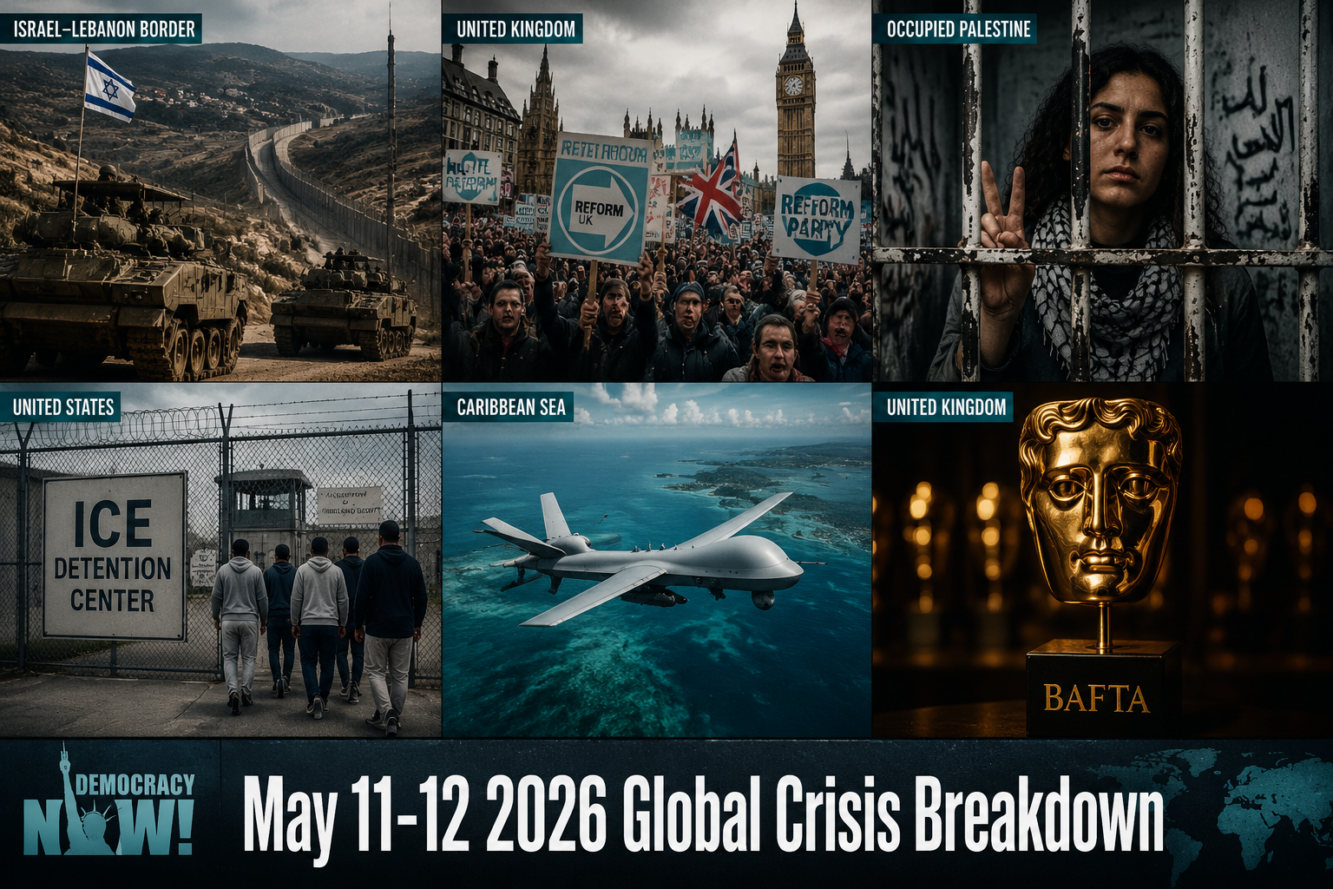
Here is a structured overview of the top stories by region:
| Region | Story | Status |
|---|---|---|
| Middle East | Iran-U.S. ceasefire collapse | Ongoing standoff |
| Lebanon | Israeli strikes kill civilians | Active conflict |
| Gaza | Ceasefire violations continue | Truce breaking down |
| UK | Far-right electoral surge | Historic gains confirmed |
| U.S. (domestic) | ICE detention tragedy | Family separated; son died |
| U.S. (foreign policy) | Cuba surveillance flights surge | Escalating |
| U.S. (legal) | Virginia redistricting overturned | Republicans win court ruling |
How Is the Middle East Crisis Developing Across These Headlines?
The Middle East dominates the May 11–12 breakdown with three overlapping crises running at the same time. The Trump administration publicly rejected Iran’s ceasefire response, calling it “Totally Unacceptable” — a characterization that signals diplomatic talks have effectively collapsed for now [1].
Meanwhile, Israeli military strikes on Lebanon killed dozens of people, including an infant and medical personnel, even though a ceasefire deal was technically in place [1]. Separately, Israeli forces killed three Palestinians in what are now documented violations of the Gaza ceasefire agreement [1].
“A ceasefire that exists only on paper while civilians continue to die is not a ceasefire — it is a countdown.”
Two activists aboard a Gaza-bound humanitarian aid flotilla were abducted and then forcibly deported by Israeli authorities, raising serious questions about civilian access to aid corridors [1]. For readers tracking biodiversity loss and humanitarian corridors as linked issues, this story connects resource access to geopolitical control.
Key pattern to watch: All three Middle East stories share a common thread — existing agreements are being violated without meaningful international enforcement.
What Does the UK Far-Right Surge Mean for Global Democracy?
Nigel Farage’s far-right populist party recorded historic gains in UK local elections, a result that has triggered calls for Labour Prime Minister Keir Starmer to resign [7]. This is not an isolated event — it fits a broader pattern of far-right parties gaining ground across Western democracies in 2026.
- Reform UK’s local election performance was described as historically significant
- Labour’s losses were significant enough to generate internal party pressure on Starmer
- The result mirrors similar far-right gains seen in France, Germany, and parts of Eastern Europe over the past two years
For context on how bipartisan unity narratives are being tested globally, the UK result is a useful case study. Populist movements are now winning not just protest votes but actual governing power at the local level.
How Are U.S. Immigration Policies Creating Human Costs?
Two immigration stories from the May 11–12 Democracy Now headlines breakdown illustrate the direct human consequences of current enforcement policy.
Story 1 — ICE detention tragedy: A couple detained by ICE was allowed to reunite with their terminally ill son only one day before he died of cancer. The story became a focal point for critics of aggressive detention practices [10].
Story 2 — Mahmoud Khalil deportation: The Justice Department moved to expedite the deportation of Palestinian activist Mahmoud Khalil, a case that has drawn significant attention from civil liberties organizations [10].
Both cases raise a consistent question: at what point does enforcement policy cross into a violation of basic humanitarian standards? The billionaires and power dynamics that shape immigration policy rarely appear in the same frame as the families affected — but these stories force that connection.
What U.S. Foreign Policy Moves Are Flying Under the Radar?
Two stories from the May 11–12 breakdown deserve more attention than they are currently receiving.
Cuba surveillance surge: The U.S. military significantly increased reconnaissance flights off Cuba’s coast, a move that has not generated major mainstream coverage but signals a shift in posture toward the island nation [10].
Pentagon boat strike: The Pentagon confirmed that a recent boat strike killed two people, with one survivor. Questions about operational protocols and accountability remain open [10].
These stories connect to China’s innovative edge and global military competition — as U.S. surveillance operations expand in one region, they often reflect broader strategic repositioning. The lack of mainstream coverage on the Cuba flights is itself a story worth tracking.
Why Did a Censored Gaza Documentary Win a BAFTA?
A Gaza documentary that the BBC refused to air won the prestigious BAFTA Award — a result that highlights a growing tension between institutional media gatekeeping and the independent recognition of important journalism [1].
The win is significant for two reasons:
- It validates the film’s quality despite institutional suppression
- It draws public attention to the BBC’s editorial decision, which critics argue was politically motivated
For anyone following press freedom issues, this story connects directly to how CBC News coverage and other public broadcasters handle politically sensitive material. The BAFTA result suggests that industry peers disagreed with the BBC’s decision loudly and publicly.
What Is the Virginia Redistricting Ruling and Why Does It Matter?
Virginia’s high court struck down a voter-approved congressional map, handing Republicans a significant legal victory [10]. This ruling matters beyond Virginia’s borders because it sets a precedent for how courts can override direct voter decisions on electoral boundaries.
- Voter-approved maps can be challenged and overturned through judicial review
- The ruling shifts congressional district lines in Republicans’ favor ahead of upcoming elections
- Critics argue it undermines the democratic principle that voters, not courts, should draw their own districts
This connects to broader concerns about Bill 5 and legislative overreach that readers tracking democratic accountability will recognize as part of a national pattern.
Frequently Asked Questions
What is Democracy Now and why do its headlines matter? Democracy Now is an independent, non-commercial news organization founded in 1996. Its headlines matter because it consistently covers stories that major commercial networks underreport, particularly on human rights, foreign policy, and social justice.
Where can I watch or listen to the May 11–12, 2026 Democracy Now broadcasts? Full episodes are available at democracynow.org [3][5], on YouTube [2], and through the Democracy Now podcast feed [6][8].
Was there a ceasefire between Israel and Gaza in May 2026? A ceasefire agreement was in place, but Democracy Now’s May 11 headlines documented at least three Palestinian deaths attributed to Israeli forces as violations of that agreement [1].
What happened to Mahmoud Khalil? The Justice Department moved to expedite his deportation in mid-May 2026. Khalil is a Palestinian activist whose case has become a focal point in debates about free speech and immigration enforcement [10].
Why were the flotilla activists deported? Two activists aboard a Gaza-bound humanitarian aid flotilla were abducted by Israeli forces and subsequently deported. The incident raised concerns about the legality of intercepting civilian humanitarian missions [1].
Is Narges Mohammadi still in prison? As of the May 11 headlines, Narges Mohammadi — an Iranian political prisoner and Nobel Peace Prize laureate — was hospitalized after collapsing in prison, highlighting serious concerns about her treatment and health [1].
What does the UK local election result mean for national politics? Nigel Farage’s Reform UK party made historic gains, putting significant pressure on Labour and Prime Minister Keir Starmer. Analysts see it as a warning sign for Labour ahead of the next general election [7].
How can I stay updated on these stories? Follow Democracy Now’s daily headlines at democracynow.org [4] and subscribe to the podcast [6] for ongoing coverage.
Conclusion: What to Do With This Information
The Democracy Now Headlines Breakdown: Top Global Crises Unfolding May 11-12, 2026 is not just a news summary — it is a map of where accountability is failing. Ceasefire agreements are being violated without consequence. Humanitarian workers are being deported. Families are being separated during medical emergencies. Courts are overriding voter decisions.
Actionable next steps for informed readers:
- Verify independently: Cross-reference these stories with primary sources at democracynow.org [4] and radiofree.org [10]
- Share the BAFTA/BBC story: Press freedom stories gain power when audiences amplify them
- Track the Virginia ruling: Watch how other states respond to the redistricting precedent
- Follow the Iran-U.S. talks: The “Totally Unacceptable” characterization suggests a new escalation phase is possible
- Support humanitarian organizations working in Gaza and Lebanon aid corridors
Staying informed is not passive. Each of these stories has a pressure point where public attention changes outcomes.
References
[1] Headlines for May 11, 2026 – https://www.radiofree.org/2026/05/11/headlines-for-may-11-2026/ [2] Watch – https://www.youtube.com/watch?v=TTj9AkGfZE4 [3] Democracy Now May 11 Show – https://www.democracynow.org/shows/2026/5/11 [4] Democracy Now – https://www.democracynow.org [5] Democracy Now May 12 Show – https://www.democracynow.org/shows/2026/5/12 [6] Democracy Now Podcast – https://www.democracynow.org/podcast.xml [7] Democracy Now Podcast Apple – https://podcasts.apple.com/us/podcast/democracy-now-2026-05-11-monday/id73802554?i=1000767192717 [8] Democracy Now Audio – https://podcast.app/democracy-now-audio-p1609 [10] Headlines for May 11, 2026 (Radio Free) – https://www.radiofree.org/2026/05/11/headlines-for-may-11-2026/
Much Appreciate You Sharing This Post - It Helps MUCH!!!