

























Defense Secretary Hegseth Grilled on Iran Conflict Costs: Taxpayer Burden and Path to Escalation in 2026

Last updated: May 13, 2026
Quick Answer: The U.S.-Iran war has cost American taxpayers $29 billion in just 11 weeks, with Pentagon comptroller Jay Hurst warning that figure is “not exhaustive.” Defense Secretary Hegseth Grilled on Iran Conflict Costs: Taxpayer Burden and Path to Escalation in 2026 has become the defining congressional flashpoint of the year, as bipartisan lawmakers demand transparency on emergency funding, weapons stockpiles, and an exit strategy that the Pentagon has yet to clearly define.
Key Takeaways
- 💰 $29 billion — the Pentagon’s latest war cost estimate as of May 12, 2026, up from $25 billion just two weeks earlier [2][6]
- 📈 Costs are rising at roughly $286 million per week, based on the two-week interval increase
- 🏠 Independent analysts estimate the broader economic impact could reach $200 billion, potentially costing average families “thousands, or even tens of thousands of dollars” [1]
- 🔫 Approximately $24 billion of the $29 billion total covers munitions replacement and equipment repair [6]
- ⚖️ Both Republican and Democratic lawmakers grilled Hegseth in back-to-back hearings on May 12, 2026 [9]
- 🛡️ Hegseth dismissed weapons stockpile concerns as “unhelpfully overstated,” claiming “we have plenty of what we need” [9]
- ☠️ 14 American servicemembers have been killed in the conflict as of late April 2026 [5]
- 🔒 Hegseth refused to disclose the dollar amount or timeline for the pending supplemental funding request [2]
- 🌍 Escalation risks include Strait of Hormuz disruption, oil price spikes, and shifting global alliances [4]
- ⚠️ The $29 billion figure was explicitly described as incomplete by the Pentagon’s own comptroller [6]
How Did the $29 Billion War Cost Figure Come About?
The $29 billion total reflects updated Pentagon accounting for equipment repairs, munitions replacement, and operational expenses after 11 weeks of active conflict. It is not a final number.
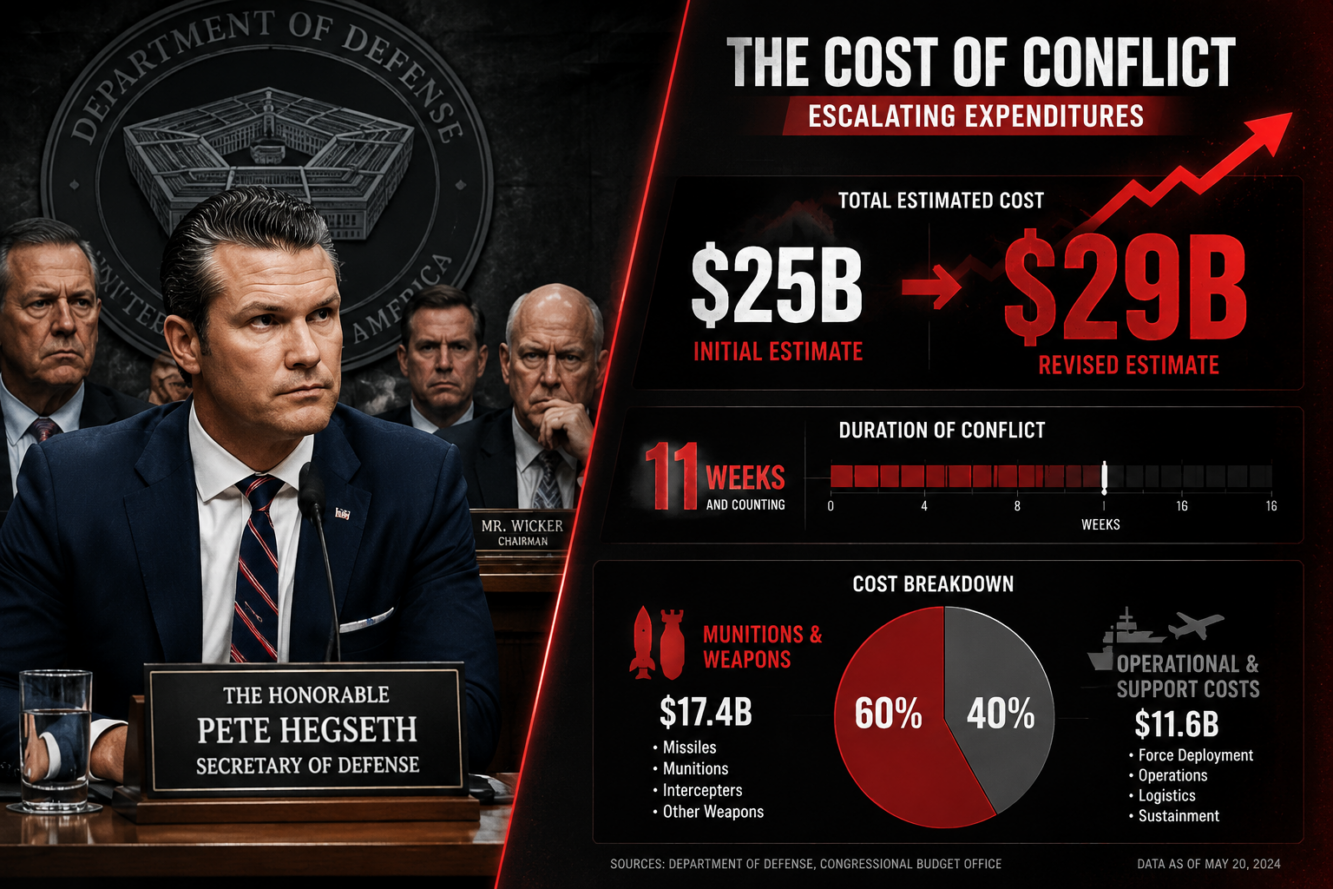
Pentagon comptroller Jay Hurst testified before Congress on May 12, 2026, presenting the revised figure and cautioning that the estimate “was not exhaustive.” [6] The breakdown is significant:
| Cost Category | Estimated Amount |
|---|---|
| Munitions replacement & equipment repair | ~$24 billion |
| Operational costs (deployed forces) | ~$5 billion |
| Total (as of May 12, 2026) | $29 billion |
The speed of escalation is striking. Costs jumped from $25 billion on April 29 to $29 billion by May 12 — a $4 billion increase in roughly two weeks. [2][5] At that rate, the weekly burn approaches $286 million.
Common mistake: Treating the $29 billion figure as comprehensive. Hurst’s own testimony signals additional costs will surface as accounting catches up with battlefield reality.
What Did Congress Actually Ask Hegseth — and Did He Answer?
Defense Secretary Hegseth Grilled on Iran Conflict Costs: Taxpayer Burden and Path to Escalation in 2026 reached a new intensity on May 12, when Hegseth faced back-to-back hearings before both House and Senate subcommittees. Lawmakers from both parties pressed him on three core issues — and received incomplete answers on all three. [7][8]
The three central questions lawmakers raised:
- Supplemental funding: How much is the Pentagon requesting, and when? Hegseth declined to provide a figure or timeline. [2]
- End game strategy: What does success look like, and how does the U.S. exit? Hegseth stated the Pentagon has “a plan to escalate if necessary, a plan to retrograde if necessary, a plan to shift assets” — without specifying which path is preferred. [9]
- Weapons stockpile sustainability: Are munitions running low given rapid consumption? Hegseth called stockpile concerns “unhelpfully overstated” and said “we have plenty of what we need.” [9]
The bipartisan nature of the pushback is notable. This isn’t a partisan fight — members of Hegseth’s own party are demanding answers alongside Democrats. [7]
For context on how political discourse shapes public understanding of military conflicts, the Bulwark Podcast coverage has tracked similar congressional accountability debates.
What Is the Real Cost to American Families?
The official $29 billion figure captures direct military expenditure, but the broader economic toll lands differently for ordinary households.
Independent analysts calculating the full economic impact — including supply chain disruption, energy price increases, and reduced trade — estimate the total burden could reach approximately $200 billion, with potential job losses of up to one million within a year. [1] For the average American family, that translates to “thousands, or even tens of thousands of dollars,” according to opinion analysis published by the New York Times. [1]
Where the economic pressure shows up:
- Energy prices: Any disruption to the Strait of Hormuz — through which roughly 20% of global oil supply passes — would spike gasoline and heating costs immediately [4]
- Consumer goods: Supply chain friction raises prices on imported products
- Federal debt: Supplemental war funding adds to deficit spending, compounding long-term interest costs
- Job market: Defense-sector reallocation and economic uncertainty suppress private investment
The Center for Strategic and International Studies has long studied how prolonged Middle East conflicts translate into domestic economic drag — a dynamic now playing out in real time.
How Fast Are War Costs Escalating, and Is There a Ceiling?
Costs are escalating faster than initial projections, and the Pentagon has not offered a spending ceiling or a projected total. That uncertainty is itself a problem for Congress.
The trajectory in numbers:
- Late April 2026: $25 billion estimated [5]
- May 12, 2026: $29 billion confirmed [2][6]
- Projected weekly increase (if trend holds): ~$286 million
Hurst’s warning that the $29 billion is “not exhaustive” suggests the real number is already higher. Lawmakers pressing for a supplemental funding request need that figure to authorize additional spending — and Hegseth’s refusal to provide it leaves Congress unable to act with full information. [2]
Edge case to watch: If the Strait of Hormuz faces a blockade or sustained disruption, operational costs could spike sharply beyond current projections. [4] Oil and gas price shocks would add an indirect fiscal layer on top of direct military spending.
What Are the Escalation Risks Beyond Current Spending?
The conflict is 11 weeks old and showing signs of continued escalation rather than resolution. [2] Hegseth’s contingency language — “escalate if necessary” — signals the Pentagon is not ruling out a deeper military commitment.
Key escalation risk factors:
- Strait of Hormuz: A blockade scenario would disrupt global oil markets and draw in additional regional and international actors [4]
- Weapons stockpile depletion: Despite Hegseth’s dismissal, rapid munitions consumption in modern air campaigns is a documented concern from recent conflicts
- Allied positioning: Global alliances are shifting, with some partners signaling discomfort at extended U.S. engagement
- Iranian response capacity: 11 weeks of conflict has not eliminated Iran’s ability to retaliate or escalate asymmetrically
For readers tracking ceasefire developments and diplomatic off-ramps, the situation remains fluid as of mid-May 2026.
What De-escalation Paths Exist?
De-escalation requires political will, a defined end state, and a credible diplomatic channel — none of which Hegseth clearly articulated in his May 12 testimony.
Realistic off-ramps analysts have identified include:
- Negotiated ceasefire with third-party mediation (regional powers or European allies)
- Defined military objectives met — triggering a planned withdrawal rather than an open-ended commitment
- Congressional funding constraints — lawmakers withholding supplemental authorization unless conditions are attached
- Diplomatic back-channels — quiet negotiations running parallel to military operations
The absence of a clear end game, combined with rising costs and bipartisan congressional frustration, creates pressure for the administration to define success terms publicly. [7][8]
Thoughtful analysis of bureaucratic nightmares in military procurement and oversight has shown that undefined objectives are the single biggest driver of cost overruns in extended conflicts.
What Happened at the April 29 Hearing That Set the Stage?
The May 12 hearings didn’t emerge from nowhere. At a late April Congressional session, Hegseth criticized both Democratic and Republican lawmakers for what he called “reckless, ineffective, and defeatist rhetoric,” describing congressional skepticism as “the most significant challenge we face right now.” [5]
That combative posture backfired. Rather than quieting critics, it hardened bipartisan resolve to demand more accountability — producing the more structured, pointed questioning that defined the May 12 sessions. [7]
At that April 29 hearing, the Pentagon also confirmed 14 American servicemembers killed in the conflict. [5] That human cost, alongside the financial one, has shifted the tone of congressional oversight from procedural to urgent.
FAQ
Q: What is the current confirmed cost of the U.S.-Iran war? A: $29 billion as of May 12, 2026, per Pentagon comptroller Jay Hurst — and that figure is explicitly described as incomplete. [6]
Q: Why won’t Hegseth reveal the supplemental funding request amount? A: He has not provided a public explanation. During testimony, he simply declined to disclose the figure or timeline despite repeated congressional requests. [2]
Q: How much of the $29 billion is for weapons and equipment? A: Approximately $24 billion covers munitions replacement and equipment repair; the remaining ~$5 billion covers operational costs for deployed forces. [6]
Q: Are U.S. weapons stockpiles running low? A: Hegseth says no, calling concerns “unhelpfully overstated.” Independent analysts and some lawmakers remain skeptical given documented consumption rates. [9]
Q: How many Americans have died in the Iran conflict? A: 14 servicemembers as of late April 2026, per Pentagon data released at the April 29 hearing. [5]
Q: What could the war ultimately cost American families? A: Opinion analysts estimate the broader economic impact could reach $200 billion, potentially costing average families thousands to tens of thousands of dollars. [1]
Q: Is Congress able to stop or limit the war? A: Congress controls the funding. Withholding or conditioning supplemental appropriations is the primary leverage lawmakers hold, though they haven’t yet exercised it. [7]
Q: What is the Strait of Hormuz risk? A: The Strait carries roughly 20% of global oil supply. A blockade would spike energy prices globally and could draw additional military actors into the conflict. [4]
Conclusion: What Should Readers Do With This Information?
The Defense Secretary Hegseth Grilled on Iran Conflict Costs: Taxpayer Burden and Path to Escalation in 2026 story is not just a Washington budget dispute — it’s a direct financial and security question for every American household.
Actionable steps for engaged citizens:
- Contact your congressional representatives and ask specifically where they stand on the supplemental funding request and what conditions, if any, they plan to attach
- Track the cost trajectory — the next Pentagon update will reveal whether the $286 million weekly increase is accelerating or stabilizing
- Monitor energy markets as a leading indicator of Strait of Hormuz risk; sustained oil price spikes signal escalation pressure
- Read the actual testimony — primary sources from the May 12 hearings are publicly available and more informative than summary coverage
- Demand a defined end state — ask your representatives what “success” looks like and what the exit criteria are
At $29 billion and climbing, with 14 lives lost and no supplemental funding figure on the table, the gap between what Congress is asking and what the Pentagon is answering is itself the story. Bipartisan accountability pressure is the most functional check available right now — and it only works if constituents are paying attention.
References
[1] Hegseth Says This War Has Cost $25 Billion (Opinion) – https://www.nytimes.com/2026/05/08/opinion/hegseth-war-cost.html
[2] Pentagon Puts Iran War Cost at $29 Billion as Hegseth Deflects – https://www.nytimes.com/2026/05/12/us/politics/iran-war-cost-hegseth-congress.html
[4] Defense Secretary Pete Hegseth Faces Back-to-Back Bipartisan Questioning Hearings – https://kutv.com/news/nation-world/defense-secretary-pete-hegseth-faces-back-to-back-bipartisan-questioning-hearings-as-iran-war-costs-rise-ceasefire-wavers-house-senate-subcommittee-military-budget-2027-strait-of-hormuz-blockade-oil-gas-prices
[5] Pentagon Puts Iran War Cost at $25 Billion as Hegseth Berates Skeptics – https://www.nytimes.com/2026/04/29/us/politics/hegseth-iran-war-cost.html
[6] Cost of Iran War Up to $29B as Lawmakers Push for Details – https://www.stripes.com/theaters/us/2026-05-12/hegseth-iran-war-funding-29-billion-21650587.html
[7] Hegseth Gets Bipartisan Grilling on Rising Costs of the Iran War and Trump’s End Game (WDIO) – https://www.wdio.com/ap-top-news/hegseth-gets-bipartisan-grilling-on-rising-costs-of-the-iran-war-and-trumps-end-game/
[8] Hegseth Gets Bipartisan Grilling on Rising Costs of the Iran War and Trump’s End Game (AJC) – https://www.ajc.com/news/2026/05/hegseth-gets-bipartisan-grilling-on-rising-costs-of-the-iran-war-and-trumps-end-game/
[9] Hegseth Is Facing a New Round of Questioning from Congress on the Iran War and More – https://www.wsls.com/news/politics/2026/05/12/hegseth-is-facing-a-new-round-of-questioning-from-congress-on-the-iran-war-and-more/
Much Appreciate You Sharing This Post - It Helps MUCH!!!