



















E-Bike Enforcement Crackdown 2026: Sidewalk Speed Limits, Age Restrictions, and Municipal Fines You Need to Know

Last updated: February 27, 2026
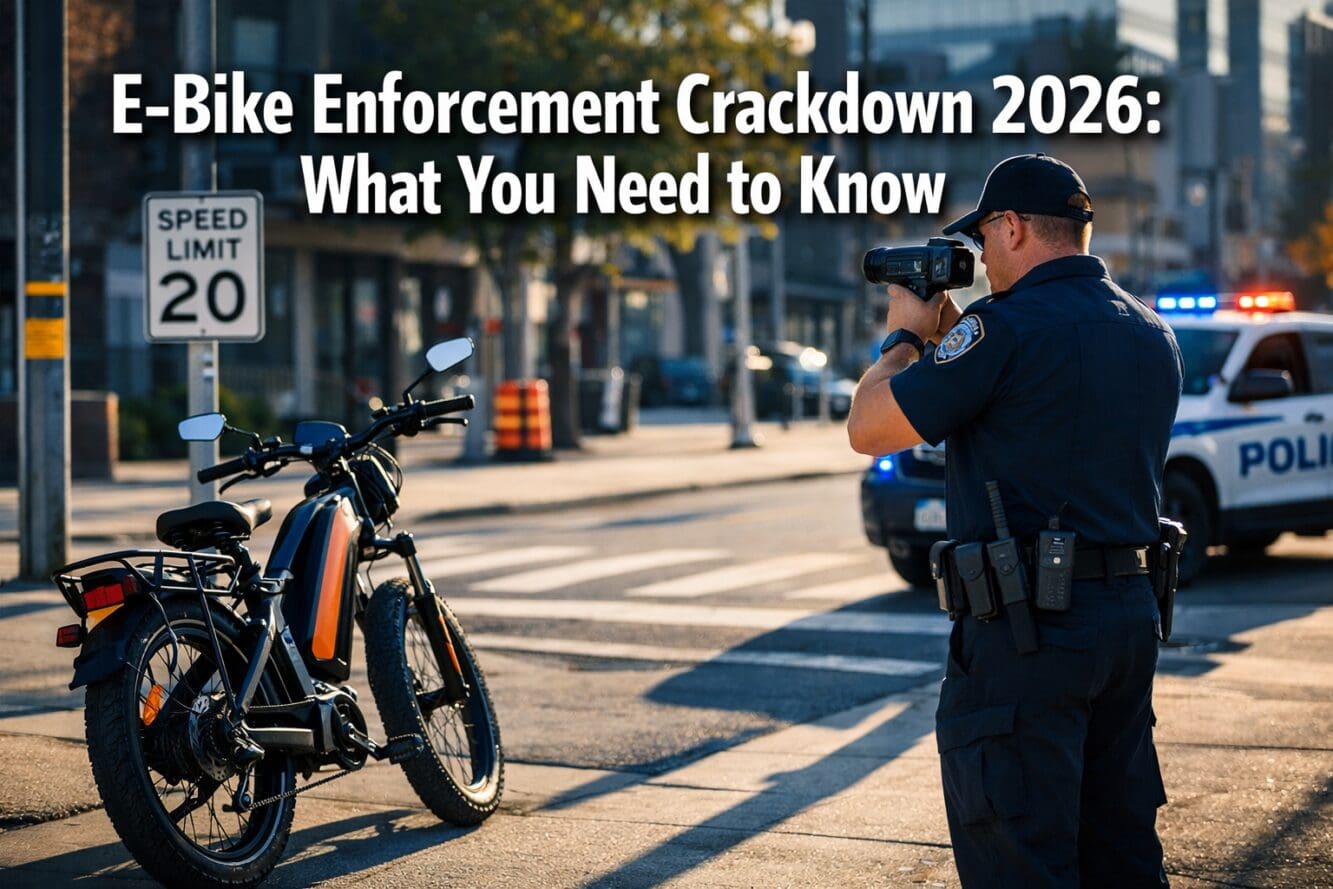
Municipalities across North America are ramping up e-bike enforcement in 2026, with new sidewalk speed limits, stricter age restrictions, and fines reaching up to $500 for violations. The E-Bike Enforcement Crackdown 2026: Sidewalk Speed Limits, Age Restrictions, and Municipal Fines You Need to Know represents a major shift in how cities regulate electric bicycles, with police departments now using handheld radar guns and mobile testing equipment to catch violators. Understanding these new rules can help riders avoid costly tickets and keep their bikes out of impound lots.

Key Takeaways
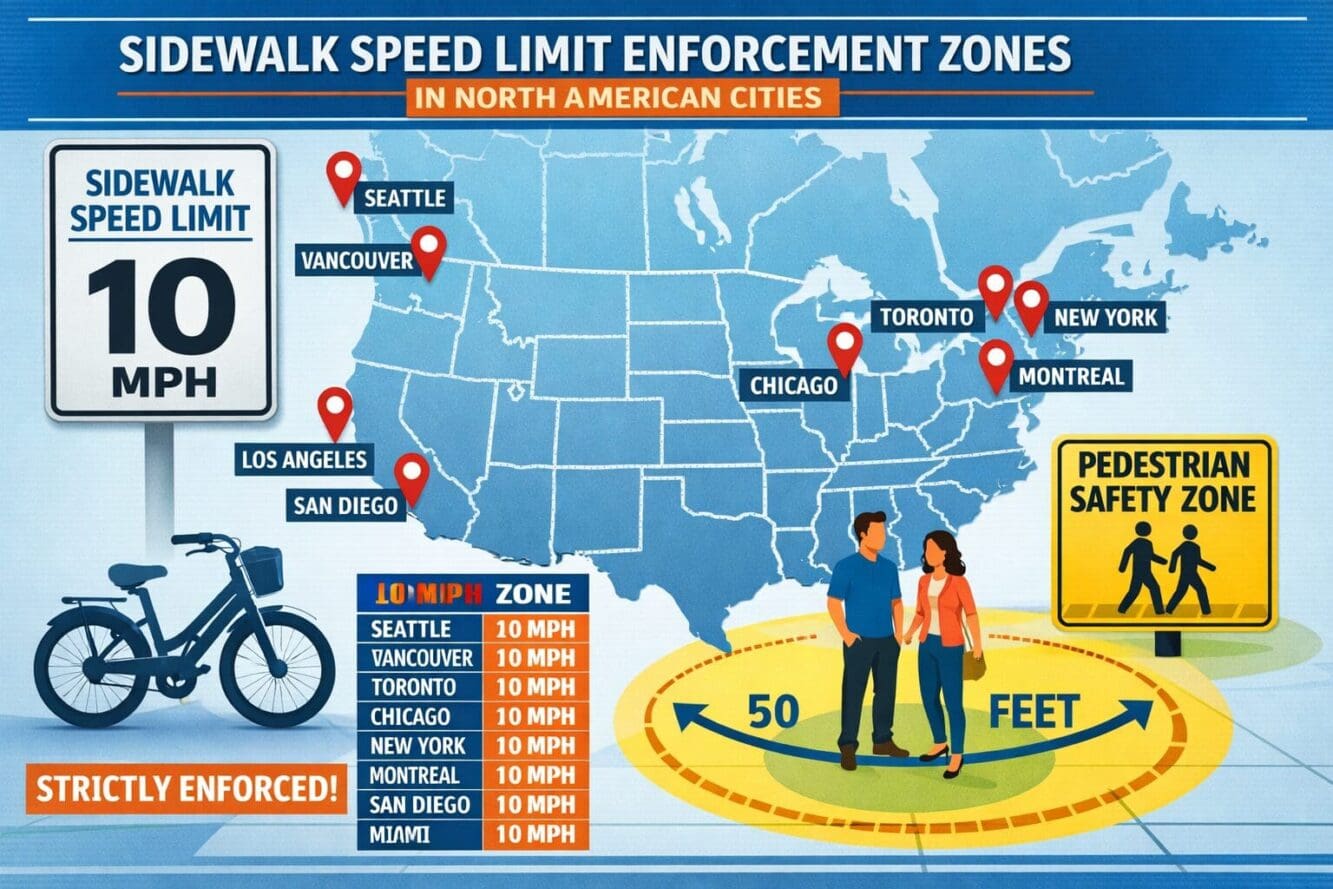
- Sidewalk speed limits are now capped at 10 mph when pedestrians are within 50 feet in many jurisdictions[1]
- Municipal fines range from $100 to $500 depending on the violation and location, with some areas imposing penalties on parents of minor violators[4]
- Age restrictions vary by city, with some requiring riders to be 16 or 18 years old for certain e-bike classes
- Police enforcement has intensified with handheld radar devices and mobile dynamometer testing to verify e-bike speeds[2]
- Grace periods exist in some states like New Jersey, giving riders six months to comply before active ticketing begins[3]
- Impound authority allows police in certain cities to seize e-bikes that exceed speed ratings or violate local ordinances[4]
- Yield requirements mandate that e-bike riders give audible signals before passing pedestrians on shared paths[1]
- Data tracking systems are being implemented statewide in Florida to monitor e-bike crashes and violations[1]
Quick Answer
The E-Bike Enforcement Crackdown 2026 introduces strict sidewalk speed limits (typically 10 mph near pedestrians), age restrictions ranging from 14 to 18 years depending on jurisdiction, and municipal fines between $100 and $500 for violations. Police departments are using radar guns and mobile testing equipment to enforce these rules, with some cities authorizing bike impoundment for repeat offenders. Riders should check their local ordinances, slow down near pedestrians, and ensure their e-bikes meet class specifications to avoid penalties.
What Are the New Sidewalk Speed Limits for E-Bikes in 2026?
Most jurisdictions implementing the E-Bike Enforcement Crackdown 2026 have set sidewalk speed limits at 10 mph or less when pedestrians are nearby. Florida’s recently passed legislation prohibits e-bike riders from exceeding 10 mph on sidewalks or pedestrian areas when any pedestrian is within 50 feet[1]. This creates a dynamic speed limit that requires constant awareness of your surroundings.
Key speed limit requirements:
- 10 mph maximum when pedestrians are within 50 feet on sidewalks
- Yield to pedestrians at all times on shared pathways
- Audible signal required before passing pedestrians (bell, horn, or verbal warning)[1]
- Park and recreational area limits often match sidewalk restrictions
Common mistake: Many riders assume the 10 mph limit applies only when directly approaching a pedestrian. The 50-foot rule means you need to slow down well before reaching someone, not just at the moment of passing.
Choose this approach if: You frequently ride through downtown areas or on multi-use paths. Install a speedometer app on your phone or use your e-bike’s display to monitor your speed constantly near pedestrian zones.
How Much Are Municipal Fines for E-Bike Violations?
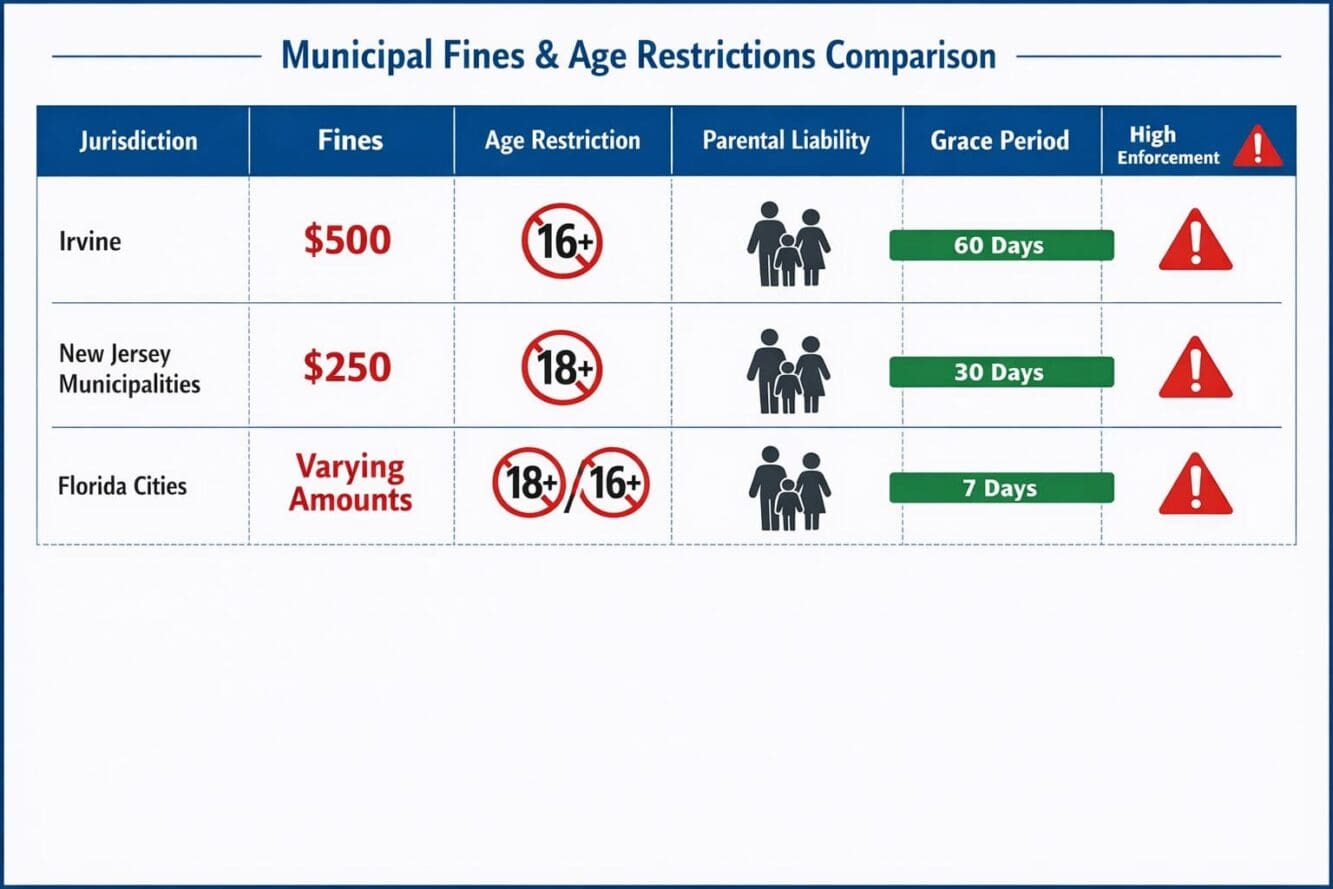
Municipal fines for e-bike violations in 2026 vary significantly by location but typically range from $100 to $500 per incident. In Orange County, California (including Irvine), parents could face fines up to $500 if their children violate proposed e-bike laws[4]. Most violations are classified as noncriminal traffic infractions, treated as nonmoving violations similar to parking tickets[1].
Fine structure by violation type:
| Violation Type | Typical Fine Range | Notes |
|---|---|---|
| Sidewalk speeding | $75-$250 | First offense usually lower |
| Failure to yield to pedestrians | $100-$300 | Higher in school zones |
| No audible signal when passing | $50-$150 | Often paired with other violations |
| Underage operation | $150-$500 | May include parental liability[4] |
| Operating illegal class e-bike | $200-$500 | Can include impoundment |
Enforcement hot spots in 2026:
- Orange County, California: Aggressive enforcement with parental fines and impound authority[4]
- Florida municipalities: Statewide crackdown following unanimous Senate passage of new regulations[1]
- New Jersey: Comprehensive e-bike regulations treating some models as mopeds, though six-month grace period applies[3][5]
- Major city downtowns: Enhanced enforcement in pedestrian-heavy areas
Edge case: Some cities impose escalating fines for repeat offenders, with third violations potentially doubling the base fine amount. Check your local ordinances for specific penalty schedules.

What Age Restrictions Apply to E-Bike Riders in 2026?
Age restrictions for e-bike operation vary by jurisdiction and e-bike class, with most cities requiring riders to be between 14 and 18 years old depending on the bike’s power and speed capabilities. The E-Bike Enforcement Crackdown 2026 has pushed many municipalities to adopt stricter age limits, particularly for Class 3 e-bikes (those capable of 28 mph with pedal assist).
Common age restriction frameworks:
- Class 1 e-bikes (pedal-assist up to 20 mph): Minimum age 14-16 in most areas
- Class 2 e-bikes (throttle-assist up to 20 mph): Minimum age 16 in many jurisdictions
- Class 3 e-bikes (pedal-assist up to 28 mph): Minimum age 16-18, helmet required
- Parental liability: Parents can be held financially responsible for violations by minor riders[4]
Helmet requirements by age:
- Riders under 16: Mandatory helmet in most jurisdictions
- Riders under 18: Required for Class 3 e-bikes
- All ages: Recommended but not always legally required for Class 1 and 2
Decision rule: If your child is under 16, stick with Class 1 e-bikes and ensure they wear helmets. For teens 16-17, verify your local ordinances before allowing Class 2 or Class 3 operation, as some cities prohibit minors from riding higher-powered models entirely.
How Are Police Enforcing E-Bike Regulations in 2026?
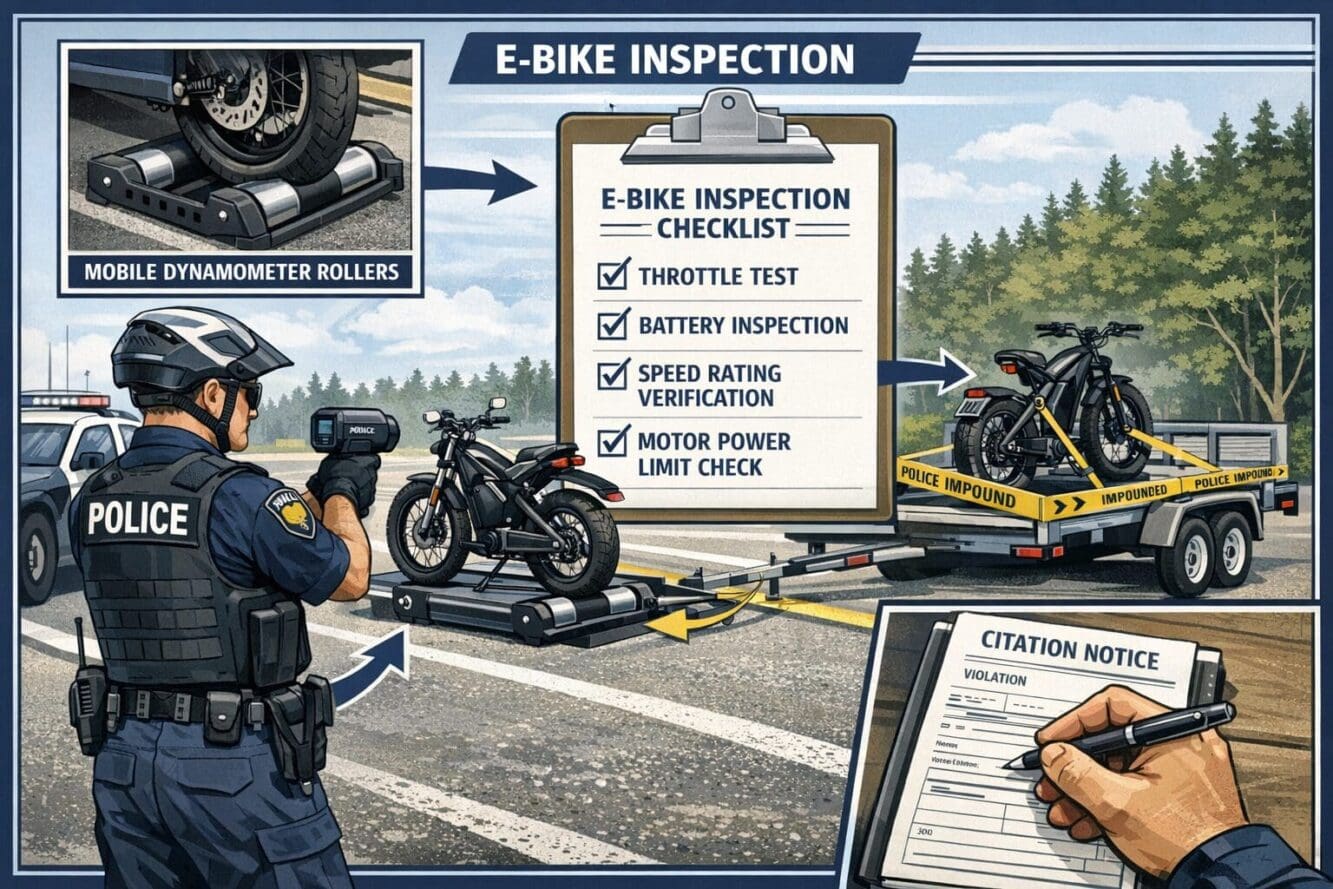
Police enforcement of e-bike regulations has become significantly more sophisticated in 2026, with departments deploying handheld radar devices, mobile dynamometer testing equipment, and multi-step technical inspections during traffic stops[2]. Many municipal police departments have equipped bicycle patrols with handheld radar specifically calibrated for e-bikes, allowing officers to measure speeds on sidewalks and shared paths.
Modern enforcement techniques:
- Handheld radar guns: Officers measure e-bike speeds in real-time on sidewalks and paths[2]
- Mobile dynamometer testing: Small rollers placed under rear wheels test throttle performance and maximum speed[2]
- Technical inspections: Multi-point checks including throttle verification, battery casing assessment, and class label confirmation[2]
- Bike impoundment: Bikes exceeding labeled speed ratings can be seized as illegal mopeds[2]
What to expect during an e-bike traffic stop:
- Officer will ask for identification and proof of age
- Visual inspection of e-bike class label and equipment
- Possible throttle test to verify speed capabilities
- Speed measurement if violation suspected
- Citation issued for confirmed violations
- Potential impoundment if bike doesn’t meet class specifications
Common mistake: Riders often modify their e-bikes to exceed class speed limits, then get caught during technical inspections. Even if you’re riding slowly at the moment of the stop, officers can test your bike’s maximum capabilities.
For those interested in broader cycling initiatives in the region, Collingwood is on the move celebrating bike month showcases community efforts to promote safe cycling.
What Is the Micromobility Device Safety Task Force?
Florida has established a Micromobility Device Safety Task Force within the Department of Highway Safety and Motor Vehicles as part of the E-Bike Enforcement Crackdown 2026. This task force includes representatives from law enforcement, local government, industry stakeholders, and medical professionals, with recommendations due by October 1, 2026[1].
Task force responsibilities:
- Analyze e-bike crash data collected statewide
- Review current enforcement effectiveness
- Recommend safety standards and regulations
- Propose education and awareness programs
- Suggest infrastructure improvements for e-bike safety
Statewide data tracking mandate: The Florida Highway Patrol and all police departments and sheriff’s offices must maintain comprehensive crash data including date/time, electric bicycle class, operator age, and driver’s license status[1]. This data will inform future policy decisions and help identify high-risk areas and behaviors.
Timeline: Most provisions of Florida’s new e-bike law take effect upon signing, with certain sections scheduled to begin July 1, 2026[1]. Other states are watching Florida’s model closely and may adopt similar task forces.
How Can You Avoid E-Bike Violations and Fines?
Avoiding violations under the E-Bike Enforcement Crackdown 2026 requires understanding local rules, maintaining proper equipment, and practicing defensive riding habits. The key is staying informed about your specific municipality’s ordinances and riding conservatively in enforcement hot spots.
Practical compliance checklist:
✓ Install a speedometer or use your e-bike’s display to monitor speed constantly
✓ Slow to 10 mph or less when any pedestrian is within 50 feet on sidewalks[1]
✓ Equip a bell or horn for audible warnings before passing pedestrians[1]
✓ Verify your e-bike’s class label matches its actual performance capabilities
✓ Check local age requirements before allowing minors to operate your e-bike
✓ Avoid throttle modifications that exceed class speed limits
✓ Yield to pedestrians at all times on shared paths
✓ Stay off sidewalks in downtown areas where prohibited
High-enforcement zones to watch:
- School zones during arrival and dismissal times
- Downtown pedestrian districts
- Beachfront and waterfront promenades
- Multi-use recreational paths in parks
- Shopping districts with heavy foot traffic
Choose this strategy if: You ride daily in urban areas. Map out routes that use bike lanes and streets rather than sidewalks, reducing your exposure to pedestrian-proximity speed limits. Many navigation apps now show bike-friendly routes.
For those looking to engage with community events while staying informed about local regulations, check out navigating September: how to set meaningful goals for the new season.
What Happens During Grace Periods for New E-Bike Laws?
Some states have established grace periods for new 2026 e-bike regulations, allowing public education before active ticketing begins. New Jersey implemented a six-month grace period for its comprehensive e-bike regulations, giving riders time to understand and comply with new requirements before facing fines[3].
Grace period benefits:
- Education focus: Police issue warnings rather than citations
- Compliance assistance: Officers explain new requirements during stops
- Modification time: Riders can adjust bikes to meet new standards
- Public awareness campaigns: Municipalities distribute information about changes
What to do during a grace period:
- Research your local ordinances immediately
- Attend community information sessions if offered
- Make necessary equipment modifications
- Practice new riding behaviors (speed limits, yielding, signaling)
- Don’t assume grace periods mean no enforcement—some violations still result in citations
Edge case: Grace periods typically don’t apply to serious safety violations like reckless riding or causing pedestrian injuries. Even during grace periods, egregious violations can result in immediate citations.
After grace periods end: Enforcement becomes standard, with full fines applied to all violations. Mark your calendar for when your local grace period expires to avoid surprise tickets.
Are There Differences Between U.S. and Canadian E-Bike Enforcement?
While both U.S. and Canadian municipalities are participating in the E-Bike Enforcement Crackdown 2026, enforcement approaches and regulations differ by province and state. Canadian provinces tend to have more uniform provincial-level regulations, while U.S. enforcement varies dramatically by city and county.
Key regulatory differences:
United States:
- Highly localized enforcement with city-specific ordinances
- Three-class system (Class 1, 2, 3) widely adopted but not universal
- Municipal fines ranging $100-$500[1][4]
- Parental liability provisions in some jurisdictions[4]
- State-by-state variation in age requirements
Canada:
- Provincial regulations provide baseline standards
- Municipal bylaws add local restrictions
- Generally lower fine structures
- More emphasis on helmet requirements across all ages
- Provincial licensing requirements for higher-powered e-bikes
Choose this approach if: You ride in both countries. Research regulations for each specific city you’ll visit, not just state or provincial laws. Border cities may have dramatically different enforcement priorities.
What Should You Do If You Receive an E-Bike Citation?
If you receive a citation under the E-Bike Enforcement Crackdown 2026, you have several options for responding, but acting quickly is important. Most e-bike violations are classified as noncriminal traffic infractions, giving you the right to contest the ticket[1].
Steps to take after receiving a citation:
- Read the ticket carefully: Note the specific violation, fine amount, and response deadline
- Document the incident: Take photos of the location, your e-bike’s speedometer, and class label
- Review local ordinances: Verify whether the cited violation matches actual law
- Decide whether to contest: Consider if you have legitimate grounds for dismissal
- Pay or contest by deadline: Missing deadlines can result in additional penalties
Grounds for contesting citations:
- Incorrect e-bike class identification by officer
- Faulty radar calibration or testing equipment
- No pedestrians within 50 feet during alleged speeding violation
- Signage unclear or absent in the cited location
- Officer error in applying local ordinances
When to pay immediately: If the violation is clear and accurate, paying promptly often reduces the fine amount. Many municipalities offer 10-20% discounts for payment within 10 days.
When to contest: If you believe the citation was issued in error, you were operating legally, or the officer misidentified your e-bike’s capabilities, contesting may be worthwhile. Bring documentation, photos, and your e-bike’s manual to any hearing.
Frequently Asked Questions
Can police impound my e-bike for speeding violations?
Yes, police in some jurisdictions can impound e-bikes for violations, particularly if the bike exceeds its labeled class specifications or if riders are repeat offenders. Orange County has authorized impoundment for certain violations[4], and bikes that test above their rated speeds can be seized as illegal mopeds[2].
Do I need a license to ride an e-bike in 2026?
Most jurisdictions don’t require a driver’s license for Class 1 and Class 2 e-bikes, but some cities require licenses for Class 3 models or riders under certain ages. Florida’s new regulations include tracking of driver’s license status in crash data[1], suggesting future licensing requirements may be considered.
How do police measure e-bike speeds on sidewalks?
Police use handheld radar guns specifically calibrated for e-bikes, similar to those used for motor vehicles but adjusted for lower speeds[2]. Some departments also use mobile dynamometers that test your bike’s actual throttle performance during stops[2].
Are parents really liable for their children’s e-bike violations?
Yes, in some jurisdictions. Orange County’s proposed regulations specifically allow fines up to $500 to be imposed on parents if their children violate e-bike laws[4]. This parental liability provision is becoming more common in 2026.
What’s the difference between a warning and a citation during grace periods?
During grace periods, officers typically issue written or verbal warnings that explain the violation without imposing fines[3]. These warnings go on record but don’t require payment. Once grace periods end, the same violations result in full citations with fines.
Can I modify my e-bike to comply with new regulations?
Yes, many riders are removing throttles or having shops reprogram speed limiters to meet new class definitions[5]. However, modifications must be permanent and documented. Simply disconnecting a throttle wire may not pass technical inspection[2].
Do bike lanes have the same speed limits as sidewalks?
No, bike lanes typically don’t have the same pedestrian-proximity speed limits that apply to sidewalks. The 10 mph limit generally applies only on sidewalks and shared paths when pedestrians are within 50 feet[1]. Dedicated bike lanes often allow full e-bike speeds up to class limits.
What happens if I’m caught riding an illegal class e-bike?
E-bikes that exceed class specifications can be seized as illegal mopeds, requiring registration, licensing, and insurance[2]. You may face citations for operating an unregistered motor vehicle, which carries higher fines than standard e-bike violations.
Are there federal e-bike regulations or just local ones?
Federal law defines e-bike classes for consumer product safety, but enforcement and traffic regulations are handled at state and municipal levels. The E-Bike Enforcement Crackdown 2026 is primarily a local phenomenon with significant variation between cities.
How long do e-bike violations stay on your record?
Since most e-bike violations are classified as noncriminal traffic infractions[1], they typically remain on municipal records for 1-3 years but don’t affect your driving record or insurance rates. However, this varies by jurisdiction.
Can I ride my e-bike on sidewalks at all in 2026?
This depends entirely on your local ordinances. Some cities prohibit sidewalk riding completely in downtown areas, while others allow it with speed restrictions. Florida’s new law permits sidewalk riding but caps speeds at 10 mph near pedestrians[1].
What should I do if I see inconsistent enforcement?
Document instances of inconsistent enforcement with photos, dates, and locations. Attend city council meetings to raise concerns, or contact your local bicycle advocacy organization. Inconsistent enforcement can sometimes be grounds for contesting citations.
Conclusion
The E-Bike Enforcement Crackdown 2026: Sidewalk Speed Limits, Age Restrictions, and Municipal Fines You Need to Know represents a significant shift in how municipalities regulate electric bicycles. With sidewalk speed limits now capped at 10 mph near pedestrians[1], fines reaching up to $500 in some areas[4], and police using sophisticated radar and testing equipment[2], e-bike riders must stay informed and compliant to avoid costly violations.
Take these actions today:
- Research your local ordinances at your city’s official website or by calling the police non-emergency line
- Install speed monitoring on your e-bike through the display or a smartphone app
- Equip proper safety gear including a bell or horn for pedestrian warnings[1]
- Verify your e-bike’s class matches its actual performance to avoid impoundment[2]
- Teach young riders about new age restrictions and safety requirements
- Map enforcement hot spots in your area and plan routes accordingly
- Join local e-bike groups to stay updated on regulation changes and enforcement patterns
The crackdown aims to improve safety for both riders and pedestrians, but it requires active participation from the e-bike community. By understanding these new rules and riding responsibly, you can enjoy the benefits of e-bike transportation while avoiding the growing list of fines and penalties municipalities are imposing in 2026.
Stay safe, ride smart, and keep your e-bike out of the impound lot.
References
[1] Florida Senate Unanimously Passes E Bike Crackdown Caps Speeds Near Pedestrians – https://www.fox13news.com/news/florida-senate-unanimously-passes-e-bike-crackdown-caps-speeds-near-pedestrians
[2] Watch – https://www.youtube.com/watch?v=R8TvzKcSKWM
[3] Watch – https://www.youtube.com/watch?v=3tlULqqCxxQ
[4] Orange County E Bike Laws – https://voiceofoc.org/2026/02/orange-county-e-bike-laws/
[5] Amid Panic Following Terrible New Jersey Law Regulating All E Bikes As Mopeds Some Look To Remove Throttles From E Bike Definition – https://www.seattlebikeblog.com/2026/01/20/amid-panic-following-terrible-new-jersey-law-regulating-all-e-bikes-as-mopeds-some-look-to-remove-throttles-from-e-bike-definition/
Content, illustrations, and third-party video appearing on GEORGIANBAYNEWS.COM may be generated or curated with AI assistance or reproduced pursuant to the fair dealing provisions of the Copyright Act, R.S.C. 1985, c. C-42. Attribution and hyperlinks to original sources are provided in acknowledgment of applicable intellectual property rights. Such referencing is intended to direct traffic to and support the original rights holders’ platforms.
Much Appreciate You Sharing This Post - It Helps MUCH!!!