


















🚨 Health Canada Warns on Unregulated Peptides: What Canadians Need to Know About Online Fitness Supplements and Health Risks
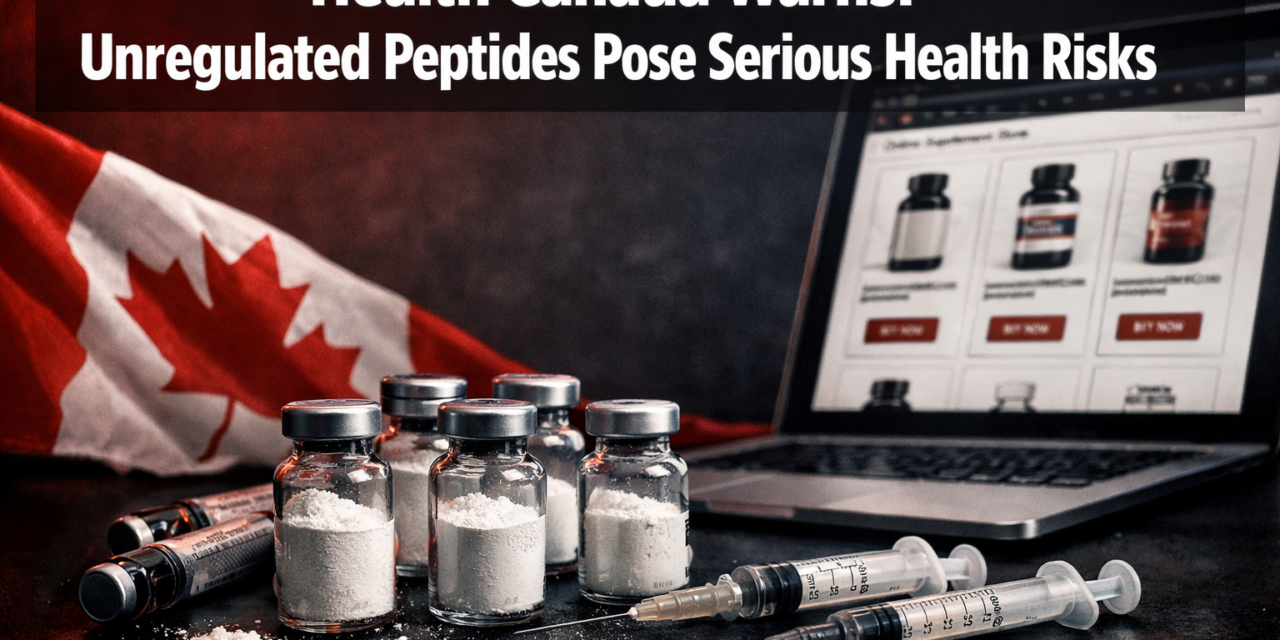
Four adverse reaction complaints in just six months — that is the alarming figure that pushed Health Canada to issue a direct public warning in early 2026, urging Canadians to “think twice before injecting peptides bought online” [1]. The products in question are not approved medications. They are unauthorized injectable peptides sold through websites, social media ads, and even promoted by influencers and some medical professionals. As the topic of Health Canada warns on unregulated peptides: what Canadians need to know about online fitness supplements and health risks dominates headlines, understanding the facts could prevent a serious — or even fatal — health outcome.
These peptides are marketed with bold promises: rapid weight loss, anti-aging benefits, sharper mental focus, and better skin. Yet none of these claims are backed by clinical evidence [1][3]. The gap between marketing hype and medical reality is wide, and Canadians are walking straight into it.
Key Takeaways 📋
- Health Canada has received 4 adverse reaction reports tied to unauthorized injectable peptides in a six-month window, triggering a formal public safety warning [1].
- Documented health risks include hormone imbalances, blood clots, liver and kidney damage, and the potential to promote tumor growth [1].
- Most online peptides are manufactured without regulatory oversight, arrive as unmarked powder labeled “for research use only,” and include no sterile supplies or instructions [1].
- These products remain illegal for sale in Canada, but enforcement is difficult, and Canadian companies continue to sell them [3].
- Safer, evidence-based alternatives exist for achieving fitness and wellness goals without risking life-threatening side effects.
What Are Peptides and Why Are Canadians Buying Them?
Peptides are short chains of amino acids — essentially small proteins — that occur naturally in the body. They play roles in hormone production, immune function, and cell signaling. In a clinical setting, certain peptides are used in approved medications under strict medical supervision.
The problem begins when unauthorized peptides are sold online as fitness and wellness supplements. These products target Canadians looking for shortcuts to:
- 🏋️ Weight loss and fat burning
- 💪 Muscle growth and athletic performance
- 🧴 Anti-aging and improved skin
- 🧠 Mental clarity and focus
- ✨ General wellness boosts
Popular unauthorized peptides include BPC-157, ipamorelin, and MOTS-c — none of which are approved for human use in Canada [2]. Despite this, slick marketing and influencer endorsements have created a booming underground market. As explored in a related discussion about the truth about trending health products like Ozempic and cancer-linked foods, consumers often trust online health claims without verifying their scientific basis.
Health Canada Warns on Unregulated Peptides: The Specific Dangers Canadians Face
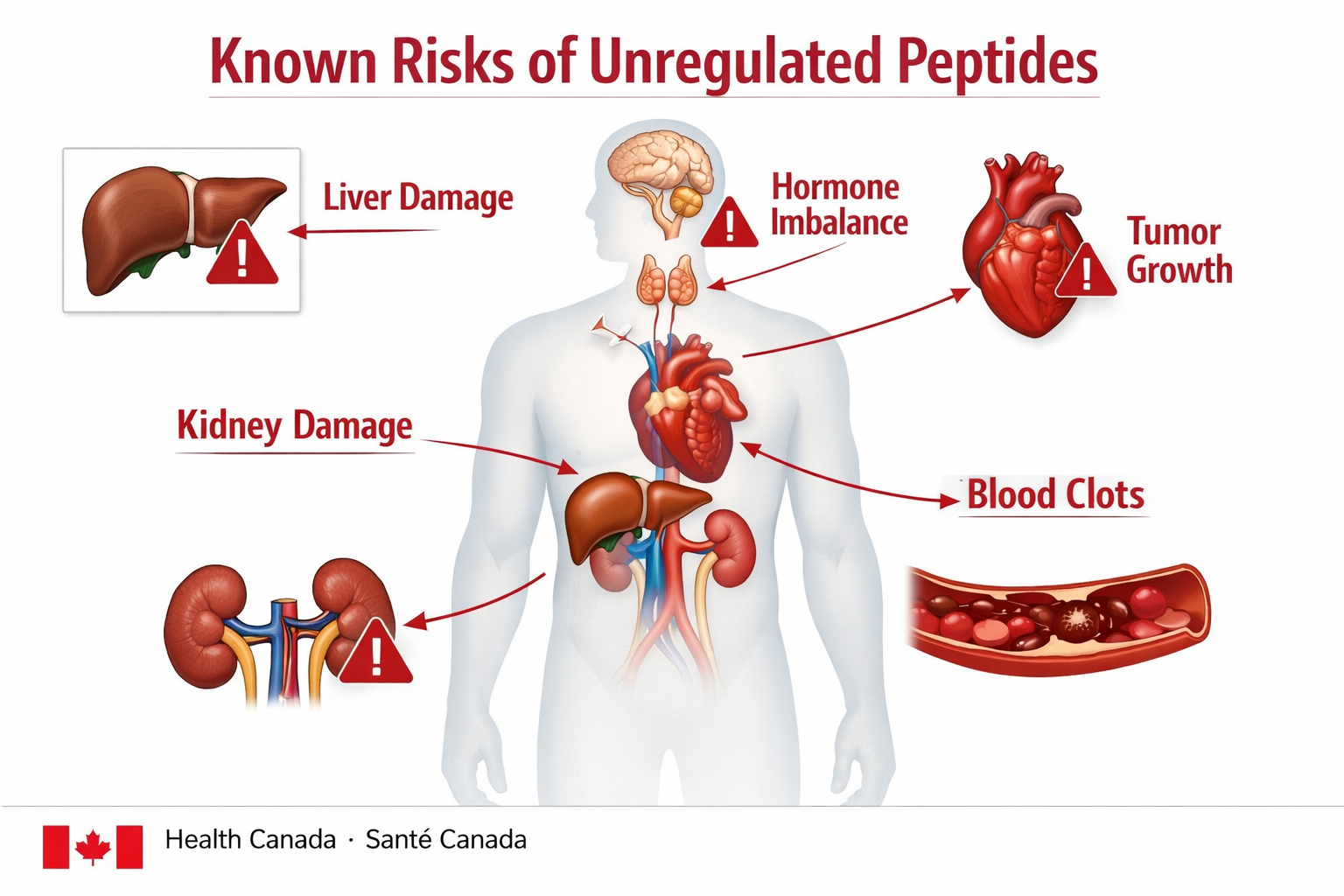
The health risks associated with unauthorized injectable peptides are not theoretical. Health Canada officials have documented specific dangers that every Canadian should understand [1][3]:
Documented Health Risks at a Glance
| Risk Category | Potential Consequences |
|---|---|
| 🔴 Hormone Imbalances | Disrupted endocrine function, mood changes, fertility issues |
| 🔴 Blood Clots | Stroke, pulmonary embolism, deep vein thrombosis |
| 🔴 Liver Damage | Hepatotoxicity, organ failure |
| 🔴 Kidney Damage | Renal stress, chronic kidney disease |
| 🔴 Tumor Growth | Promotion of existing or undetected cancers |
| 🔴 Immune Reactions | Potentially fatal allergic or autoimmune responses |
“Your body mounts an immune response to unfamiliar foreign substances. With unregulated peptides, that response can trigger potentially fatal unintended side effects across multiple body systems.” — Health Canada officials [1]
Because these peptides have not been well studied, consumers have no way of knowing how they might interact with existing medications, pre-existing conditions, or even their unique biology [1]. The risks compound when products are injected directly into the bloodstream, bypassing the body’s natural digestive safeguards.
Understanding how industries sometimes deny or downplay health risks for profit provides important context for why unregulated supplement markets thrive despite clear dangers.
How Unregulated Peptides Reach Canadian Consumers
The Supply Chain Problem
Most unauthorized peptides sold online are manufactured in compounding labs with zero regulatory oversight [1]. This means:
- ❌ No quality control — Purity and potency are impossible to verify
- ❌ No sterility guarantees — Contamination risks are real and significant
- ❌ No dosage guidance — Products arrive as powder without instructions
- ❌ No accountability — Manufacturers face minimal legal consequences
When these products arrive at a Canadian doorstep, they typically come marked “for research use only” and often include disclaimers stating they are “not for human or animal use” [1]. No sterile water, syringes, or reconstitution instructions are included. Buyers then turn to YouTube videos, Reddit threads, and social media posts for guidance on how to prepare and inject these substances.
The Influencer Pipeline
One of the most troubling aspects of this crisis is the role of paid influencers and even some medical professionals in promoting unauthorized peptides [1]. These endorsements lend an air of legitimacy to products that have never undergone clinical trials. It is a pattern similar to how online scams exploit trust and credibility to reach unsuspecting consumers.
Red Flags: How to Spot Unauthorized Peptide Products 🚩
Canadians can protect themselves by learning to recognize warning signs. Before purchasing any injectable supplement online, look for these red flags:
- “For research use only” labels — This means the product is not approved for human consumption [1]
- No Drug Identification Number (DIN) — All legal health products in Canada carry a DIN, NPN, or DIN-HM
- Sold without a prescription — Injectable peptides that require medical supervision should never be available over the counter
- Powder form without supplies — Legitimate medications include proper reconstitution materials and clear instructions
- Bold health claims without citations — Promises of rapid weight loss, anti-aging, or muscle growth with no clinical evidence [1][3]
- Promoted primarily through social media — Influencer endorsements are not medical evidence
- No Canadian company address or contact information — Legitimate sellers are transparent about their identity
💡 Quick Rule: If a product claims to do everything but comes with no prescription, no DIN, and no clinical data — walk away.
What Health Canada Is Doing About It — and Why It Is Not Enough
Health Canada has taken enforcement action. The agency has seized several unauthorized injectable peptides from the market [1]. However, the sheer volume of online sellers — including Canadian-based companies — makes comprehensive enforcement extremely difficult [3].
Current Enforcement Challenges
- Products are sold through international websites that fall outside Canadian jurisdiction
- New sellers replace seized operations almost immediately
- Social media platforms are slow to remove peptide advertisements
- Consumer demand remains high, driven by wellness culture and influencer marketing
Meanwhile, south of the border, the FDA is considering lifting restrictions on approximately 14 specific peptide treatments as of late March 2026 [2]. The U.S. Department of Health and Human Services has not provided a specific reclassification timeline, but any changes could influence the Canadian regulatory landscape. Products like BPC-157, ipamorelin, and MOTS-c are currently prohibited from being produced by compounding pharmacies in the United States [2].
This evolving regulatory picture makes it even more important for Canadians to stay informed. The story of Athletic Greens and questions about supplement industry credibility illustrates how marketing can outpace science in the wellness space.
Safer Alternatives for Fitness and Wellness Goals
The desire to look better, feel stronger, and age gracefully is completely understandable. But achieving those goals does not require injecting unregulated substances. Here are evidence-based alternatives that deliver real results without life-threatening risks:
For Weight Loss
- 🥗 Balanced nutrition with a modest caloric deficit
- 🚶 Regular physical activity — even 30 minutes of daily walking makes a measurable difference
- 👩⚕️ Consult a physician about approved weight management options
For Muscle Growth
- 🏋️ Progressive resistance training with proper programming
- 🥚 Adequate protein intake from whole food sources
- 😴 Quality sleep — recovery is where growth happens; learn more about how experts optimize sleep for peak performance
For Anti-Aging and Skin Health
- ☀️ Sun protection and consistent skincare routines
- 💧 Hydration and nutrient-dense foods
- 🧘 Stress management — chronic stress accelerates aging; consider somatic practices for stress relief
For Mental Clarity
- 🧠 Regular exercise improves cognitive function
- ☕ Moderate caffeine use — explore the surprising link between coffee and mental health
- 📵 Digital detoxes and mindfulness practices
Conclusion: Protect Yourself and Spread the Word
The message from Health Canada is clear: unauthorized injectable peptides pose real, documented dangers — from blood clots and organ damage to tumor growth and fatal immune reactions [1][3]. Despite seizures and warnings, these products continue to flood online marketplaces, fueled by influencer culture and unproven health claims.
Here are actionable steps every Canadian should take in 2026:
- ✅ Never purchase injectable supplements without a prescription from a licensed healthcare provider
- ✅ Check for a DIN, NPN, or DIN-HM on any health product before buying
- ✅ Report suspicious products to Health Canada’s online complaint form
- ✅ Talk to a doctor before starting any new supplement or wellness regimen
- ✅ Share this information with friends and family who may be tempted by online peptide ads
The pursuit of better health should never come at the cost of health itself. When it comes to Health Canada warns on unregulated peptides: what Canadians need to know about online fitness supplements and health risks, the safest path forward is one guided by science, not social media.
References
[1] Watch – https://www.youtube.com/watch?v=5BF5_pSnV_o
[2] The Government May Soon Lift Restrictions On Some Peptide Treatments – https://news.wjct.org/2026-03-26/the-government-may-soon-lift-restrictions-on-some-peptide-treatments
[3] Watch – https://www.youtube.com/watch?v=bg3SDFi1CdA
Content, illustrations, and third-party video appearing on GEORGIANBAYNEWS.COM may be generated or curated with AI assistance or reproduced pursuant to the fair dealing provisions of the Copyright Act, R.S.C. 1985, c. C-42. Attribution and hyperlinks to original sources are provided in acknowledgment of applicable intellectual property rights. Such referencing is intended to direct traffic to and support the original rights holders’ platforms.