




















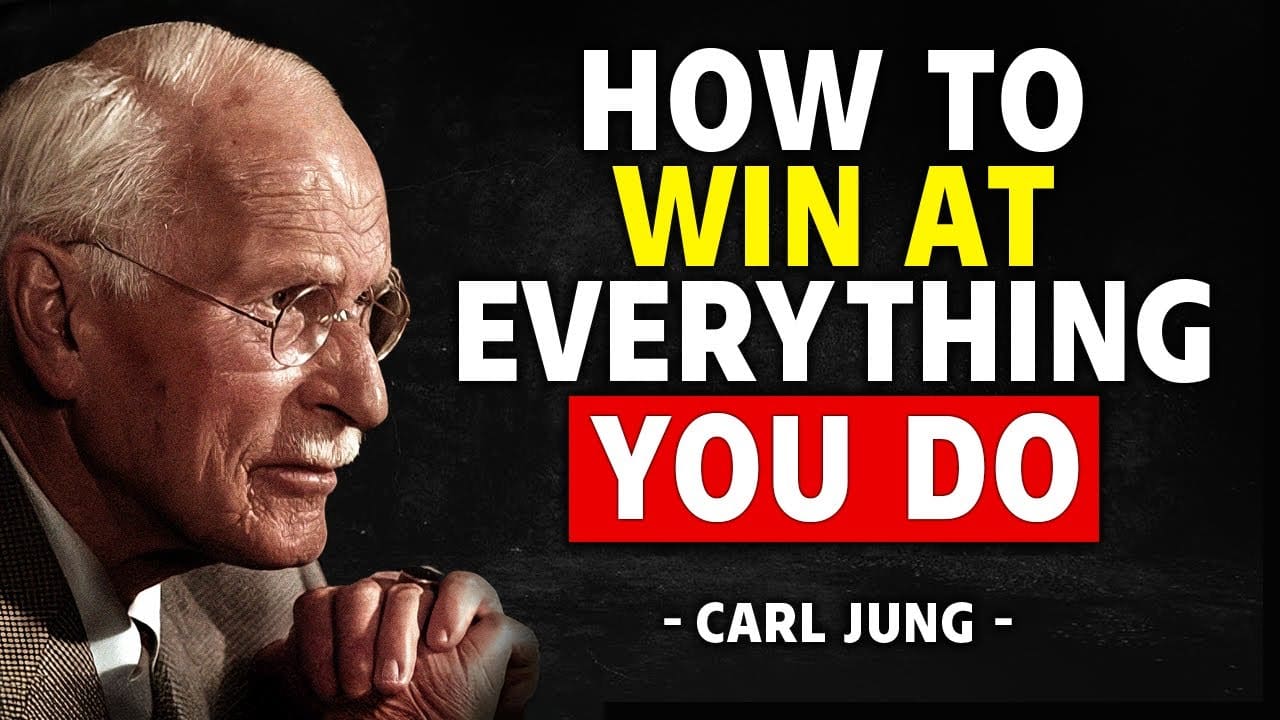
How To Win (At Everything You Do) – Carl Jung

Sharing is SO MUCH APPRECIATED!


In this video, we explore Carl Jung’s powerful principles for winning in every area of life, not through force, luck, or competition, but through inner alignment.
You’ll discover how mastering your emotions, activating the right archetype at the right moment, and letting the Self lead can transform the way you work, think, and respond to challenges.
These lessons will teach you to stop operating from ego, make clearer decisions, conserve your energy, and move with a grounded confidence that naturally attracts success. By the end, you’ll understand how to win without chasing, achieve without burning out, and step into a version of yourself whose presence creates results long before effort even begins. The Shadow Work
Carl Gustav Jung (1875–1961)
Carl Gustav Jung was born on July 26, 1875, in Kesswil, in the Swiss canton of Thurgau, the first surviving son of Paul Achilles Jung, a rural pastor in the Swiss Reformed Church, and Emilie Jung. Wikipedia A quiet and observant child, Jung carried a certain loneliness in his early years. Biography His family background was deeply religious — his maternal grandfather, Samuel Preiswerk, was the dean of the Basel clergy and pastor of a major church, and was among the first in Europe to advocate for the restoration of Palestine to the Jewish people. Social Sci LibreTexts These ecclesiastical roots both shaped and ultimately drove Jung away from the path everyone expected of him.
As was expected of him given his father’s vocation and many male relatives, Jung was assumed to enter the clergy. Instead, he read philosophy extensively in his teens, then attended the University of Basel, where he explored biology, paleontology, religion, and archaeology before settling on medicine. Biography He graduated from the University of Basel in 1900 and earned his M.D. two years later from the University of Zurich. Biography This broad intellectual curiosity would define his entire career.
Jung worked as a research scientist at the Burghölzli psychiatric hospital in Zurich, under the pioneering psychiatrist Eugen Bleuler. Wikipedia At the hospital, he observed how different words elicited emotional responses from patients, which he believed represented subconscious associations. These observations led him to develop the term “complex” to describe such emotionally charged conditions. Biography His work there earned him a growing reputation across Europe.
After encountering Sigmund Freud’s work, Jung entered into an uneasy but productive collaboration with the older psychologist. They worked together to popularize psychoanalysis during its difficult early years, when the radical new understanding of the mind was meeting considerable opposition. The SAP Jung became Freud’s hand-picked heir to the psychoanalytic throne and was one of the psychiatrists who accompanied Freud on his famous visit to America. Social Sci LibreTexts
Jung was openly acknowledged as heir apparent to Freud’s legacy until the differences in their theoretical positions and personalities became impossible to ignore, and they split irreconcilably in 1913. The SAP Jung challenged Freud’s belief that sexuality was the foundation of neurosis, and also disagreed with his methods, asserting that Freud’s work was too one-sided. Biography The break proved to be a personal crisis for Jung, but ultimately a creatively transformative one.
The rupture with Freud propelled Jung into a period of intense self-exploration and discovery, from which he emerged having developed the concepts that would become the cornerstones of analytical psychology. The SAP Among the most significant of these were the concepts of synchronicity, archetypal phenomena, the collective unconscious, the psychological complex, and extraversion and introversion. Wikipedia These ideas would ripple far beyond clinical psychiatry.
Jung traveled extensively throughout his life, including trips to Africa, India, and the United States — particularly to visit the Pueblo Indians in New Mexico — and he studied the cultures he encountered in depth. Social Sci LibreTexts His work proved influential across psychiatry, anthropology, archaeology, literature, philosophy, and religious studies. Wikipedia He was among the first psychologists to seriously engage with Eastern philosophy, mythology, and alchemy as windows into the human psyche.
Jung’s treatment of American businessman Rowland Hazard in 1926, and his conviction that alcoholics might recover through a vital spiritual or religious experience, played a crucial role in the chain of events that led to the founding of Alcoholics Anonymous. Wikipedia His legacy has been complicated by controversy, including his relationships with women and allegations of anti-Semitism during the war years, which have been extensively discussed by scholars. The SAP His personal life was richly documented in his memoir Memories, Dreams, Reflections, dictated near the end of his life.
Carl Jung died at home in Küsnacht, Switzerland, in 1961, at the age of 85. Social Sci LibreTexts His legacy lives on across the world, where his ideas remain part of society’s collective thinking. The SAP Concepts he introduced — archetypes, the shadow, introversion and extroversion, the collective unconscious — have entered everyday language and continue to shape psychology, literature, art, and spirituality. More information on his life and work can be found at the C.G. Jung Institute and on his comprehensive Wikipedia entry.
Sharing is SO MUCH APPRECIATED!