




















Iran War Fuel Crisis Hits Canadian Air Travel: Cancellations, Skyrocketing Fares, and Summer Trip Contingency Plans
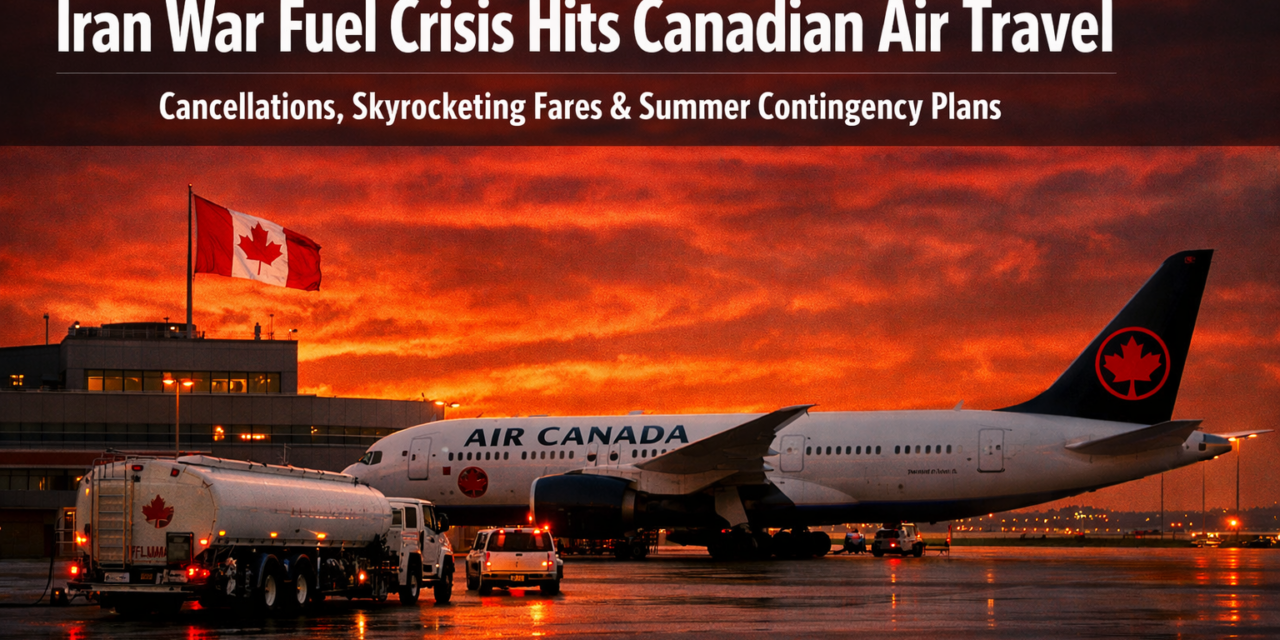
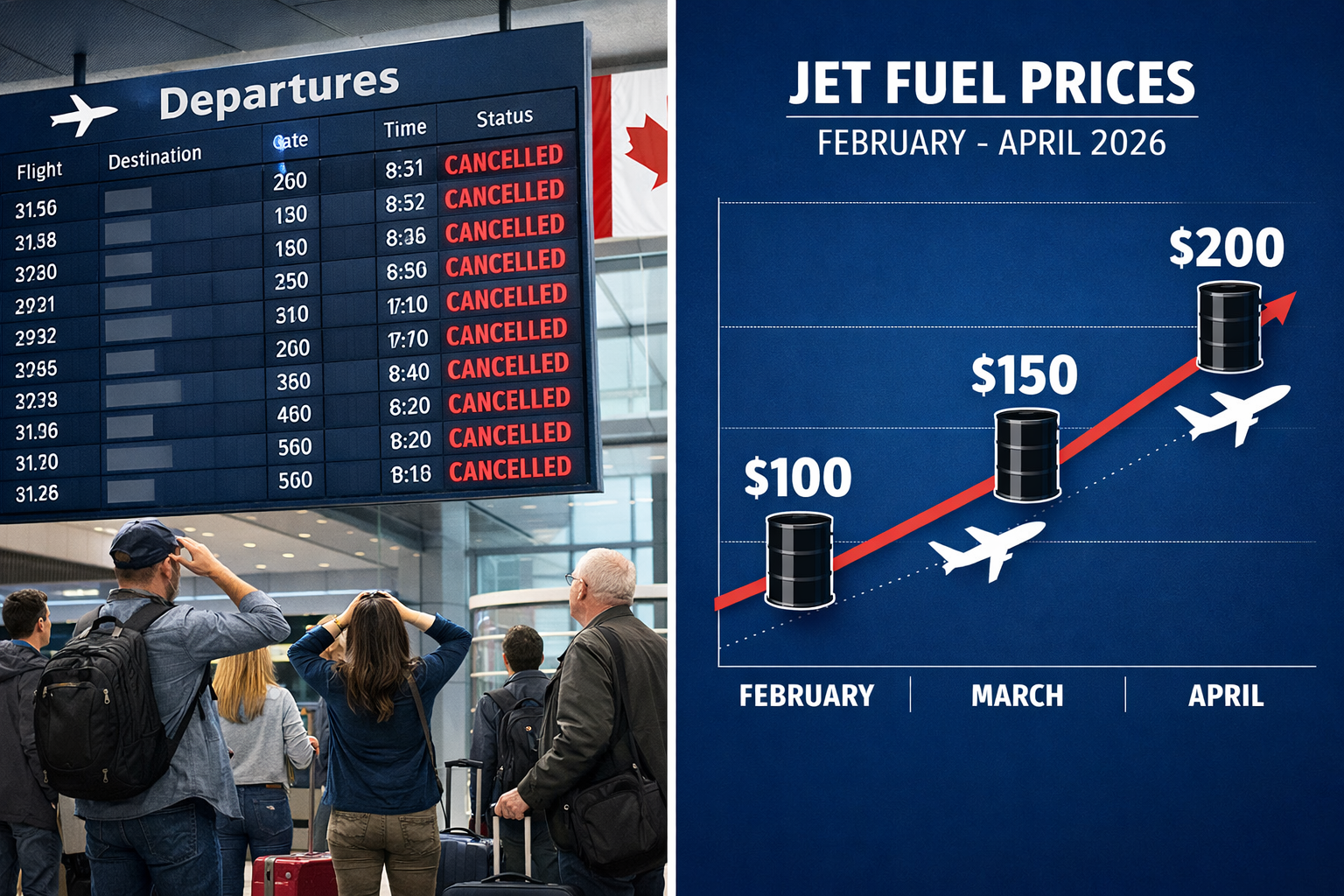
Jet fuel prices have doubled in less than two months, soaring from roughly $100 to approximately $200 per barrel since late February 2026 [3]. For millions of Canadians who booked summer vacations months ago, that single statistic now threatens to upend every flight, every itinerary, and every budget. The Iran war fuel crisis hits Canadian air travel hard—bringing cancellations, skyrocketing fares, and summer trip contingency plans to the forefront of every traveller’s mind. With Air Canada suspending routes, Air Transat slashing roughly 1,000 flights, and WestJet layering on fuel surcharges, the 2026 travel season is shaping up to be the most disrupted in recent memory [1][2].
Understanding what happened, which carriers are affected, and what alternatives remain is no longer optional—it is essential for anyone holding a boarding pass this summer.
Key Takeaways
- ✈️ Jet fuel prices have roughly doubled since late February, reaching ~$200/barrel by mid-April 2026 [3][4].
- 🚫 Air Canada is suspending six routes starting late May, including key U.S.–Canada connections through at least late 2026 [1].
- 📉 Air Transat is cutting ~1,000 flights this summer, primarily on short-haul routes [2].
- 💰 Fare hikes of 40–50% are already being passed to passengers, with full cost pass-through expected by year-end [1].
- 🗺️ Domestic alternatives—road trips, rail travel, and regional destinations—offer Canadians viable summer contingency plans.
How the Iran War Fuel Crisis Hits Canadian Air Travel: Cancellations, Skyrocketing Fares, and Summer Trip Contingency Plans Explained
The Strait of Hormuz Bottleneck
The root cause is geopolitical. The ongoing conflict involving Iran has led to the effective closure of the Strait of Hormuz, a narrow waterway through which 20–30% of the world’s oil trade normally flows [5][1]. With that shipping lane blocked, massive volumes of crude oil remain trapped in Middle Eastern storage facilities, choking global fuel supply chains.
The ripple effects reached aviation almost immediately. As broader fossil fuel markets tightened—a dynamic explored in depth in reporting on how gas fuels the climate problem—jet fuel became one of the hardest-hit commodities because airlines cannot easily substitute alternative energy sources.
The Numbers Behind the Crisis
| Metric | Before Crisis (Feb 2026) | Current (Mid-Apr 2026) |
|---|---|---|
| Jet fuel price (per barrel) | ~$100 | ~$200 [3] |
| Brent crude oil | Below $80 | Exceeded $100 in early March [3] |
| Global airline capacity outlook | +4% to +6% growth | Up to −3% decline [3] |
| Airlines cutting flights (top 20) | 0 | 19 of 20 [3] |
The International Energy Agency warned on April 16 that Europe has roughly six weeks of jet fuel remaining [3]. If conditions persist, cancellations could accelerate dramatically by late May—right as Canadian summer travel peaks.
Which Canadian Airlines Are Affected—and How?
Air Canada
Air Canada announced the suspension of six routes beginning in late May and June 2026 [1]:
- Salt Lake City → Toronto: Suspended from end of June through sometime in 2027.
- New York JFK → Toronto: Suspended June 1 – October 25.
- New York JFK → Montreal: Suspended June 1 – October 25.
- Additional routes yet to be confirmed.
These cuts target connections where demand is lower or where alternative routing exists. However, travellers booked on these specific flights face rebooking headaches and potential fare increases on remaining options.
Air Transat
Air Transat is making the most aggressive cuts among Canadian carriers, eliminating approximately 1,000 flights throughout summer 2026 [2]. The reductions focus primarily on short-haul routes, which are less profitable per seat-mile when fuel costs spike. Affected routes will see reduced service through October.
WestJet and Sunwing
Both WestJet and Sunwing have implemented fuel surcharges on existing bookings and new tickets [2]. WestJet is also progressively cutting flights month-to-month, meaning the schedule travellers see today may shrink further by July or August.
💡 Pro Tip: Check your airline’s website weekly. Route suspensions are being announced on rolling timelines, and early awareness gives travellers more rebooking options.
Fare Increases: How Much More Will Canadians Pay?
United Airlines CEO Scott Kirby stated publicly that the carrier is already passing 40–50% of fuel cost increases directly to passengers, with plans to reach 100% pass-through by year-end [1]. Canadian carriers are following a similar trajectory.
Here is what that means in practical terms:
- A domestic Canadian flight that cost $350 round-trip in January could now cost $500–$525.
- Transatlantic flights are seeing even steeper increases due to longer fuel burn times.
- Last-minute bookings—already expensive—are becoming prohibitively costly on high-demand routes.
Global Context
This is not a Canada-only problem. Nineteen of the world’s 20 largest airlines cut flights in May 2026 [3]. Lufthansa Group alone is reducing 20,000 flights across six European hubs through October, saving an estimated 40,000 metric tons of jet fuel [1]. The crisis is truly global, and Canadian travellers competing for seats on international routes face worldwide demand pressure.
For those feeling the financial squeeze, understanding how broader energy markets shape everyday costs is critical. Resources like this deep dive into the truth about fossil fuels provide valuable context.
Your Rights as a Canadian Air Traveller
When airlines cancel flights due to external factors like fuel shortages, passenger rights become complicated. Under Canada’s Air Passenger Protection Regulations (APPR), the key question is whether a disruption is within or outside the airline’s control.
What travellers should know:
- ✅ Airlines must offer rebooking on the next available flight or a refund if the cancellation is within their control.
- ⚠️ Fuel shortages caused by geopolitical conflict may be classified as outside the airline’s control, potentially limiting compensation [4].
- ✅ Regardless of cause, airlines must still provide rebooking or refund options for cancelled flights.
- 📝 Document everything—keep confirmation emails, cancellation notices, and receipts for expenses incurred.
🔑 “Even when disruptions are classified as extraordinary circumstances, passengers retain the right to a refund or rebooking.” — AirHelp [4]
Summer Trip Contingency Plans for Canadians
With international and cross-border flights increasingly unreliable, smart contingency planning is essential. Here are actionable alternatives:
1. Explore Domestic Destinations 🇨🇦
Canada offers world-class summer experiences that do not require a plane ticket. Georgian Bay, the Rockies, the Maritimes, and countless provincial parks are accessible by car or rail. Local communities like Collingwood are hosting vibrant summer events—from live concert series to music festivals at scenic retreats.
2. Consider Rail and Road Travel 🚗🚂
VIA Rail and regional bus services remain unaffected by jet fuel prices. Road trips, while subject to higher gasoline costs, still offer significantly more price stability than air travel. Stay informed about transit and transportation updates in your area.
3. Book Flexible Fares
If flying is unavoidable, always choose refundable or flexible fare classes. The small premium now could save hundreds if your flight is cancelled later.
4. Travel Insurance Is Non-Negotiable
Purchase comprehensive travel insurance that explicitly covers trip cancellation due to fuel shortages or geopolitical events. Read the fine print carefully.
5. Shift Travel Dates
Airlines are cutting most aggressively in June through August. Shoulder-season travel in September or October may offer better availability and lower fares—if the crisis eases.
6. Prioritize Wellness Over Stress
Travel disruptions take a mental toll. Whether plans change or not, finding calm through breathing techniques and spending restorative time in nature can help manage the anxiety that comes with uncertainty.
What Happens Next? Watching the Ceasefire Talks
There is cautious optimism. Brent crude oil prices dipped below $100 per barrel in April as ceasefire negotiations gained traction [3]. If a diplomatic resolution reopens the Strait of Hormuz, fuel supplies could normalize within weeks—though airline schedules would take longer to recover.
However, industry analysts warn that even a best-case scenario leaves summer 2026 deeply disrupted. Airlines cannot reinstate cancelled routes overnight, and the financial damage from months of elevated fuel costs will keep fares high well into autumn.
Conclusion
The Iran war fuel crisis hits Canadian air travel at the worst possible time—just as millions of families finalize summer plans. With jet fuel prices doubled, major carriers slashing routes, and fares climbing by 40–50% or more, the 2026 travel landscape demands flexibility, preparation, and realistic expectations.
Here are the most important next steps for Canadian travellers:
- Check your bookings now. Verify whether your flights are on routes being suspended or reduced.
- Understand your rights. Know what refunds and rebooking options your airline must provide.
- Build a Plan B. Identify domestic alternatives, flexible dates, and ground transportation options.
- Buy travel insurance that covers geopolitical disruptions.
- Monitor developments weekly. Ceasefire talks could shift the outlook rapidly.
Summer 2026 will not look like the season Canadians planned—but with the right contingency strategy, it can still be memorable for the right reasons. 🍁
References
[1] Airlines Begin Cutting Flights As Iran War Energy Supply Shocks Worsen United States Iran Conflict Canada Shutdown – https://wjla.com/news/nation-world/airlines-begin-cutting-flights-as-iran-war-energy-supply-shocks-worsen-united-states-iran-conflict-canada-shutdown
[2] Watch – https://www.youtube.com/watch?v=_D3M1_jRcFs
[3] Airlines Cancel Flights Rising Jet Fuel Prices Shortage Iran 2026 4 – https://www.businessinsider.com/airlines-cancel-flights-rising-jet-fuel-prices-shortage-iran-2026-4
[4] Jet Fuel Shortage What It Means For Your Flight And Your Rights – https://www.airhelp.com/en-int/blog/jet-fuel-shortage-what-it-means-for-your-flight-and-your-rights/
[5] 2026 Iran War Fuel Crisis – https://en.wikipedia.org/wiki/2026_Iran_war_fuel_crisis
Content, illustrations, and third-party video appearing on GEORGIANBAYNEWS.COM may be generated or curated with AI assistance or reproduced pursuant to the fair dealing provisions of the Copyright Act, R.S.C. 1985, c. C-42. Attribution and hyperlinks to original sources are provided in acknowledgment of applicable intellectual property rights. Such referencing is intended to direct traffic to and support the original rights holders’ platforms.