


















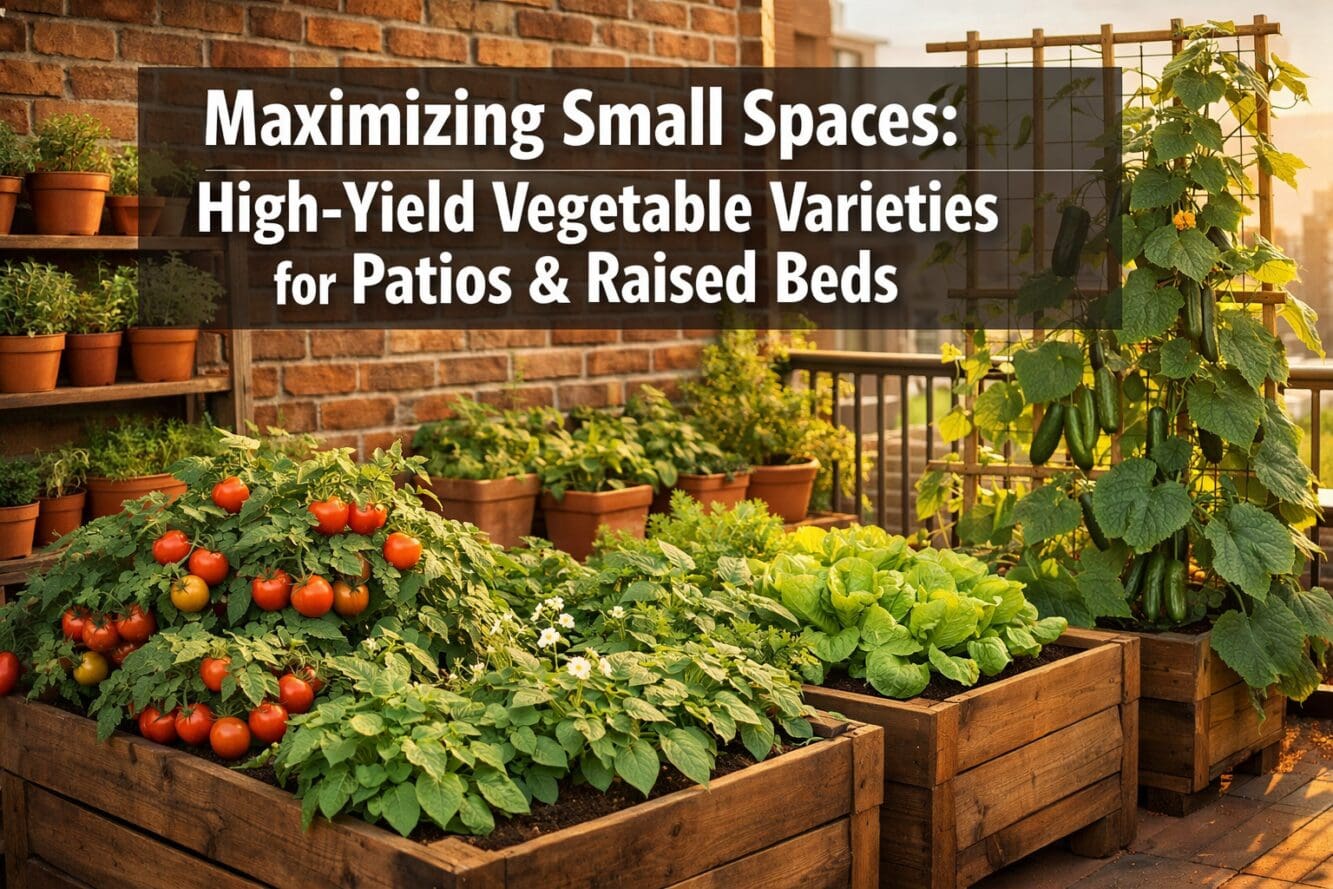
Maximizing Small Spaces: High-Yield Vegetable Varieties and Layout Strategies for Patios and Raised Beds

Last updated: February 27, 2026
Limited square footage does not mean limited harvests. Maximizing small spaces with high-yield vegetable varieties and layout strategies for patios and raised beds is one of the most practical approaches Canadian urban gardeners can take in 2026, whether working with a 4×8-foot raised bed, a condo balcony, or a narrow side yard. The right combination of compact cultivars and smart spatial design can produce surprising volumes of fresh food from areas most people would dismiss as too small.
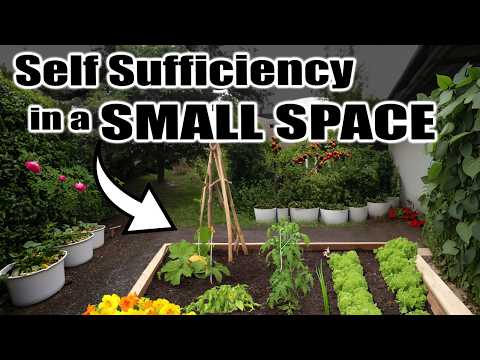
This guide covers specific varieties that perform well in tight quarters, layout methods that squeeze more production from every square foot, and the common mistakes that waste space in small gardens.
Key Takeaways
- Bush and dwarf varieties of beans, tomatoes, cucumbers, and peppers produce full-sized harvests in half the footprint of standard plants.
- Vertical growing (trellises, stacking planters, wall-mounted systems) is the single most effective way to increase yield per square foot [1][3].
- Square foot gardening and interplanting reduce wasted soil and keep beds productive all season.
- Microclimate assessment of sun, shade, and moisture patterns on a patio or yard should happen before any planting [3].
- Hydro-zoning (grouping plants by water and sun needs) cuts waste and improves plant health in compact setups [3].
- Succession planting of fast crops like lettuce extends the harvest window by weeks.
- Tabletop and container gardens offer mobility, letting gardeners chase sunlight or dodge extreme weather [3].
- Drip irrigation with mulch can reduce water loss significantly in raised beds and containers [3].
Quick Answer
A small patio or raised bed can yield enough vegetables for regular meals when planted with compact, high-producing varieties like Patio Choice Yellow Hybrid Tomato, Blue Lake 274 Bush Bean, and Marketmore 76 Cucumber, and arranged using vertical growing, square foot spacing, and succession planting. The key is choosing cultivars bred for small footprints and pairing them with layout strategies that eliminate dead space.
Which Vegetable Varieties Produce the Most in Small Spaces?
The highest yields in compact gardens come from varieties specifically bred for short, bushy growth habits that still set heavy fruit. Here are the top performers for patios and raised beds in 2026:
Tomatoes
- Patio Choice Yellow Hybrid Tomato: A true container variety that stays compact while producing clusters of sweet yellow fruit. Ideal for pots as small as 5 gallons [2][3].
- Heatmaster Tomato: Bred for heat tolerance, which matters for south-facing patios and raised beds that absorb and radiate warmth. Maintains productivity when temperatures spike [2][3].
Beans
- Blue Lake 274 Bush Bean: One of the most reliable compact producers. Unlike pole beans, bush types don’t need tall supports and deliver heavy harvests over a concentrated period, making them perfect for small raised beds [2].
Peppers
- California Wonder Bell Pepper: A compact plant that produces full-sized bells. Works well in containers (minimum 3-gallon pot) and raised bed corners [2][3].
Cucumbers
- Marketmore 76 Slicing Cucumber: Can be grown vertically on a small trellis, keeping the footprint to about one square foot of bed space while vining upward [2][3].
- Bush cucumber varieties: Stay contained without trellising, though yields are slightly lower than trellised vining types.
Leafy Greens
- Black-Seeded Simpson Lettuce: Fast-growing, cut-and-come-again variety that thrives in partial shade, making it useful for spots that don’t get full sun [2]. Plant every two weeks for continuous harvest.
Herbs and Companion Plants
- Genovese Basil and Sweet Basil: Compact, productive, and useful as companion plants near tomatoes [2].
- PowWow Wild Berry Echinacea Coneflower: Supports pollinators in small gardens, which directly improves fruit set on tomatoes, peppers, and cucumbers [2].

| Variety | Type | Space Needed | Container Friendly? | Key Benefit |
|---|---|---|---|---|
| Patio Choice Yellow Tomato | Determinate tomato | 1–2 sq ft | Yes (5-gal pot) | Compact, heavy producer |
| Blue Lake 274 Bush Bean | Bush bean | 1 sq ft per 4 plants | Yes (wide pot) | No staking needed |
| California Wonder Pepper | Bell pepper | 1 sq ft | Yes (3-gal pot) | Full-sized fruit |
| Marketmore 76 Cucumber | Vining cucumber | 1 sq ft + trellis | Yes (with support) | Vertical growing |
| Black-Seeded Simpson | Leaf lettuce | 0.5 sq ft | Yes (shallow pot) | Shade tolerant |
| Black Beauty Zucchini | Summer squash | 2–3 sq ft | Possible (large pot) | Very high yield |
Common mistake: Choosing indeterminate tomato varieties for small spaces. These can grow 6–8 feet tall and wide, overwhelming a compact bed. Stick with determinate or dwarf types unless vertical space is abundant.
How Should a Small Raised Bed Be Laid Out for Maximum Yield?
The most productive small-bed layout combines square foot spacing, vertical elements, and strategic plant placement based on height and sun exposure.
Square Foot Gardening Basics
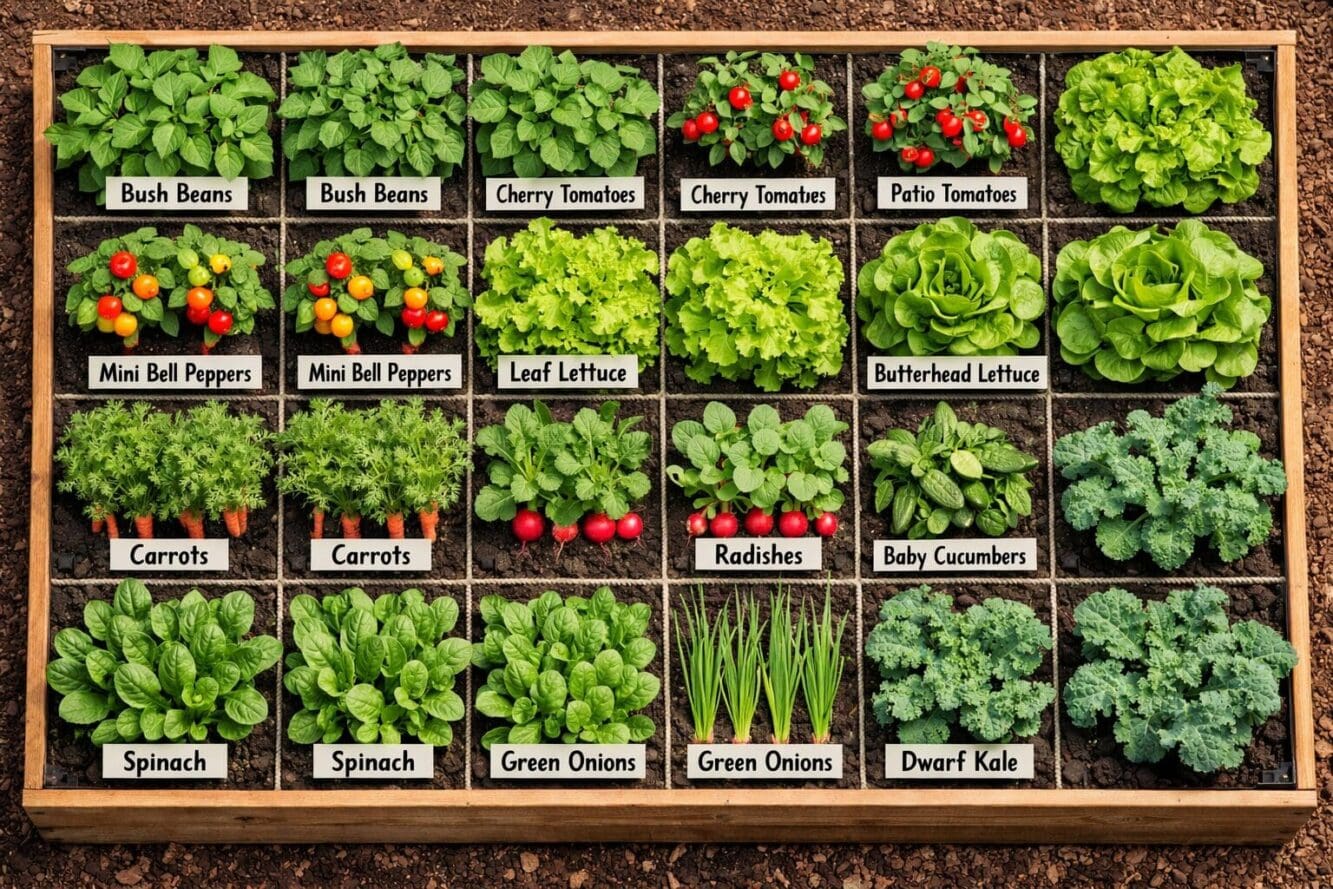
Divide the bed into a grid of 1-foot squares. Each square gets a specific number of plants based on mature size:
- 1 plant per square: Tomatoes, peppers, zucchini
- 4 plants per square: Lettuce, basil
- 9 plants per square: Bush beans, spinach
- 16 plants per square: Radishes, green onions
This eliminates row spacing (which wastes 50% or more of bed area in traditional layouts) and keeps every inch productive.
Height Zoning
Place tall plants (tomatoes, trellised cucumbers) on the north side of the bed so they don’t shade shorter crops. Medium plants (peppers, bush beans) go in the middle. Low growers (lettuce, herbs) go on the south-facing edge where they’ll get direct light.
Succession Planting
When a fast crop like lettuce or radishes finishes, immediately replant that square. A single square foot can produce three or four harvests of quick crops in a Canadian growing season (roughly May through September, depending on zone).
Choose square foot gardening if the bed is 4×4 or 4×8 feet. For beds smaller than 3×3, container-style planting with individual pots may be more practical.
For those interested in community garden programs and local growing initiatives, these same layout principles apply to shared plots.
Why Is Vertical Growing So Important for Patios and Raised Beds?
Vertical growing is the single highest-impact strategy for maximizing small spaces with high-yield vegetable varieties and layout strategies for patios and raised beds. Growing upward instead of outward can double or triple the effective growing area of a small footprint [1][3].
Practical Vertical Methods
- A-frame trellises: Fit over a raised bed, supporting cucumbers, peas, or small melons on both sides.
- Wall-mounted planters: Attach to fences or building walls for herbs, strawberries, and lettuce.
- Stacking planters and tiered shelving: Allow multiple levels of containers on a patio, each getting adequate light.
- String or netting supports: Simple and cheap. Run twine from the bed frame to an overhead structure for beans and cucumbers.
What Grows Well Vertically?
Cucumbers, pole beans, peas, small melons, and vining tomatoes all perform well on vertical supports. Avoid trying to grow heavy crops like full-sized watermelons vertically unless the support structure is very sturdy and fruits are individually supported with slings.
Edge case: North-facing patios with limited direct sun. Vertical structures here can actually reduce light to lower plants. In shaded situations, keep vertical elements minimal and focus on shade-tolerant crops like lettuce and herbs.
How Do Container and Tabletop Gardens Fit Into Small-Space Growing?
Container and tabletop gardens are among the biggest trends in 2026 gardening because they offer flexibility that fixed beds cannot [3]. A container garden can be rearranged to follow seasonal sun patterns, moved indoors during unexpected frost, or relocated entirely if conditions change.
Container Sizing Guide
- 5-gallon containers: Tomatoes, peppers, eggplants
- 3-gallon containers: Bush beans, herbs, small peppers
- 1–2 gallon containers: Lettuce, radishes, green onions
- Window boxes: Herbs, microgreens, small lettuce varieties
Tabletop gardens, which sit on raised surfaces at waist height, also reduce physical strain and can be placed on apartment balconies, rooftop patios, or driveways [3]. They’re especially practical for Canadian gardeners dealing with short growing seasons, since containers warm up faster in spring than in-ground soil.
Decision rule: Choose containers over raised beds if the growing space is a hard surface (concrete patio, balcony) or if mobility matters. Choose raised beds if there’s access to ground soil and the garden will stay in one location.
Gardeners exploring sustainable development practices will find that container growing aligns well with resource-efficient food production.
What Is Microclimate Assessment and Why Does It Matter?
Before planting anything, map the microclimates of the available space. This means tracking where sunlight falls at different times of day, which spots are sheltered from wind, and where water tends to pool or drain quickly [3].
How to Assess Microclimates
- Track sunlight: Note which areas get 6+ hours of direct sun (full sun), 3–6 hours (partial sun), or less than 3 hours (shade). Do this over several days.
- Check wind exposure: Patios near building corners or open balconies often have strong wind channels that dry out soil and stress plants.
- Observe drainage: Raised beds drain faster than ground-level containers. Patio surfaces can create heat reflection that dries containers from below.
Place heat-loving crops (tomatoes, peppers, eggplants) in the warmest, sunniest spots. Put lettuce and herbs in areas that get afternoon shade, which prevents bolting during summer heat.
Those curious about how environmental factors affect growing conditions can apply similar thinking to garden microclimate planning.
How Does Hydro-Zoning Improve Small Garden Efficiency?
Hydro-zoning means grouping plants with similar water and sunlight needs together so that irrigation is efficient and no plant gets too much or too little water [3]. In a small garden, this is especially important because overwatering one plant often means the neighbor gets soaked too.
Practical Hydro-Zoning Groups
- High water, full sun: Tomatoes, cucumbers, zucchini
- Moderate water, full sun: Peppers, beans, eggplants
- Low water, partial shade: Most herbs (basil is an exception; it likes more water), lettuce in hot weather
In a raised bed, place the thirstiest plants together on one end and run drip irrigation with emitters spaced accordingly. Drip systems paired with 2–4 inches of organic mulch can reduce water evaporation significantly compared to overhead watering [3].
Common mistake: Mixing drought-tolerant herbs like rosemary and thyme in the same container or bed section as water-hungry tomatoes. The herbs develop root rot while the tomatoes stay thirsty.
What Are the Biggest Mistakes When Maximizing Small Spaces with High-Yield Vegetable Varieties and Layout Strategies for Patios and Raised Beds?
Most small-garden failures come from a few predictable errors:
- Overcrowding: Planting too densely reduces airflow, increases disease, and actually lowers total yield. Follow recommended spacing even when it feels wasteful.
- Ignoring soil quality: Small containers and raised beds deplete nutrients faster than in-ground gardens. Refresh soil with compost each season and use a balanced fertilizer during the growing period.
- Choosing full-sized varieties: A single indeterminate tomato can consume an entire 4×4 bed. Always check the mature size before buying transplants or seeds.
- Skipping pollinator support: Without pollinators, fruiting crops like tomatoes, peppers, and cucumbers produce poorly. Include at least one flowering plant like echinacea or marigolds [2].
- Neglecting succession planting: Harvesting a crop and leaving the space empty wastes weeks of growing time.
- Poor drainage in containers: Containers without drainage holes cause root rot quickly. Always drill holes if they’re not present.
For insights into how local communities support environmental awareness and sustainable practices, consider connecting with regional gardening groups.
Step-by-Step Checklist: Setting Up a High-Yield Small Garden
- Assess the space: Map sunlight, wind, and drainage patterns over 3–5 days.
- Choose the format: Raised bed, containers, or a combination based on surface type and mobility needs.
- Select compact varieties: Prioritize bush, dwarf, and determinate cultivars.
- Plan the layout: Use square foot spacing, height zoning (tall plants north, short plants south), and vertical elements.
- Group by water needs: Apply hydro-zoning principles.
- Install efficient irrigation: Drip lines or self-watering containers, plus mulch.
- Add pollinator plants: At least one flowering species per bed or patio grouping.
- Schedule succession plantings: Mark calendar dates for replanting fast crops every 2–3 weeks.
- Monitor and adjust: Check soil moisture daily in containers (they dry out fast), and watch for overcrowding as plants mature.
FAQ
How much food can a 4×8 raised bed produce?
A well-planned 4×8 raised bed using square foot gardening methods can produce enough salad greens, tomatoes, peppers, and herbs for regular meals for one to two people throughout the growing season. Exact yields depend on variety selection and climate zone.
Can tomatoes grow in 5-gallon buckets?
Yes. Determinate and dwarf varieties like Patio Choice Yellow Hybrid perform well in 5-gallon containers with good drainage and consistent watering [2].
What vegetables grow best in shade?
Lettuce, spinach, kale, and most herbs tolerate partial shade (3–4 hours of direct sun). Fruiting crops like tomatoes and peppers need a minimum of 6 hours of direct sunlight.
Is square foot gardening better than row gardening for small spaces?
For spaces under 100 square feet, square foot gardening is significantly more space-efficient because it eliminates walking rows and uses intensive spacing.
How often should raised bed soil be replaced?
Full replacement isn’t usually necessary. Top-dress with 2–3 inches of compost each spring and add balanced fertilizer during the growing season. Replace soil entirely only if disease problems persist.
Do I need to hand-pollinate in a patio garden?
On enclosed balconies or patios with very low insect traffic, hand-pollinating tomatoes and peppers (by gently shaking flower clusters or using a small brush) can improve fruit set. Open patios with nearby flowering plants usually attract enough pollinators [2].
What’s the minimum sun for a vegetable garden?
Most fruiting vegetables need 6–8 hours of direct sun. Leafy greens and herbs can manage with 3–4 hours. Fewer than 3 hours limits options to microgreens and some shade-tolerant herbs.
How deep should a raised bed be for vegetables?
A minimum of 6 inches for lettuce and herbs, 12 inches for most vegetables, and 18 inches for root crops like carrots. Deeper beds also retain moisture longer.
Can dwarf fruit trees grow on a patio?
Yes. Dwarf apple, citrus, and fig trees can be grown in large containers (15–25 gallons) on patios with adequate sunlight [1][3]. In Canadian climates, most need winter protection or indoor storage.
What is the best mulch for raised beds?
Straw, shredded leaves, or untreated wood chips work well. Apply 2–4 inches to reduce evaporation and suppress weeds [3].
Conclusion
Maximizing small spaces with high-yield vegetable varieties and layout strategies for patios and raised beds comes down to three things: choosing the right compact varieties, using every dimension of the available space (including vertical), and managing water and sunlight with precision.
Start by assessing the specific conditions of the growing area. Pick two or three proven compact varieties from the list above. Use square foot spacing and add at least one vertical element. Group plants by water needs, and plan succession plantings so the garden stays productive from spring through fall.
Canadian urban gardeners working with even a few square feet of patio or a single raised bed can produce meaningful harvests with this approach. The constraint isn’t space; it’s planning. And with the right plan, a small garden performs far beyond its footprint.
For more on how communities are engaging with local food and garden programs, explore nearby initiatives that support urban growers. Those interested in eggplant varieties and other warm-season crops for small spaces will find additional variety recommendations there.
References
[1] Gardening Trends 2026 – https://dennis7dees.com/gardening-trends-2026/
[2] What Gardeners Are Growing Next 2026 Trends To Know – https://seedsnsuch.com/blogs/gardeners-greenroom/what-gardeners-are-growing-next-2026-trends-to-know
[3] How To Design A Climate Resilient Vegetable Garden In 2026 – https://vegplotter.com/blog/how-to-design-a-climate-resilient-vegetable-garden-in-2026
Content, illustrations, and third-party video appearing on GEORGIANBAYNEWS.COM may be generated or curated with AI assistance or reproduced pursuant to the fair dealing provisions of the Copyright Act, R.S.C. 1985, c. C-42. Attribution and hyperlinks to original sources are provided in acknowledgment of applicable intellectual property rights. Such referencing is intended to direct traffic to and support the original rights holders’ platforms.
Much Appreciate You Sharing This Post - It Helps MUCH!!!