


















Ontario Student Assistance Cuts Spark Protests: Ford Government’s OSAP Reforms and Debt Impacts Explained
Last updated: March 6, 2026
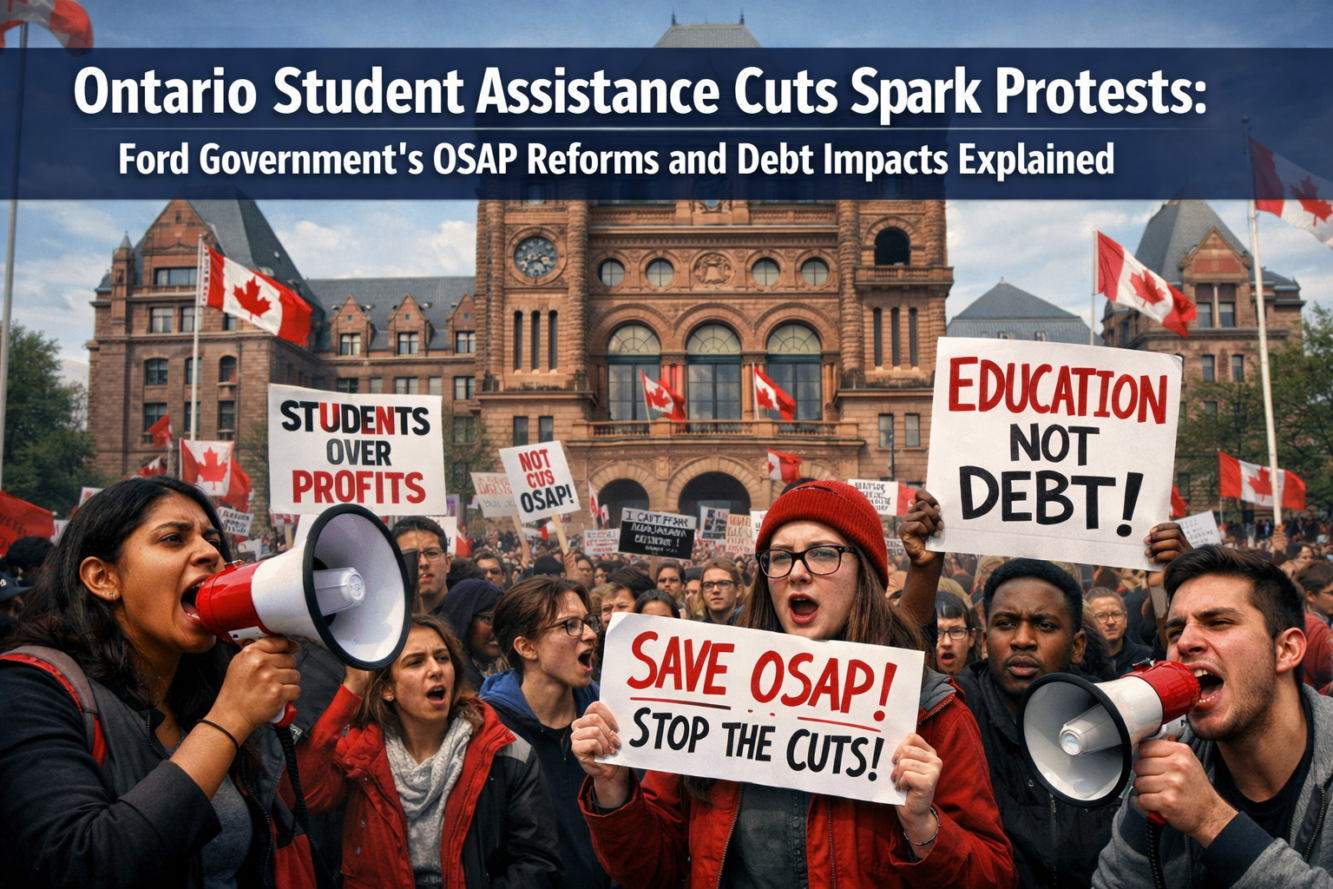
Hundreds of Ontario students marched on Queen’s Park on March 4, 2026, demanding the reversal of sweeping changes to the Ontario Student Assistance Program (OSAP) that shift financial aid from grants back to loans. The Ford government’s reforms, announced in February 2026, fundamentally reshape how post-secondary students receive financial support—leaving many facing tens of thousands of dollars in additional debt. Ontario Student Assistance Cuts Spark Protests: Ford Government’s OSAP Reforms and Debt Impacts Explained reveals how these policy changes affect current and future students, what the government claims justifies the cuts, and what options remain for students navigating this new financial landscape.
Key Takeaways
- Grant-to-loan reversal: OSAP is shifting from primarily grants back to primarily loans, reversing a 2017 policy that made grants the dominant form of aid
- Career college students lose access: OSAP eligibility has been terminated for career college students, affecting a rapidly growing applicant pool
- Tuition freeze ended: A seven-year tuition fee freeze was lifted in February 2026, allowing institutions to raise costs
- Debt projections soar: First-year students estimate completing a four-year degree could result in approximately $80,000 in debt under the new system
- $6.4 billion institutional funding: The government is providing additional funding to post-secondary institutions to offset grant reductions
- Grant spending jumped 143%: OSAP grant spending reached $1.7 billion in the most recent fiscal year, up from previous levels
- Large-scale protests: Hundreds demonstrated at Queen’s Park on March 4, 2026, with two arrests made during the event
- Cost-of-living crisis timing: Changes coincide with rising rent and grocery costs, forcing students to work extended hours while studying
Quick Answer
The Ford government is drastically scaling back OSAP grants in favor of loans, ending a 2017 policy that prioritized non-repayable aid. Students now face significantly higher debt burdens—potentially $80,000 for a four-year degree—while career college students have lost OSAP eligibility entirely. The government justifies these changes by citing unsustainable 143% grant spending increases and is providing $6.4 billion in additional institutional funding, but student advocates argue the timing during a cost-of-living crisis will force many to abandon post-secondary education.
What Are the Major Changes to OSAP in 2026?
The Ford government implemented three fundamental changes to OSAP in February 2026: shifting from grants to loans, ending career college eligibility, and lifting the tuition fee freeze. These reforms represent the most significant restructuring of Ontario student financial aid since the Wynne government’s 2017 expansion.[1]
The three core changes include:
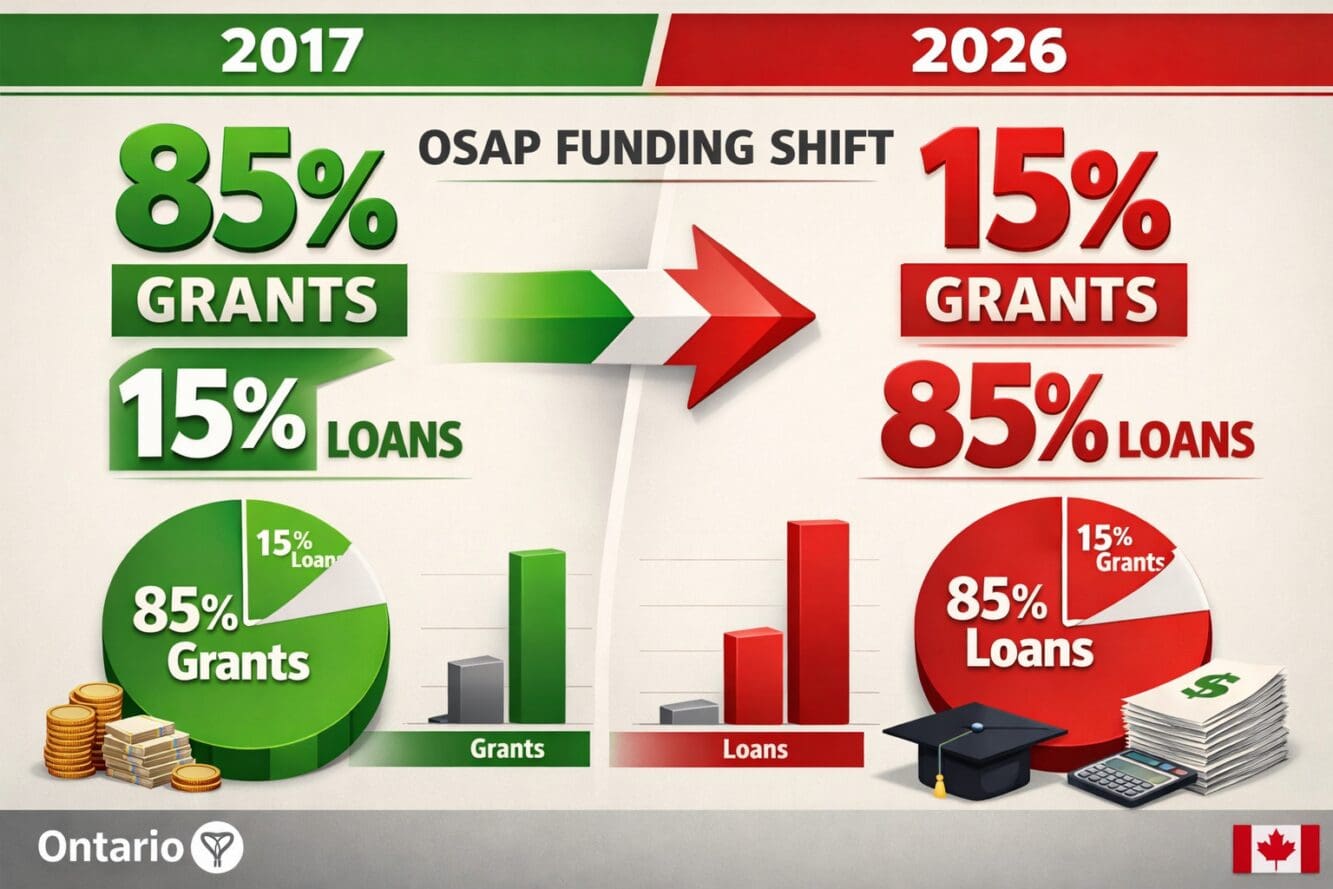
- Grant-to-loan ratio reversal: OSAP is returning to a structure where approximately 85% of aid comes as loans and 15% as grants, reversing the 2017 policy that flipped this ratio
- Career college exclusion: Students attending career colleges can no longer apply for OSAP, a restriction affecting thousands who chose vocational training paths
- Tuition freeze elimination: Post-secondary institutions can now raise tuition fees after seven years of frozen rates, potentially adding thousands to student costs
Choose the loan-heavy system if: You have family financial support, can work substantial hours while studying, or plan to enter high-paying fields that justify debt loads.
Common mistake: Assuming the $6.4 billion institutional funding will prevent tuition increases—institutions control their own fee structures and may raise costs despite receiving additional government support.
How Much Debt Will Ontario Students Face Under the New OSAP System?
Students attending the March 4 protest reported that completing a four-year degree could result in approximately $80,000 in debt under the new system, particularly affecting low-income students without family financial support. Toronto Metropolitan University students indicated they would graduate with “tens of thousands of dollars more in debt” compared to previous expectations.[1]
Debt burden factors include:
- Tuition costs: Four years of tuition at Ontario universities typically ranges from $28,000 to $60,000 depending on program
- Living expenses: Rent, food, and transportation add $15,000 to $25,000 annually in major cities like Toronto
- Lost grant support: Students who previously received $10,000 to $15,000 in annual grants now receive equivalent amounts as repayable loans
- Interest accumulation: Federal and provincial loan interest begins accruing six months after graduation
Decision rule: If your projected debt exceeds your expected first-year salary by more than 1.5 times, consider part-time study, community college alternatives, or delaying enrollment to work and save.
Edge case: Students who started programs before the February 2026 changes may have different grant-loan ratios depending on when they applied—check with your institution’s financial aid office for your specific situation.
Why Did the Ford Government Cut OSAP Grants?
The government cited unsustainable spending growth as the primary justification for scaling back grants. OSAP grant spending reached $1.7 billion in the most recent fiscal year, representing a 143% increase since 2020. Career college applications increased by more than 300% from 2021, significantly straining OSAP budgets.[1]
Government rationale includes:
- Budget sustainability: The 143% spending increase was deemed financially unsustainable for provincial budgets
- Career college surge: A 300% increase in career college applications created unexpected financial pressure on OSAP
- Institutional investment: The $6.4 billion additional funding to post-secondary institutions is characterized as “historic investments” that reduce the need for individual grants
- Historical precedent: Until 2017, OSAP operated with 85% loans and 15% grants—the government views this as a return to normal rather than a cut
Colleges and Universities Minister Nolan Quinn defended the changes as necessary rebalancing, but student advocates argue the timing during a cost-of-living crisis demonstrates misplaced priorities.
What Happened at the March 4, 2026 Queen’s Park Protest?
Hundreds of Ontario post-secondary students and supporters gathered at Queen’s Park on Wednesday, March 4, 2026, to protest the OSAP changes. The Canadian Federation of Students’ Ontario chairperson Cyrielle Ngeleka condemned the reforms as harmful during a cost-of-living crisis, highlighting that students already face rising rent and grocery costs.[1]
Protest details:
- Attendance: Hundreds of students from universities and colleges across Ontario
- Location: Queen’s Park, Ontario legislature grounds
- Demands: Reversal of grant cuts, restoration of career college eligibility, maintenance of tuition freeze
- Arrests: Two people were arrested—Rohtansh Saini, 22, for allegedly vandalizing a George Brown statue, and Mason Wallington, 21, for assaulting a peace officer while interfering with the arrest[1]
Protester concerns centered on:
- Increased debt burdens forcing students to work extended hours while studying
- Some students reporting they skip meals to afford basic expenses
- Fear that low-income students will abandon post-secondary education entirely
- Timing during housing and food cost inflation making student poverty worse
Who Is Most Affected by Ontario Student Assistance Cuts Spark Protests: Ford Government’s OSAP Reforms and Debt Impacts Explained?
Low-income students without family financial support face the most severe impacts from the OSAP reforms. Students who relied on grants to cover living expenses now must either take on significantly more debt, work additional hours that interfere with studies, or reconsider post-secondary education entirely.
Most affected groups:
- First-generation university students: Often from families with limited savings and no experience navigating student debt
- Career college students: Completely lost OSAP eligibility, eliminating a critical funding source for vocational training
- Students in expensive cities: Toronto, Ottawa, and other high-cost areas where rent and living expenses consume most aid
- Mature students: Often supporting families while studying, with limited capacity to work additional hours
- Students in longer programs: Medicine, law, and engineering students facing six to eight years of education now accumulate proportionally higher debt
Choose alternative paths if: You’re from a low-income background and projected debt exceeds $60,000—consider starting at community college, working part-time while studying, or exploring apprenticeship programs that pay while you learn.
What Does the $6.4 Billion Institutional Funding Actually Mean for Students?
The Ford government is providing $6.4 billion in additional funding to post-secondary institutions as part of the broader post-secondary funding overhaul. However, this institutional funding doesn’t directly reduce individual student costs—it supports university and college operations, infrastructure, and programming.[1]
What institutional funding covers:
- Operating budgets: Day-to-day costs of running universities and colleges
- Faculty and staff: Salaries and benefits for professors, lecturers, and administrative staff
- Infrastructure: Building maintenance, technology upgrades, research facilities
- Program development: New courses, degree programs, and credential offerings
What it doesn’t guarantee:
- Lower tuition fees (institutions can still raise costs)
- More student services or support programs
- Increased bursaries or scholarships
- Better student-to-faculty ratios
Common misconception: Many students assume institutional funding will prevent tuition increases, but the lifted tuition freeze means institutions can raise fees regardless of government funding levels.
How Do the 2026 OSAP Changes Compare to Previous Policies?
The 2026 reforms essentially reverse the 2017 changes implemented by former Premier Kathleen Wynne’s government. Understanding this historical context clarifies why the current changes feel so dramatic to students who entered post-secondary education in recent years.[1]
| Period | Grant-Loan Ratio | Career College Access | Tuition Policy | Context |
|---|---|---|---|---|
| Pre-2017 | 15% grants, 85% loans | Available | Market rates | Traditional OSAP structure |
| 2017-2026 | 85% grants, 15% loans | Available | Frozen for 7 years | Wynne government expansion |
| 2026 Forward | 15% grants, 85% loans | Eliminated | Freeze lifted | Ford government “rebalancing” |
Key differences:
- Grant spending: Increased from manageable levels to $1.7 billion annually, then cut back
- Career college applications: Surged 300% from 2021, prompting eligibility elimination
- Political philosophy: Wynne prioritized accessibility through grants; Ford prioritizes institutional funding and loan-based aid
What Options Do Students Have to Manage OSAP Debt Under the New System?
Students facing higher debt loads under the reformed OSAP system have several strategies to minimize long-term financial impact, though none fully replace the lost grant support.
Debt management strategies:
- Start at community college: Complete two years at lower-cost colleges, then transfer to university for final two years
- Work-study balance: Accept that part-time study may take longer but results in less debt accumulation
- Apply for institutional aid: Many universities offer bursaries and scholarships separate from OSAP
- Consider co-op programs: Paid work terms can offset education costs and provide income
- Live at home if possible: Eliminating rent costs can save $10,000 to $15,000 annually
- Explore federal programs: Canada Student Grants remain available and aren’t affected by provincial changes
- Investigate employer tuition support: Some employers offer education benefits for part-time students
Repayment assistance programs:
- Repayment Assistance Plan (RAP): Federal program that adjusts payments based on income
- Six-month grace period: No payments required for six months after graduation
- Income-based repayment: Monthly payments capped at percentage of income for qualifying borrowers
Common mistake: Ignoring loan counseling and repayment planning until after graduation—start understanding repayment obligations in your first year to make informed decisions about borrowing amounts.
FAQ
Q: When do the OSAP grant cuts take effect?
The changes were announced in February 2026 and apply to applications for the 2026-2027 academic year and beyond. Students already receiving OSAP may see changes to their aid packages.
Q: Can career college students still get any financial aid?
Career college students can no longer access OSAP but may qualify for federal Canada Student Loans and Grants, private student lines of credit, or institutional bursaries if available.
Q: Will tuition fees definitely increase now that the freeze is lifted?
Individual institutions decide their tuition rates. The lifted freeze allows increases but doesn’t mandate them—check with your specific university or college for their fee policies.
Q: How much will the average Ontario student owe after a four-year degree?
Debt levels vary widely based on program, living situation, and family support. Protesters estimated approximately $80,000 for students relying heavily on OSAP without family contributions, though individual circumstances differ significantly.
Q: Are there any programs exempt from the OSAP changes?
The reforms apply broadly across OSAP, but specific exemptions or transitional provisions may exist—contact your institution’s financial aid office for program-specific guidance.
Q: What was the grant-to-loan ratio before 2017?
Before the Wynne government’s 2017 changes, OSAP provided approximately 15% of aid as grants and 85% as loans, which is the ratio being restored under the Ford government’s 2026 reforms.
Q: Can students protest or appeal their OSAP decisions?
Students can appeal OSAP decisions through official channels if circumstances change or errors occur, but the policy changes themselves are government decisions that require political advocacy to reverse.
Q: How does Ontario’s student debt compare to other provinces?
Ontario students typically graduate with higher debt than most other provinces due to higher tuition costs and living expenses, particularly in Toronto—these reforms may widen that gap further.
Q: Will the $6.4 billion institutional funding create more spaces for students?
The institutional funding supports operations and may enable enrollment growth, but capacity decisions depend on individual institutions and aren’t guaranteed by the funding announcement.
Q: What happens if I can’t afford to continue my education under the new system?
Explore part-time study, temporary withdrawal while working to save, transfer to lower-cost institutions, or seek emergency bursaries from your school—many institutions have financial counselors who can discuss options.
Q: Are international students affected by these OSAP changes?
International students weren’t eligible for OSAP before these changes and remain ineligible—the reforms affect Ontario residents and Canadian citizens/permanent residents.
Q: How can students advocate for policy reversal?
Contact MPPs, join student unions and advocacy organizations like the Canadian Federation of Students, participate in demonstrations, and vote in provincial elections where post-secondary policy is debated.
Conclusion
The Ontario Student Assistance Cuts Spark Protests: Ford Government’s OSAP Reforms and Debt Impacts Explained represent a fundamental shift in how Ontario funds post-secondary education. By reversing the 2017 grant expansion and returning to a loan-heavy model, the Ford government argues it’s creating sustainable funding while investing $6.4 billion in institutions. Students counter that the timing during a cost-of-living crisis will force many—particularly low-income and first-generation learners—to abandon post-secondary education or graduate with crushing debt burdens approaching $80,000.
Immediate action steps for affected students:
- Review your financial aid package for the 2026-2027 year to understand your specific grant and loan amounts
- Meet with financial aid counselors at your institution to explore bursaries, scholarships, and alternative funding
- Calculate projected total debt for your complete program to make informed decisions about borrowing limits
- Consider cost-reduction strategies like community college transfers, living at home, or co-op programs
- Stay informed about policy developments through student unions and advocacy organizations
- Contact your MPP to express concerns about how the changes affect your education plans
The March 4 protests at Queen’s Park demonstrate that students won’t accept these changes without resistance. Whether advocacy efforts can reverse or modify the reforms remains uncertain, but the debate over accessibility, affordability, and who should bear the cost of post-secondary education will continue shaping Ontario’s political landscape throughout 2026 and beyond.
For students navigating this new reality, understanding the full scope of changes, calculating realistic debt projections, and exploring every available funding alternative has never been more critical to achieving post-secondary education goals without financial devastation.
References
[1] Students Protest Cuts To Amount Of Osap Grants They Can Receive – https://toronto.citynews.ca/2026/03/04/students-protest-cuts-to-amount-of-osap-grants-they-can-receive/
Content, illustrations, and third-party video appearing on GEORGIANBAYNEWS.COM may be generated or curated with AI assistance or reproduced pursuant to the fair dealing provisions of the Copyright Act, R.S.C. 1985, c. C-42. Attribution and hyperlinks to original sources are provided in acknowledgment of applicable intellectual property rights. Such referencing is intended to direct traffic to and support the original rights holders’ platforms.