























OpenAI Just Betrayed Nvidia: Julia McCoy says “The AI War Begins NOW”!
In the high-stakes world of artificial intelligence, partnerships can crumble faster than algorithms can process data.
When Nvidia withdrew from a planned $60 billion investment in OpenAI in early 2026, it sent shockwaves through the tech industry and marked the beginning of what experts are now calling The AI War—a battle that will reshape the future of technology, business, and global innovation.
Imagine building your entire empire on someone else’s foundation, only to discover they’re pulling the blueprints out from under you. That’s essentially what happened when OpenAI, the company behind ChatGPT, found itself at odds with Nvidia, the chip manufacturer that powers virtually every AI system on the planet. This isn’t just a business disagreement—it’s a fundamental shift in the power dynamics of the artificial intelligence industry that will affect everyone from tech enthusiasts to world leaders. 🌍

Key Takeaways
- Nvidia withdrew from a $60 billion investment commitment to OpenAI, down from an initially announced $100 billion deal in September 2025[1]
- OpenAI has been dissatisfied with Nvidia’s latest AI chips and actively seeking alternatives since 2025, straining their foundational partnership[3]
- The AI War represents a critical turning point where chip manufacturers and AI developers compete for market dominance
- Gaming GPU production is being delayed throughout 2026 as Nvidia prioritizes AI chip manufacturing over consumer products[2]
- Strategic implications could reshape the entire AI industry, opening opportunities for competitors like Google and Microsoft
Understanding The AI War: What Really Happened
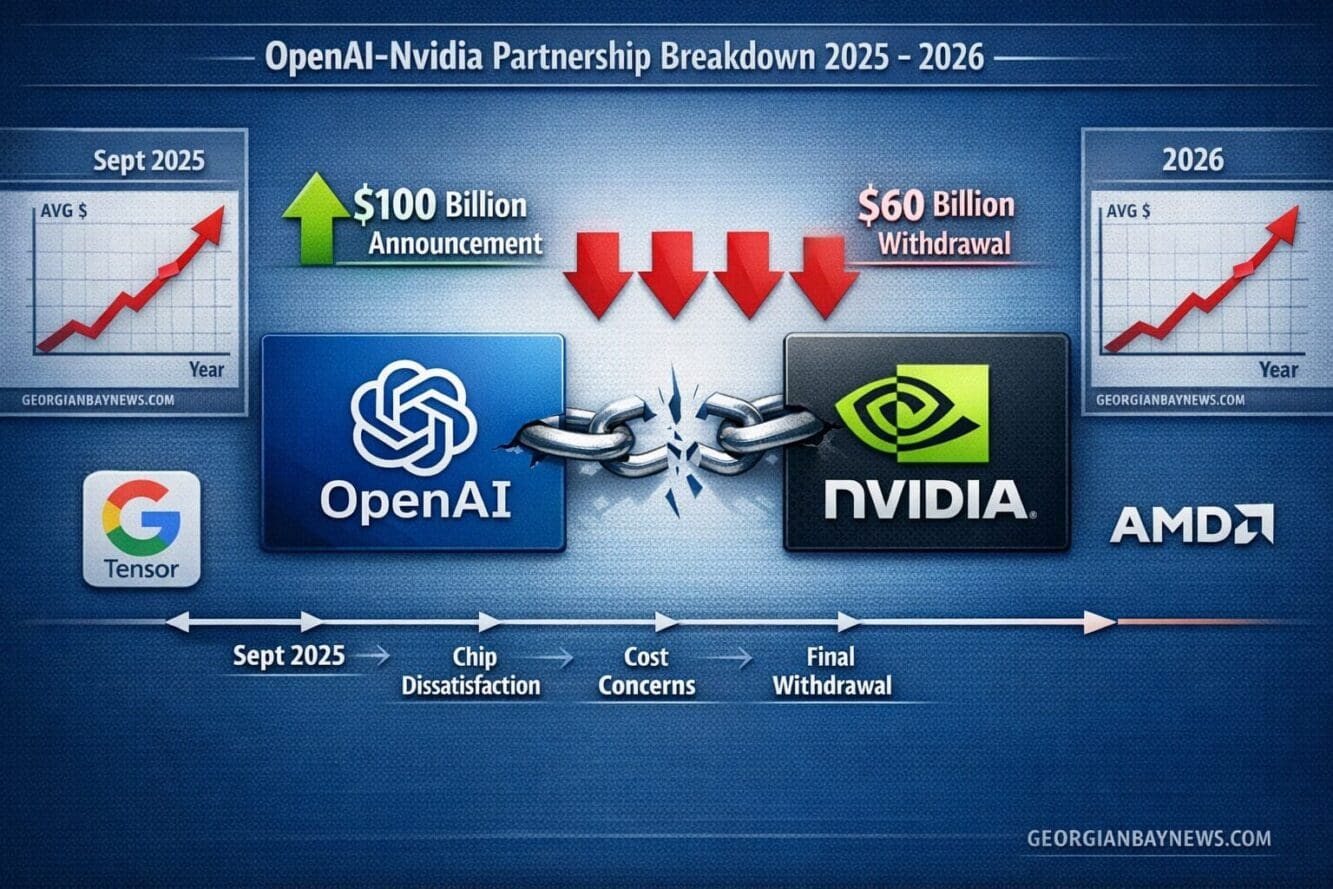
The relationship between OpenAI and Nvidia was supposed to be the tech industry’s perfect marriage. OpenAI created groundbreaking AI models, while Nvidia provided the powerful GPUs (graphics processing units) that made those models possible. But like many seemingly perfect partnerships, cracks began to show beneath the surface.
The $60 Billion Betrayal
In September 2025, the tech world celebrated when Nvidia, Microsoft, and Amazon announced a combined $100 billion investment commitment to OpenAI. Fast forward to early 2026, and that celebration turned into confusion when Nvidia CEO Jensen Huang pulled his company’s portion—a massive $60 billion—from the deal.[1]
Huang’s public statement was diplomatic: it was “never a commitment.” But sources close to the situation revealed that he privately criticized OpenAI’s operational management, suggesting deeper issues at play.[1] This withdrawal wasn’t just about cold feet—it signaled a fundamental disagreement about OpenAI’s viability and future direction.
“OpenAI is characterized as a ‘yawning financial wound’ that threatens the broader AI sector and Nvidia’s markets.”[1]
The Chip Dissatisfaction Problem
Here’s where The AI War gets technical. According to eight sources familiar with the matter, OpenAI has been unhappy with some of Nvidia’s latest artificial intelligence chips since 2025.[3] This dissatisfaction wasn’t just about performance—it was about cost.
Running AI models requires enormous computational power. Every time someone uses ChatGPT, it requires GPU processing. Those GPUs come from Nvidia, and they’re expensive. OpenAI found itself paying premium prices for chips that didn’t always meet their specific needs, creating what industry insiders call an “inference cost problem.”[3]
Think of it like this: imagine you’re running a taxi service, but you can only buy vehicles from one manufacturer who charges premium prices for cars that consume twice as much fuel as you need. Eventually, you’d start looking for alternatives—and that’s exactly what OpenAI did.

The AI War: How This Conflict Reshapes Technology
The breakdown between OpenAI and Nvidia isn’t happening in isolation. It’s part of a larger transformation in how AI technology is developed, deployed, and controlled.
Gaming Casualties: When AI Takes Priority
One of the most immediate casualties of The AI War is the gaming community. Nvidia announced it’s delaying new gaming GPU releases throughout 2026, including the highly anticipated “Kicker” chip.[2] Why? Because global memory shortages and the overwhelming demand for AI chips have forced the company to make a choice.
Nvidia chose AI over gamers. 🎮
The demand for GeForce RTX GPUs remains strong among gaming enthusiasts, but memory supply constraints mean Nvidia must prioritize where its limited resources go.[2] This decision reflects a brutal economic reality: AI chips generate far more revenue than gaming products, even though gaming built Nvidia’s empire.
For everyday consumers, this means:
- Higher prices for existing gaming GPUs
- Longer wait times for new releases
- Limited availability of current-generation cards
- Increased competition from AMD and Intel alternatives
The Financial Viability Question
OpenAI’s financial situation has become a central concern in The AI War. Despite ChatGPT’s massive popularity and widespread adoption, the company burns through cash at an alarming rate. Training large language models costs hundreds of millions of dollars, and running them for millions of daily users adds ongoing operational expenses that dwarf most tech companies.[1]
This creates a paradox for Nvidia. If OpenAI fails, Nvidia loses billions in potential GPU sales revenue. Yet continuing to support a financially unstable partner poses its own risks.[3] It’s like being a landlord to a tenant who brings tremendous prestige but might not make rent—you want them to succeed, but you can’t ignore the warning signs.
The AI War: Strategic Moves and Market Implications
As The AI War intensifies, major tech players are repositioning themselves for advantage. This isn’t just about OpenAI and Nvidia anymore—it’s about the entire future of artificial intelligence development.
The Arms Dealer Strategy
Nvidia is pivoting toward what industry analysts call an “arms supplier” strategy.[1] Rather than betting everything on one AI company, Nvidia is developing Rubin racks for plug-and-play data center construction and backing Coreweave’s AI data center infrastructure. This approach allows Nvidia to sell chips to everyone—OpenAI, Google, Microsoft, Amazon, and countless smaller players.
It’s a smart hedge. When you’re selling shovels during a gold rush, you don’t need to pick which prospector will strike it rich. You sell to all of them.
Competitive Opportunities in The AI War
The conflict between OpenAI and Nvidia has opened doors for competitors:
Google’s Position:
- Google’s Tensor chips are a generation behind Nvidia’s latest offerings
- However, superior software optimization could compensate for hardware gaps[1]
- Google has deep pockets and vertical integration advantages
- The company can afford to subsidize AI development through other revenue streams
Microsoft’s Advantage:
- Already invested heavily in OpenAI ($13 billion commitment)
- Developing custom AI chips to reduce Nvidia dependence
- Azure cloud infrastructure provides alternative revenue while supporting AI development
- Strategic position as both OpenAI investor and potential chip alternative supplier
AMD and Intel:
- Both companies see an opening to challenge Nvidia’s GPU dominance
- AMD’s MI300 series targets AI workloads specifically
- Intel’s Gaudi accelerators offer cost-competitive alternatives
- Market share gains possible as OpenAI and others diversify suppliers
The broader AI revolution is creating opportunities for companies that can offer alternatives to the Nvidia-dominated ecosystem.
What The AI War Means for Different Stakeholders
For Tech Professionals and Developers
The AI War creates both challenges and opportunities for people working in technology:
Challenges:
- Uncertainty about which platforms and chips will dominate
- Need to learn multiple hardware optimization approaches
- Potential project delays due to chip availability
- Budget pressures from rising GPU costs
Opportunities:
- Growing demand for hardware-agnostic AI development skills
- New roles optimizing AI models for diverse chip architectures
- Consulting opportunities helping companies navigate vendor choices
- Innovation in AI efficiency and cost reduction
For Businesses and Organizations
Companies using AI face strategic decisions influenced by The AI War:
- Vendor Diversification: Don’t rely solely on one chip supplier or AI platform
- Cost Management: Explore alternatives to expensive Nvidia GPUs for inference workloads
- Strategic Partnerships: Consider cloud providers offering diverse hardware options
- Long-term Planning: Build flexibility into AI infrastructure investments
For Canadians and North Americans
The geopolitical dimensions of The AI War matter for regional competitiveness:
- Job Creation: AI chip manufacturing and data center construction create high-paying jobs
- Economic Growth: The AI industry represents trillions in future economic value
- Strategic Independence: Reducing dependence on single suppliers enhances resilience
- Innovation Ecosystems: Competition drives innovation in AI technology development
For Canadians specifically, this creates opportunities to position the country as a neutral ground for AI development, leveraging abundant clean energy for data centers and strong tech talent pools.
For Seniors and Non-Technical Audiences
You might wonder why The AI War matters if you’re not a tech professional. Here’s the simple truth: AI is increasingly embedded in healthcare, banking, government services, and daily life. Who controls AI development affects:
- Healthcare Access: AI diagnostics and treatment recommendations
- Financial Services: Fraud detection and personalized banking
- Customer Service: Automated support systems
- Transportation: Self-driving vehicles and traffic management
- Entertainment: Content recommendations and creation
When major companies fight over AI control, it ultimately affects the services we all use every day.
The Road Ahead: Predictions and Possibilities

The AI War is just beginning, and several scenarios could play out over the coming years:
Scenario 1: Nvidia Maintains Dominance
Despite tensions, Nvidia’s technological lead and established ecosystem prove too strong for competitors to overcome. OpenAI and others continue using Nvidia chips while negotiating better terms. Nvidia’s “arms dealer” strategy succeeds, and the company captures 70%+ of the AI chip market through 2028.
Scenario 2: Fragmented Market Emerges
OpenAI successfully diversifies to Google, AMD, and custom chip solutions. Other AI companies follow suit. Nvidia’s market share drops to 40-50% as competition intensifies. This scenario benefits consumers through lower prices and innovation but creates complexity for developers.
Scenario 3: OpenAI Fails, Reshaping The AI War
If OpenAI’s financial challenges prove insurmountable, the company could be acquired, merged, or shut down. This would validate Nvidia’s concerns but also eliminate a major customer. Microsoft would likely absorb OpenAI’s technology, while Google and others rush to fill the market gap.
Scenario 4: Regulatory Intervention
Governments concerned about AI monopolies impose regulations requiring chip diversity and open standards. This would fundamentally reshape The AI War by preventing any single company from dominating the entire stack from chips to applications.
Actionable Insights: What You Can Do Now
Whether you’re a tech professional, business leader, or interested observer, The AI War offers lessons and action items:
For Individuals:
✅ Stay Informed: Follow AI news and developments to understand how changes affect your industry
✅ Develop Flexible Skills: Learn AI concepts that transfer across platforms, not just one vendor’s tools
✅ Invest Wisely: If investing in tech stocks, diversify across AI chip makers and application companies
✅ Advocate for Competition: Support policies promoting healthy competition in AI development
For Businesses:
✅ Audit AI Dependencies: Identify where your operations rely on specific vendors
✅ Build Redundancy: Develop relationships with multiple AI and chip providers
✅ Optimize Costs: Explore cost-effective alternatives for AI inference workloads
✅ Plan Strategically: Include AI vendor risk in your long-term technology planning
For Policymakers and Leaders:
✅ Promote Competition: Create regulatory frameworks preventing monopolistic practices
✅ Invest in Infrastructure: Support domestic AI chip manufacturing and data center development
✅ Fund Research: Back academic and commercial research into AI efficiency and alternatives
✅ Ensure Access: Develop policies ensuring smaller companies can access AI technology
Conclusion: Embracing The AI War Era
The breakdown between OpenAI and Nvidia marks more than a failed business deal—it represents the maturation of the AI industry from collaborative experimentation to competitive warfare. The AI War will define the next decade of technological development, economic growth, and global competitiveness.
For tech enthusiasts, this is an exciting time. The monopolistic comfort of a single dominant player is giving way to genuine competition, which historically drives innovation and reduces costs. For businesses, the message is clear: diversify your AI strategy and don’t put all your computational eggs in one basket.
For everyday people—from seniors navigating AI-powered healthcare to young professionals building careers in technology—The AI War will ultimately determine how accessible, affordable, and beneficial AI becomes in our daily lives.
The battle has begun. The question isn’t whether The AI War will reshape our world—it’s how we’ll adapt to the changes it brings. By staying informed, remaining flexible, and demanding that competition serves the public good rather than just corporate profits, we can help ensure this technological revolution benefits everyone, not just the companies fighting to control it.
The future of AI won’t be written by one company or one chip manufacturer. It will be written by the collective actions of developers, businesses, policymakers, and citizens who recognize that The AI War is ultimately about who controls the most transformative technology of our generation. Make sure you’re part of shaping that future. 🚀
References
[1] Why Is Nvidia Circling Openai – https://danablankenhorn.com/2026/02/why-is-nvidia-circling-openai.html
[2] Watch – https://www.youtube.com/watch?v=DWHqTjSBaAo
[3] Watch – https://www.youtube.com/watch?v=w1g2aETvSUQ
[4] Sam Altman And The Day Nvidias Meteoric – https://garymarcus.substack.com/p/sam-altman-and-the-day-nvidias-meteoric
Some content and illustrations on GEORGIANBAYNEWS.COM are created with the assistance of AI tools.
GEORGIANBAYNEWS.COM shares video content from YouTube creators under fair use principles. We respect creators’ intellectual property and include direct links to their original videos, channels, and social media platforms whenever we feature their content. This practice supports creators by driving traffic to their platforms.
Much Appreciate You Sharing This Post - It Helps MUCH!!!