





















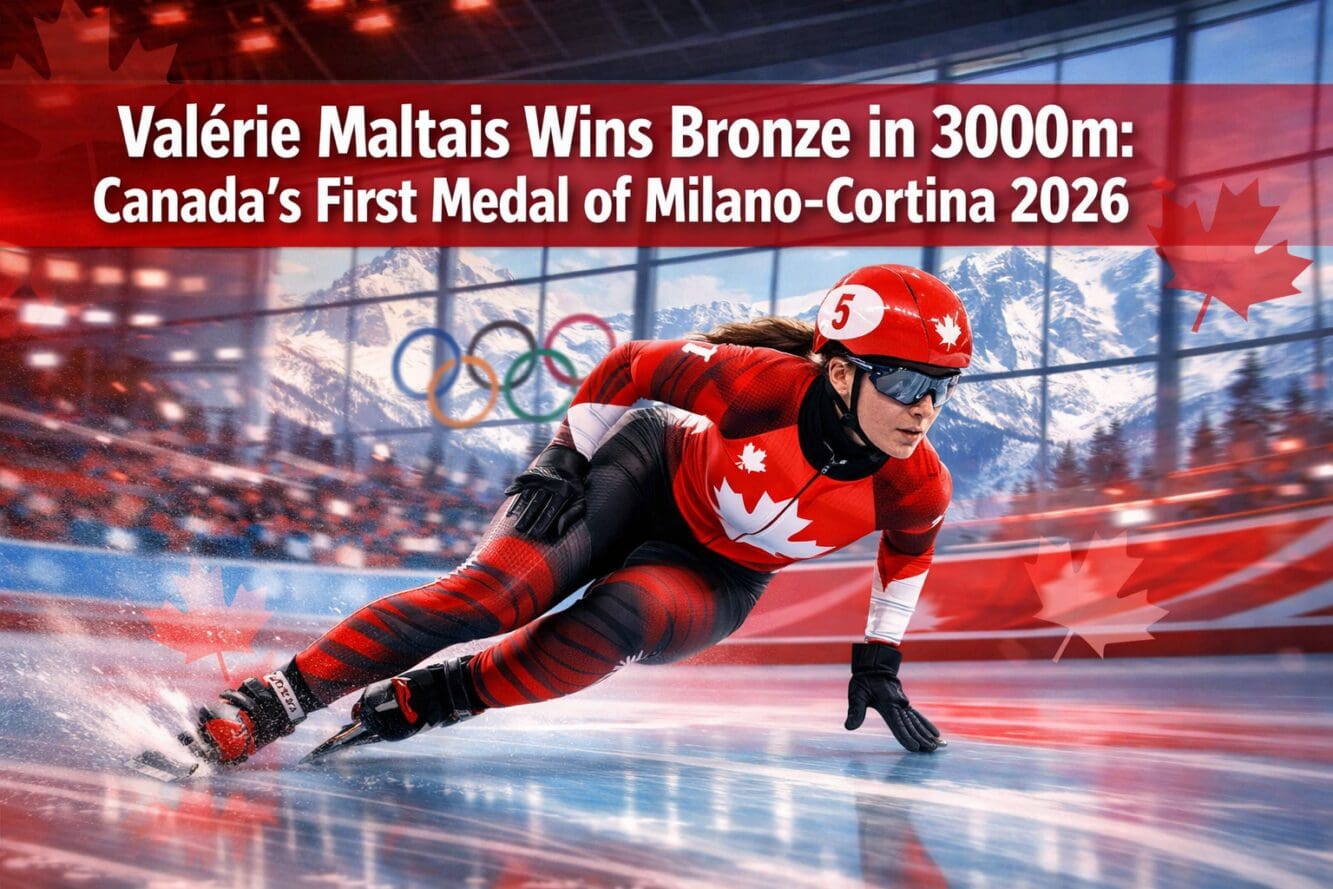
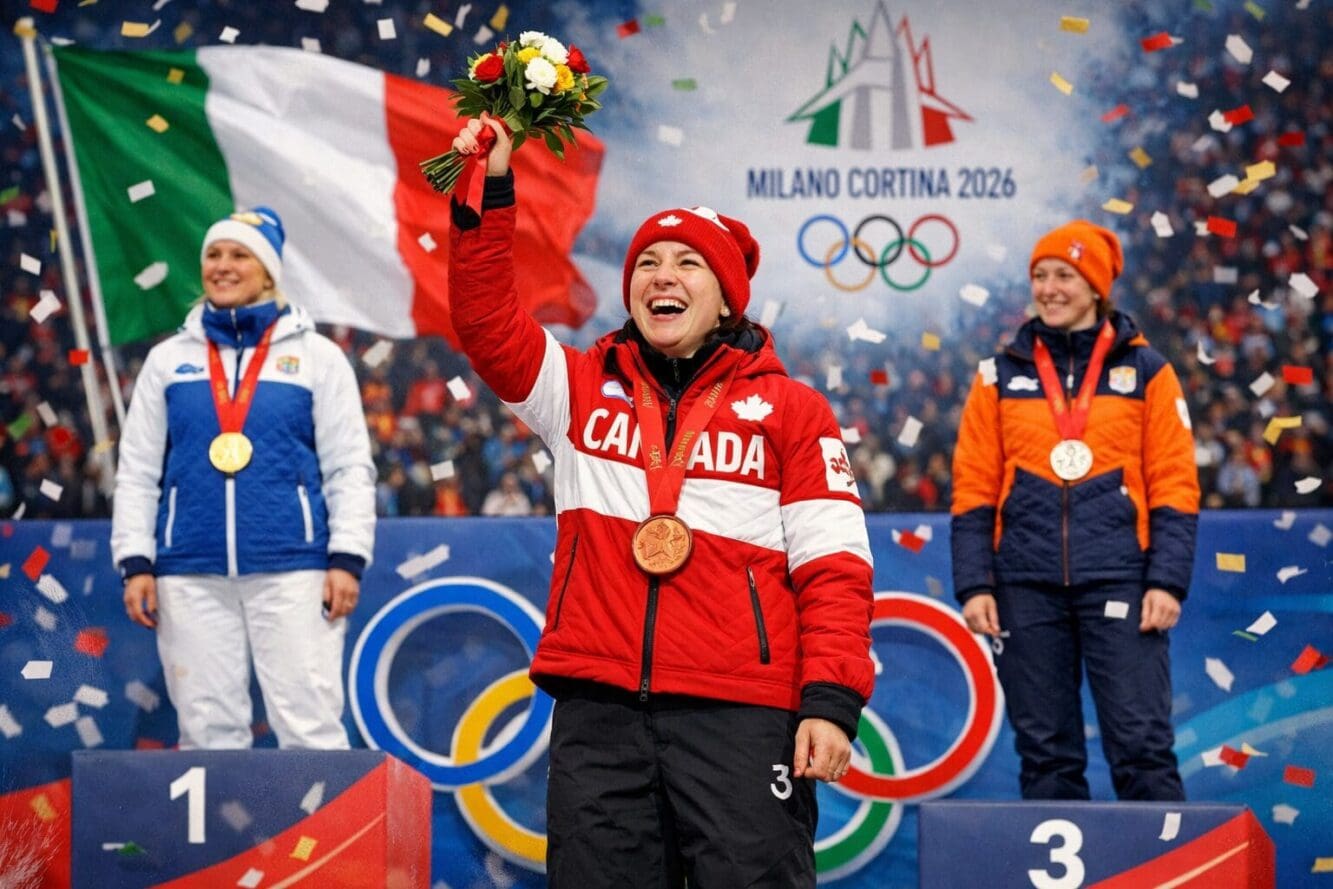
The roar of the crowd echoed through the ice oval as Valérie Maltais crossed the finish line, securing Canada’s opening medal at the Milano-Cortina 2026 Winter Olympics. In a stunning display of endurance and determination, the 36-year-old speed skater claimed bronze in the women’s 3000-meter long-track event, marking a historic moment for Team Canada and capping off an extraordinary Olympic journey that has spanned five Games. Valérie Maltais Wins Bronze in 3000m: Canada’s First Medal of Milano-Cortina 2026 represents not just a personal triumph, but a beacon of hope for the entire Canadian delegation as they pursue excellence on Italian ice.

🥉 Valérie Maltais secured Canada’s first medal at Milano-Cortina 2026 with a bronze finish in the women’s 3000m long-track speed skating event
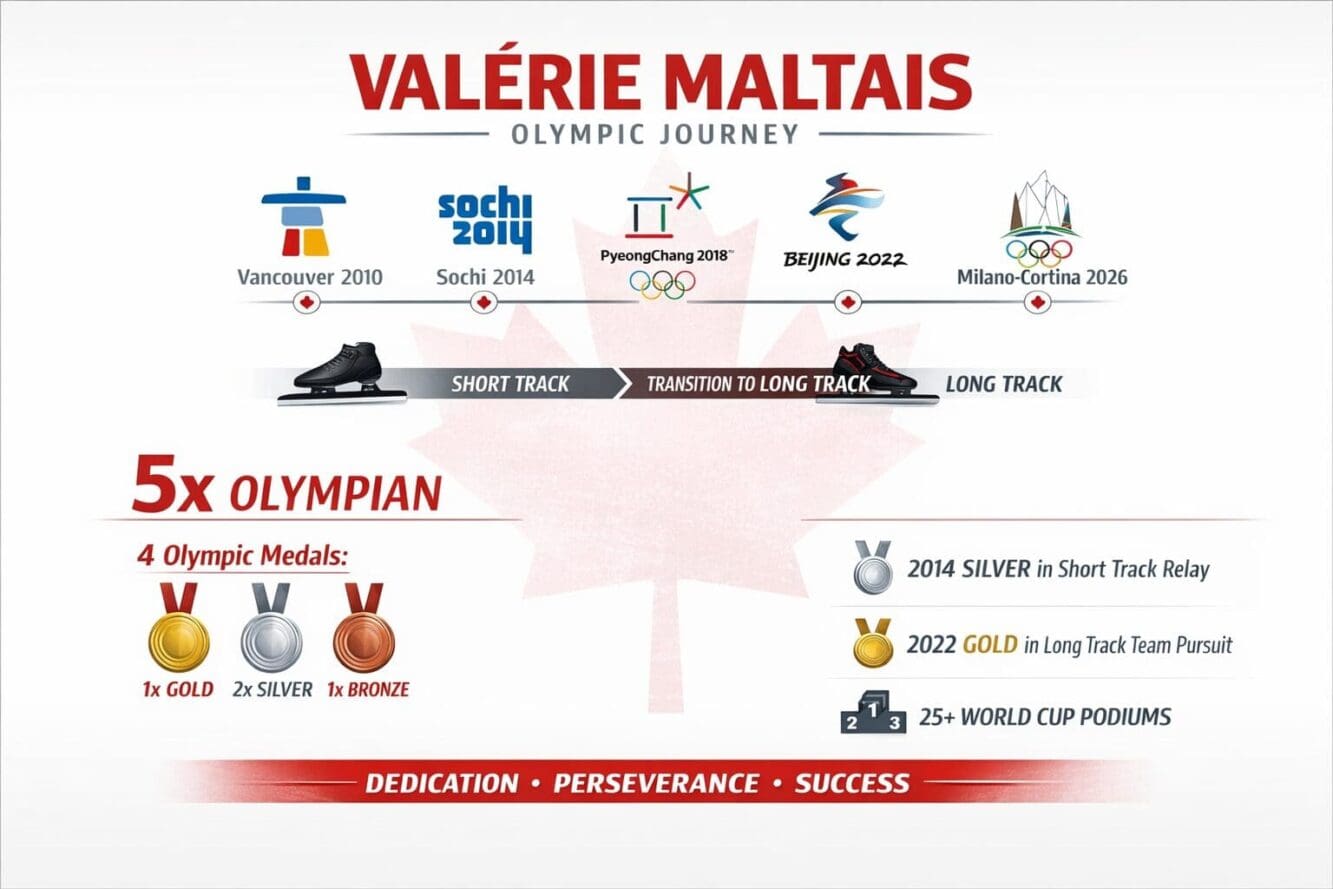
🏅 Five-time Olympian achievement: Maltais has competed in every Winter Olympics since 2010, transitioning from short-track to long-track skating
⏱️ Record-breaking performance: Her time demonstrated exceptional endurance and strategic racing at age 36
🇨🇦 Team Canada momentum: This early medal win energizes the entire Canadian delegation and sets a positive tone for the Games
💪 Perseverance pays off: After near-misses and challenges throughout her career, Maltais’s dedication finally earned her an individual Olympic medal

The women’s 3000-meter long-track speed skating event unfolded with breathtaking intensity at the state-of-the-art ice oval in Cortina d’Ampezzo. Maltais, skating in the outer lane during her pairing, demonstrated exceptional pacing strategy from the opening stride. Her technique showcased years of refinement, with powerful leg drives and aerodynamic positioning that kept her competitive against younger rivals.
The 3000m distance requires a delicate balance between speed and endurance—a test that perfectly suited Maltais’s evolved skating style. Here’s how the race unfolded:
| Lap Range | Strategy | Performance |
|---|---|---|
| Laps 1-3 | Conservative start, establish rhythm | Positioned in top 5 |
| Laps 4-6 | Maintain pace, conserve energy | Held bronze position |
| Laps 7-9 | Increase tempo, tactical positioning | Defended against challengers |
| Final 2 Laps | Maximum effort, sprint finish | Secured bronze medal |
Maltais’s final time placed her firmly on the podium, just seconds behind the gold and silver medalists. Her ability to maintain form throughout the grueling 7.5-lap race demonstrated the culmination of decades of training and competition experience.
“This bronze medal represents every early morning practice, every setback, every moment I questioned whether I could continue. It’s proof that perseverance and belief in yourself can overcome any obstacle.” — Valérie Maltais
Valérie Maltais’s Olympic story is one of remarkable transformation and resilience. Her journey began in 2010 at the Vancouver Winter Olympics, where she competed in short-track speed skating. Over the next 16 years, she would become one of Canada’s most dedicated and versatile winter athletes.
Maltais initially made her mark in short-track speed skating, competing at:
The transition to long-track speed skating came as Maltais sought new challenges and opportunities to extend her Olympic career. This switch required completely relearning technique, as long-track skating emphasizes sustained power over longer distances rather than the explosive bursts and tactical maneuvering of short-track racing.
At the Beijing 2022 Winter Olympics, Maltais competed in long-track events, gaining valuable experience that would prove crucial for her 2026 campaign. The four-year preparation period saw her:
✅ Refine her long-track technique with specialized coaching
✅ Build endurance capacity through targeted training programs
✅ Compete internationally to gain racing experience
✅ Overcome injuries and physical challenges of elite competition
✅ Maintain mental resilience despite being one of the oldest competitors
Her dedication to continuous improvement, even as she approached her late thirties, inspired teammates and coaches alike. This commitment to excellence mirrors the perseverance shown by many Canadian athletes who refuse to let age define their capabilities.
Valérie Maltais Wins Bronze in 3000m: Canada’s First Medal of Milano-Cortina 2026 carries significance far beyond the individual achievement. Early medals often catalyze team momentum, creating a positive psychological environment that can influence performance across all sports.
Sports psychologists recognize the “first medal effect“—when a nation’s opening medal at an Olympic Games creates:
For Team Canada, having a veteran athlete like Maltais deliver this crucial first medal sends a powerful message: experience, dedication, and strategic preparation matter.
Based on pre-Games projections, Canada aimed to secure 20-25 medals across all winter sports disciplines. With Maltais’s bronze secured, attention now turns to other strong medal contenders in:
The early success in speed skating also bodes well for other Canadian skaters competing in various long-track and short-track events throughout the Games.
At 36 years old, Valérie Maltais defies conventional wisdom about peak athletic performance. Her bronze medal achievement challenges assumptions about age limitations in elite sport and provides inspiration for athletes who refuse to accept arbitrary retirement timelines.
Speed skating has traditionally been dominated by athletes in their early-to-mid twenties, when explosive power and recovery capacity peak. However, Maltais’s success demonstrates that:
🎯 Technical mastery can compensate for marginal decreases in raw power
🎯 Strategic racing intelligence improves with experience
🎯 Mental toughness develops through years of competition
🎯 Efficient training becomes more important than volume as athletes age
Her achievement joins a growing list of “veteran” Olympic medalists who prove that smart training, injury prevention, and tactical excellence can extend athletic careers well beyond traditional expectations.
Maltais’s journey offers valuable insights for athletes at all levels:
The 3000-meter race requires exceptional aerobic capacity, lactate tolerance, and pacing precision. Maltais’s bronze-medal performance showcased mastery of all these elements.
Speed skating coaches who analyzed Maltais’s technique noted several key factors:
Stroke Efficiency 💨
Her leg extension and recovery demonstrated minimal wasted motion, conserving energy over the 7.5-lap distance.
Body Position 🏃♀️
Maintaining an optimal aerodynamic posture throughout the race reduced air resistance and preserved power output.
Cornering Technique 🔄
Smooth transitions through turns prevented speed loss and maintained rhythm.
Finishing Power ⚡
Despite fatigue, Maltais accelerated in the final laps, defending her position against competitors.
Maltais’s preparation for Milano-Cortina 2026 incorporated cutting-edge training methodologies:
These evidence-based approaches allowed her to compete effectively against athletes a decade younger.
Valérie Maltais Wins Bronze in 3000m: Canada’s First Medal of Milano-Cortina 2026 adds another chapter to Canada’s proud speed skating tradition. The nation has produced Olympic champions and world record holders across multiple generations.
Canadian speed skaters have consistently delivered Olympic medals:
Maltais now joins this distinguished group, with her unique story of longevity and reinvention setting her apart.
Speed Skating Canada’s development programs continue to nurture young talent who will represent the nation at future Olympics. Maltais’s success provides a blueprint for career longevity and demonstrates that athletes can remain competitive through strategic evolution and unwavering dedication.
The organization’s investment in coaching, facilities, and sports science ensures that Canada will remain a speed skating powerhouse for decades to come.
Beyond the technical and competitive aspects, Maltais’s bronze medal resonates emotionally with Canadians across the country. Her story embodies values that transcend sport:
🍁 Perseverance through adversity
🍁 Commitment to excellence
🍁 Graceful aging and adaptation
🍁 National pride and representation
Social media erupted with congratulations as news of her medal spread, with Canadians from coast to coast celebrating this achievement. Her success reminds the nation that dedication and hard work can overcome obstacles and achieve dreams, regardless of age or circumstance.
With the bronze medal secured, Maltais may have additional events remaining at Milano-Cortina 2026, depending on her competition schedule. Her performance in the 3000m suggests she could be competitive in other long-track distances as well.
Canadian speed skaters will compete in multiple events throughout the Games:
Each event presents opportunities for additional medals and memorable performances.
The positive momentum from Maltais’s bronze creates an optimistic atmosphere for Canadian athletes competing in all sports. Early success often correlates with strong overall medal counts, as confidence spreads throughout the delegation.
Canadian fans can look forward to exciting competitions in ice hockey, curling, freestyle skiing, and numerous other disciplines where Canada traditionally excels.
Valérie Maltais Wins Bronze in 3000m: Canada’s First Medal of Milano-Cortina 2026 represents far more than a third-place finish. It symbolizes resilience, reinvention, and the refusal to accept limitations. At 36 years old, competing at her fifth Olympic Games, Maltais delivered when it mattered most, securing Canada’s opening medal and inspiring a nation.
Her journey from short-track specialist to long-track bronze medalist demonstrates that athletic careers can evolve and extend through strategic adaptation and unwavering commitment. For young athletes, she provides a roadmap for longevity. For older competitors, she offers proof that age need not define potential.
Whether you’re an athlete, coach, or sports enthusiast, Maltais’s achievement offers valuable lessons:
✅ Embrace change and new challenges to extend your competitive career
✅ Invest in technical mastery as a counterbalance to age-related physical changes
✅ Maintain unwavering belief in your abilities despite setbacks
✅ Celebrate milestones while continuing to pursue excellence
✅ Inspire others through dedication and positive example
As the Milano-Cortina 2026 Winter Olympics continue, Canadians will watch with pride as their athletes compete on the world stage. Valérie Maltais has set the tone with her bronze medal, and Team Canada is poised to build on this momentum throughout the Games.
The first medal is secured. The journey continues. Go Canada Go! 🇨🇦
Some content and illustrations on GEORGIANBAYNEWS.COM are created with the assistance of AI tools.
GEORGIANBAYNEWS.COM shares video content from YouTube creators under fair use principles. We respect creators’ intellectual property and include direct links to their original videos, channels, and social media platforms whenever we feature their content. This practice supports creators by driving traffic to their platforms.