


















Quantum Computing Hardware Breakthroughs: The Latest Error-Correction and Qubit Stability Milestones Explained
Last updated: May 23, 2026
Quick Answer
Quantum computing hardware breakthroughs in 2025 and 2026 have moved the field from theoretical promise to measurable engineering progress. The most significant advances center on error correction: multiple research teams have now demonstrated that logical qubits — qubits protected by error-correcting codes — can outperform the raw physical qubits underneath them, a threshold the field has chased for decades [1][8].
Key Takeaways
- Google’s Willow processor demonstrated below-threshold surface-code error correction on real hardware, meaning more physical qubits actually reduced error rates rather than adding noise [5].
- Logical qubits now outperform physical qubits on real devices, confirmed by Infleqtion and others in early 2026 [8].
- Algorithmic Fault Tolerance (AFT), developed by QuEra with Harvard and Yale, dramatically cuts the overhead needed to run error-corrected circuits on neutral-atom hardware [8].
- Science Tokyo published a new error-correction code approaching the theoretical hashing bound, potentially reducing the number of physical qubits needed per logical qubit [1].
- Error correction is now the industry’s defining challenge, according to a 2025 quantum sector report [3].
- Quantum computers are not yet practical for most businesses; the near-term window for real-world advantage is narrowing to specific high-value domains.
- Current systems still require near-absolute-zero temperatures and are highly sensitive to environmental interference.
- Costs for access to quantum hardware range from cloud API pricing (a few dollars per task) to full system ownership estimated in the tens of millions of dollars.
What Exactly Is a Qubit and How Does It Work?
A qubit is the basic unit of quantum information. Unlike a classical bit, which is either 0 or 1, a qubit can exist in a superposition of both states simultaneously until it is measured. Qubits also exhibit entanglement, allowing two or more qubits to share correlated states regardless of physical distance.
In practice, qubits are built from physical systems like superconducting circuits (IBM, Google), trapped ions (IonQ, Quantinuum), or neutral atoms (QuEra). Each platform has different trade-offs in speed, connectivity, and error rates. The key challenge: qubits are fragile. Any interaction with the surrounding environment — heat, vibration, stray electromagnetic fields — can corrupt their quantum state, a process called decoherence.
Why Do Quantum Computers Have So Many Errors, and How Are Scientists Fixing Them?
Quantum errors arise because physical qubits decohere quickly and gate operations are imperfect. A single computation requiring thousands of operations will accumulate errors faster than useful results can be extracted.
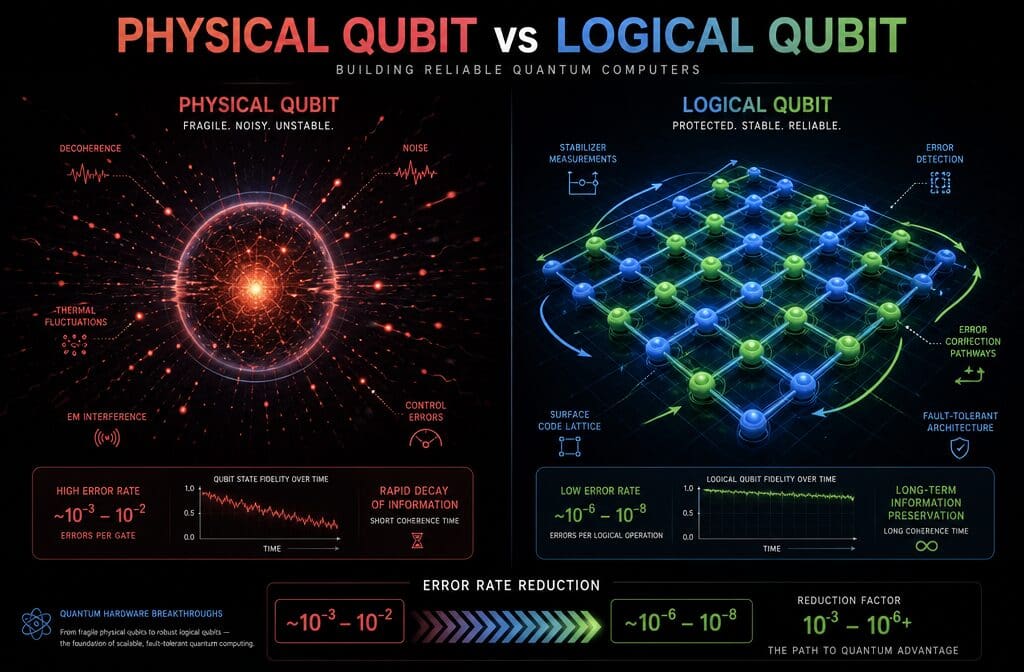
The fix is quantum error correction (QEC): encoding one logical qubit across many physical qubits so that errors can be detected and corrected without disturbing the underlying quantum information. The problem historically was that adding more physical qubits also added more potential error sources, making things worse, not better.
That changed with Google’s Willow processor. Google demonstrated below-threshold error correction, where increasing the size of the surface code actually reduced the logical error rate [5]. This is the first time a real device crossed this critical engineering boundary. Shortly after, Infleqtion showed that logical qubits on their hardware outperformed the physical qubits beneath them, confirming the result is not platform-specific [8].
“Error correction is no longer a science experiment — it’s an engineering race.” — framing widely used in the quantum industry following Google’s Willow results [1]
What Type of Error Correction Is Most Promising Right Now?
Surface codes remain the most mature approach and are the basis of Google’s Willow results. They arrange physical qubits in a 2D grid and use neighboring qubits to detect errors without measuring the data qubits directly [5].
Two newer approaches are gaining ground fast:
ApproachKey AdvantageWho Is Using ItSurface CodesWell-studied, hardware-compatibleGoogle, IBMAlgorithmic Fault Tolerance (AFT)Cuts overhead on near-term hardwareQuEra, Harvard, YaleHashing-bound codesFewer physical qubits per logical qubitScience Tokyo research
AFT is particularly notable because it allows fault-tolerant computation with far fewer physical qubits than traditional QEC requires, making it relevant for hardware available today rather than a decade from now [8].
How Do Quantum Computers Compare to Classical Computers Right Now?
Quantum computers are not faster than classical computers at most tasks. Classical hardware still wins on general-purpose computation, data storage, and any problem that doesn’t specifically benefit from quantum parallelism.
Where quantum devices show genuine advantage is in sampling problems — tasks designed to be hard for classical machines by construction. Google’s Willow processor completed a specific benchmark task in under five minutes that would take a classical supercomputer an estimated astronomical amount of time [5]. However, that benchmark is not a practical application; it is a proof-of-capability.
For real-world problems like drug discovery, materials simulation, and optimization, quantum advantage is still being demonstrated at small scales. The honest assessment as of 2026: quantum computers are ahead of where many predicted, but behind the most optimistic commercial timelines [10].
How Stable Are Current Quantum Computing Systems?
Stability, measured as coherence time, has improved significantly across platforms. Superconducting qubits now routinely achieve coherence times in the millisecond range, up from microseconds a few years ago. Trapped-ion and neutral-atom systems achieve longer coherence times but operate more slowly.
The bigger stability issue is gate fidelity — how accurately a quantum operation can be performed. Two-qubit gate fidelities above 99.9% have been demonstrated in controlled settings, but maintaining that across a full processor with hundreds of qubits remains difficult [2]. Environmental isolation (dilution refrigerators operating near absolute zero) is still mandatory for superconducting systems, which limits portability and raises operating costs.
What Companies Are Leading Quantum Computing Hardware Research?
Several organizations are driving the current wave of hardware progress:
- Google Quantum AI — Willow processor, surface code milestone [5]
- IBM — Modular architecture, Heron processor family
- QuEra Computing — Neutral-atom platform, AFT development [8]
- IonQ and Quantinuum — Trapped-ion systems with high gate fidelity
- Infleqtion — Logical qubit performance demonstration [8]
- Science Tokyo — Academic research on hashing-bound error codes [1]
The competitive dynamic has shifted. As one industry report noted, error correction has become the defining challenge separating leaders from followers [3].
Can Quantum Computers Solve Problems Classical Computers Can’t?
Yes, in principle — and increasingly in narrow practice. Quantum computers are theoretically superior for factoring large numbers (Shor’s algorithm), simulating quantum chemistry, and certain optimization problems. None of these have yet been demonstrated at a scale that beats the best classical methods on a practically useful problem.
The 2026 milestone to watch is whether any team can demonstrate quantum advantage on a problem with real commercial or scientific value, not just a constructed benchmark [10][4]. Researchers at several institutions are targeting molecular simulation as the first likely candidate.
How Much Does a Quantum Computer Cost in 2026?
Full ownership of a quantum computing system is estimated in the range of $10 million to $50 million or more, depending on qubit count, platform type, and the cryogenic infrastructure required. These figures are industry estimates; vendors do not publish standard price lists.
For most organizations, cloud access is the practical route. IBM, AWS (via Amazon Braket), Microsoft Azure Quantum, and others offer pay-per-use pricing, typically ranging from a few cents to a few dollars per quantum task, depending on hardware and shot count. This makes experimentation accessible to small businesses and research teams without capital investment.
Is Quantum Computing Good for Small Businesses or Just Big Tech?
Right now, quantum computing delivers direct value mainly to large organizations with specific high-complexity problems: pharmaceutical companies, financial institutions, logistics firms, and national labs. Small businesses have little to gain from quantum hardware today.
That said, cloud-based quantum access means any business can experiment without owning hardware. For small enterprises interested in staying ahead of emerging technology trends, the practical step is to monitor developments and identify whether any core business problem — supply chain optimization, for example — maps to a quantum-amenable algorithm. Acting now on quantum strategy is premature for most small businesses; building awareness is not.
Which Industries Will Benefit Most from Quantum Computing Breakthroughs?
The industries with the clearest near-term benefit are those where classical simulation hits a hard wall:
- Pharmaceuticals and biotech — molecular simulation for drug discovery
- Finance — portfolio optimization, risk modeling, fraud detection
- Materials science — designing new batteries, semiconductors, and catalysts
- Logistics — large-scale routing and scheduling optimization
- Cybersecurity — both as a threat (breaking RSA encryption) and a solution (quantum key distribution)
Energy and space research are also cited as long-term beneficiaries, particularly for modeling complex physical systems. Businesses in these sectors should be tracking quantum developments closely and beginning to assess cryptographic risk now, given that quantum-capable decryption is a medium-term concern [9].
What Are the Most Common Mistakes in Quantum Computing Design?
Overestimating near-term hardware. Many early quantum computing projects failed because teams applied quantum algorithms to problems where classical methods were already near-optimal. Quantum advantage requires the right problem, not just quantum hardware.
Other frequent errors include:
- Ignoring error rates when benchmarking performance — raw qubit counts mean little without fidelity data
- Underestimating overhead — fault-tolerant computation requires many physical qubits per logical qubit, sometimes hundreds
- Skipping classical co-processing — hybrid quantum-classical algorithms outperform pure quantum approaches on current hardware [10]
- Neglecting post-quantum cryptography — organizations that delay migrating to quantum-resistant encryption face future risk [9]
What Are the Biggest Challenges Preventing Quantum Computers from Being Practical?
Three core engineering problems remain unsolved at scale [2][4]:
- Error rates — even with recent breakthroughs, fault-tolerant computation at useful scale requires millions of physical qubits, far beyond current systems
- Qubit connectivity — not all qubits can interact directly, forcing costly swap operations
- Scalable manufacturing — producing thousands of high-fidelity qubits with consistent properties is a fabrication challenge comparable to early semiconductor development
The field is making measurable progress on all three fronts, but the gap between today’s best hardware and a fault-tolerant, general-purpose quantum computer is still significant [8][10].
Are There Any Risks or Downsides to Quantum Computing Technology?
The most widely discussed risk is cryptographic vulnerability. Sufficiently powerful quantum computers could break RSA and elliptic-curve encryption, which secures most of the internet today. The U.S. National Institute of Standards and Technology (NIST) finalized its first post-quantum cryptographic standards in 2024, and migration timelines are now a serious concern for governments and enterprises [9].
Other risks include:
- Energy consumption — cryogenic cooling systems draw significant power
- Access inequality — early quantum advantage may concentrate in well-funded organizations
- Overhyped investment cycles — capital misallocation based on inflated timelines has already affected the sector
For organizations tracking broader technology and business risk, quantum-related cryptographic exposure deserves attention now, not after the hardware matures.
FAQ
Q: What is a logical qubit?
A logical qubit is a qubit encoded across multiple physical qubits using error-correcting codes. It behaves like a single, more reliable qubit even as the underlying physical qubits experience errors.
Q: What is the surface code?
The surface code is a quantum error-correcting code that arranges physical qubits in a 2D grid. Neighboring qubits detect errors without disturbing the data qubits directly. It is currently the most hardware-compatible QEC approach.
Q: What did Google’s Willow processor actually prove?
Willow demonstrated below-threshold error correction: adding more physical qubits to the surface code reduced the logical error rate, rather than increasing it. This is a key engineering milestone [5].
Q: How many physical qubits does a useful quantum computer need?
Estimates vary widely. Fault-tolerant algorithms for practical problems like drug discovery are estimated to require millions of physical qubits. Current leading systems have hundreds to a few thousand [4].
Q: When will quantum computers be commercially useful?
Narrow quantum advantage on specific scientific problems may arrive within 3 to 5 years. General-purpose quantum computing that outperforms classical hardware broadly is likely 10 or more years away, based on current hardware trajectories [10].
Q: Is my data safe from quantum computers today?
Yes, current quantum computers cannot break modern encryption. However, organizations should begin migrating to post-quantum cryptographic standards now, because data harvested today could be decrypted by future quantum systems [9].
Q: What is Algorithmic Fault Tolerance (AFT)?
AFT is a technique developed by QuEra with Harvard and Yale that reduces the resource overhead of fault-tolerant quantum computation, making error-corrected circuits feasible on near-term neutral-atom hardware [8].
Q: What is decoherence?
Decoherence is the loss of a qubit’s quantum state due to interaction with its environment (heat, vibration, electromagnetic noise). It is the primary source of errors in quantum hardware.
Conclusion
The quantum computing hardware breakthroughs covered here — from Google’s Willow surface-code milestone to AFT on neutral-atom platforms — represent a genuine shift from laboratory curiosity to engineering discipline. Error correction has moved from theoretical framework to demonstrated hardware result, and logical qubits now outperform physical qubits on real devices [5][8].
Actionable next steps by audience:
- Researchers and developers: Explore cloud quantum platforms (IBM Quantum, Amazon Braket) to build familiarity with current hardware constraints. Focus on hybrid quantum-classical algorithms for near-term relevance.
- Business leaders: Assess cryptographic risk now. Begin evaluating whether your organization’s core problems (optimization, simulation, logistics) map to quantum-amenable algorithms.
- Policy and security teams: Follow NIST post-quantum cryptography standards and set a migration timeline. Waiting is the highest-risk option.
- Investors and strategists: Distinguish between companies demonstrating hardware milestones and those selling roadmap promises. Error correction benchmarks — not raw qubit counts — are the credible signal.
The race is no longer about whether quantum error correction works. It works. The question now is how fast the engineering can scale.
References
[1] Quantum Error Correction Breakthroughs – https://www.techmonitor.ai/quantum/quantum-error-correction-breakthroughs/
[2] 2026 01 Error Technology Quantum Real World – https://phys.org/news/2026-01-error-technology-quantum-real-world.html
[3] Quantum Report Says Error Correction Now The Industry’s Defining Challenge – https://thequantuminsider.com/2025/11/19/quantum-report-says-error-correction-now-the-industrys-defining-challenge/
[4] Error Correction Defining Quantum Timeline 2026 – https://www.scquantum.org/news/error-correction-defining-quantum-timeline-2026
[5] S41586 024 08449 Y – https://www.nature.com/articles/s41586-024-08449-y
[8] New Advances Bring The Era Of Quantum Computers Closer Than Ever – https://www.quantamagazine.org/new-advances-bring-the-era-of-quantum-computers-closer-than-ever-20260403/
[9] 2026 Reality Check Why Quantum Cracks In Standard – https://www.reddit.com/r/QuantumComputing/comments/1qvwfnx/2026_reality_check_why_quantum_cracks_in_standard/
[10] Quantum Computing In Early 2026 Where The Real Progress Actually Is – https://www.quantumbytz.com/articles/quantum-computing-in-early-2026-where-the-real-progress-actually-is
Content, illustrations, and third-party video appearing on GEORGIANBAYNEWS.COM may be generated or curated with AI assistance or reproduced pursuant to the fair dealing provisions of the Copyright Act, R.S.C. 1985, c. C-42. Attribution and hyperlinks to original sources are provided in acknowledgment of applicable intellectual property rights. Such referencing is intended to direct traffic to and support the original rights holders’ platforms.