
















MLP’s Latest Team Moves and Format Changes: What Fans Should Watch Next

Last updated: May 23, 2026
Quick Answer
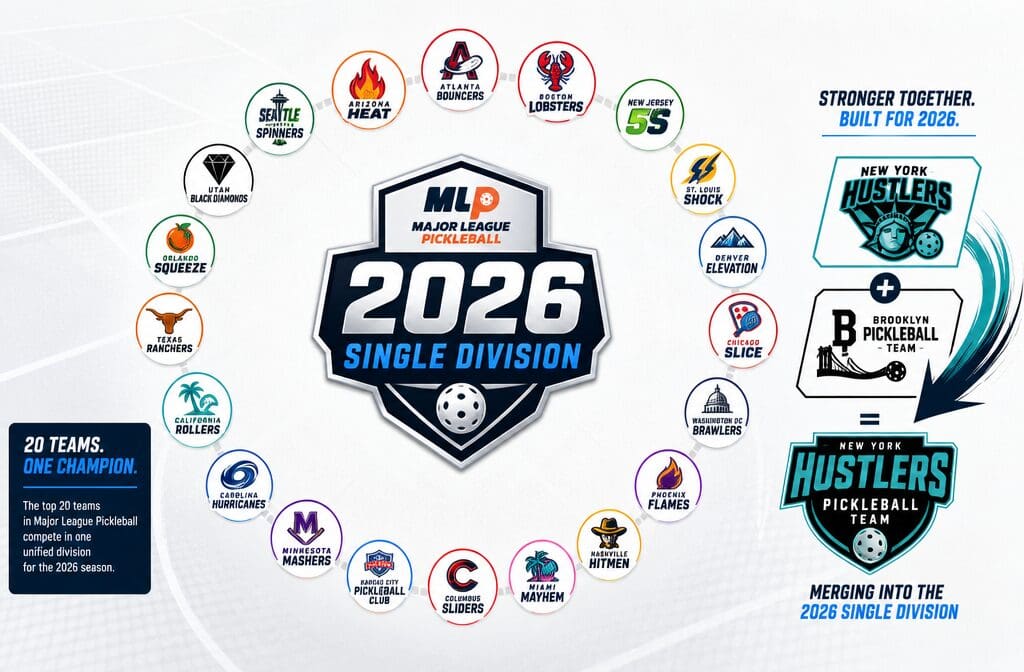
Major League Pickleball has restructured into a single 20-team division for 2026, eliminating the Premier and Challenger tiers while introducing a 66-pick draft with bidding mechanics and expanded six-player rosters that can all compete in the same match [1][6]. The New York Hustlers and Brooklyn Pickleball Team merged, and the league implemented new regular-season structures with revised scoring formats designed to increase competitive balance and entertainment value [1][6]. These changes fundamentally alter team strategy, player movement, and how fans experience professional pickleball.
Key Takeaways
- Single division structure: MLP consolidated from two tiers to one 20-team league for 2026, streamlining competition [1][6]
- Full roster utilization: All six players on a team can now compete in the same match, enabling specialist deployment [6]
- New draft system: The 2026 draft featured 66 picks using a bidding mechanism rather than traditional selection order [1]
- Team merger: New York Hustlers and Brooklyn Pickleball Team combined into one franchise [1]
- Enhanced regular season: More structured event scheduling with standings that directly affect playoff qualification [6]
- Revised scoring: Updated rally scoring and Dreambreaker-style singles tiebreakers maintain match length while boosting entertainment [6]
- Crossover talent: High-profile athletes like Sophia Kenin joined MLP, signaling growing league prestige [1]
- Active trade windows: Multiple offseason trade and waiver periods created unprecedented roster movement [2][5]
- Strategic depth: Teams can now leverage 5th and 6th roster spots for specific doubles or singles matchups [6]
- Competitive parity: Format changes aim to level the playing field and increase unpredictability [6]
What Teams Changed Rosters in Major League Pickleball This Season
The 2026 MLP offseason saw extensive roster turnover across all 20 franchises, with multiple trade windows and waiver periods creating unprecedented player movement [2][5]. The most significant structural change was the merger of the New York Hustlers and Brooklyn Pickleball Team into a single franchise, reducing the league from 21 to 20 teams [1].
Key roster developments included:
- Multiple trade windows opened between late 2025 and early 2026, allowing teams to reshape their lineups [5]
- Final waiver period triggered last-minute roster adjustments as teams optimized for the new six-player format [2]
- 66-pick draft redistributed talent across the league using a new bidding system [1]
- Crossover signings brought athletes from other sports, including tennis player Sophia Kenin [1]
The expanded six-player rosters meant teams needed to balance star power with specialist depth, leading to strategic acquisitions of players who excel in specific doubles combinations or singles matchups [6]. Teams that previously relied on four core players now had to identify complementary skill sets for positions five and six.
Common mistake: Assuming the merger was purely geographic. The New York/Brooklyn consolidation was part of the league’s broader strategy to create a more sustainable 20-team structure with balanced competition [1].
How Are the New MLP Team Format Rules Different From Last Year
MLP eliminated the Premier and Challenger division split in favor of a single 20-team league, fundamentally changing how teams qualify for championship events [1][6]. Previously, teams competed in separate tiers with promotion and relegation; now all 20 franchises compete in the same regular season with standings determining playoff seeding [6].
Major Format Changes for 2026
Category2025 Format2026 FormatLeague StructurePremier + Challenger divisionsSingle 20-team divisionRoster Size4-6 players6 players (all usable per match)Draft SystemTraditional selection order66-pick bidding mechanismRegular SeasonEvent-based with less structureStructured schedule with standingsRoster DeploymentLimited lineup rotationAll 6 players can compete same matchScoringTraditional rally scoringEnhanced rally scoring + Dreambreaker singles
The most impactful change: Teams can now deploy all six roster members in a single match, allowing coaches to substitute specialists for specific doubles pairings or singles matchups rather than committing to a four-player lineup for an entire event [6]. This creates tactical depth similar to professional tennis or team tennis formats.
The new regular-season structure means every match affects playoff qualification, replacing the previous event-by-event approach where teams could recover from poor performances more easily [6]. Choose this format if you want sustained competitive pressure; it penalizes inconsistency more than the old system.
Which Pro Pickleball Players Got Traded to Different Teams
Specific trade details from the 2026 offseason remain partially undisclosed, but multiple trade windows between December 2025 and February 2026 facilitated significant player movement [5]. The league opened Trade Window 1 in late 2025, followed by additional periods that allowed teams to adjust rosters after the draft [5].
Notable movement patterns included:
- Draft-related reshuffling: The 66-pick draft redistributed players across franchises, with teams using the bidding system to target specific athletes [1]
- Waiver period activity: The final waiver window before the season saw teams making last-minute adjustments to optimize chemistry [2]
- Strategic acquisitions: Teams targeted players who complemented their existing stars’ playing styles, particularly for the new 5th and 6th roster spots [2]
Who benefits most: Players with specialist skills (elite singles players, left-handed doubles specialists, or defensive grinders) gained value because teams can now deploy them strategically rather than needing all-around performers for every position [6].
Edge case: Some established partnerships were broken up during the draft and trades, forcing players who had developed chemistry over multiple seasons to adapt to new partners [2]. This creates short-term uncertainty but potentially better long-term competitive balance.
How Much Do MLP Players Actually Earn Now
MLP has not publicly disclosed specific salary figures or salary cap details for the 2026 season, making exact compensation difficult to verify. However, the league’s growth, increased sponsorship activity, and addition of crossover athletes like Sophia Kenin suggest rising compensation levels compared to previous years [1].
Factors affecting 2026 player earnings:
- Roster expansion to guaranteed six-player teams means more roster spots but potentially diluted per-player budgets
- League consolidation into a single division may have concentrated resources among 20 franchises rather than spreading them across two tiers
- Increased media attention and mainstream business coverage indicate growing revenue that could translate to higher player compensation [6]
- Crossover talent joining the league typically requires competitive salaries to attract athletes from established sports [1]
What we know: The league implemented some form of team salary structure to maintain competitive balance, though specific cap numbers have not been released [6]. Teams must balance star player salaries against the need to fill six competitive roster spots.
Choose this league if: You’re a top-tier pickleball pro seeking structured team competition with growing mainstream visibility. The format changes suggest MLP is investing in long-term sustainability over short-term spending sprees.
Why Did Some Top Players Leave Their Original MLP Teams
Top players changed teams primarily due to the 2026 draft restructuring, strategic team rebuilding, and the merger that displaced New York/Brooklyn rosters [1][2]. The consolidation from 21 to 20 teams automatically forced roster changes, while the bidding-based draft gave teams new mechanisms to pursue specific players [1].
Key reasons for player movement:
- Forced displacement: The New York Hustlers/Brooklyn merger meant at least 6-12 players needed new teams [1]
- Draft mechanics: The bidding system allowed teams to aggressively pursue targets, potentially outbidding a player’s previous team [1]
- Strategic fit: The new six-player format prioritized different skill combinations, making some players less valuable to their original teams [6]
- Competitive ambitions: Players seeking championship opportunities may have requested trades to stronger rosters [2]
- Chemistry concerns: Some partnerships that worked in the four-player format didn’t translate to the expanded roster structure [2]
Common mistake new team owners make: Overvaluing star power without considering how six players will mesh tactically. The new format rewards balanced rosters with complementary specialists over top-heavy lineups with weak depth [6].
Who this affects most: Mid-tier players who previously secured roster spots as all-around contributors now face competition from specialists who excel in specific matchup scenarios [2].
Is Mixed Doubles Still a Key Part of MLP Competitions
Mixed doubles remains a core component of MLP match formats in 2026, continuing the league’s tradition of showcasing both men’s and women’s talent in combined team competitions [6]. The format changes enhanced rather than diminished mixed doubles’ importance by allowing teams to deploy specialist pairings from their expanded six-player rosters [6].
How mixed doubles fits the new format:
- Tactical deployment: Teams can now select their optimal mixed doubles pairing from multiple combinations rather than being locked into limited options [6]
- Specialist advantage: Players who excel specifically in mixed doubles (strong net players, left-handed combinations) gained roster value [6]
- Match structure: Mixed doubles continues to count toward overall team scoring alongside men’s and women’s doubles and singles [6]
The ability to use all six roster members in a single match means coaches can substitute mixed doubles specialists who might not be as strong in gender-specific doubles, adding strategic depth to team construction [6].
Edge case: Teams with strong gender balance across all six players have more flexibility than those with four strong players of one gender and two weaker players of the other, making roster balance during draft and trades critical.
What Are the Biggest Strategic Shifts in Team Compositions
The expansion to full six-player active rosters fundamentally changed team building from star-focused to depth-oriented strategies [6]. Teams now prioritize complementary skill sets and matchup-specific specialists rather than simply assembling the four best available players [6].
Strategic Priorities for 2026 Rosters
Depth over star power: Teams need competitive players in positions 5-6 who can exploit specific matchups rather than roster spots that never see court time [6].
Specialist value: Players who excel in narrow roles (elite singles, left-handed doubles, defensive specialists) became more valuable because coaches can deploy them situationally [6].
Chemistry across multiple combinations: Rather than developing one or two partnerships, teams must ensure multiple pairing options work effectively together [6].
Singles capability: The introduction of Dreambreaker-style singles tiebreakers means teams need at least two strong singles players rather than relying solely on doubles specialists [6].
Tactical flexibility: Rosters that offer multiple lineup configurations for different opponents have competitive advantages over rigid four-player cores with weak depth [6].
Choose this approach if: You’re building a team for sustained regular-season success rather than single-event peaks. The new format rewards consistent depth over volatile star performances.
Which MLP Teams Are Most Likely to Dominate This Season
Predicting 2026 dominance requires evaluating which teams best adapted to the new six-player format, draft positioning, and offseason acquisitions [2][7]. Teams that secured balanced rosters with specialist depth and strong singles players hold advantages over star-heavy lineups with weak 5th and 6th positions [6][7].
Factors indicating championship potential:
- Draft success: Teams that identified undervalued specialists in the 66-pick draft gained competitive edges [1]
- Roster balance: Franchises with four elite players plus two strong specialists outperform top-heavy rosters [6]
- Coaching adaptation: Teams whose coaches understand the new tactical possibilities of six-player deployment [6]
- Chemistry development: Franchises that maintained core partnerships while adding complementary pieces [2]
- Regular-season consistency: The structured schedule rewards teams that perform well across multiple events rather than peaking once [6]
What to watch: Early-season performance will reveal which teams successfully integrated new players and adapted tactics to the format changes [7]. Teams struggling to deploy their 5th and 6th roster spots effectively will fall behind quickly.
Mistake to avoid: Assuming previous championship teams will automatically dominate. The format changes leveled the playing field, and teams that optimized for the old system may struggle to adapt [6].
How Are the New Team Salary Caps Affecting Player Recruitment
While MLP has not publicly disclosed specific salary cap figures for 2026, the league implemented financial structures designed to maintain competitive balance across the 20-team single division [6]. These constraints affect how teams allocate resources across six roster spots rather than concentrating spending on four stars.
Salary cap implications for recruitment:
- Depth over stars: Teams must balance star player salaries against the need for competitive 5th and 6th roster members [6]
- Specialist market: Players with narrow but elite skills may command lower salaries than all-around stars, creating value opportunities [6]
- Crossover talent costs: Attracting athletes from other sports (like Sophia Kenin) likely requires premium compensation that affects remaining roster budget [1]
- Competitive parity: Salary structures prevent wealthy franchises from simply buying championships, forcing strategic roster construction [6]
Who benefits: Mid-tier players with specialist skills gained leverage because teams need to fill six competitive spots within budget constraints. Teams can’t afford six superstars, creating opportunities for role players [6].
Edge case: Teams in major markets (former New York/Brooklyn franchise, for example) may have non-salary advantages (endorsements, exposure) that help attract talent despite cap constraints [1].
What Mistakes Are New MLP Team Owners Making
New team owners frequently overvalue star power while underestimating the importance of roster depth and specialist skills in the six-player format [6]. The transition from four-player cores to full six-player active rosters requires different team-building philosophies that some franchises have been slow to adopt [6].
Common ownership mistakes in 2026:
- Top-heavy rosters: Spending heavily on positions 1-4 while treating spots 5-6 as afterthoughts creates tactical limitations [6]
- Ignoring specialists: Failing to value players who excel in narrow roles (singles, specific doubles combinations) [6]
- Chemistry assumptions: Assuming talented players will automatically mesh without considering playing style compatibility [2]
- Draft strategy errors: Not adapting to the bidding system’s unique dynamics during the 66-pick draft [1]
- Format misunderstanding: Building rosters optimized for the old event-based system rather than the new regular-season structure [6]
- Neglecting coaching: Underinvesting in coaching staff who understand the tactical possibilities of six-player deployment [6]
What works instead: Successful franchises build balanced rosters with clear roles for all six players, invest in coaching that maximizes tactical flexibility, and prioritize complementary skill sets over individual star power [6][7].
Choose specialists if: Your top four players have clear strengths and weaknesses. Adding specialists who compensate for those gaps creates better overall team performance than adding generalists [6].
Who Benefits Most From the Latest MLP Format Changes
Players with specialist skills, mid-tier professionals, and teams with strong organizational depth benefit most from the 2026 format changes [6]. The six-player active roster system and regular-season structure reward depth and consistency over individual brilliance and single-event peaks [6].
Winners From Format Changes
Specialist players: Elite singles players, left-handed doubles specialists, and defensive grinders gained roster value because teams can deploy them situationally [6].
Mid-tier pros: Players ranked 15-40 in the sport found more roster opportunities as teams needed competitive depth beyond four stars [6].
Well-coached teams: Franchises with coaching staffs who understand tactical substitution and matchup exploitation gained competitive advantages [6].
Balanced rosters: Teams that avoided top-heavy construction and built six-player depth [6].
Consistent performers: The regular-season structure rewards players who perform well across multiple events rather than peaking once [6].
Potential Losers
- Volatile stars: Players who deliver spectacular peaks but inconsistent results struggle in the regular-season format [6]
- One-dimensional teams: Rosters built around a single partnership without depth [6]
- Generalist role players: Athletes who were “good enough” for 4th roster spots face competition from specialists [6]
The bottom line: The format changes prioritize team depth, tactical flexibility, and sustained performance over individual star power and single-event heroics [6].
Are Pro Pickleball Team Dynamics Getting More Competitive
Yes, the 2026 format changes significantly increased competitive intensity across MLP by eliminating the Premier/Challenger division split and implementing a regular-season structure where every match affects playoff qualification [6]. The single 20-team division means all franchises compete directly rather than some teams dominating a lower tier [1][6].
Factors increasing competitiveness:
- Parity mechanisms: The draft bidding system and salary structures prevent talent concentration [1][6]
- Regular-season pressure: Structured scheduling means teams can’t recover from poor events as easily [6]
- Tactical depth: Six-player rosters allow more teams to compete by exploiting matchup advantages [6]
- Elimination of tiers: No more “easy wins” against Challenger-level competition [1][6]
- Increased stakes: Mainstream media coverage and growing sponsorship raise the importance of every match [6]
What this means for fans: More matches with playoff implications, fewer blowouts, and greater unpredictability throughout the season [6]. The format changes were explicitly designed to increase entertainment value through competitive balance [6].
Edge case: Dominant teams from previous years may struggle early as they adapt to the new format, creating unexpected results that boost overall league competitiveness [6][7].
What Do Casual Pickleball Fans Need to Know About These Changes
Casual fans should understand that MLP now operates as a single 20-team league with a structured regular season where teams use six-player rosters and every match affects playoff qualification [1][6]. The changes make following the league more similar to traditional professional sports with standings, playoff races, and strategic depth [6].
Quick Guide for Casual Fans
League structure: One division, 20 teams, regular-season schedule leading to playoffs [1][6].
Team rosters: Six players per team, all of whom can compete in the same match [6].
Match format: Mixed doubles, men’s doubles, women’s doubles, and singles with enhanced scoring [6].
What’s different: Teams can substitute specialists for specific matchups, making coaching and tactics more visible [6].
Why it matters: More competitive balance, fewer predictable outcomes, and sustained storylines throughout the season [6].
How to follow: Pay attention to standings and playoff races rather than just individual event results [6].
Star power: High-profile crossover athletes like Sophia Kenin joining the league [1].
Choose this league if: You enjoy team sports with strategic depth, sustained competitive narratives, and growing mainstream visibility. The format changes make MLP more accessible to casual sports fans [6].
FAQ
When does the 2026 MLP season start?
The 2026 MLP season follows the offseason trade and draft period that concluded in early 2026, with the regular season beginning shortly after [5][7]. Specific event dates are available on the official MLP schedule.
How many teams are in MLP for 2026?
MLP operates with 20 teams in a single division for 2026, down from 21 after the New York Hustlers and Brooklyn Pickleball Team merger [1].
Can all six players on an MLP roster play in the same match?
Yes, the 2026 format allows all six roster members to compete in the same match, enabling strategic substitutions and specialist deployment [6].
What happened to the Premier and Challenger divisions?
MLP eliminated the two-tier structure in favor of a single 20-team division for 2026, with all franchises competing in the same regular season [1][6].
How does the new MLP draft work?
The 2026 draft featured 66 picks using a bidding system rather than traditional selection order, allowing teams to compete for specific players [1].
What is a Dreambreaker in MLP?
The Dreambreaker is a singles tiebreaker format used to decide close matches, adding singles competition to the traditional doubles-focused format [6].
Do MLP players get paid salaries?
Yes, MLP operates with team salary structures, though specific figures are not publicly disclosed. The league’s growth suggests increasing compensation levels [6].
Which tennis player joined MLP for 2026?
Sophia Kenin, a professional tennis player, signed with MLP for the 2026 season, representing growing crossover appeal [1].
How does the regular season affect MLP playoffs?
The 2026 format implements a structured regular season where match results and standings directly determine playoff qualification and seeding [6].
What are the biggest strategy changes for MLP teams in 2026?
Teams now prioritize roster depth and specialist skills across six players rather than concentrating talent in four positions, with tactical substitution becoming a key competitive factor [6].
Can I watch MLP matches live?
MLP broadcasts matches through various media partners, with specific streaming and broadcast information available on the league’s official channels [9].
What makes the 2026 MLP format more entertaining?
The six-player roster system, enhanced scoring, singles tiebreakers, and competitive balance mechanisms create more unpredictable matches and sustained storylines throughout the regular season [6].
Conclusion
MLP’s 2026 transformation represents the most significant structural change in the league’s history, consolidating into a single 20-team division with expanded rosters and a regular-season format that prioritizes depth, tactical flexibility, and sustained competitive balance. The elimination of Premier and Challenger tiers, combined with the ability to deploy all six roster members in the same match, fundamentally alters team strategy and increases parity across the league [1][6].
For fans, these changes create a more accessible and engaging product with traditional sports elements like standings, playoff races, and strategic coaching decisions. The addition of crossover athletes like Sophia Kenin signals growing mainstream appeal, while the format adjustments ensure more competitive matches and fewer predictable outcomes [1][6].
What to watch next: Pay attention to which teams successfully integrate their 5th and 6th roster spots, how coaches exploit tactical substitution opportunities, and which specialists emerge as high-value role players in the new system. Early-season results will reveal which franchises adapted most effectively to the format changes and which are still optimizing their approach [6][7].
Action steps for fans: Follow regular-season standings rather than just individual event results, watch for strategic substitutions during matches, and track how teams deploy specialists in specific matchup situations. The 2026 season offers unprecedented strategic depth for engaged fans willing to look beyond star power to understand team construction and tactical execution [6].
References
[1] Major League Pickleball 2026 Changes New York Hustlers Brooklyn Pickleball Team Merger – https://thekitchenpickle.com/blogs/news/major-league-pickleball-2026-changes-new-york-hustlers-brooklyn-pickleball-team-merger
[2] Predicting 11 Roster Changes During The Final Mlp Waiver Period – https://www.thedinkpickleball.com/predicting-11-roster-changes-during-the-final-mlp-waiver-period/
[6] Major League Pickleball Competition Changes For 2026 Season – https://www.forbes.com/sites/toddboss/2026/01/14/major-league-pickleball-competition-changes-for-2026-season/
[7] Previewing Mlp 2026 Assessing Offseason Moves – https://pickleball.com/news/previewing-mlp-2026-assessing-offseason-moves
[9] Mlp Updates – https://majorleaguepickleball.co/news/category/mlp-updates/
Content, illustrations, and third-party video appearing on GEORGIANBAYNEWS.COM may be generated or curated with AI assistance or reproduced pursuant to the fair dealing provisions of the Copyright Act, R.S.C. 1985, c. C-42. Attribution and hyperlinks to original sources are provided in acknowledgment of applicable intellectual property rights. Such referencing is intended to direct traffic to and support the original rights holders’ platforms.