















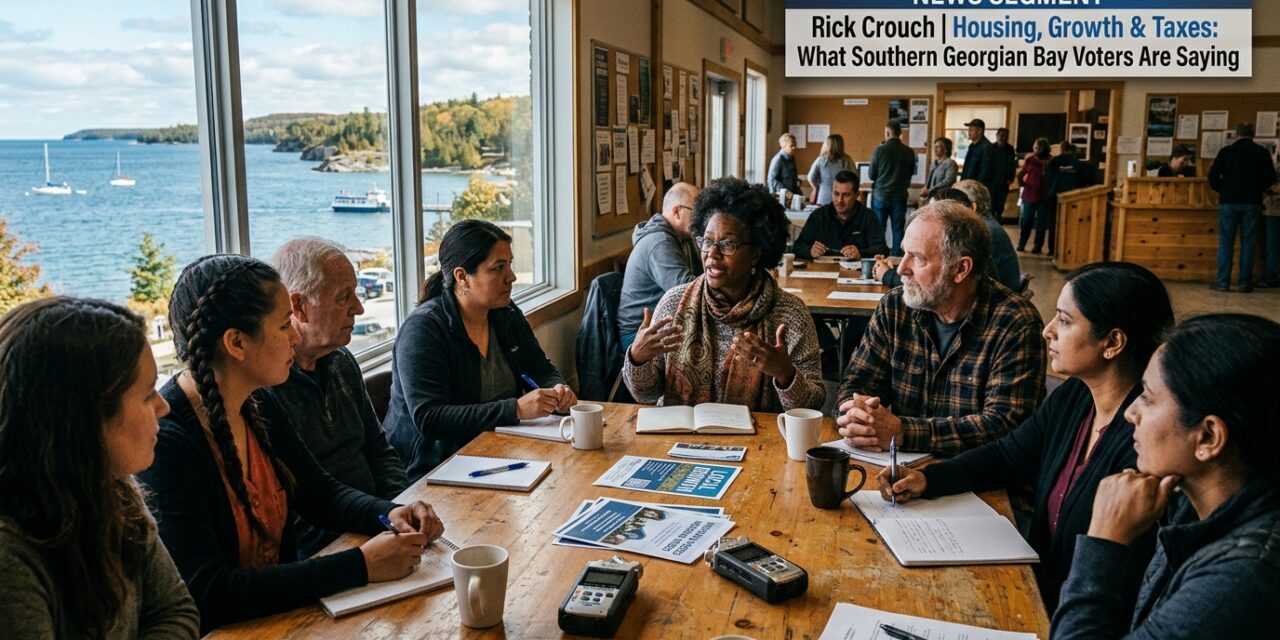
Rick Crouch | Housing, Growth & Taxes: What Southern Georgian Bay Voters Are Saying
by Rick Crouch | Community Issues, Environmental Issues, Municipal Affairs, Political & Economic News
As we approach the upcoming 2026 municipal election campaign season, it is becoming increasingly clear that housing affordability, community growth, and property taxes will be among the most important issues influencing how residents cast their ballots. While property taxes have always been issues raised at election time, the matter of affordable housing and community growth become increasingly significant topics with voters in recent years and this year will be no exception.
Many of us in the real estate profession regard affordable housing both for property owners and renters as a serious issue that needs attention. In recent weeks I have attended two meetings with respect to housing affordability, one of which was a symposium in Owen Sound where the keynote speaker was Nik Nanos of Nanos Research, one of the top research/polling companies in Canada. During the meeting Mr. Nanos, whom I had met and spoken with a year ago, presented the results of a recent survey commissioned by the One Point Association of REALTORS® of whom I am a member and Past President (2008).
This presentation provided valuable insight into what residents in municipalities such as Collingwood, Owen Sound and Kincardine are thinking about regarding the future of their communities. While every municipality is unique, many of the findings closely mirror the conversations I have been having with Buyers, Sellers, property owners, and residents both full and part-time throughout Collingwood, the Blue Mountains and Southern Georgian Bay region.
The survey reveals communities wrestling with important challenges one being, how do we create housing opportunities for future generations while preserving the quality of life that attracted many of us to this region in the first place?
Housing Affordability Remains Top of Mind
For many residents, housing affordability continues to be a significant concern. As shown in the chart below, 11% of those surveyed saw the cost of housing to a major concern, particularly in Collingwood and Owen Sound. Housing came in second behind inflation and the cost of living at 17%. Young families, first-time buyers, essential workers, and even retirees looking to downsize are finding it increasingly difficult to secure housing that meets their needs and budget.

Continuing down the list of top responses, homelessness was a major concern in Owen Sound as was crime, these two go hand-in-hand. In Collingwood residents were more focused on the environment which is not surprising given the town’s aging sewage treatment plant with roads and transportation issues coming in not far behind.

What I have found as a real estate Broker for over 25 years, is that despite affordability challenges, the dream of homeownership remains alive and well. Many younger residents still aspire to own a home in the communities where they live and work. That is encouraging because homeownership has long been one of the foundations of financial stability and community building. The challenge, however, is creating enough housing options to make that dream achievable and this always raises the need for a sound employment strategy.
The Job Market
Employment is what brought me to Collingwood back in 1985 when I was transferred to the area by Goodyear Canada, to lead the marketing and sales activities at their Collingwood hose manufacturing plant. Back then this area was still a manufacturing hub with the Collingwood Shipyards, Harding Carpet, Kaufman Furniture, LOF Glass (now Pilkington) and Nacan Starch among others. Most of the town’s manufacturing has leff, not only from this area but from North America and manufacturing of a large scale is highly unlikely to ever return.
Not surprising only 20% of Collingwood residents surveyed rated the job market as “good.” The local economy and job market has for the most part, become a service industry for tourism and other segments other than manufacturing with lower paying positions that are out of synch with area housing costs either for buying or renting.

Notwithstanding the limited job opportunities, 86% of Collingwood respondents rate the community as a good place to raise a family largely due to the lifestyle the area offers. Virtually unlimited recreational amenities across four seasons, attractive residential communities, schools are more.

An even higher number, 90% of residents view Collingwood as a safe place to live. Not surprisingly with a high degree of homelessness and crime, only 56% of those in Owen Sound see the city as a safe place to reside.

Residents Support Balanced Growth
One of the strongest messages from the survey is that residents are not looking for a one-size-fits-all solution to addressing the need for affordable housing.
Nearly half of respondents, 47% indicated they support a balanced approach to housing growth that includes a mix of housing types. This includes single-family homes, townhomes, apartments, duplexes, triplexes, secondary suites, and other forms of housing that can accommodate people at different stages of life and income levels. Only 12% of those surveyed remained “unsure” as to what approach was needed.

This is important because housing needs are changing. Young professionals, growing families, retirees, and seasonal residents all have different requirements. Successful communities are those that provide a variety of housing options rather than relying on a single development model and price point(s).
Of those surveyed, 52% of respondents felt that multiplexes, four-unit homes should be allowed in existing neighbourhoods. Similarly, 44% felt that programs should be expanded to support the establishment of secondary or backyard suites. See chart below
Lastly, 27% were in favour of preventing municipalities from passing by-laws that would prohibit rental property owners from renovating their properties without approval while 38% were opposed to such action. It would suggest this latter group want a voice in accepting or opposing such activity, hence the need to retain some type of approval process.

Specific Issues of Concern
Every municipality has its own issues or areas of concern. For the town of Collingwood, water and wastewater was by far the most significant issue with 49% of residents being concerned while 18% are somewhat concerned. Conversely, 28% said they were unconcerned while 3% were somewhat concerned with 3% unsure.

To address the water and wastewater issue and with 67% of residents concerned or somewhat concerned, 56% were in support of pausing development until infrastructure capacity is addressed and expanded.
Further as mentioned above, with 28% of respondents saying they are “unconcerned’ about the town’s water and wastewater capacity, only 10% would oppose and 4% would somewhat oppose pausng development. There seems to be a disconnect here with a fair number of people being “unconcerned” 28% yet just half of those would support pausing development.

The Property Tax Dilemma
Perhaps the most revealing finding from the survey was the divide regarding property taxes and infrastructure.
Many residents want municipalities to keep property taxes as low as possible, while others recognize that roads, water and wastewater systems, recreational facilities, emergency services, and other infrastructure investments are necessary to support future growth.
This creates a difficult balancing act for municipal councils with 47% in favour of keeping taxes down even if housing slows while 42% are will to accept a small tax increase to support housing infrastructure. Priorities need to be focused on providing essential servies rather that “nice-to-have” amenities with money that might be left over.
Most residents understand that growth comes with costs both from a financial perspective as well as lifestyle. The question is not whether infrastructure is needed but rather who should pay for it and how quickly communities should or are able to grow.
These discussions are likely to become increasingly important during election campaigns as candidates outline their priorities and visions for the future.
Housing Will Influence How People Vote
One of the most significant findings in the survey is that housing issues are expected to influence voting decisions for many residents in the upcoming municipal election. That should not come as a surprise. Below is a summary as to what residents (voters) are focused on.
- 84% saying they are worried about the next generations’s ability to afford a home
- Over 50% feel municipalities are not doing enough or they are frustrated by the lack of progress on housing affordability

The chart below clealy reflects voter sentiment:
- 45% say housing will affect their voting choices
- 51% of survey participants dream of owning a home
- 37% “disagree” with having a dream of home ownership. This begs the question, is home ownership not a priority or have they simply been forced to give up that dream?
According to Royal Bank of Canada’s Spring Home Ownership Poll, 67% of Canadians say they have always dreamed of buying a home (up from 62% in 2025)

Municipal governments play a direct role in planning decisions, zoning policies, development approvals, infrastructure investments, and housing initiatives. Residents understand that local councils have a significant impact on how communities evolve over time.
As a result, voters are paying close attention to where candidates stand on issues such as:
- Housing affordability
- Responsible growth
- Infrastructure investment
- Property taxes
- Community planning
- Protection of neighbourhood character
- Availability of housing for local workers and families that coincide with housing costs
Candidates who can present practical, balanced solutions may find themselves connecting with voters who are increasingly concerned about these issues.
Out of the entire Nanos Research presentation the one slide that perhaps jumps out the most about the upcoming municipal election is the one below that shows,
- 25% of survey respondents are undecided
- 25% plan to vote for incumbents, often it’s their friend or a family member
- 50% essentially want a clean slate on their municipal council, they are unhappy with the performance of those currenrly in place on a variety of fronts and simply want and will vote for change.

What This Means for Southern Georgian Bay
Throughout Collingwood, The Blue Mountains, Thornbury, Meaford, Clearview Township, Wasaga Beach, and surrounding communities, we are seeing many of the same challenges highlighted in this survey.
Residents want housing opportunities for their children and grandchildren. They want well-maintained infrastructure. They want responsible fiscal management. They want to preserve the character and appeal of their communities. Most importantly, they want elected officials who understand the need to balance all of these priorities. At the end of the day all of this comes down to municipal councils being “accountable” to their constituents.
There are no simple answers hence some tough decisions need to be made.
The survey clearly demonstrates that residents are engaged, for the most part informed, and paying attention. Housing affordability and community growth are no longer niche issues. They have become mainstream concerns that will likely shape voter decision making and municipal policy discussions for years to come.
Final Thoughts
As both a real estate professional and long-time resident of Southern Georgian Bay, I believe the conversation should not be about choosing between growth and preservation. Rather, it should focus on how we achieve thoughtful, sustainable growth that strengthens our communities while maintaining the qualities that make them special.
From a personal perspective, I ran for Collingwood Council in 2014 and was narrowly defeated. One of the main points of my campaign was my belief that, “you can’t stop development, but you must manage it for a variety of reasons one of which is to preserve the very reason why people choose to reside here in the first place.” It would suggest that pausing development, managing municipal finances and priorties that focus on key infrastructure services such as water, wastewater, roads are an integral part of that challenge. Rec centres, dog parks, socces fields and other such amenities are nice-to-have, but they can’t come at the expense of key essential needs like roads, water and wastewatet services.
The upcoming municipal election presents an opportunity for voters to evaluate how candidates plan to address housing affordability, infrastructure needs, and property tax pressures. Based on the findings of this survey, these issues are likely to be front and centre when residents head to the ballot box.
The future of our communities will depend on finding solutions that balance affordability, opportunity, fiscal responsibility, and quality of life for current and future generations alike.
This information shared herein is not simply the opinion of myself or the One Point Association of REALTOS®/ Rather these are are results of the survey conducted by Nanos Research and can be view by clicking: A Housing Crunch and a Hunger for Change
NOTE: The author is a Broker, Market Value Appraiser-Residential with Sotheby’s International Realty Canada and a Past President (2008) of the One Point Association of REALTORS®. Trusted Advice Generates Elevated Results.
📞 Direct: 705-443-1037📧 Email: rcrouch@sothebysrealty.ca
This post is not intended to solicit homes or other properties already listed for sale.