






















Last updated: June 27, 2026
Roughly half of adults over 55 report difficulty falling or staying asleep, but not all of that is a disorder — some changes are a normal part of aging [1]. Sleep problems in older adults stem from a mix of biological shifts, chronic illness, medications, and lifestyle habits, and most respond well to targeted changes in routine or, when needed, professional treatment. The key is knowing which symptoms are expected and which ones signal something treatable.
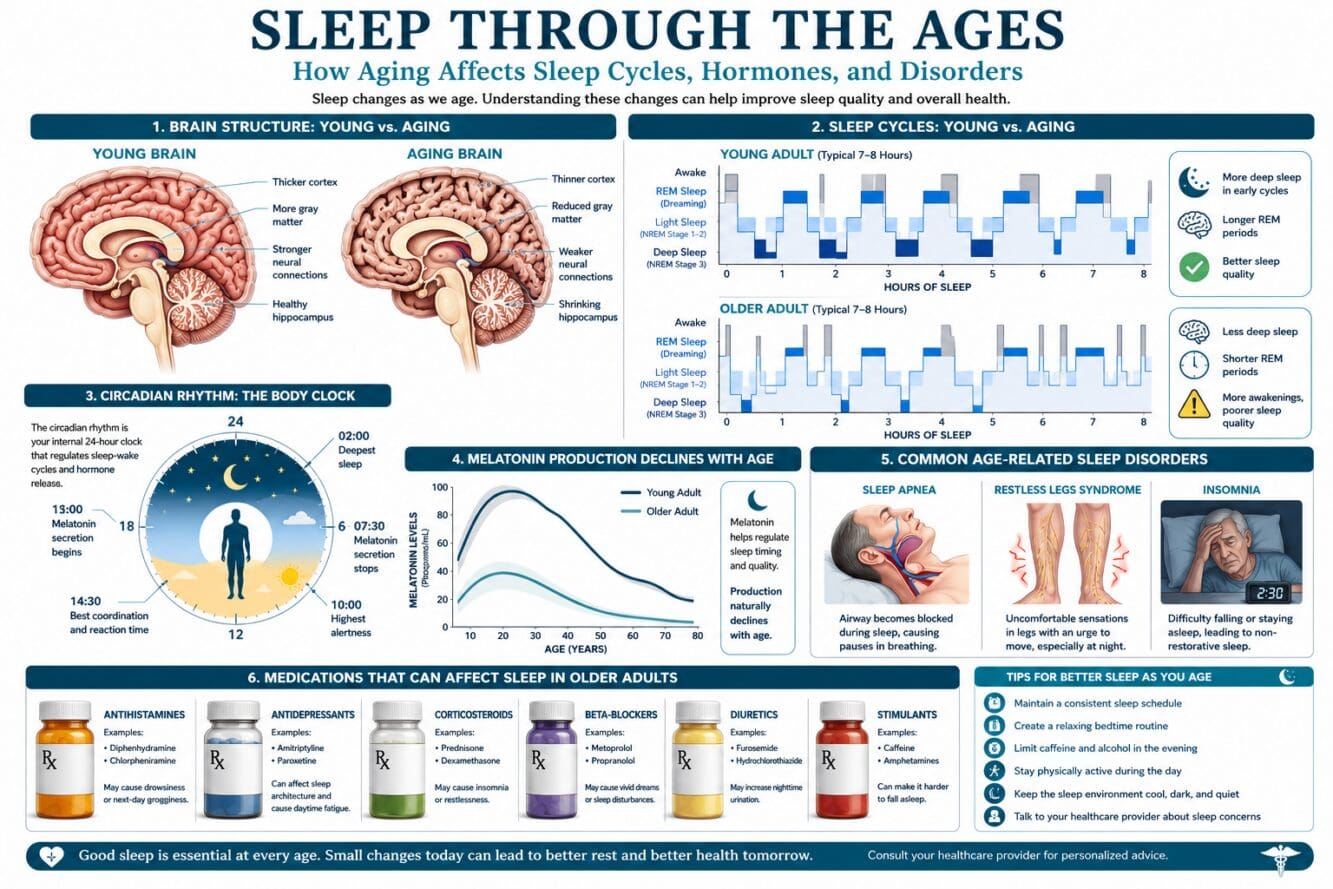
Sleep problems in older adults arise from several overlapping factors, not a single cause. Biological changes in the aging brain reduce the production of melatonin and alter the circadian clock, making it harder to fall asleep and stay asleep through the night [2].
Key contributors include:
Managing stress is also relevant here — chronic psychological stress elevates cortisol, which works against the body’s natural sleep signals.
Waking at night is the most common sleep complaint among older adults. The most frequent reasons are lighter sleep architecture (less deep sleep means minor sounds or movements cause arousal), nocturia (the need to urinate at night, often linked to diuretic medications or prostate issues), pain, and sleep apnea causing brief awakenings the person may not fully remember [1] [2].
Common mistake: Many older adults assume waking at 3 a.m. means they need to go to bed earlier. In fact, going to bed too early is often the cause — it stretches the sleep window beyond what the body can sustain, leading to mid-night waking.
Sleep patterns do change with age, but the need for sleep does not disappear. Adults over 65 still need 7 to 8 hours of sleep per night, according to guidance from the American Academy of Sleep Medicine [4]. What changes is sleep efficiency — older adults may spend more time in bed but get less restorative sleep.
It is normal to:
It is not normal to:
Normal aging changes sleep structure but does not cause significant daytime impairment. Insomnia, by clinical definition, involves difficulty sleeping at least three nights per week for three or more months, combined with noticeable effects on daytime functioning — fatigue, concentration problems, irritability, or reduced performance [6].
Decision rule: If poor sleep is affecting daily life, it is insomnia (or another sleep disorder) and warrants assessment. If sleep is lighter and slightly shorter but daytime function is fine, that is likely normal aging.
Several commonly prescribed drugs disrupt sleep as a side effect. This is one of the most overlooked causes of sleep problems in older adults [1] [5].
| Medication Class | How It Affects Sleep |
|---|---|
| Diuretics | Cause nighttime urination |
| Beta-blockers | Suppress melatonin; cause vivid dreams |
| Antidepressants (SSRIs) | Can cause insomnia or fragmented sleep |
| Corticosteroids | Increase alertness and cortisol |
| Decongestants | Stimulant effect delays sleep onset |
| Antihypertensives | Some cause nighttime awakenings |
Anyone who notices sleep worsening after starting a new medication should speak with their prescribing physician before stopping it.
Sleep apnea becomes more common with age and is significantly underdiagnosed in seniors. Obstructive sleep apnea (OSA) occurs when throat muscles relax during sleep and block the airway, causing repeated brief awakenings. Research linked to Stanford Sleep Medicine Centre work highlights the growing awareness of OSA in aging populations.
OSA is especially concerning because it is associated with accelerated cognitive decline in people with Alzheimer’s disease [3]. Symptoms to watch for include loud snoring, gasping during sleep (reported by a partner), morning headaches, and excessive daytime sleepiness. CPAP therapy is effective and well-tolerated in older adults when properly fitted.
For mild to moderate sleep problems in older adults, behavioral and environmental changes produce meaningful results without medication risks [4].
Effective strategies include:
Melatonin can help older adults whose sleep problems relate to circadian timing — for example, those who wake too early or have jet lag. Low doses (0.5 to 1 mg) taken 1-2 hours before the desired bedtime are generally preferred over higher doses [5].
However, melatonin has limited evidence for treating chronic insomnia in seniors. Over-the-counter sleep aids containing diphenhydramine (such as Benadryl or ZzzQuil) are not recommended for older adults — they cause next-day grogginess, confusion, and increase fall risk.
Safer options under medical supervision:
Benzodiazepines and Z-drugs (zolpidem, zopiclone) carry significant risks in seniors, including falls and cognitive impairment, and should only be used short-term if at all [6].
Yes, most sleep problems in older adults are treatable. CBT-I resolves chronic insomnia in 70-80% of patients and produces longer-lasting results than medication [1] [6]. When an underlying condition (sleep apnea, pain, medication side effect) is identified and addressed, sleep often improves substantially.
The Stanford University School of Medicine has been involved in research confirming that even adults in their 70s and 80s show significant sleep improvement with structured behavioral interventions.
See a doctor when:
Untreated sleep disorders in older adults are linked to higher risks of falls, cardiovascular disease, obesity, and diabetes [1]. Early intervention matters.
Family members can support better sleep by addressing the environment and routine without creating pressure around sleep itself (which worsens anxiety and insomnia).
Practical steps:
Side sleeping (particularly the left side) is generally recommended for older adults. It reduces snoring and sleep apnea events, supports spinal alignment, and may reduce acid reflux. Back sleeping is acceptable for those without apnea but increases airway obstruction risk in those who snore. Stomach sleeping is the least recommended position at any age, as it strains the neck and lower back.
For seniors with arthritis or hip pain, a pillow between the knees while side sleeping reduces joint pressure significantly.
Sleep problems in older adults are common but not inevitable, and most are addressable once the underlying cause is identified. The first step is separating normal age-related changes from treatable conditions like insomnia, sleep apnea, or medication side effects. Start with consistent sleep and wake times, morning light exposure, and a review of any medications that may be disrupting rest. If symptoms persist beyond three weeks or affect daytime safety and function, speak with a physician — a referral for CBT-I or a sleep study can make a significant difference. Better sleep at any age is achievable with the right approach.
Q: Is it normal for older adults to need less sleep?
Adults over 65 still need 7 to 8 hours of sleep. What changes is sleep efficiency and timing, not the total requirement.
Q: What is the safest sleep aid for seniors?
CBT-I (Cognitive Behavioral Therapy for Insomnia) is the safest and most effective first-line treatment. Low-dose melatonin or ramelteon may help with circadian issues. Antihistamine-based sleep aids are not recommended for older adults.
Q: Can sleep apnea develop in old age?
Yes. Sleep apnea becomes more common with age, particularly in men and in people who are overweight. It is frequently undiagnosed in seniors and can worsen cognitive decline [3].
Q: Why do older adults wake up so early?
The circadian clock shifts earlier with age, causing earlier sleepiness and earlier waking. Going to bed too early amplifies this effect.
Q: Does alcohol help older adults sleep?
No. Alcohol may speed up sleep onset but disrupts sleep architecture, increases nighttime awakenings, and worsens sleep apnea [1].
Q: How long does CBT-I take to work?
Most people see meaningful improvement within 4 to 8 weeks of structured CBT-I sessions, with results that last longer than medication-based approaches [6].
Q: Can exercise improve sleep in seniors?
Yes. Regular moderate exercise — particularly morning or early afternoon walks — is one of the most consistently effective non-drug interventions for sleep quality in older adults [4].
Q: Should older adults nap?
Short naps (under 20 minutes, before 3 p.m.) are fine. Long or late-afternoon naps reduce sleep pressure and make nighttime sleep harder to achieve.
[1] Sleep Disorders In The Elderly – https://www.healthline.com/health/sleep/sleep-disorders-in-the-elderly
[2] Sleep Older – https://www.uclahealth.org/medical-services/sleep-medicine/patient-resources/patient-education/sleep-older
[3] Art 20047832 – https://www.mayoclinic.org/diseases-conditions/alzheimers-disease/in-depth/alzheimers/art-20047832
[4] medlineplus.gov – https://medlineplus.gov/ency/article/000064.htm
[5] Causes – https://www.healthinaging.org/a-z-topic/sleep-problems/causes
[6] Drc 20355173 – https://www.mayoclinic.org/diseases-conditions/insomnia/diagnosis-treatment/drc-20355173
Content, illustrations, and third-party video appearing on GEORGIANBAYNEWS.COM may be generated or curated with AI assistance or reproduced pursuant to the fair dealing provisions of the Copyright Act, R.S.C. 1985, c. C-42. Attribution and hyperlinks to original sources are provided in acknowledgment of applicable intellectual property rights. Such referencing is intended to direct traffic to and support the original rights holders’ platforms.