























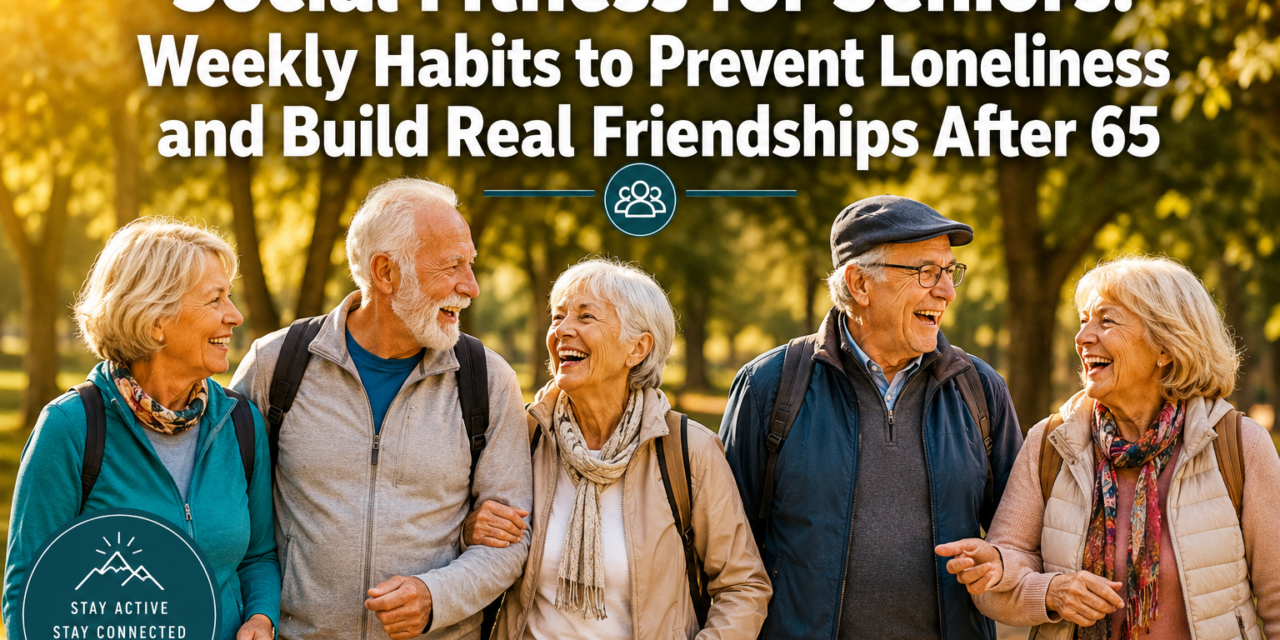
Social Fitness for Seniors: Weekly Habits to Prevent Loneliness and Build Real Friendships After 65

Last updated: May 25, 2026
Quick Answer: Social fitness for seniors means treating social connection like physical exercise — scheduling it, repeating it weekly, and progressively building stronger relationships over time. Adults 65 and older who engage in regular social activity reduce their risk of cognitive decline, heart disease, and depression. The goal is not to have hundreds of acquaintances but to build a small, consistent network of genuine connections through structured weekly habits.
Key Takeaways
- Approximately 25% of Americans aged 65 and older experience social isolation, making it one of the most common and underaddressed health risks in retirement [1]
- Social isolation is linked to higher risks of heart disease, depression, cognitive decline, and Alzheimer’s disease [2]
- Experts recommend 1 to 3 hours of social interaction daily (roughly 7–21 hours per week) to meaningfully reduce loneliness [3]
- Treating social connection as a weekly “workout” — with set times, recurring activities, and accountability partners — produces better results than waiting for connection to happen naturally
- Community centers, walking groups, volunteer programs, and hobby classes are among the most effective and affordable ways for seniors to meet new people [4]
- Introverted seniors benefit most from structured, small-group activities rather than large social events
- Technology (video calls, apps, online communities) supplements but does not fully replace in-person connection for preventing loneliness [7]
- Common mistakes include waiting to feel motivated, choosing only passive activities, and not following up after a first meeting
What Exactly Is Social Fitness, and How Does It Work for Older Adults?
Social fitness is the practice of actively maintaining and building social relationships through deliberate, repeated effort — the same way physical fitness requires regular exercise. For older adults, it means scheduling social contact, setting small weekly goals, and treating relationship-building as a health habit rather than a casual afterthought.
The concept matters because social connection does not maintain itself after retirement. Work colleagues, neighborhood routines, and family proximity often disappear, leaving a gap that must be filled intentionally. Research links regular social engagement to reduced risks of dementia, stroke, and heart disease [4].
How it works in practice:
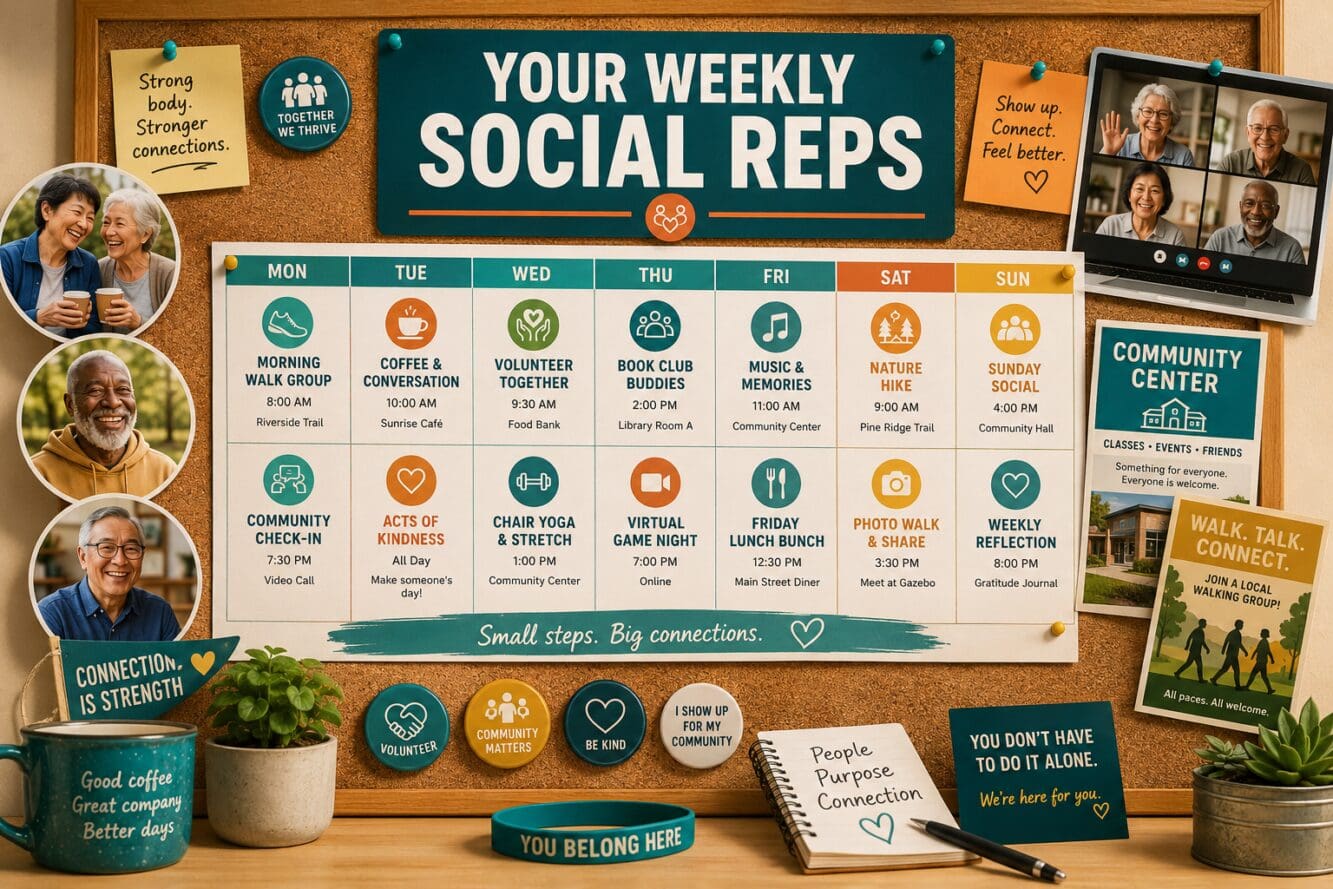
- Set a minimum of 2–3 scheduled social interactions per week
- Treat each interaction as a “rep” — consistency matters more than intensity
- Use an accountability partner (a friend, family member, or group) to stay on track
- Gradually expand the circle by adding one new activity or contact per month
How Much Time Per Week Do Seniors Need to Socialize to Reduce Loneliness?
Research from the Social Connection Guidelines suggests that 1 to 3 hours of meaningful social interaction per day — or 7 to 21 hours per week — is associated with better social well-being and lower loneliness [3]. For most seniors, even reaching the lower end of that range represents a significant improvement.
A practical starting point for someone rebuilding their social life:
| Weekly Goal | Activity Example | Time Investment |
|---|---|---|
| Baseline (beginner) | 1 coffee meetup + 1 group class | ~3–5 hours/week |
| Moderate | 2 group activities + 1 phone/video call | ~7–10 hours/week |
| Active | Daily short interactions + 2 group events | 14+ hours/week |
Common mistake: Counting passive activities (watching TV with someone in the room) as social time. Meaningful interaction requires back-and-forth conversation and genuine engagement.
What Are the Health Risks of Social Isolation in Retirement?
Social isolation in older adults is not just emotionally uncomfortable — it is a documented medical risk. Loneliness is associated with increased rates of high blood pressure, heart disease, obesity, depression, cognitive decline, and Alzheimer’s disease [2]. The CDC identifies social isolation as a serious public health concern with outcomes comparable to smoking 15 cigarettes a day (an estimate widely cited in public health literature, based on meta-analyses of mortality data).
Key risks at a glance:
- Cardiovascular: Higher rates of hypertension and heart disease
- Neurological: Faster cognitive decline and elevated dementia risk
- Mental health: Depression and anxiety are significantly more common in isolated seniors
- Physical: Reduced motivation for exercise, poorer sleep, and weakened immune response
Seniors who maintain active social lives show measurably better outcomes across all of these categories [4].
Best Places for Seniors to Meet New Friends: Community Centers and Beyond
Local community centers are among the most accessible starting points for social fitness for seniors. They typically offer workshops, fitness classes, arts programs, and social events — all in one location, often at low or no cost [5].
Where to look:
- Municipal recreation centers — most offer senior-specific programming
- Libraries — book clubs, lectures, and skill-sharing workshops
- Faith communities — regular gatherings with shared values
- Volunteer organizations — structured, purposeful contact with others [5]
- Continuing education programs — college campuses often welcome older learners
For residents in the South Georgian Bay region, local community hubs and seasonal events offer natural gathering points for older adults seeking connection. Local arts programming, such as events supported by the South Georgian Bay Music Foundation, can also serve as entry points for building friendships around shared interests.
Choose a community center if: you want variety, low cost, and a built-in schedule. Avoid it if you need a very specific niche interest — in that case, a hobby club or Meetup group is a better fit.
Are Walking Groups or Senior Exercise Classes Good for Making Friends?
Yes — group physical activity is one of the most effective dual-purpose strategies for social fitness. Joining a walking group or senior exercise class improves physical health while creating repeated, low-pressure opportunities for conversation [4].

Repetition is key. Seeing the same people weekly builds familiarity, which is the foundation of real friendship. A single yoga class rarely produces a new friend; twelve consecutive Tuesday classes often do.
Best group activity options by personality type:
- Extroverts: Zumba, group fitness, choir, team sports like squash or pickleball
- Introverts: Walking groups (smaller, easier conversation), art classes, gardening clubs
- Mixed: Volunteer teams, book clubs, cooking classes
How Much Do Senior Social Clubs and Meetup Groups Typically Cost?
Most senior social activities are low-cost or free. Municipal recreation programs for seniors often charge $5–$15 per class or offer monthly passes under $50. Volunteer work costs nothing. Many library and community center programs are completely free.
Cost breakdown (estimates):
- Community center membership: $0–$50/month
- Meetup.com group events: typically $0–$20 per event
- Continuing education (audit basis): $0–$100/semester at many colleges
- Faith community activities: generally free
- Senior travel clubs: variable, but day trips often run $30–$80
Edge case: Seniors on fixed incomes should ask directly about subsidized memberships — most municipal centers offer them but don’t advertise them prominently.
Activities That Work Well for Introverted Seniors Who Want Friends
Introverted seniors build friendships best through structured, recurring small-group activities rather than open-ended social events. The structure removes the pressure of initiating conversation, and the recurring format builds natural familiarity over time [5].
Top picks for introverts:
- Small walking groups (4–8 people)
- Book clubs with a set discussion format
- Art or pottery classes
- Gardening or nature programs
- Volunteer roles with a defined task (library shelving, food bank sorting)
Exploring local spirituality groups or contemplative communities can also offer a quieter, values-aligned social environment for introverts who find large gatherings draining.
Avoid: Large mixers, speed-friending events, or open drop-in socials — these formats tend to favor extroverts and can feel exhausting for introverts without producing lasting connections.
Is Online Friendship as Good as In-Person for Preventing Loneliness?
Online connection helps but does not fully replace in-person interaction for preventing loneliness in older adults. Video calls, social media, and online communities can meaningfully reduce isolation — especially for seniors with limited mobility — but research and clinical guidance consistently show that face-to-face contact produces stronger emotional bonds and better health outcomes [7].
Technology tools that genuinely help:
- Video calling (FaceTime, Zoom, Google Meet) — best for maintaining existing relationships
- Facebook Groups — good for finding local interest groups before meeting in person
- Meetup.com — bridges online discovery with in-person events
- Senior-specific platforms (Stitch, SilverSurfers) — designed for peer connection after 50
Using a smartphone confidently opens access to all of these tools. Many libraries and community centers offer free digital literacy workshops for seniors who want to get more comfortable with technology.
Rule of thumb: Use technology to schedule and maintain relationships; use in-person time to deepen them.
Signs You May Be Experiencing Unhealthy Social Isolation
Social isolation often develops gradually, making it easy to miss. Key warning signs include:
- Going more than a week without a meaningful conversation outside the household
- Losing interest in activities that used to be enjoyable
- Feeling invisible or irrelevant in social settings
- Relying entirely on one person (a spouse or adult child) for all social contact
- Declining invitations regularly without replacing them with other social plans
If several of these apply, it’s a signal to treat social connection as an active priority — not something to get around to eventually [2].
How to Start Conversations and Make Friends When You’re Shy
Shyness is not a permanent barrier to friendship — it responds to practice. The most effective approach for shy seniors is to reduce the stakes of each interaction by choosing structured settings where conversation has a built-in topic (a class, a task, a shared activity) [6].
Practical conversation starters that work:
- Comment on the shared activity: “Have you been coming to this class long?”
- Ask for a small recommendation: “Do you know if the library has a book club?”
- Follow up after a first meeting: “I enjoyed talking last week — same time next Tuesday?”
The follow-up is where most shy seniors stall. Sending a short note or making a brief call after a first meeting is the single most effective step toward turning an acquaintance into a friend.
Social Activities for Seniors With Limited Mobility
Limited mobility does not have to mean limited social life. Many high-quality social activities are fully accessible or can be adapted [4].
Accessible options:
- Seated exercise or chair yoga classes
- In-home or online book clubs via video call
- Volunteer phone banking or mentorship programs (done from home)
- Arts and crafts groups held in accessible community spaces
- Intergenerational programs where younger volunteers come to seniors
Local open house events at community centers are often fully accessible and provide a low-effort entry point for seniors who find travel challenging.
Common mistake: Assuming mobility limitations mean social life must shrink. In most communities, adapted programming exists — it just requires asking specifically for it.
Common Mistakes Seniors Make When Trying to Build New Social Networks
Building a new social network after 65 takes more deliberate effort than it did at 35, and several common errors slow the process down [1].
Mistakes to avoid:
- Waiting to feel ready — motivation follows action, not the other way around
- Attending once and expecting results — friendship requires repeated exposure
- Choosing only passive activities — watching a film together is less connecting than discussing it
- Relying on one venue or one person — diversify across at least 2–3 social contexts
- Not following up — the follow-up converts a pleasant encounter into an actual friendship
Conclusion: Build Your Social Fitness Routine Starting This Week
Social fitness for seniors is not a vague aspiration — it is a set of weekly habits that protect brain health, heart health, and emotional well-being after 65. The research is clear: regular, meaningful social interaction reduces the risk of dementia, depression, and cardiovascular disease [2][4]. The strategy is equally clear: treat social connection like exercise, schedule it, repeat it, and build on it gradually.
Actionable next steps:
- This week: Identify one recurring group activity (a class, club, or walking group) and register or attend
- This month: Add a second social touchpoint — a volunteer shift, a coffee date, or an online community
- Ongoing: Use a simple weekly checklist to track social “reps” and hold yourself accountable
- When stuck: Ask a community center staff member directly what programs exist for seniors — most have options that aren’t well advertised
Small, consistent steps compound into a genuinely rich social life. The first rep is always the hardest.
Frequently Asked Questions
What is social fitness for seniors?
Social fitness for seniors means actively maintaining and building social relationships through deliberate weekly habits — treating friendship like a health practice that requires regular effort, not something that happens automatically.
How many social interactions per week do seniors need?
Experts recommend 7 to 21 hours of meaningful social interaction per week (1–3 hours daily) to meaningfully reduce loneliness and support well-being [3]. Even reaching the lower end of this range produces measurable benefits.
What are the best activities for seniors who want to make friends?
Walking groups, community center classes, volunteer programs, book clubs, and hobby-based meetups are among the most effective. Recurring, structured activities work better than one-off social events [5].
Can online friendships prevent loneliness in seniors?
Online connection helps reduce isolation, especially for seniors with limited mobility, but in-person interaction produces stronger emotional bonds and better health outcomes. Technology works best as a supplement, not a replacement [7].
What are the health risks of social isolation for older adults?
Social isolation in seniors is linked to higher rates of heart disease, high blood pressure, depression, cognitive decline, and Alzheimer’s disease [2]. It is considered a significant public health risk.
How do introverted seniors make friends?
Introverted seniors do best in small, structured group settings where conversation has a built-in focus — such as a class, volunteer task, or book club — rather than open-ended social events [5].
How much does it cost to join senior social groups?
Most options are low-cost or free. Community center memberships typically run $0–$50/month, and many library and volunteer programs cost nothing. Subsidized memberships are often available but must be requested directly.
What are the signs of unhealthy social isolation?
Going more than a week without meaningful conversation, losing interest in enjoyable activities, and declining invitations without replacement plans are key warning signs [2].
How can seniors with limited mobility stay socially active?
Seated exercise classes, video call book clubs, volunteer phone programs, and accessible community events are all strong options. Most communities have adapted programming — seniors just need to ask for it specifically [4].
What is the single most effective step a shy senior can take to make friends?
Following up after a first meeting — with a short message or call — is the step that most reliably converts a pleasant acquaintance into an actual friendship [6].
Can cognitive-behavioral therapy help seniors build social connections?
Yes. The CDC identifies psychological interventions including CBT and mindfulness as promising approaches to help older adults develop the skills and confidence needed for stronger social connections [6].
Is volunteering a good way for seniors to meet people?
Volunteering is one of the most effective strategies because it provides repeated contact with like-minded people, a shared purpose, and a structured environment that makes conversation natural [5].
References
[1] How To Make Friends At Any Age – https://www.healthline.com/health/how-to-make-friends-at-any-age?utm_source=openai
[2] Staying Social As A Senior – https://www.healthline.com/health-news/staying-social-as-a-senior?utm_source=openai
[3] How Much Social Time Do We Need – https://www.socialconnectionguidelines.org/en/evidence-briefs/how-much-social-time-do-we-need?utm_source=openai
[4] Social Activities For Seniors – https://www.healthline.com/health/medicare/social-activities-for-seniors?utm_source=openai
[5] Ways To Expand Your Social Life For Older People – https://www.healthline.com/health/ways-to-expand-your-social-life-for-older-people?utm_source=openai
[6] Index – https://www.cdc.gov/social-connectedness/data-research/promising-approaches/index.html?utm_source=openai
[7] Preventing Loneliness In Seniors – https://www.centerwellprimarycare.com/en/resources/preventing-loneliness-in-seniors.html?utm_source=openai
Much Appreciate You Sharing This Post - It Helps MUCH!!!