


















The $225 Million Pickleball Investment Boom: What Apollo’s Deal Means for Pro Tours, Players, and Fans


Last updated: June 19, 2026
Quick Answer
Apollo Sports Capital’s $225 million investment into Pickleball Inc. on May 1, 2026, created a unified sports empire by merging the PPA Tour, Major League Pickleball, and four supporting businesses under one roof, valued at $750 million. This consolidation shifts power from independent tour operators to a vertically integrated corporation, potentially increasing player prize money and sponsorship leverage while reducing competitive league options. The deal positions pickleball as a serious professional sport but raises questions about monopolistic control and league autonomy.
Key Takeaways
- Apollo Sports Capital invested $225 million into Pickleball Inc., valuing the combined entity at $750 million as of May 2026
- Six businesses merged into one: PPA Tour, Major League Pickleball, Pickleball Central, Pickleball Play Solutions, Pickleball.com, and Just Courts
- Combined 2025 revenue exceeded $140 million, with $30 million from sponsorships alone; 2026 tour revenue projected at $74 million
- Tom Dundon and the Pardoe family retain majority ownership despite the substantial outside investment
- The consolidation creates a single negotiating entity for media rights, potentially commanding higher broadcast fees
- Players may benefit from increased prize pools but face reduced leverage with only one major professional tour operator
- Infrastructure development will accelerate with dedicated capital for court construction and facility upgrades
- The unified platform integrates retail, technology, tournament operations, and venue management for the first time
- Pickleball reached 24 million U.S. players in 2025, marking five consecutive years as America’s fastest-growing sport
- International expansion becomes more feasible with consolidated resources and unified brand identity

What Does the $225 Million Pickleball Investment Actually Include?
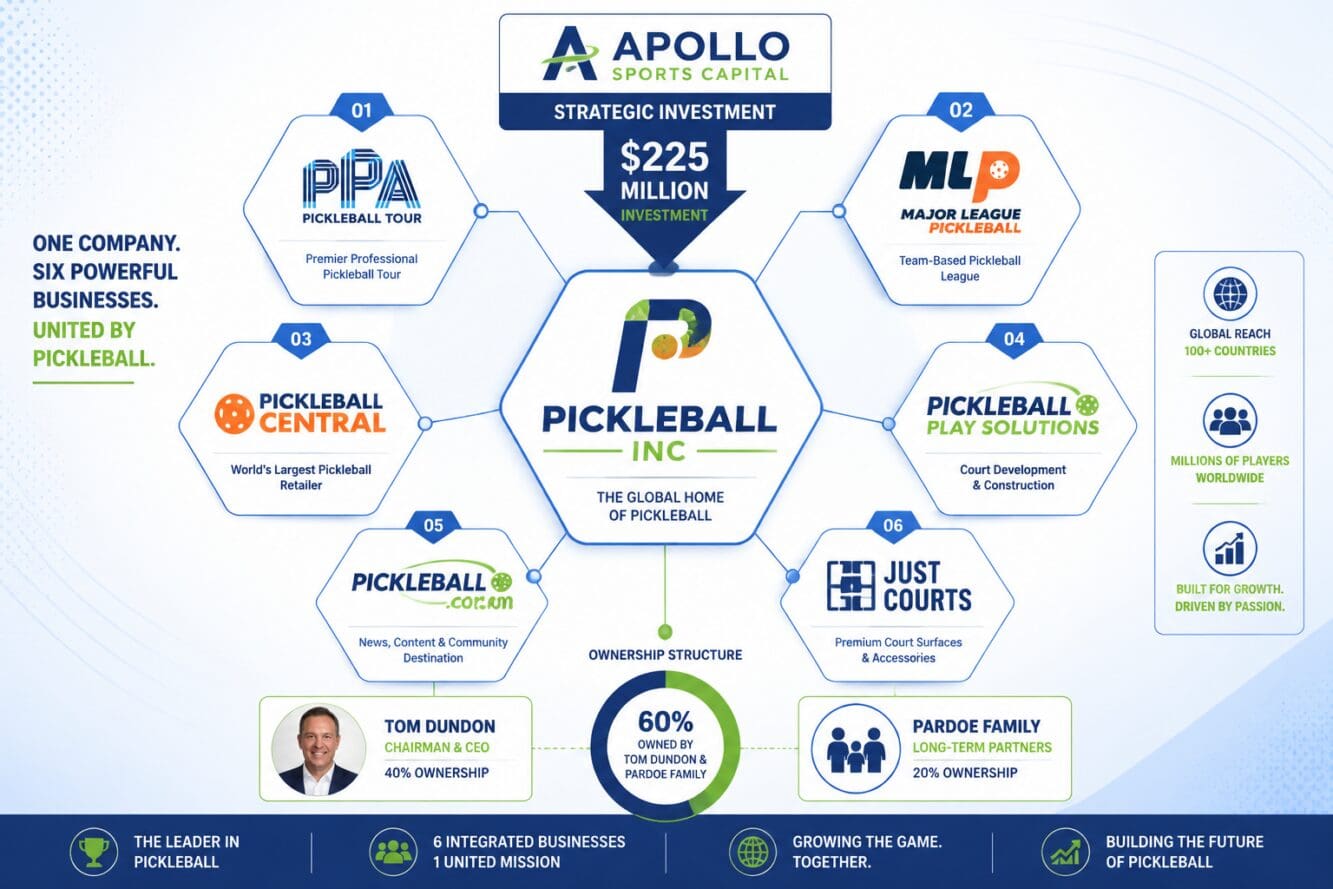
The $225 Million Pickleball Investment Boom: What Apollo’s Deal Means for Pro Tours, Players, and Fans centers on a structured investment that consolidates six previously separate businesses into Pickleball Inc. [1] This isn’t simply tour funding—it’s a complete vertical integration of professional leagues, retail operations, technology platforms, and infrastructure development.
The six integrated entities are:
- PPA Tour (Carvana PPA Tour): The primary professional singles and doubles circuit with established broadcast partnerships
- Major League Pickleball (MLP): The team-based professional league featuring franchise ownership models
- Pickleball Central: The sport’s largest equipment and apparel retailer
- Pickleball Play Solutions: Technology platform for court booking, league management, and player engagement
- Pickleball.com: Digital media hub and community resource platform
- Just Courts: Facility development and court construction division [4]
This structure allows Pickleball Inc. to control every touchpoint in the player and fan journey, from discovering the sport online to booking court time, purchasing equipment, watching professional matches, and playing in organized leagues.
Tom Dundon and the Pardoe family maintain majority ownership, ensuring founding leadership retains strategic control despite the significant outside capital injection. [1] This ownership structure matters because it prevents Apollo from dictating competitive decisions while still providing growth capital and operational expertise.
How Does Apollo’s Deal Change the Professional Tour Landscape?
The consolidation eliminates competition between the PPA Tour and MLP for sponsorship dollars, broadcast slots, and venue dates. Before this merger, the two tours occasionally competed for the same corporate partners and media attention, potentially depressing the value of both properties.
With unified operations, Pickleball Inc. can now approach broadcasters and sponsors with a complete season calendar, guaranteed player participation across both tour formats, and consolidated viewership metrics. This positioning significantly increases negotiating leverage for media rights deals. [5]
What changes for tour operations:
- Single scheduling authority prevents conflicting event dates
- Shared player pool eliminates exclusive contract disputes
- Unified broadcast package increases per-event production value
- Consolidated sponsorship inventory commands premium pricing
- Integrated digital platforms provide better fan engagement data
The 2026 projected tour revenue of $74 million represents only the competition side of the business. [3] When combined with retail, technology subscriptions, and facility revenue streams, the total addressable market expands substantially beyond traditional tour economics.
Choose this consolidated model if you’re a sponsor seeking maximum exposure across all professional pickleball properties. The single point of contact and unified brand architecture simplifies activation and measurement compared to negotiating separate deals with competing tours.
What Does The $225 Million Pickleball Investment Boom Mean for Player Compensation?
Professional pickleball players face a double-edged outcome from this consolidation. Prize pools will likely increase as sponsorship revenue grows and media deals expand, but players lose the negotiating leverage that comes from competing tour options.
In 2025, combined business verticals generated over $140 million in revenue, with approximately $30 million from sponsorships. [3] A portion of increased revenue should flow to prize money, appearance fees, and player benefits, but the distribution formula remains at management’s discretion without competitive pressure from alternative tours.
Player impact considerations:
- Increased earning potential: Larger prize pools funded by better sponsorships and media deals
- Reduced negotiating power: No alternative major tour to create bidding competition for top talent
- Standardized contracts: Unified player agreements across both PPA and MLP formats
- Better production value: Higher-quality broadcasts potentially increase player marketability and personal sponsorship opportunities
- Franchise equity: MLP’s team ownership model offers some players ownership stakes, creating long-term wealth opportunities beyond prize money
The professionalization trajectory accelerates with this capital infusion, attracting higher-caliber athletes from tennis, table tennis, and other racquet sports. [6] This talent influx raises competitive standards but also increases pressure on existing professionals to perform or risk losing tour cards.
A common mistake is assuming consolidation automatically benefits players. Without a players’ association or collective bargaining agreement, athletes have limited influence over revenue sharing percentages or working conditions. The absence of tour competition removes market-based checks on management decisions.
How Does Vertical Integration Affect Fans and Accessibility?
The $225 Million Pickleball Investment Boom: What Apollo’s Deal Means for Pro Tours, Players, and Fans extends beyond professional competition to grassroots participation. The integrated model connects professional tours with retail, court booking, and facility development, creating a seamless pathway from casual play to competitive participation.
Fan experience improvements:
- Unified digital platform for tournament schedules, live streaming, and on-demand content
- Integrated retail experience with tour-branded merchandise and equipment
- Technology-enabled court booking through Pickleball Play Solutions
- Facility development through Just Courts increases court availability in underserved markets
- Community engagement tools connecting amateur leagues with professional tour content
The investment specifically targets infrastructure gaps. With 24 million U.S. players in 2025 [1], court availability remains a significant constraint. Just Courts’ inclusion in the merger directly addresses this bottleneck with dedicated capital for facility construction.
However, vertical integration also concentrates market power. If Pickleball Inc. becomes the dominant facility operator, equipment retailer, and tour organizer, independent businesses face competitive disadvantages. This consolidation could reduce diversity in playing venues, retail options, and tournament formats over time.
Choose independent operators if you value variety and competitive pricing. The consolidated entity offers convenience and integration but potentially at the cost of market competition and innovation from alternative providers.
What Sponsorship and Media Opportunities Does Consolidation Create?
Corporate sponsors gain significant advantages from dealing with a single entity controlling all major professional pickleball properties. The unified structure eliminates redundant negotiations, simplifies activation across multiple touchpoints, and provides comprehensive measurement across the entire ecosystem.
The consolidated sponsorship inventory includes:
- Tour naming rights: Title sponsorship across both PPA and MLP properties
- Venue branding: Consistent presence across all tournament locations
- Broadcast integration: Unified media packages across all televised and streamed events
- Retail partnerships: Product placement and exclusive distribution through Pickleball Central
- Digital platforms: Advertising and content integration across Pickleball.com and booking platforms
- Facility sponsorships: Branding opportunities at Just Courts locations
Media companies benefit from negotiating a complete season package rather than piecemeal event rights. This structure enables long-term broadcast agreements similar to established professional sports leagues, potentially bringing pickleball to major networks and streaming platforms with guaranteed programming schedules.
The $750 million valuation [2] signals investor confidence that consolidated media rights will command premium pricing. For comparison, emerging sports leagues typically struggle to secure consistent broadcast slots and sponsorship commitments due to fragmented ownership and uncertain scheduling.
A decision rule for sponsors: invest in Pickleball Inc. properties if you want comprehensive category exclusivity and integrated activation. Pursue niche tournament sponsorships or regional events if you prefer targeted exposure without the premium pricing of tour-wide deals.
How Does This Investment Position Pickleball for Global Expansion?
While the primary focus remains the U.S. market, the unified structure and substantial capital position Pickleball Inc. for international growth. [3] The consolidated brand identity, proven business model, and operational expertise create a replicable framework for launching tours and facilities in new markets.
International expansion advantages:
- Single brand identity simplifies market entry and recognition
- Proven technology platforms scale across geographies
- Facility development expertise transfers to international markets
- Unified player pool enables international tour stops without conflicting schedules
- Consolidated media rights create attractive packages for international broadcasters
Secondary markets in Canada, Europe, and Asia show growing pickleball participation, but lack the organized infrastructure and professional competition that drives sustained growth. Pickleball Inc.’s integrated model addresses these gaps simultaneously rather than requiring separate entities to coordinate.
The investment timeline matters. With five consecutive years as America’s fastest-growing sport [1], pickleball sits at an inflection point where international expansion could either accelerate growth or dilute resources. The $225 million capital injection provides runway to pursue both domestic maturation and international development without choosing between them.
An edge case: rapid international expansion could strain operational capacity and brand consistency. Successful sports leagues typically establish domestic dominance before pursuing global growth. Premature international investment risks undermining U.S. market development while failing to establish sustainable international operations.
What Are the Risks and Concerns With This Level of Consolidation?
The $225 Million Pickleball Investment Boom: What Apollo’s Deal Means for Pro Tours, Players, and Fans raises legitimate concerns about market concentration and competitive dynamics. When a single entity controls professional tours, retail, technology platforms, and facility development, the potential for monopolistic behavior increases.
Key risk factors:
- Reduced competitive pressure: No alternative major tour creates complacency risk
- Player leverage: Athletes have limited options if disputes arise with tour management
- Innovation constraints: Vertical integration may discourage experimentation with alternative formats or rules
- Pricing power: Consolidated retail and facility operations could lead to higher consumer costs
- Barrier to entry: New competitors face an entrenched incumbent with superior resources and integrated operations
Independent tournament organizers, equipment manufacturers, and facility operators now compete against a well-funded, vertically integrated corporation with advantages at every level. This dynamic could reduce market diversity and limit consumer choice over time.
The ownership structure provides some protection. Tom Dundon and the Pardoe family’s majority stake [1] means they retain decision-making authority and presumably care about long-term sport development rather than short-term financial extraction. However, future ownership changes or financial pressures could shift priorities.
A common mistake is assuming consolidation always harms competition. In emerging sports, fragmentation often prevents the critical mass needed for sustainable growth. Unified operations can accelerate professionalization, attract better athletes, and secure media deals that would be impossible for smaller, independent operators.
Frequently Asked Questions
What is Pickleball Inc. and how was it formed?
Pickleball Inc. is the parent company created through the merger of six businesses: the PPA Tour, Major League Pickleball, Pickleball Central, Pickleball Play Solutions, Pickleball.com, and Just Courts. Apollo Sports Capital led a $225 million investment on May 1, 2026, to form this unified entity valued at $750 million. [1]
Who owns Pickleball Inc. after the Apollo investment?
Tom Dundon and the Pardoe family remain majority shareholders of Pickleball Inc. despite Apollo Sports Capital’s $225 million investment. This ownership structure ensures founding leadership maintains strategic control while benefiting from outside capital and expertise. [1]
How much revenue does Pickleball Inc. generate?
Combined business verticals generated over $140 million in revenue in 2025, with approximately $30 million from sponsorships. The two tours alone project $74 million in combined revenue for 2026. [3]
Will players earn more money under the consolidated structure?
Players will likely see increased prize pools as sponsorship revenue and media deals grow, but they lose negotiating leverage from competing tour options. The actual impact depends on how management allocates increased revenue between operations, facilities, and player compensation.
What happens to independent pickleball tournaments and facilities?
Independent operators continue to exist but now compete against a well-funded, vertically integrated corporation with advantages in sponsorships, media deals, player access, and operational scale. This dynamic may make it harder for independent businesses to compete effectively.
Does this investment change how amateur players access courts and leagues?
The investment should improve court availability through Just Courts facility development and enhance league management through Pickleball Play Solutions technology. However, market consolidation could reduce competitive pricing and facility options in some markets.
How does this compare to other professional sports league structures?
The vertical integration resembles UFC’s model more than traditional stick-and-ball sports leagues. Pickleball Inc. controls tours, venues, retail, and media rather than operating as a league of independent team owners. This structure concentrates power but enables faster decision-making.
What does this mean for pickleball’s Olympic aspirations?
A unified governing structure and professional tour system strengthens pickleball’s case for Olympic inclusion by demonstrating organized governance, global reach, and competitive standards. However, Olympic recognition depends on many factors beyond professional tour structure.
Can new professional tours compete with Pickleball Inc.?
New tours face significant barriers including Pickleball Inc.’s player contracts, sponsor relationships, venue access, and media deals. While legally possible, competing effectively against a $750 million vertically integrated incumbent presents substantial challenges.
How quickly will the $225 million be deployed?
Specific deployment timelines haven’t been publicly disclosed, but the investment will fund facility development, technology platform enhancement, international expansion, increased prize pools, and operational scaling over multiple years rather than immediate spending.
What happens if the consolidated model fails?
If financial performance disappoints or operational challenges emerge, Apollo Sports Capital and majority owners could restructure operations, sell individual business units, or seek additional investment. The $750 million valuation provides cushion but isn’t guaranteed.
Are there antitrust concerns with this level of consolidation?
Pickleball remains a small sport relative to established professional leagues, likely keeping it below antitrust scrutiny thresholds. However, if Pickleball Inc. uses market power to exclude competitors or harm consumers, regulatory attention could increase.
Conclusion
The $225 Million Pickleball Investment Boom: What Apollo’s Deal Means for Pro Tours, Players, and Fans represents a watershed moment in the sport’s evolution from recreational pastime to professional enterprise. Apollo Sports Capital’s investment creates the first vertically integrated pickleball ecosystem, consolidating professional tours, retail, technology, and infrastructure under unified management valued at $750 million.
This consolidation delivers clear benefits: increased sponsorship leverage, better media deals, improved production quality, enhanced fan experiences, and accelerated facility development. The unified structure positions pickleball to compete for attention and resources against established professional sports rather than remaining a fragmented niche activity.
However, concentration of market power raises legitimate concerns about player leverage, competitive innovation, and barriers to entry for independent operators. The success of this model depends on management’s commitment to balanced growth that serves players, fans, and the broader pickleball community rather than prioritizing short-term financial returns.
Next steps for stakeholders:
- Players: Monitor compensation trends and consider collective organization to maintain negotiating leverage
- Fans: Engage with integrated platforms while supporting independent tournaments and facilities to maintain market diversity
- Sponsors: Evaluate consolidated inventory against targeted regional or niche opportunities based on marketing objectives
- Facility operators: Assess partnership opportunities with Just Courts versus maintaining independent operations
- Investors: Watch operational execution and revenue growth against the $750 million valuation benchmark
The pickleball investment boom signals the sport’s arrival as a serious professional enterprise. Whether this consolidation ultimately benefits all stakeholders depends on execution, governance, and the balance between growth ambitions and community values that made pickleball America’s fastest-growing sport.
References
[1] Apollo Sports Capital Leads Landmark 225 Million Investment In Pickleball Inc – https://pickleball.com/news/apollo-sports-capital-leads-landmark-225-million-investment-in-pickleball-inc?utm_source=openai
[2] Apollo Sports Capital Injects 225 Million Into Unified Pickleball Entity – https://ministryofsport.com/apollo-sports-capital-injects-225-million-into-unified-pickleball-entity/?utm_source=openai
[3] Apollo Sports Capital Pickleball Investment Canada – https://www.apollopickleball.ca/blogs/news/apollo-sports-capital-pickleball-investment-canada?utm_source=openai
[4] sgieurope – https://www.sgieurope.com/corporate/pickleball-goes-vertical-again/121059.article?utm_source=openai
[5] sportssummit – https://sportssummit.org/new/?n=10063&utm_source=openai
[6] Apollo Injeta Us 225 Milhoes No Pickleball E Acelera Consolidacao Do Esporte Nos Estados Unidos – https://www.mktesportivo.com/2026/05/apollo-injeta-us-225-milhoes-no-pickleball-e-acelera-consolidacao-do-esporte-nos-estados-unidos/?utm_source=openai
Content, illustrations, and third-party video appearing on GEORGIANBAYNEWS.COM may be generated or curated with AI assistance or reproduced pursuant to the fair dealing provisions of the Copyright Act, R.S.C. 1985, c. C-42. Attribution and hyperlinks to original sources are provided in acknowledgment of applicable intellectual property rights. Such referencing is intended to direct traffic to and support the original rights holders’ platforms.
Much Appreciate You Sharing This Post - It Helps MUCH!!!